An Agent SDK Triage Bot for Commercial Insurance Submissions
TL;DR
Commercial underwriters drown in PDF submissions.
Last updated: April 28, 2026
The Inbox That Eats Underwriters#
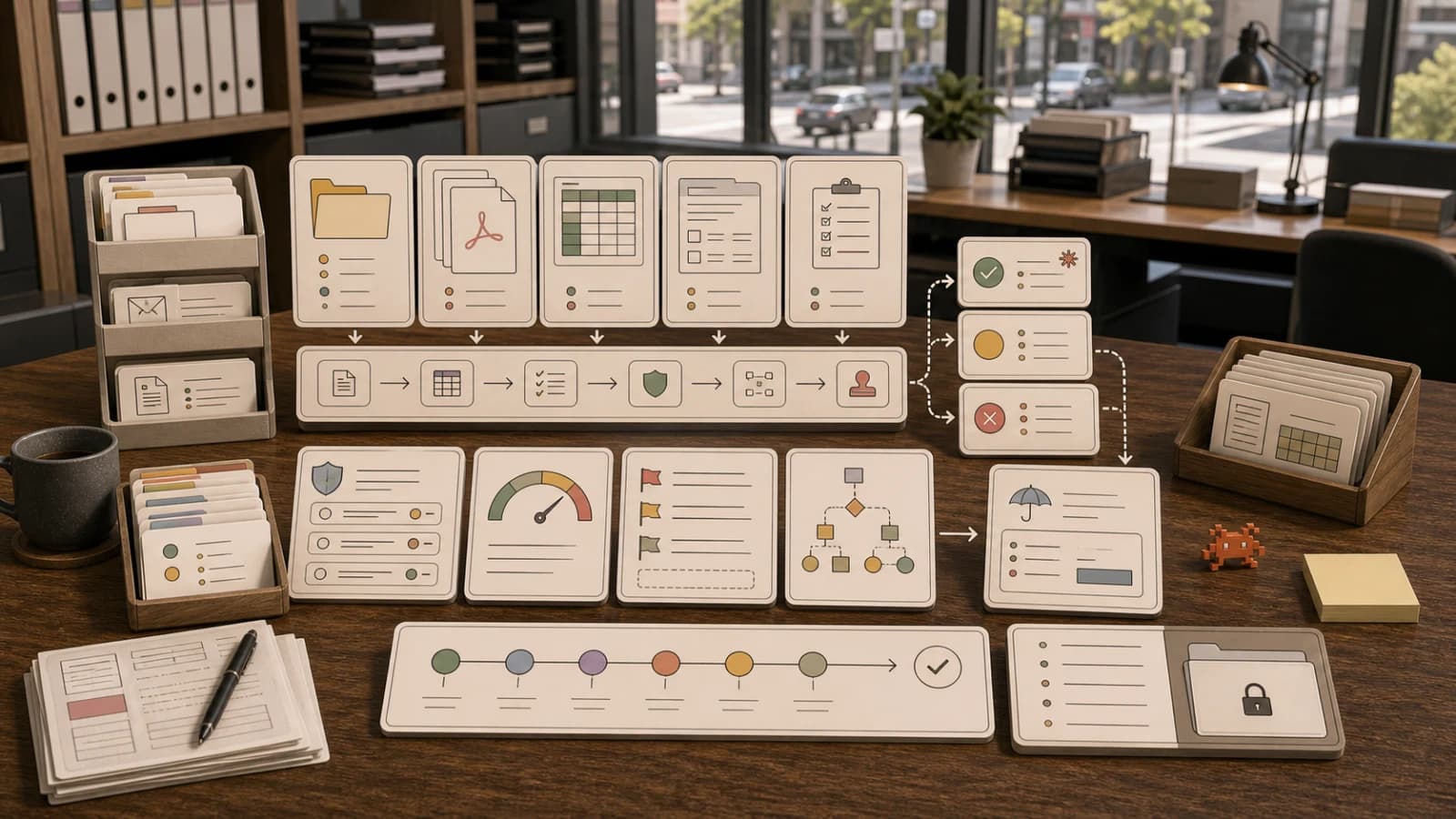
A commercial underwriter at a mid-market property and casualty carrier opens around forty submissions a day. Each one arrives as an email with three to fifteen attachments: a broker cover letter, a five-year loss run, a SOV spreadsheet, an ACORD 125, an ACORD 140, sometimes a building inspection report, sometimes a PDF that is just a photo of a fax. The first job is not pricing. The first job is deciding whether the submission is even quotable inside the carrier's appetite.
For the larger agent workflow map, read What Is Claude Code? The Complete Guide for 2026 and 60 Claude Code Tips and Tricks for Power Users; they give the architecture and implementation context this piece assumes.
Most carriers handle this with a junior underwriting assistant who does the same checks every time: is the named insured already a customer, is the SIC or NAICS in our appetite, are the loss runs current, does the SOV total match the cover letter, are any required forms missing. It is a thirty-minute job per submission that nobody enjoys and everybody does badly by 4pm. The agentic wedge is not "automate underwriting." That is regulated and mostly a bad idea. The wedge is "automate the triage memo," with a hard stop before any decision that affects price or binding.
Why The Agent SDK And Not A Workflow Tool#
You could build this in n8n or Power Automate. Many carriers tried. The reason it usually fails is that submissions are messy in long-tail ways. Brokers send the SOV embedded as an image inside a PDF. Loss runs come from twelve different carrier formats. The ACORD form has handwritten amendments in the margins. A rigid workflow handles 60% and dies on the rest. A coding agent with file system access, an LLM, and a skill library handles 90% and writes a clean note about the 10% it could not.
The Claude Agent SDK is the right tool because it gives you the same primitives Claude Code uses, programmatically: tool use, skills, hooks, MCP servers, transcript output. You wrap it in a job runner that pulls from a shared mailbox, and you get a triage bot that produces a memo per submission with full audit lineage.
File Structure#
submission-triage/
  src/
    index.ts                 # Agent SDK entry point
    runner.ts                # mailbox poller, queue, retry
    types.ts                 # Submission, Memo, AppetiteRule
  skills/
    parse-acord/
      SKILL.md
      scripts/extract.py     # uses pdfplumber + a labeled schema
    parse-loss-run/
      SKILL.md
      scripts/normalize.py   # carrier-specific adapters
    parse-sov/
      SKILL.md
      scripts/sov_to_csv.py
    appetite-check/
      SKILL.md
      rules.yaml             # appetite filters, owned by underwriting
  mcp/
    policy-admin.ts          # read-only PAS lookup
    naics-lookup.ts
  prompts/
    triage-memo.md
  hooks/
    redact-pii.sh            # PreToolUse, scrubs SSNs, EINs from transcripts
    no-bind.sh               # PostToolUse, blocks any write to PAS
  out/
    {submission-id}/
      memo.md
      lineage.jsonl
      attachments/
The Skills#
The four skills are the heart of the system. Each is a small SKILL.md plus a script. The agent picks them up automatically and the underwriting team can update rules.yaml without touching code.
parse-acord knows the ACORD 125 and 140 layouts and returns a JSON object with named insured, mailing address, FEIN, SIC, NAICS, requested coverages, and a confidence per field. It does not guess. If a field is unreadable, it returns null and a reason.
parse-loss-run is the messiest one. It has a small registry of carrier templates (Travelers, Hartford, Liberty, CNA, Chubb, the regional ones the carrier sees most) and a fallback prompt for unknown formats. Output is a normalized five-year frequency and severity table.
parse-sov extracts the schedule of values, totals it, and compares to the cover letter number. A mismatch over 5% is flagged.
appetite-check reads rules.yaml, which encodes the carrier's actual appetite: NAICS in/out lists, TIV bands, loss frequency thresholds, geographic exclusions. The output is a clean pass or a list of specific reasons for referral.
The Triage Prompt#
The prompt the agent runs per submission is short and constrained:
You are a submission triage assistant. You do not make underwriting decisions. You produce a triage memo using only the skills available. For the submission in
inbox/{id}/, runparse-acord,parse-loss-run,parse-sov, thenappetite-check. Writeout/{id}/memo.mdusing the template inprompts/triage-memo.md. If any skill returns low confidence, say so explicitly. Never write to the policy admin system. Never quote a premium.
The memo template is the artifact that matters. Underwriters review the memo, not the agent. A good memo has: insured snapshot, appetite verdict with cited rules, loss summary, missing-information list, and a recommendation queue (decline, refer to senior, ready to quote).
The Hooks That Make Compliance Sleep#
Two hooks carry the regulatory weight.
redact-pii.sh runs as a PreToolUse hook on every transcript write. It strips SSNs, EINs in non-allowed contexts, and any string that looks like a driver's license. This keeps the agent's transcripts safe to retain for the seven years your state DOI probably requires.
no-bind.sh runs as a PostToolUse hook and rejects any tool call that targets a write endpoint on the policy admin system MCP. The MCP server itself is read-only, but the hook is a second layer. Auditors love a second layer.
A third optional hook ships transcripts to your SIEM in the same JSONL format you already use for human underwriter activity. From a SOC2 perspective the agent becomes just another principal with an audit trail.
Realistic Risks#
Three risks are worth naming.
Bias. If rules.yaml encodes a proxy for a protected class, the agent will faithfully reproduce that bias at scale. Mitigation: have a model-risk reviewer audit rules.yaml the same way they would audit a rating algorithm.
Hallucinated extraction. The agent might confidently report a TIV that is wrong because the SOV had a merged cell. Mitigation: the SOV-vs-cover-letter cross-check, and a hard rule that any TIV above a threshold gets human extraction regardless of confidence.
Drift. Brokers change their templates. Carriers acquire each other and rename their loss-run formats. Mitigation: a weekly job that flags any submission where more than two skills returned low confidence, and routes those to a "improve the skill" backlog.
Minimal Next Step#
You can stand up a useful version of this in an afternoon, against your own sample submissions, no PAS integration required.
npm create @anthropic-ai/agentand pick the TypeScript template- Drop ten anonymized PDF submissions into
inbox/ - Write
appetite-check/rules.yamlwith five real appetite rules from your underwriting guide - Implement
parse-acordfirst, usingpdfplumberand a single labeled example - Wire the triage prompt into
src/index.ts - Run it against the ten submissions and read the memos
Two of the ten will be wrong in interesting ways. Those two are the spec for the next iteration. Show the other eight to an underwriter and watch what they do with the memo. The carriers that win the next decade are not the ones with the biggest underwriting teams. They are the ones whose teams stop reading PDFs and start reading memos.
FAQ#
Does this bot make underwriting decisions?#
No. The triage prompt explicitly forbids it from quoting a premium or writing to the policy admin system. It only produces a memo with an appetite verdict, a loss summary, and a recommendation queue for a human underwriter to act on.
Why use the Claude Agent SDK instead of a workflow automation tool like n8n?#
Workflow tools handle the common cases well but break on the long tail: SOVs embedded as images, inconsistent loss-run formats from different carriers, and handwritten ACORD amendments. A coding agent with file access and a skill library can handle those messier cases and clearly flag what it could not parse.
How is compliance enforced if the agent has file and tool access?#
Two hooks carry that weight: a PreToolUse hook that redacts PII from transcripts before they are written, and a PostToolUse hook that rejects any tool call targeting a write endpoint on the policy admin system. A read-only MCP server is the first layer; the hook is the second.
What is the realistic risk of this system reproducing bias?#
If rules.yaml encodes a proxy for a protected class, the agent will faithfully apply that bias at scale, since it is only executing the appetite rules it is given. The mitigation is a model-risk reviewer auditing rules.yaml the same way they would audit a rating algorithm, not trusting the agent to catch it.
Continue Reading#
Get the next deep dive like this in your inbox
One email a week on Claude Agent SDK and the rest of the AI dev stack. Free.
Read next
Human-in-the-Loop Patterns for AI Agents: Approvals in 5 SDKs
How LangGraph, Mastra, the AI SDK, OpenAI Agents SDK and Claude Agent SDK pause agent tool calls for approval, with verified code for all five.
15 min readHow to Build an AI Agent in 2026: A Practical Guide
A step-by-step guide to building AI agents that actually work. Choose a framework, define tools, wire up the loop, and ship something real.
10 min readDo Your Agent Hooks Fail Open? Claude Code vs Codex vs Cursor vs Gemini CLI
A guard hook that crashes, times out or points at a missing script lets the tool call through by default in Claude Code. v2.1.295 adds onFailure: block. Here is what each coding agent does when your policy hook breaks, with real test runs.
13 min readNew here? Start with
Technical content at the intersection of AI and development. Building with AI agents, Claude Code, and modern dev tools - then showing you exactly how it works.