GPT-5.6 Sol, Terra, and Luna: A Developer's Guide to OpenAI's New Model Family
TL;DR
A practical guide to choosing GPT-5.6 Sol, Terra, and Luna, using programmatic tool calling, caching, and the multi-agent beta in production.
Last updated: August 1, 2026
What changed: OpenAI cut the family's mid and budget tiers on July 30: Terra dropped from $2.50/$15 to $2/$12 and Luna from $1/$6 to $0.20/$1.20 (an 80% cut), with priority processing renamed Fast mode. The routing logic below is unchanged, but the price points are better than they were at launch. The table is verified against the live pricing page on August 1, 2026.
OpenAI's GPT-5.6 release is a family, not one model with three price points. Sol is the frontier tier for difficult professional work, Terra is the cost-and-capability middle, and Luna is optimized for high-volume workloads. The useful developer question is therefore not "which model is smartest?" It is "which tier should handle each step of this workflow?"
This guide focuses on the API surface and the engineering decisions around it. OpenAI says the family is generally available in the Responses API, with a 1.05 million-token context window, up to 128K output tokens, and support for functions, web search, file search, and computer use. All three tiers accept the same model-generation inputs, so a router can change cost and capability without redesigning every prompt.
The GPT-5.6 family at a glance#
| Model | API model ID | Best fit | Input / output per 1M tokens | Context / max output |
|---|---|---|---|---|
| GPT-5.6 Sol | gpt-5.6-sol (alias gpt-5.6) | Complex coding, research, long-running professional workflows | $5 / $30 | 1.05M / 128K |
| GPT-5.6 Terra | gpt-5.6-terra | Strong everyday agents and balanced workloads | $2 / $12 | 1.05M / 128K |
| GPT-5.6 Luna | gpt-5.6-luna | High-volume classification, extraction, and routine transformations | $0.20 / $1.20 | 1.05M / 128K |
The models expose reasoning effort from none through max, according to the model catalog. That gives you two independent controls: tier selects the model's capability and economics, while effort controls how much work it should invest for a request. Treat both as runtime policy, not constants buried in application code.
OpenAI reports results across coding, knowledge work, computer use, science, and cybersecurity evaluations. Those are OpenAI-reported benchmarks, not a substitute for your own task-level evals. The practical signal is consistency: the release emphasizes fewer tokens, fewer model turns, and lower estimated cost for comparable work, especially when the model can coordinate tools instead of narrating every intermediate step.
A routing policy that works in practice#
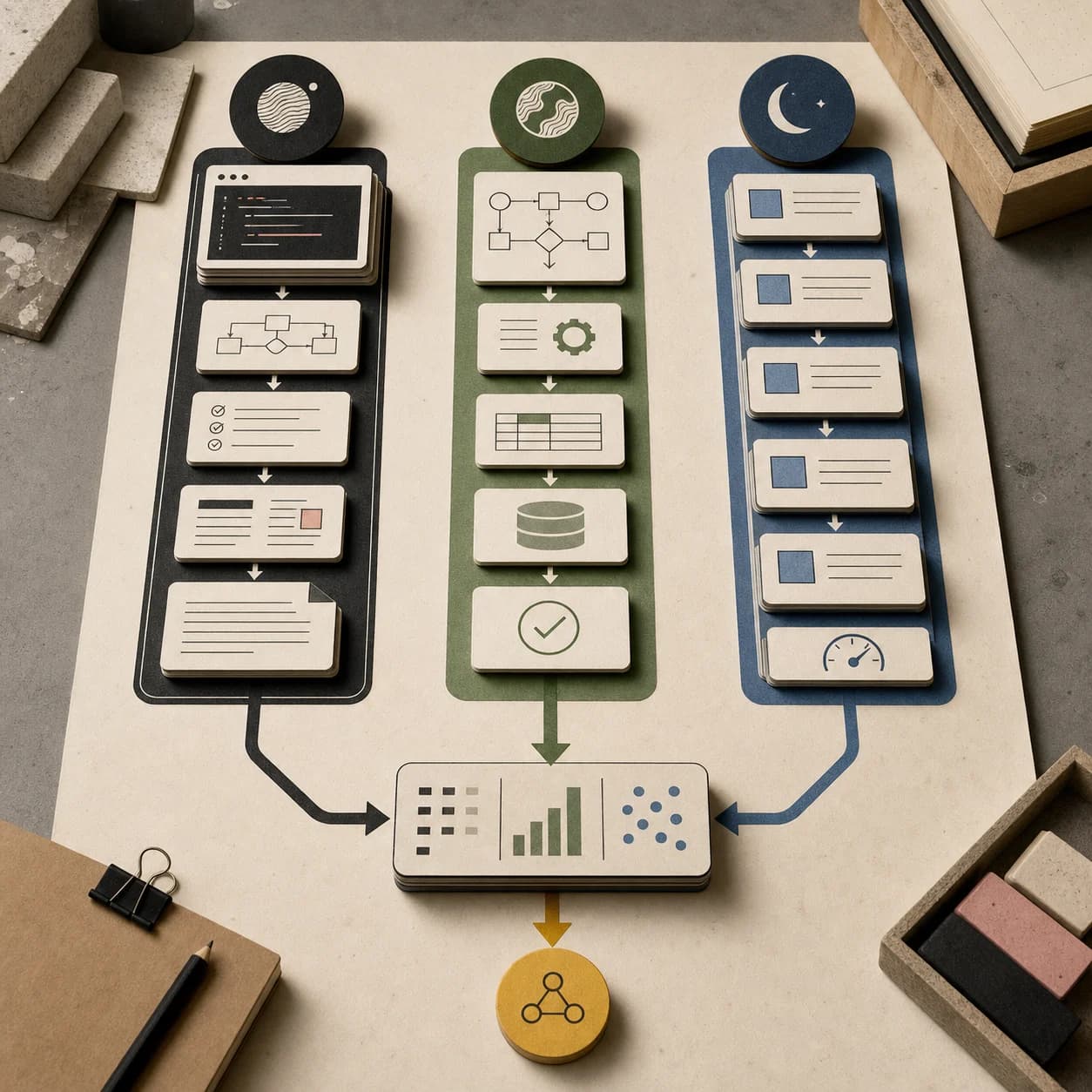
Start with Luna for work that is repetitive, bounded, and easy to grade. Examples include normalizing records, assigning a support category, extracting fields into a schema, or drafting a first pass that will always be reviewed. Move to Terra when the task has several dependent steps, ambiguous context, or a meaningful tool call. Use Sol when failure is expensive, the work spans many files, or the agent must plan, execute, inspect, and revise a result.
| Workflow step | Default tier | Escalate when |
|---|---|---|
| Triage and routing | Luna | The input is ambiguous or high impact |
| Retrieval and synthesis | Terra | Sources conflict or the context is unusually broad |
| Code change with tests | Terra | The change crosses subsystems or needs visual inspection |
| Security review or complex debugging | Sol | Keep Sol when the risk or blast radius is high |
| Final artifact polish | Sol or Terra | Use Sol for design-sensitive, multi-file output |
Log the selected tier, effort, tool calls, latency, token counts, and evaluator result. A router should be able to learn from those traces. In many systems, the cheapest path is not "always Luna"; it is Luna for the easy majority, with a clear escalation path when a grader or guardrail says the result needs another pass. That escalation-shaped policy is the core of our cost-effective model routing guide, which works through the same decision in dollars.
The Responses API as the control plane#
The Responses API is the common surface for the GPT-5.6 family. A minimal request can select a model and provide an input, while tools are attached as capabilities your application is willing to expose. Keep the example below deliberately generic: use the current SDK and Responses API reference for the exact language-specific types and authentication setup.
import OpenAI from "openai";

const client = new OpenAI();

const response = await client.responses.create({
  model: "gpt-5.6-terra",
  input: "Summarize the deployment failures in the attached incident notes.",
  tools: [
    { type: "file_search" },
    {
      type: "function",
      name: "create_ticket",
      description: "Create an incident ticket",
      strict: true,
      parameters: {
        type: "object",
        properties: {
          title: { type: "string" },
        },
        required: ["title"],
        additionalProperties: false,
      },
    },
  ]
});

console.log(response.output_text);
The important architectural choice is ownership. Your server should authorize each function, validate arguments, enforce timeouts, and record the result. The model can choose a tool, but it should not become your permission system. For web, file, and computer-use tools, define the data boundary and retention policy just as carefully as you would for a human operator.
Programmatic tool calling: fewer round trips#
GPT-5.6 introduces programmatic tool calling in the Responses API. Instead of returning every intermediate result to the model and asking what to do next, the model can write and run a lightweight program in memory that coordinates tools, filters intermediate data, and returns only the useful state. OpenAI describes this as compatible with Zero Data Retention because the coordination program runs in the request flow rather than requiring a persistent external workspace.
This matters when an agent must inspect many records, call several APIs, or repeatedly transform tool output. Direct tool calling can make your prompt enormous: tool result A goes back to the model, then tool result B, then a combined answer. Programmatic calling lets the workflow filter early and pass a compact summary forward. It is not a reason to remove observability. Capture the tool plan, inputs, outputs, and final decision, subject to your data policy, so you can reproduce failures.
Use it where the work is data-heavy and deterministic. For a single lookup, a normal function call is simpler. For a fan-out over hundreds of items, programmatic coordination can reduce context growth and model turns. Benchmark both paths with your real payload sizes, because token savings depend on how much intermediate data would otherwise cross the model boundary.
Prompt caching is now an application design concern#
GPT-5.6 adds explicit cache breakpoints and a 30-minute minimum cache life. Cached input reads receive a 90% discount, while cache writes for GPT-5.6 and later are billed at 1.25 times the uncached input rate. Put stable instructions, schemas, and reference material before request-specific data, then place a cache breakpoint after the stable prefix. Do not cache user-specific secrets or content that should not persist for the cache lifetime.
Caching is most useful for agents with a large system prompt, a long policy bundle, or a repeated repository context. Measure cache hit rate and effective input cost. If a prompt changes on every request, a breakpoint adds complexity without a benefit.
Multi-agent beta and the ultra setting#
OpenAI's ultra setting coordinates four agents in parallel by default for demanding work. The API exposes a multi-agent beta that lets GPT-5.6 run concurrent subagents and synthesize their work in one request. This is promising for independent research paths, code review perspectives, or parallel file analysis, but it is not free parallelism.
Start with a single Sol or Terra agent and a reliable evaluator. Add parallel agents only when the subtasks are genuinely independent and you can define a synthesis contract. Set a budget for total tokens, tool calls, and wall-clock time. Require each subagent to return evidence, assumptions, and an uncertainty signal, then have the synthesizer resolve conflicts rather than averaging prose. Beta behavior and limits can change, so isolate the orchestration behind a feature flag and keep a single-agent fallback. We compared the ultra mode against Codex subagents in Sol Ultra and Codex subagents.
Safety and production boundaries#
The GPT-5.6 system card describes layered safeguards, monitoring, and access controls, with additional scrutiny for high-risk cyber and biology capabilities. Your application still owns authorization, sandboxing, secret handling, and auditability. Run tools with least privilege, make destructive actions confirmable, and separate read-only research from write access. For coding agents, use disposable worktrees or sandboxes and require tests before merging.
Do not infer safety from a high benchmark score. Red-team the exact tools and data paths your product exposes. A capable model with a poorly scoped function can create more risk than a weaker model with good boundaries.
A rollout plan#
- Build a task set from production traces and label success criteria.
- Run the same prompts through Luna, Terra, and Sol at
none,medium, andmaxeffort where applicable. - Compare quality, latency, input and output tokens, cache hits, tool errors, and escalation rate.
- Ship a router with explicit fallbacks and a per-workflow budget.
- Add programmatic tool calling to one data-heavy path and measure it against direct calls.
- Treat multi-agent as an opt-in beta behind a flag, with a single-agent fallback.
The result should be a model policy you can explain: Luna handles volume, Terra handles the default agent loop, and Sol handles the cases where more capability pays for itself.
FAQ#
Is GPT-5.6 Sol the same as gpt-5.6?#
The API model catalog lists gpt-5.6-sol as the model ID and gpt-5.6 as its alias. Pin the full ID when you need an explicit deployment choice, and use the alias only when its update behavior fits your release policy.
Which GPT-5.6 model should I use first?#
Use Terra as a sensible baseline for an agent or application workflow. Start with Sol when the task is complex or high consequence, and start with Luna when volume and cost dominate and you have a reliable grader.
Does a 1.05M context window mean every request should include a million tokens?#
No. Large context is an option, not a target. Retrieval, compaction, caching, and concise tool results usually produce lower latency and better cost than sending every available document on every turn.
Is multi-agent ready for every production workload?#
No. OpenAI describes the API multi-agent capability as beta. Use it for controlled experiments with budgets, observability, and a single-agent fallback until its behavior and limits are stable for your workload.
Official Sources#
| Source | URL | Last Verified |
|---|---|---|
| GPT-5.6 Announcement | openai.com/index/gpt-5-6 | July 14, 2026 |
| OpenAI API Models | developers.openai.com/api/docs/models | July 14, 2026 |
| OpenAI Tools Guide | developers.openai.com/api/docs/guides/tools | July 14, 2026 |
| GPT-5.6 Sol Preview | openai.com/index/previewing-gpt-5-6-sol | July 14, 2026 |
| GPT-5.6 System Card | deploymentsafety.openai.com/gpt-5-6 | July 14, 2026 |
| OpenAI Pricing | openai.com/api/pricing | July 14, 2026 (re-verified August 1, 2026) |
Continue Reading#
- Budget AI Coding Models Compared - Luna vs V4 Flash vs Gemini 3.5 Flash vs Haiku 4.5
- The $5 Workhorse: GPT-5.6 Sol vs Claude Opus 5 - Sol measured against Anthropic's mainline
- Model Routing Strategies That Cut AI Spend - escalation policies in dollars
- GPT-5.6 Luna's 80% Price Cut - the July 30 cut and the market reaction
- Frontier Model API Pricing - the standing rate card across all providers
Get the next deep dive like this in your inbox
One email a week on OpenAI and the rest of the AI dev stack. Free.
Read next on AI coding tools
OpenAI Cuts GPT-5.6 Luna 80% and Terra 20%: The Cost-Per-Task Math for Agent Builders
Luna drops from $1/$6 to $0.20/$1.20 per million tokens, Terra from $2.50/$15 to $2/$12, and Sol gets a paid Fast mode. What the new floor means for agent economics, Codex quotas, and the competition.
8 min readOpenAI Retunes GPT-5.6 Sol in ChatGPT and Makes Luna the Free Tier Default
GPT-5.6 Sol gets a chat-focused retune with 68% fewer factual errors in OpenAI's internal eval, a new effort slider, and GPT-5.6 Luna becomes the default model for Free and Go users with unlimited text chats. What the API did not change and why the split matters.
7 min readGPT-5.6 vs Claude 5: What the New Tiers Mean for Choosing a Coding Model
OpenAI's GPT-5.6 Sol, Terra, and Luna tiers versus Anthropic's Claude Fable 5 and Mythos 5. Verified pricing, benchmarks, and a practical framework for picking a coding model in July 2026.
9 min readNew here? Start with
Technical content at the intersection of AI and development. Building with AI agents, Claude Code, and modern dev tools - then showing you exactly how it works.