Agentic Search Works Best When It Writes Queries, Not Answers
TL;DR
SNEWPAPERS is a useful Show HN signal: the strongest agentic search products do not replace search results with prose. They teach the agent to operate a real search system.
Direct answer
Agentic Search Works Best When It Writes Queries, Not Answers
SNEWPAPERS is a useful Show HN signal: the strongest agentic search products do not replace search results with prose. They teach the agent to operate a real search system.
Best for
Developers comparing real tool tradeoffs before choosing a stack.
Covers
Verdict, tradeoffs, pricing signals, workflow fit, and related alternatives.
| Official Sources | |
|---|---|
| SNEWPAPERS | Historical newspaper archive with semantic search and agentic assistant |
| SNEWPAPERS Show HN | Hacker News launch discussion with technical details |
| Chronicling America (LOC) | Library of Congress source collection for newspaper digitization |
| OpenSearch Documentation | Search engine used for full-text and semantic retrieval |
| Anthropic RAG Guide | Retrieval-augmented generation patterns for Claude |
| Vercel AI SDK RAG Examples | Reference RAG implementation patterns |
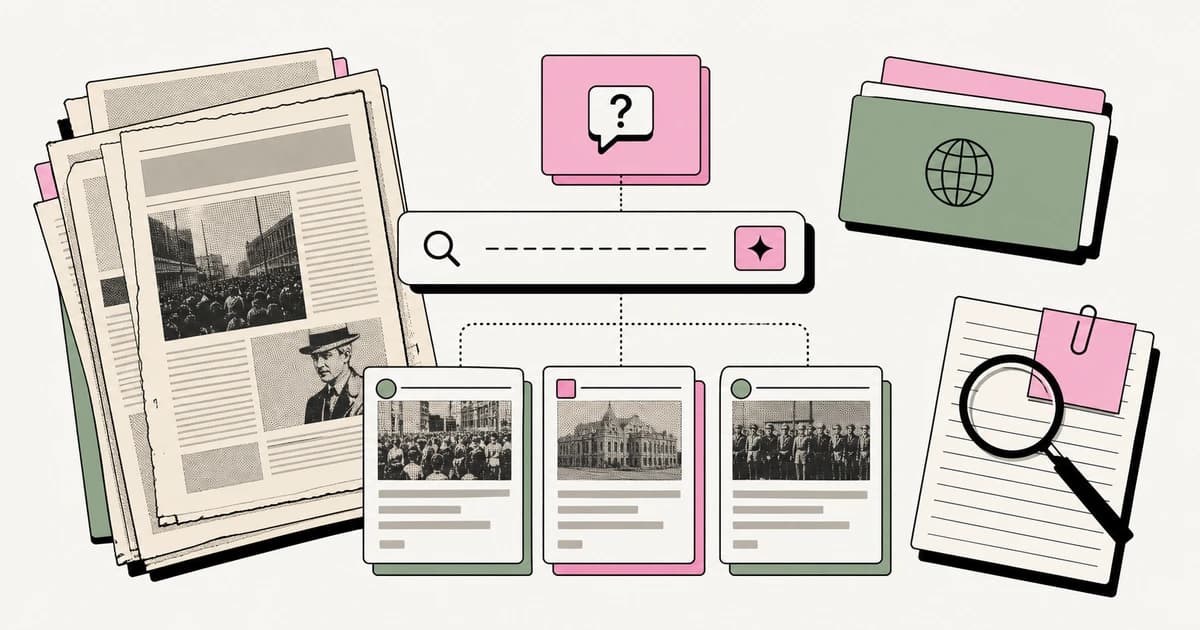
One of the more interesting Show HN launches today was not a coding tool. It was SNEWPAPERS, a historical newspaper archive built around full-text extraction, semantic search, and an agentic search assistant.
The author says they extracted more than 600,000 newspaper pages from the Chronicling America collection, about 5TB of source material, then built a pipeline for layout segmentation, classification, OCR, semantic indexing, and query assistance.
That is a big data project. But the product lesson is more specific:
Agentic search works best when the agent writes queries, not when it replaces the search system with a paragraph.
That sounds small. It is not.
Most "AI search" products collapse three jobs into one chat box:
- Understand what the user wants.
- Retrieve the right evidence.
- Write the final answer.
That is fine for simple lookups. It gets shaky when the corpus is messy, historical, huge, domain-specific, or full of source ambiguity.
SNEWPAPERS points at a better pattern: let the agent help the user operate the search system, then keep the actual search interface and source documents visible.
The hard part is not the chat#
Historical newspapers are a brutal corpus.
The source pages have columns, broken scans, advertisements, small headlines, multiple article fragments, OCR errors, page furniture, different eras of typography, and weird layout conventions. A keyword search over raw scans produces noise. A pure semantic search can miss exact names, dates, places, or spellings. A chat-only abstraction can hide too much evidence.
The SNEWPAPERS Show HN post describes a multi-model pipeline:
- layout processing
- OCR
- LLM-based classification
- heuristics for segmentation
- OpenSearch
- Postgres
- semantic search
- an agentic search tool that writes useful queries
That last part is the product move.
The assistant is not just answering from a black box. It helps users formulate searches, then the user can inspect the saved queries and continue exploring the results.
That keeps the archive in the loop.
HN pushed on the right UX problem#
The Hacker News comments were positive but practical. One commenter who works with complicated datasets said the hard part is often UI: even experienced search people struggle to see how they would use a large corpus until they can try a focused slice. They suggested making a small public segment immediately searchable without registration, such as one year of Olympic coverage.
That is the right critique.
When the dataset is this large, "we have the archive" is not enough. The product has to give users a starting wedge.
For agentic search, the first interaction matters more than the model quality. A user needs to see:
- what the agent searched for
- why that query was generated
- what filters were applied
- which results came back
- where the source evidence lives
- how to refine the next query
If the agent hides that trail, the user gets a confident answer and no search skill. If the agent exposes the trail, the user gets leverage.
From the archive
Approval Fatigue Is an Agent Security Bug
May 2, 2026 • 7 min read
Claude Code Agent Teams, Subagents, and MCP: The 2026 Playbook
May 2, 2026 • 9 min read
Client-Side Tool Calling Is the Privacy Pattern AI Apps Need
May 2, 2026 • 7 min read
Codex Changelog April 2026: Goals, Browser Use, GPT-5.5, and Safer Agents
May 2, 2026 • 9 min read
Query-writing agents are underrated#
There is a pattern here that applies beyond newspapers.
For domain search, the best agent is often a query planner:
TXT
User intent:
Find early newspaper coverage of bank runs in rural towns.

Agent output:
Search query:
  ("bank run" OR "run on the bank" OR "depositors rushed")
Filters:
  year: 1890-1935
  publication type: local newspaper
  section: news
Follow-up:
  Search by bank name once candidate towns appear.
That is more useful than a prose answer if the user is doing real research.
The agent turns vague intent into a search strategy. The search engine does retrieval. The UI shows sources. The user keeps judgment.
This division of labor is cleaner than "chat with all documents." It also scales better across messy corpora because each layer can be improved independently.
OCR can get better. Layout extraction can get better. The search index can get better. The query planner can get better. The result UI can get better. None of those improvements require pretending the model is the archive.
The RAG lesson#
RAG builders should pay attention.
A lot of RAG apps are designed as answer machines. The user asks a question. The system retrieves chunks. The model writes an answer. Maybe citations appear at the bottom.
That is useful for support docs and narrow knowledge bases.
For exploratory research, it is often the wrong primitive.
Exploratory search needs:
- saved queries
- facets
- date ranges
- entity filters
- source previews
- side-by-side comparison
- result clustering
- provenance
- follow-up search paths
An agent can help drive those controls. It should not erase them.
SNEWPAPERS is interesting because the assistant sits on top of an actual search product. It can help you ask better questions without making the result page irrelevant.
That is the architecture I would copy.
The product risk#
The risk is onboarding.
Large archives need a fast proof moment. If users have to register, invent a query, understand the corpus, and interpret a result set before they feel the product, many will leave before the agent can help.
The HN suggestion of public slices is strong because it narrows the first run:
- one theme
- one date range
- one preloaded query
- one visible search trail
- one obvious refinement
For an archive product, that is not marketing fluff. It is core UX. The product has to teach users what kind of questions the corpus can answer.
Agentic search can help, but only if it starts from concrete examples.
My take#
The durable idea in SNEWPAPERS is not "AI reads old newspapers."
It is that agentic search should make the underlying search system more usable.
The agent should translate intent into queries, propose filters, preserve search history, surface source evidence, and help users iterate. The answer can come later. In serious research products, the trail is often more valuable than the summary.
This is the same pattern developers should use in internal tools, legal search, enterprise knowledge bases, observability, security investigations, and research assistants.
Do not make the model pretend to be the database.
Teach it to operate the database well.
Frequently Asked Questions#
What is agentic search?#
Agentic search uses an AI agent to help users formulate queries, apply filters, and navigate search results instead of replacing the search system with a chat interface. The agent translates intent into search operations while keeping the underlying search engine and source documents visible.
Why should agents write queries instead of answers?#
When the corpus is messy, large, or domain-specific, a prose answer hides too much evidence. A query-writing agent helps users build better searches, inspect results, and refine their approach. The user keeps judgment and the search trail stays visible for verification and follow-up.
What makes historical newspaper search hard?#
Historical newspapers have columns, broken scans, OCR errors, multiple article fragments, different typography conventions, and layout noise. Pure keyword search produces irrelevant matches. Pure semantic search misses exact names and dates. The pipeline needs layout processing, OCR, classification, and structured indexing before search becomes useful.
How does SNEWPAPERS handle this complexity?#
SNEWPAPERS runs a multi-model pipeline: layout processing, OCR, LLM-based classification, heuristics for segmentation, OpenSearch for full-text, Postgres for metadata, and semantic search for intent matching. The agentic assistant sits on top and helps users write better queries against this indexed corpus.
When should RAG apps expose search controls instead of just answering?#
Exploratory research needs saved queries, facets, date ranges, source previews, result clustering, and follow-up paths. Support docs and narrow knowledge bases can use answer-first RAG. Research products, legal search, enterprise knowledge bases, and investigation tools should expose the search trail because the evidence path is often more valuable than the summary.
What is the onboarding risk for large archive products?#
Users need a fast proof moment. If registration, query formulation, and result interpretation all happen before the user feels the value, many will leave. Public slices with preloaded queries, narrow date ranges, and visible search trails lower the barrier and teach users what questions the corpus can answer.
How does this pattern apply to internal tools?#
Internal tools for observability, security investigation, legal discovery, and enterprise knowledge management benefit from the same split. The agent should translate intent into queries and propose filters. The search system should do retrieval. The UI should show sources. The user should keep judgment and be able to iterate.
What is the difference between query-writing agents and chat-with-docs?#
Chat-with-docs collapses query formulation, retrieval, and answer generation into one black box. Query-writing agents separate those jobs: the agent helps ask better questions, the search engine retrieves, and the UI shows evidence. Each layer can improve independently without pretending the model is the archive.
Continue Reading#
Read next
RAG with Claude: Add Context Without Retraining
A production-grade RAG pipeline with Claude. Chunking that survives real documents, retrieval tuning that actually moves the needle, citation tracking, and the prompt caching trick that makes RAG cheap enough to ship.
10 min readWhat is RAG? Retrieval Augmented Generation Explained
How RAG works, why it matters, and how to implement it in TypeScript. The technique that lets AI models use your data without fine-tuning.
8 min readTool Use in the Claude API: Production Patterns for Reliable Agents
Master tool use in the Claude API. Schema design, retry logic, multi-step loops, and the failure modes that only show up at 10k calls a day.
12 min readShare
Developers Digest
Technical content at the intersection of AI and development. Building with AI agents, Claude Code, and modern dev tools - then showing you exactly how it works.
300+ videos30K+ GitHub stars850+ articles
Related Tools
AI Frameworks

LlamaIndex
LLM data framework for connecting custom data sources to language models. Best-in-class RAG, data connectors, and query...
View ToolAI Frameworks

Haystack
Open-source AI orchestration framework by deepset. Modular pipelines for RAG, agents, semantic search, and multimodal ap...
View ToolAI Coding

Sourcegraph Cody
AI coding assistant with deep codebase context. Indexes your entire repo graph for accurate answers. VS Code and JetBrai...
View ToolAI Frameworks

LangChain / LangGraph
Most popular LLM framework. 100K+ GitHub stars. Chains, RAG, vector stores, tool use. LangGraph adds stateful multi-agen...
View ToolApps from Developers Digest
SaaS ProductsIn Progress
Sales Genius Workspace
Research accounts, surface pain points, build demo scripts, and draft follow-up emails.
View AppDirectories
CLI Directory
Find the right CLI without trawling GitHub. Search, filter, install.
View AppSaaS ProductsIn Progress
Community Insight Engine
Turn community complaints and requests into validated product bets and weekly briefs.
View AppRelated Guides
Guide
Built-in Subagents - Claude Code
Researcher, auditor, reviewer, and other ready-made subagent types.
Claude CodeGuide
AI Agent Frameworks Compared: LangGraph vs CrewAI vs Mastra vs CopilotKit
Deep comparison of the top AI agent frameworks - LangGraph, CrewAI, Mastra, CopilotKit, AutoGen, and Claude Code.
AI AgentsGuide
Command History - Claude Code
Per-directory prompt history with Ctrl+R reverse search.
Claude CodeRelated Videos
SearchGPT: OpenAI's New AI Search Prototype
In this video, I dive into SearchGPT, OpenAI's new AI search prototype designed to deliver fast and accurate answers with clear and relevant sources. I discuss its user interface, features...
Video·
FireSearch: An Open-Source Deep Research Template Built with Next.js, Firecrawl and LangGraph
Repo: ⭐ https://github.com/mendableai/firesearch Introducing FireSearch: The Open Source Deep Research Template Built with Next.js, Firecrawl and LangGraph In this video, the creator introduce...
Video·
ChatLLM Operator | New 1 Click AI Agent automates your work and research
Meet ChatLLM Operator 🌐✈️📊 In this video, I'll show you the capabilities of ChatLLM Operator. Discover how this affordable tool, at just $10 a month, can autonomously handle tasks...
Video·
Related Posts

10 min read
RAG
RAG with Claude: Add Context Without Retraining
A production-grade RAG pipeline with Claude. Chunking that survives real documents, retrieval tuning that actually moves...
8 min read
RAG
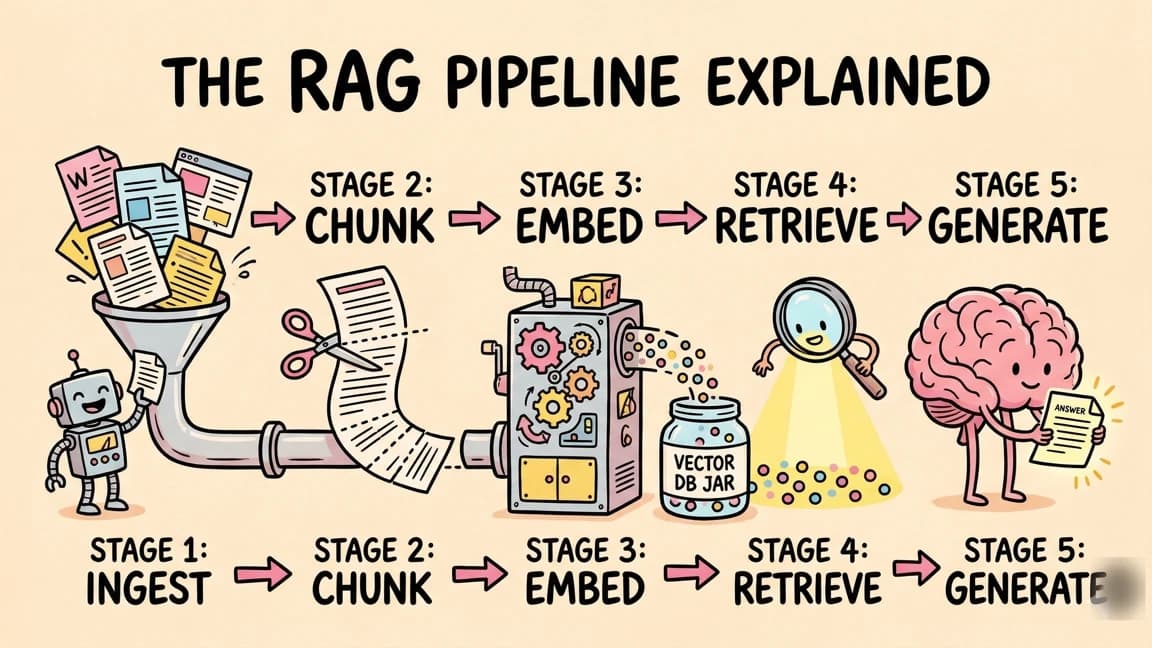
What is RAG? Retrieval Augmented Generation Explained
How RAG works, why it matters, and how to implement it in TypeScript. The technique that lets AI models use your data wi...

12 min read
Claude API
Tool Use in the Claude API: Production Patterns for Reliable Agents
Master tool use in the Claude API. Schema design, retry logic, multi-step loops, and the failure modes that only show up...

9 min read
AI Agents
The Agent Reliability Cliff: Why Your 10-Step Chain Only Succeeds 20% of the Time
The math of agent pipelines is brutal. 85% reliability per step compounds to about 20% at 10 steps. Here is why long cha...

5 min read
LangChain
LangChain vs Vercel AI SDK: Which TypeScript AI Framework Should You Use?
Two popular frameworks for building AI apps in TypeScript. Here is when to use each and why most Next.js developers shou...
10 min read
AI Agents
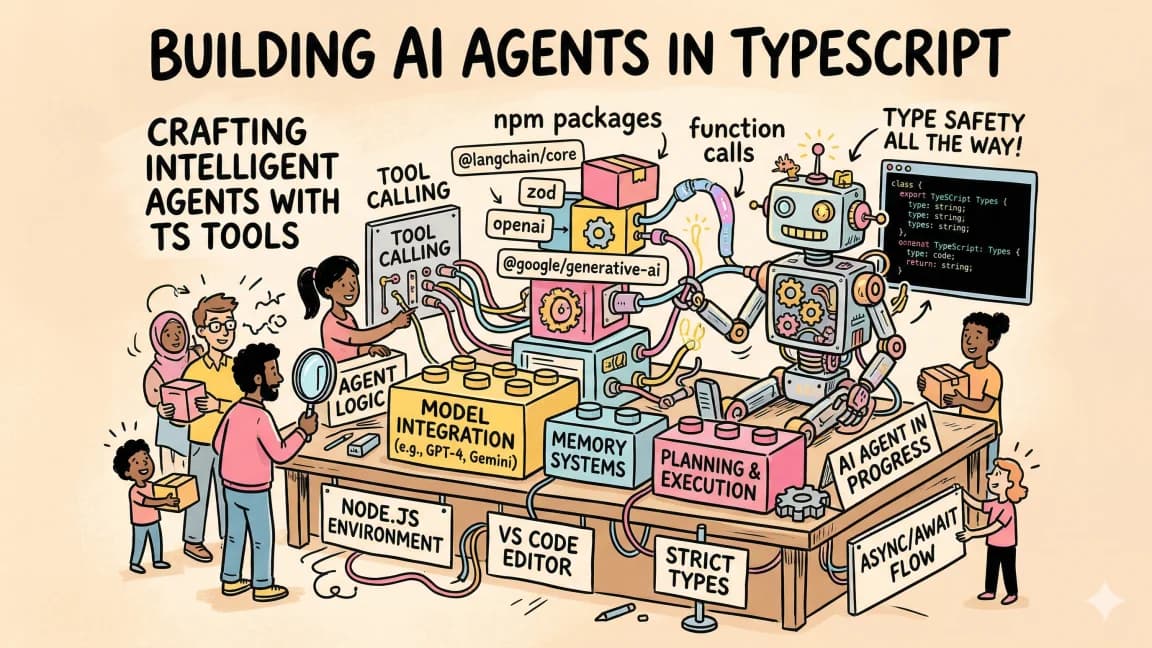
How to Build AI Agents in TypeScript
A practical guide to building AI agents with TypeScript using the Vercel AI SDK. Tool use, multi-step reasoning, and rea...
Build with the member tools

Get Smarter About AI Dev
New tutorials, open-source projects, and deep dives on coding agents - delivered weekly.
One email per weekReal code, not theoryFree forever