Midjourney Built a Full-Body Scanner: The Image-Generation Company's Strangest, Most Revealing Bet Yet
TL;DR
Midjourney, the company that makes AI pictures, just announced a full-body ultrasonic scanner and a spa chain to put it in. It sounds like a non sequitur. It is not. Here is what was actually announced, why a generative-image lab is suddenly building medical hardware, and the sharpest skeptic and believer takes from Hacker News on whether any of it survives contact with the FDA.
Official Sources#
| Topic | Source |
|---|---|
| The announcement ("A New Era of Midjourney") | Midjourney Medical blog post |
| Hardware specs, Butterfly Network deal, 60-second claim | Engadget |
| "Big claims, no track record" skeptical framing | The Next Web |
| Strategy / world-model thesis | Latent Space |
| Community reaction | Hacker News thread (id 48579650) |
The most surprising AI announcement of the month did not come from a model lab, did not involve a new model, and barely involves AI at all. On June 17, David Holz, the founder of Midjourney, walked on stage and unveiled a machine that scans the inside of your body. Then he announced a spa to put it in.
This is the company whose entire identity is making pretty pictures from text prompts. The instinct is to file it under "founder hubris" and move on. That instinct is wrong, or at least incomplete. The scanner is a strange product, the medical claims deserve heavy skepticism, and the regulatory path is genuinely brutal. But the move tells you something real about how the most ambitious people in generative AI now think about where the value is going. It is worth taking seriously precisely because it is so easy to dismiss.
What Midjourney actually announced#
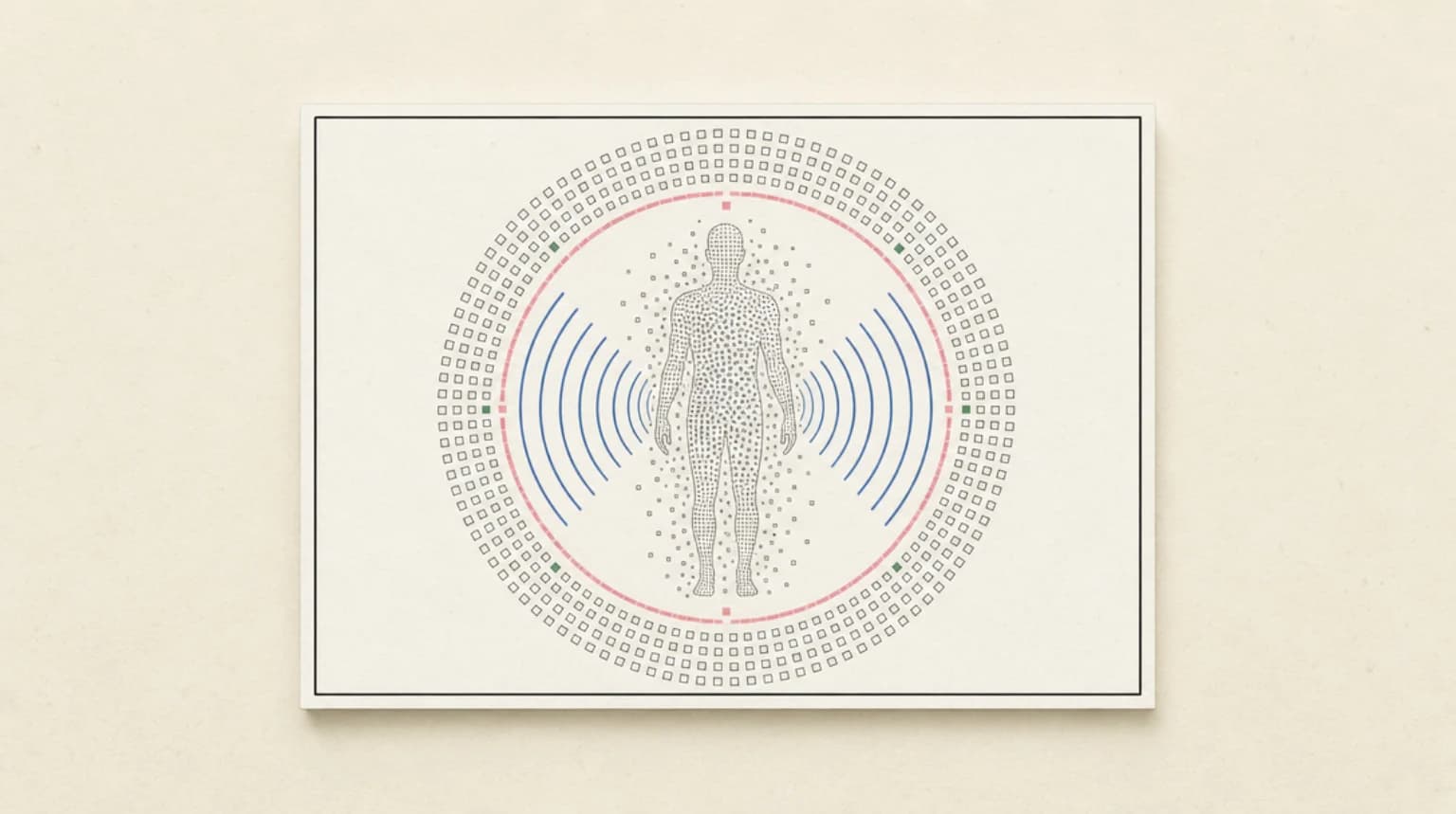
Holz introduced Midjourney Medical, a new division, and the Midjourney Scanner, a full-body ultrasonic CT imaging device. The pitch is a whole-body scan in roughly 60 seconds, framed as something as casual as a trip to a spa rather than a trip to a hospital.
The mechanism is genuinely interesting. Per Midjourney's announcement and Engadget's reporting:
- You step onto a platform in a shallow pool of warm water, and the platform lowers you at about five centimeters per second through a ring of sensors.
- The ring is packed with around half a million elements, each the size of a grain of sand, and each one can both emit ultrasound and listen for the echoes. Midjourney's own framing is that each acts "like a dolphin" using echolocation.
- The imaging is built on 40 Butterfly Network Ultrasound-on-Chip modules backed by roughly 2 petaflops of processing.
- The system fires ultrasound through the body from every angle and reconstructs a 3D map from the returning echoes.
The headline comparison is the provocative one: Holz claims the result is "in many ways superior to even MRI machines," with no radiation, no heavy magnets, at nearly a hundred times the speed. The business plan is just as audacious. The first Midjourney Spa opens in San Francisco's Union Square before the end of 2027 with about 10 scanners, complete with hot tubs, saunas, and cold plunges. The 2031 goal is a fleet of over 50,000 scanners worldwide doing a billion scans a month more total imaging capacity than every MRI machine on Earth combined.
There is one detail that reframes the whole thing, and Midjourney says it plainly: there is almost no AI in this device. It is hardware and signal processing. The imaging tech is licensed from Butterfly Network under a deal signed in November 2025 $15M upfront plus $10M a year for five years, with performance bonuses. A company famous for AI just shipped its most ambitious thing yet, and the AI is the part that hasn't been built.
Why an image company is building a body scanner#
Here is the part that's easy to miss if you stop at "lol, a spa." Midjourney's roadmap, as Holz has described it for over a year, is a ladder: images → video → 3D → real-time world models. Static images were step one. The V1 video model in April 2026 was step two. The destination Holz keeps naming is real-time, navigable, open-world simulation systems that don't generate a picture of a world but render a coherent world you can move through.
Read against that ladder, the scanner stops looking like a non sequitur. It fits the same trajectory covered in our explainer on AI agents: models that can act in a world need progressively richer representations of that world, not just text or pixels. As the Latent Space analysis put it, Holz's framing is that "the future is not only about AI models but about new infrastructure that lets AI reason over the physical body." The interesting phrase in his pitch isn't "60-second scan." It's the emphasis on "longitudinal, high-frequency, sub-millimeter differential tracking" not one scan, but the same body measured repeatedly over time. That is a data-acquisition strategy dressed as a wellness product. If you want to build models that reason about physical reality, you need dense, real, frequently-sampled data about physical reality. A scanner that a billion people step into monthly is, among other things, the largest structured dataset about human bodies ever assembled.
The financial structure makes the bet possible. Midjourney is profitable on image generation and, as Latent Space notes, positions itself as "a community-supported research lab, not a normal VC-backed startup." That's not just branding. A venture-backed company answerable to a board does not get to spend image-generation profits building underwater ultrasound rings on a five-year horizon. Midjourney does, because nobody can stop it. Whatever you think of the product, the structure the freedom to make an illegible long-term bet funded by a legible cash cow is the most strategically interesting thing here.
There's also a defensive read worth naming. In static images, Midjourney is still the quality leader but DALL·E 3 and the ChatGPT ecosystem keep pulling casual users into the gravity well, and in video, Sora 2 owns narrative generation while Midjourney's clips top out around 21 seconds. The image-gen category is commoditizing. Pivoting some of the surplus toward a category nobody else is in coastal-grade medical sensing is the kind of move a company makes when it can see the core business maturing and wants the next act to be somewhere the incumbents aren't.
From the archive
Noam Shazeer Joins OpenAI After Two Years Back at Google
Jun 18, 2026 • 5 min read
AI Model Routing: Why the Orchestration Layer Is the Next Big Play Next to the Labs
Jun 17, 2026 • 12 min read
Build Your First Agent with Vercel eve: A Step-by-Step Tutorial
Jun 17, 2026 • 10 min read
Claude Code Permissions: A Practical settings.json Guide for Allow, Deny, and Ask Rules
Jun 17, 2026 • 11 min read
The skeptics are right about the hard part#
None of the above means the product works as a medical product. It means the strategy is coherent. Those are different claims, and the gap between them is where this could die.
The single best summary of the problem comes from The Next Web: big claims, no track record. Midjourney has never built a physical product, never operated a medical device, and has no regulatory clearance. By the company's own account, the device today produces only "detailed body composition maps" body fat, muscle, organ size and not diagnoses. That distinction is not modesty; it's regulatory positioning. Body composition mapping sits below diagnostic imaging in the FDA hierarchy, which is exactly how you ship something today without clearance. Anything that would make this a real MRI rival detecting disease requires FDA approval Midjourney admits it does not have and will "pursue over time."
"Over time" is carrying a lot of weight. The hardest, most expensive, least glamorous part of the entire project is the part that hasn't started.
What Hacker News actually said#
The Hacker News thread is the most useful read on this, because it split cleanly into informed enthusiasm and informed skepticism, and both sides are worth hearing.
On the hardware, the surprise was that it mostly holds up. A commenter who has worked with MRI and phased-array beamforming wrote that the design "perhaps surprisingly doesn't trigger any immediate major technical red flags." Ultrasound tomography is real physics; the transducer arrangement is plausible. That's a meaningful signal it means the skepticism is not "this is fake," it's "this is hard in ways unrelated to the physics."
But an engineer who designs scanners for the incumbents was blunt about the marketing. Reacting to the superior-to-MRI framing, Aromasin wrote: "I help engineers design traditional scanners (Philips, GE, Siemens, etc). To be frank, this statement stinks like utter pig shit." Ultrasound cannot image through air or bone, which rules out the interior of the lungs and most of the brain, and its resolution is coarser than CT or MRI. "Superior to MRI" is true on speed, radiation, and cost, and false on exactly the axes radiologists care most about.
On the FDA, the consensus was that Midjourney is underestimating the wall in front of it. As randusername put it: "This is just not how the FDA works. At all. You can't just email them slideware and marketing materials to keep them in the loop." The clinical-validation gap is real a prototype reportedly tested on around a dozen people, no published sensitivity/specificity data, no peer review, no head-to-head against MRI.
The most substantive medical critique wasn't about the FDA at all. It was about overdiagnosis the well-documented harm of scanning healthy people. convnet wrote: "Every human body is a bit weird and there will almost always be something 'wrong' that will be visible in a full body scan... many of these oddities would never have caused issues." logravia sharpened it: "False positives are the primary issue. False positives lead to stress, invasive diagnostic procedures and wasted medical resources." This is the part the spa framing quietly buries. A billion scans a month on asymptomatic people is also a machine for generating a billion incidental findings, a large fraction of which lead to anxiety, biopsies, and follow-ups for things that would never have hurt anyone.
And yet the optimists on the thread weren't naive, they just weighted the upside differently. noduerme: "The vast majority of people on the planet have exactly zero hard data on their ailments... Bring on the terabytes and let's see what we can do." tgsovlerkhgsel went straight at the actual long-game: "With a big enough data set... labeled with diagnoses, I suspect we could get very fast and accurate automatic diagnoses." That last comment is, inadvertently, the strongest statement of why Midjourney is doing this at all. The scanner isn't the product. The longitudinal dataset, and the diagnostic models you could eventually train on it, is the product. The hardware is the data-collection rig.
The Theranos question, handled honestly#
Every "wellness startup makes bold medical claims" story now gets the Theranos comparison, and it's worth addresssing rather than dodging. The comparison is fair as a warning and unfair as a verdict.
Fair: bold superiority claims, direct-to-consumer positioning, a charismatic founder, a category (consumer medical testing) with a documented graveyard, and a sample size you could fit in a conference room. Skepticism is the correct default.
Unfair: Theranos's core technology never worked and the company lied about it. Midjourney showed a working prototype, named its hardware partner, disclosed the deal terms, and stated openly that the device is non-diagnostic and that FDA clearance hasn't been obtained. Being honest about what you can't yet do is the precise opposite of the Theranos failure mode. The risk here isn't fraud. It's the more ordinary risk that the regulatory and economic case never closes and a genuinely cool engineering demo becomes an expensive monument.
What builders should actually take from this#
You're probably not building a body scanner. But there are three transferable lessons in this announcement, and they're why it's worth your attention beyond the spectacle.
Profitable core, illegible bet. The reason Midjourney can do this is a boring, profitable product subsidizing a wild one, with an ownership structure that doesn't force quarterly legibility. If you want to make long-horizon bets, the prerequisite isn't vision, it's a cash engine you control. Strategy is downstream of structure.
The data is the moat, not the device. Strip away the spa and the move is: deploy hardware at scale to capture a proprietary, high-frequency, real-world dataset nobody else has, then train models on it later. That pattern owning the sensing layer to own the data to own the eventual model is the generalizable play, and it applies to far more mundane domains than medicine.
"Superior to MRI" is a tell. When a demo's headline claim is strongest on the axes that are easy to measure (speed, cost) and quietly silent on the axes that are hard (resolution, validation, regulatory clearance), that asymmetry tells you where the real risk lives. Read announcements for what they don't benchmark against.
Midjourney just did the most Midjourney thing imaginable: it took something nobody asked for, rendered it at impossible scale, and made you stare at it. Whether the scanner ever clears the FDA is genuinely uncertain, and the medical skepticism is earned. But underneath the spa branding is a clear-eyed bet that the durable value in AI is drifting toward whoever owns the interface to the physical world and the data it produces. That bet might not pay off here. It is not a stupid bet.
Want the strategic throughline on where AI value is actually accruing? Read our companion piece on why orchestration, not the model, is becoming the product.
Read next
'The Orchestration Is the Product': What Perplexity's Aravind Srinivas Sees That the Model Labs Don't
Perplexity launched a $200-a-month agent that coordinates 19 models and calls orchestration, not the model, the product. Here is the strategic case for why the durable, defensible layer in AI sits next to the labs, not inside them - and what 'token value per watt per user' actually means for builders.
11 min readDiffusion Language Models: How Mercury Changed the LLM Speed Game
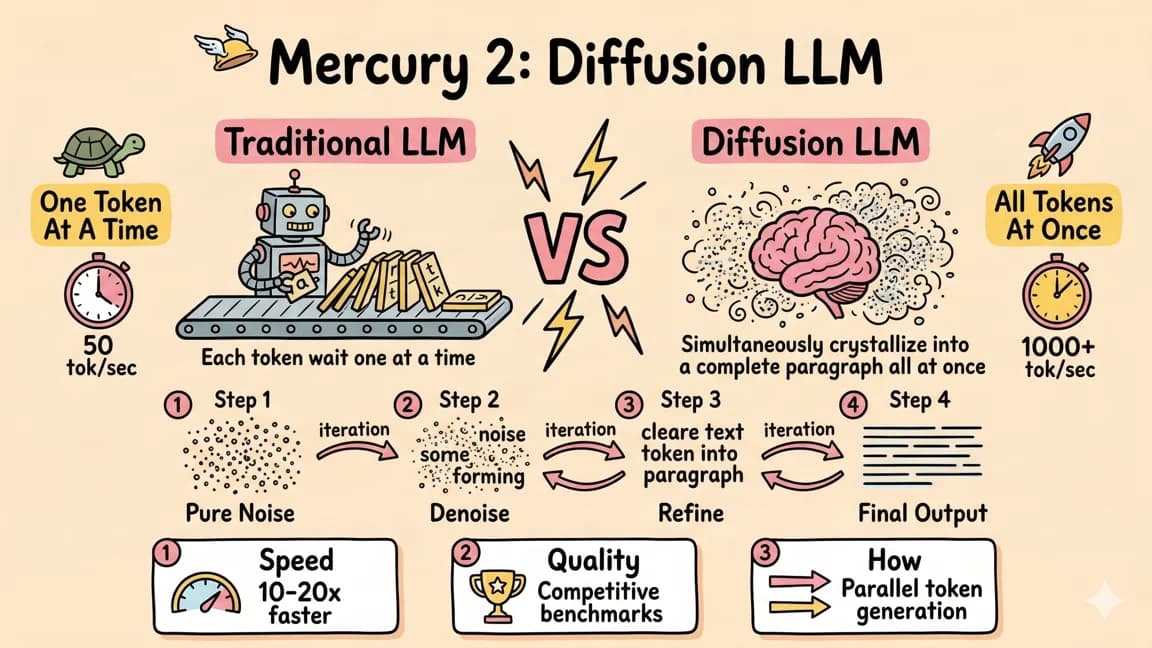
Inception Labs launched Mercury, the first commercial-grade diffusion large language model. It generates over 1,000 tokens per second on standard Nvidia hardware by replacing autoregressive generation with a coarse-to-fine diffusion process.
7 min readAI Agents Explained: A TypeScript Developer's Guide
AI agents use LLMs to complete multi-step tasks autonomously. Here is how they work and how to build them in TypeScript.
6 min readShare
Developers Digest
Technical content at the intersection of AI and development. Building with AI agents, Claude Code, and modern dev tools - then showing you exactly how it works.
300+ videos30K+ GitHub stars850+ articles
Related Guides
Related Posts

11 min read
Perplexity
'The Orchestration Is the Product': What Perplexity's Aravind Srinivas Sees That the Model Labs Don't
Perplexity launched a $200-a-month agent that coordinates 19 models and calls orchestration, not the model, the product....
7 min read
Diffusion Models
Diffusion Language Models: How Mercury Changed the LLM Speed Game
Inception Labs launched Mercury, the first commercial-grade diffusion large language model. It generates over 1,000 toke...
6 min read
AI Agents
AI Agents Explained: A TypeScript Developer's Guide
AI agents use LLMs to complete multi-step tasks autonomously. Here is how they work and how to build them in TypeScript.
Build with the member tools

Get Smarter About AI Dev
New tutorials, open-source projects, and deep dives on coding agents - delivered weekly.
One email per weekReal code, not theoryFree forever