Kill Your Agent Runs Early

TL;DR
The first production-scale trace of agentic coding says the context you keep paying for is already dead at every turn boundary. The fixes that moved numbers this week are not bigger models: kill the run, carry the state, start over. Here is the bet you can grade us on.
Sixty-six point six, sixty-six point eight, seventy-one point eight. Same model, same benchmark, three ways of running it.
The first number is a coding agent on SWE-bench Verified left to its own devices: 66.6 percent resolution. The second is the same agent killed mid-run by a cheap failure detector and restarted cold: 66.8 percent. The third is the same agent killed and restarted with the interrupted work offered back as an optional overlay: 71.8 percent. Five points of resolution for the price of knowing when to stop and carrying a diff across the restart (FailFast-RestartSmart, arXiv:2608.03222).
The detector in question is a 0.6 billion parameter model. Not the frontier, not a router, not a judge: a model smaller than most embeddings pipelines, trained to predict failure from observable action prefixes alone, no logits, no hidden states. It transfers to policies it never trained on, including closed-API models. One cheap monitor gating a fleet.
Here is what we think is happening, and we want to defend it properly: the next lever in agent quality is not the model and not the context window. It is the run lifecycle. When to kill a run, what to carry across the kill, and what to gate deterministically are now the measured wins, and the first production-scale trace of the agentic workload explains why in one number.
What we argued before, and what changed#
We have been building a position on this site across the last week. On August 1 we argued the benchmark numbers are lying to you, with double-digit noise at every layer of the eval stack (your-benchmark-is-lying-to-you). Later that day we argued the fix is architectural, not model-side: verification has to move into the artifact, not sit on top of it (the-benchmark-fix-is-architectural). On August 3 we argued the judge is leaving the loop, because evidence gates and verifiable structures beat LLM verdicts at every point a loop needs a decision (the-judge-leaves-the-loop).
The evidence this week moves the argument one level down. The judge posts were about how agents are graded and gated. The new batch is about how runs are born, kept alive, and killed - and it lands with the first production-scale measurement of the workload itself. GitHub sampled Copilot traces from June 2026: 3.2 million users, 13 million sessions, 761 million LLM calls, 95 trillion tokens (arXiv:2608.00101). For the first time we know what agentic coding looks like at planetary scale, and the shape is nothing like the chatbot workloads serving infrastructure was built for.
Agentic sessions are sparse user turns. Each turn unfolds into an autonomous loop of LLM calls, almost always coupled with tool execution. The user goes quiet; the agent works. And here is the number that should change how you think about every agent run you have ever watched grind: KV-cache hit rate averages 90 percent inside a turn, and 55 percent across turn boundaries. Context compaction and model switches destroy most of the cache. The context you are protecting when you let a run continue is the thing the serving layer has already half-thrown away.
The marginal unit of agent compute is the expensive one#
This is not the first time the numbers pointed this way. At equal token cost, every one of 18 self-inspection comparisons loses to plain repeated sampling - reflection is a worse use of the second unit of compute than sampling again (arXiv:2607.28576). Repair-only policies build much more accurate simulators that play worse (83.07 versus 88.49 on the ARC-AGI-3 measure) - more repair compute is not just wasted, it is negatively correlated with decision quality (Tycho, arXiv:2607.28287). Fixed reasoning effort loses to per-call escalation-on-stall at equal cost in optimization loops (ARES, arXiv:2607.27879). We covered the shape of this in the judge post: the marginal unit of agent compute saturates, and on a growing list of axes it goes negative.
What the new batch adds is the production-grade execution of the same idea, and the repair primitives that make it safe.
The kill. FailFast's prefix monitor, trained on terminal plus dense fail-to-pass supervision, saves 14.6 to 20.4 percent of execution tokens at a 5 percent false-positive target, and beats the per-step AgentStop adaptation on the same model (20.4 versus 12.5 percent). At a looser 25 percent false-positive target, restart-with-overlay is where the resolution gain shows up: 71.8 versus 66.8 percent for cold restart. Early termination is not lossy when the partial state is offered back. It is lossy exactly when you throw the state away.
The repair loop. A separate group ran a detect-and-repair loop over 2,823 committed agent episodes across three frameworks and four models (arXiv:2608.02464). The detector is a one-class echo-state-network ensemble with CUSUM alarms, trained only on healthy runs, about 200 microseconds per step - three orders of magnitude cheaper than an LLM judge call - and it catches 0.71 of failures at a 5 percent false-alarm budget. On top sits a deterministic verification layer that recomputes a run's stated total from the tool results it actually received: it catches 60 percent of failures at 0 of 63 false positives, with zero calibration, and it transfers across models unchanged. Then the repair: roll back the flagged episode and re-run it, which recovers 45 percent of failures against a 16 percent resampling control (p = 0.0005), lifting task success from 52 to 73 percent for about one extra model call per run.
The state. The most surprising result of the batch is Ledger (arXiv:2608.00808): a deterministic runtime layer, zero LLM calls, that distills a long-horizon coding agent's history into an explicit execution state - what it has observed, modified, and attempted - and applies it at two boundaries. An inform path appends a compact state view before each model step; a govern path checks proposed commands against the ledger and returns still-valid earlier results instead of re-executing. Across all 500 SWE-bench Verified instances it raises Pass@1 from 56.2 to 64.2 percent (GPT-5 mini) and 75.8 to 81.0 percent (MiniMax M2.5) while cutting cost by about 30 percent. Attached to OpenAI Codex it adds 3.4 points at 24.4 percent lower cost. The ablations attribute most of the resolution gain to govern and most of the efficiency gain to inform: the run's own history, rendered machine-checkable, is both a correctness fix and a cost cut.
And the failure class it kills. SWE-Touch stress-tests coding agents in shared workspaces by injecting Counter-Edits - plausible user edits that conflict with the task - when agents reach the relevant code (arXiv:2608.02499). Across nine models the Counter-Edits lower resolve rates by 7.7 points, and the trajectory analysis pins the cause: weak workspace-state awareness. Agents keep conflicting code or replace it without re-inspecting the repository and validating with targeted tests. Ledger's govern path is the systems answer to exactly that gap, and the two papers landed the same day: the failure class and the fix measured independently.
The same shape shows up when a run hands work off. On repository-level code QA, semantic search against a prebuilt index answered 65.2 percent of questions versus 46.2 percent for deep agentic search with a grep subagent in an isolated context - the pattern adopted by Claude Code, Codex, and Antigravity - at less than half the cost per correct answer, and 41.8 percent of the agentic failures happened at the planner-to-subagent handoff, usually silently, ending in a fluent confident wrong answer (arXiv:2608.01507). The most expensive lifecycle decision is not how many steps a run takes. It is where the run's working memory lives when it hands off.
From the archive
LFM2.5-2.6B: Liquid AI's On-Device Agent Model Runs at 220 Tokens/s in Under 2.5 GB
Aug 5, 2026 • 7 min read
Next.js 16.3 Is Out: Instant Navigations, 90% Less Dev Memory, and Versioned Docs for AI Agents
Aug 5, 2026 • 7 min read
The Harness Is the New Cost Lever: Databricks' Benchmark and Pi's Context Discipline
Aug 5, 2026 • 6 min read
Prime Agent: A Self-Improving Coding Harness Where Everything Is Python
Aug 5, 2026 • 22 min read
The mechanism: state, not tokens, is what should survive#
Here is the part nobody has quite said out loud, and it is the reason we think this is a trend and not a week of lucky benchmarks. Put the trace together with the repair loop and the state layer, and a consistent picture falls out.
Continuing a run is an investment in its context. The Copilot trace prices that context: inside a turn it is worth keeping, with 90 percent cache hits; across a turn boundary it is worth 55 percent, and model switches and compaction destroy it further. The run you refuse to kill is the run whose working memory the serving layer is already discarding. So "should I let this run continue" is secretly a question about what survives, and the answer the new papers converge on is that the thing which survives should not be tokens at all. It should be a compact, machine-checkable state: what was observed, what was modified, what was attempted, what was verified. Ledger shows that state layer costs nothing to build (zero LLM calls), buys 8 points of Pass@1, and cuts the bill by a third. FailFast shows the overlay can ride across a restart for free. The telemetry paper shows the whole detect-verify-repair loop can run with no LLM judge in the stack at all.
The durable unit of an agent run is shifting from the token stream to the execution-state ledger. That is why restart-with-state beats both continuing and cold restart: continuing protects a dying cache, cold restart throws away the one thing worth keeping. Kill the run, keep the state, spend the saved tokens on a fresh trajectory. Checkpoint as state, not as cache.
We have logged this as a combination thesis internally, and it is the load-bearing claim of this piece, so let us be precise about what it predicts and what would falsify it.
The bet#
By end of 2027, we expect restart-with-state-overlay to be a named repair primitive in mainstream agent harnesses, cheap prefix monitors on the hot path to be a documented pattern in fleet tuning guides, and "how much compute" to stop being the headline lever in agent-cost content - replaced by when-to-stop, what-to-carry, and what-to-gate. The economics run the right way: the monitor is a 0.6B model, the state layer is deterministic, the gate is free, and every one of them pays for itself in tokens. We are wrong if the platforms keep shipping longer-horizon modes and bigger context as the headline quality lever and kill/restart stays a research artifact. That is a graded call, and we will grade it.
The counter-case, honestly#
Every leg of this is a single result from a single research week, and the honest counter-case is stronger than we would like.
First, the curve is per-task. SKIMIX found harness-time gains are front-loaded and task-dependent - negative on multiple-choice, real on open-ended mathematical reasoning - and agent-count scaling is non-monotonic (arXiv:2607.27994). Some task classes genuinely reward more compute, and "kill early" guidance that ignores task class will be wrong on exactly the tasks where patience pays.
Second, the monitor has a deployment tax. The telemetry paper is admirably honest: its echo-state detector needs per-deployment healthy-run calibration, and cold it sits at AUROC 0.527 versus 0.885 recalibrated. A fleet that skips calibration is running on a coin flip. For small teams the calibration burden may exceed the token savings.
Third, the kill decision is not uniformly cheap. The 90 percent intra-turn cache hit rate means the early part of a turn is exactly where continuing is still cheap. Kill too early and you forfeit banked work; the monitor's false-positive budget is the price of that mistake. The upside case runs at 25 percent false positives, which is a lot of killed runs. The trade is a dial, not a theorem.
Fourth, the long-horizon measurement problem is unsolved. A position paper this week showed headline long-horizon gaps currently mix ordinary error compounding, genuinely harder decisions, and context rot, and cannot be decomposed without stage-baseline controls (arXiv:2607.27283). Our kill-early reading inherits that ambiguity: some of what looks like "continuing is wasteful" may be "this particular task is beyond the model," which no amount of lifecycle engineering fixes.
Fifth, the frontier could reset the curve. A model with reliable self-verdicts - the SVR-style trained stopping signal we covered in the judge post - makes external monitors redundant, and a model that plans context use internally could make the 55 percent cross-turn cache number obsolete. The cheap monitor predicts the current policy generation. Nothing here survives contact with a model that knows when it is wrong.
What developers should do#
-
Instrument runs before you lengthen them. A prefix monitor or a deterministic state check is cheaper than one extra reasoning step, and it is the thing every result above starts from. If you cannot tell a doomed run from a slow one, you are not running agents, you are gambling.
-
Make restart-with-state your default repair. When a run fails, do not feed its corpse more context. Kill it, keep the diff and the ledger, start fresh with the overlay. The FailFast numbers say the overlay is the entire difference between 71.8 and 66.8.
-
Carry state, not tokens, across boundaries. Ledger's inform/govern pattern is deterministic and free: observed, modified, attempted. If your agent re-executes work it already did, that is a harness bug with a measured fix, not a model limitation.
-
Trust deterministic verification over monitors where both exist. The telemetry paper's deterministic layer catches 60 percent of failures at zero false positives with no calibration; the monitor needs calibration and alarms. Use the free layer first, always. This is the same rule the judge post ended on.
-
Budget for the false-positive dial and say which side you are on: kill-early economics live or die on the monitor's false-alarm rate, and the papers above publish it. Do the same.
None of this means the model stops mattering. It means the model's job is narrowing to the parts nobody has found lifecycle for yet, and the people who get good at run governance - when to kill, what to carry, what to gate - are the people who will run fleets in 2027. This is one thread of our developing long-range scenario: the harness layer keeps absorbing the quality lever, and the agent run becomes a designed artifact with a birth, a kill condition, and a state that outlives it.
Continue Reading#
- The Judge Is Leaving the Agent Loop - related deep dive
- The Fix for Broken Benchmarks Is Architecture, Not Smarter Models - related deep dive
- Your Benchmark Is Lying to You - related deep dive
- Agent Swarms Need Receipts - related deep dive
- DeepSeek V4 Economics: Cost, Quality, and the Frontier of Agentic Coding - DeepSeek V4 Economics: The Cost-Quality Frontier for Agentic Coding in
- The Quiet Tax on Your Cheap Agent Tier - compression's invisible tax, and why serving-side levers come first
- The Response Looked Right. The Work Was Not Done. - the completion side of the lifecycle: agents claim done they have not earned, and evidence-carrying termination now certifies the stop
Sources#
- FailFast-RestartSmart: prefix-monitor failure prediction and restart-with-overlay repair - arXiv
- First production-scale characterization of the agentic coding workload from Copilot traces - arXiv
- Agent failure detection from step telemetry with rollback-repair - arXiv
- Ledger: explicit execution state as a runtime layer - arXiv
- SWE-Touch: user edits mid-task and workspace-state awareness - arXiv
- Semantic search beats subagent-grep search on repo QA - arXiv
- Sample more, reflect less: self-inspection loses to repeated sampling - arXiv
- Tycho: simulator accuracy is not decision quality - arXiv
- ARES: adaptive effort escalation in optimization loops - arXiv
- SKIMIX: skill-mixture collaboration and task-dependent gains - arXiv
- Horizon residual: separating long-horizon degradation from error compounding - arXiv
Read next
The Judge Is Leaving the Agent Loop
Evidence gates, verifiable reward games, deploy-time certificates: the fixes that moved agent quality this week did not make judges better, they removed the judge. We think the LLM verdict inside the agent loop is a transitional technology, and here is the bet you can grade us on.
10 min readThe Fix for Broken Benchmarks Is Architecture, Not Smarter Models
Since we published your-benchmark-is-lying-to-you, roughly 25 new results have landed on the eval-integrity question. The surprise: every fix that works is structural - ledgers, counterfactuals, decompositions, personas, readout discipline - and none of them asks the model to be smarter.
11 min readYour Benchmark Is Lying to You
A wave of audits in the last two days measured the noise floor of agent benchmarks: misaligned ground truth, lenient model judges, and aggregate scalars that hide real failures. Here is what the numbers actually mean, what to trust, and how to buy agents without being played.
10 min readShare
Developers Digest
Technical content at the intersection of AI and development. Building with AI agents, Claude Code, and modern dev tools - then showing you exactly how it works.
300+ videos30K+ GitHub stars850+ articles
Related Tools
AI CodingDaily Driver

Claude Code
Anthropic's agentic coding CLI. Runs in your terminal, edits files autonomously, spawns sub-agents, and maintains memory...
View ToolAI Coding

Devin
Cognition Labs' autonomous software engineer. Handles full tasks end-to-end - reads docs, writes code, runs tests, and...
View ToolAI Frameworks
C
Composio
Gives AI agents access to 250+ external tools (GitHub, Slack, Gmail, databases) with managed OAuth. Handles the auth and...
View ToolAI Coding

Codex CLI
OpenAI's open-source terminal coding agent built in Rust. Runs locally, reads your repo, edits files, and executes comma...
View ToolApps from Developers Digest
Related Guides
Guide
Writing Your First Claude Code Skill
A practical walk-through of how to design, write, and ship a Claude Code skill - from choosing when to trigger, through allowed-tools, to the steps the agent will actually follow.
Getting StartedGuide
MCP Servers Explained
What MCP servers are, how they work, and how to build your own in 5 minutes.
AI AgentsGuide
Building Your First MCP Server
Step-by-step guide to building an MCP server in TypeScript - from project setup to tool definitions, resource handling, testing, and deployment.
AI AgentsRelated Videos
TRAE: Custom AI Agents That Actually Understand Your Codebase
Check out Trae here! https://tinyurl.com/2f8rw4vm In this video, we dive into @Trae_ai a newly launched AI IDE packed with innovative features. I provide a comprehensive demonstration...
Video·
ChatLLM Operator | New 1 Click AI Agent automates your work and research
Meet ChatLLM Operator 🌐✈️📊 In this video, I'll show you the capabilities of ChatLLM Operator. Discover how this affordable tool, at just $10 a month, can autonomously handle tasks...
Video·

Buzz: Open-Source Collaboration for Humans + AI Agents
Buzz by Block: Open-Source Slack-Style Collaboration for Humans + AI Agents (Demo & Setup) Check out Arcade: https://arcade.dev.plug.dev/xiDRwlA Repo: https://github.com/block/buzz The video introd...
Video·
Related Posts
10 min read
Research
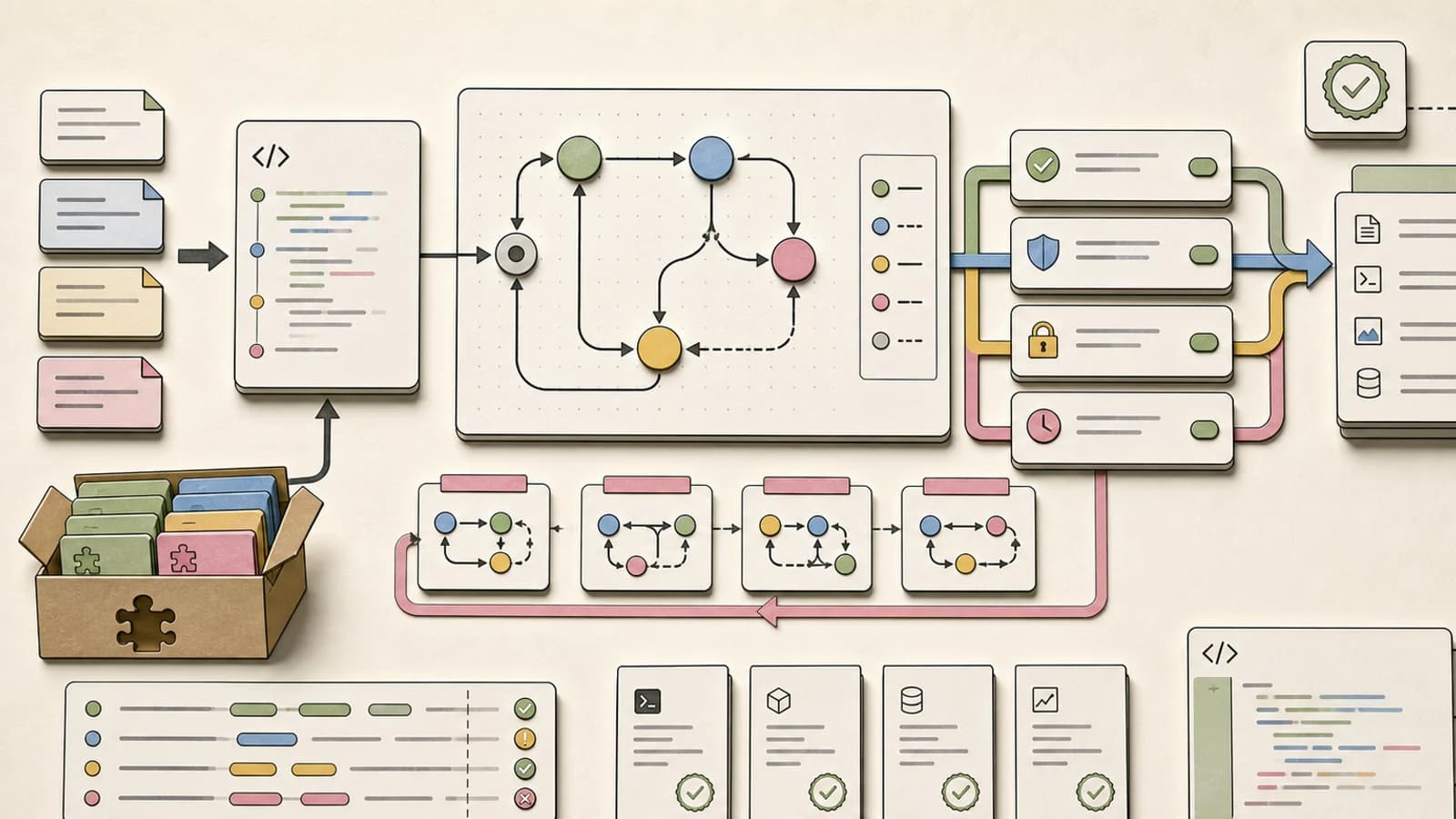
The Judge Is Leaving the Agent Loop
Evidence gates, verifiable reward games, deploy-time certificates: the fixes that moved agent quality this week did not...

11 min read
Research
The Fix for Broken Benchmarks Is Architecture, Not Smarter Models
Since we published your-benchmark-is-lying-to-you, roughly 25 new results have landed on the eval-integrity question. Th...
10 min read
Research
Your Benchmark Is Lying to You
A wave of audits in the last two days measured the noise floor of agent benchmarks: misaligned ground truth, lenient mod...
8 min read
AI Coding
Agent Swarms Need Receipts
GitHub is filling with multi-agent frameworks, skills, and coding harnesses. The useful lesson is not that every team ne...

9 min read
deepseek
DeepSeek V4 Economics: The Cost-Quality Frontier for Agentic Coding in 2026
DeepSeek V4 Pro lands an 80.6 on SWE-bench Verified in Max reasoning mode at $0.66/$1.98 per million tokens off-peak, an...

11 min read
Research
Absence Is the Failure Mode
An audit of three deployed AI scribes found one note in three carries a verified failure, and the dominant error is omis...
Build with the member tools

Get Smarter About AI Dev
New tutorials, open-source projects, and deep dives on coding agents - delivered weekly.
One email per weekReal code, not theoryFree forever