The Fix for Broken Benchmarks Is Architecture, Not Smarter Models

TL;DR
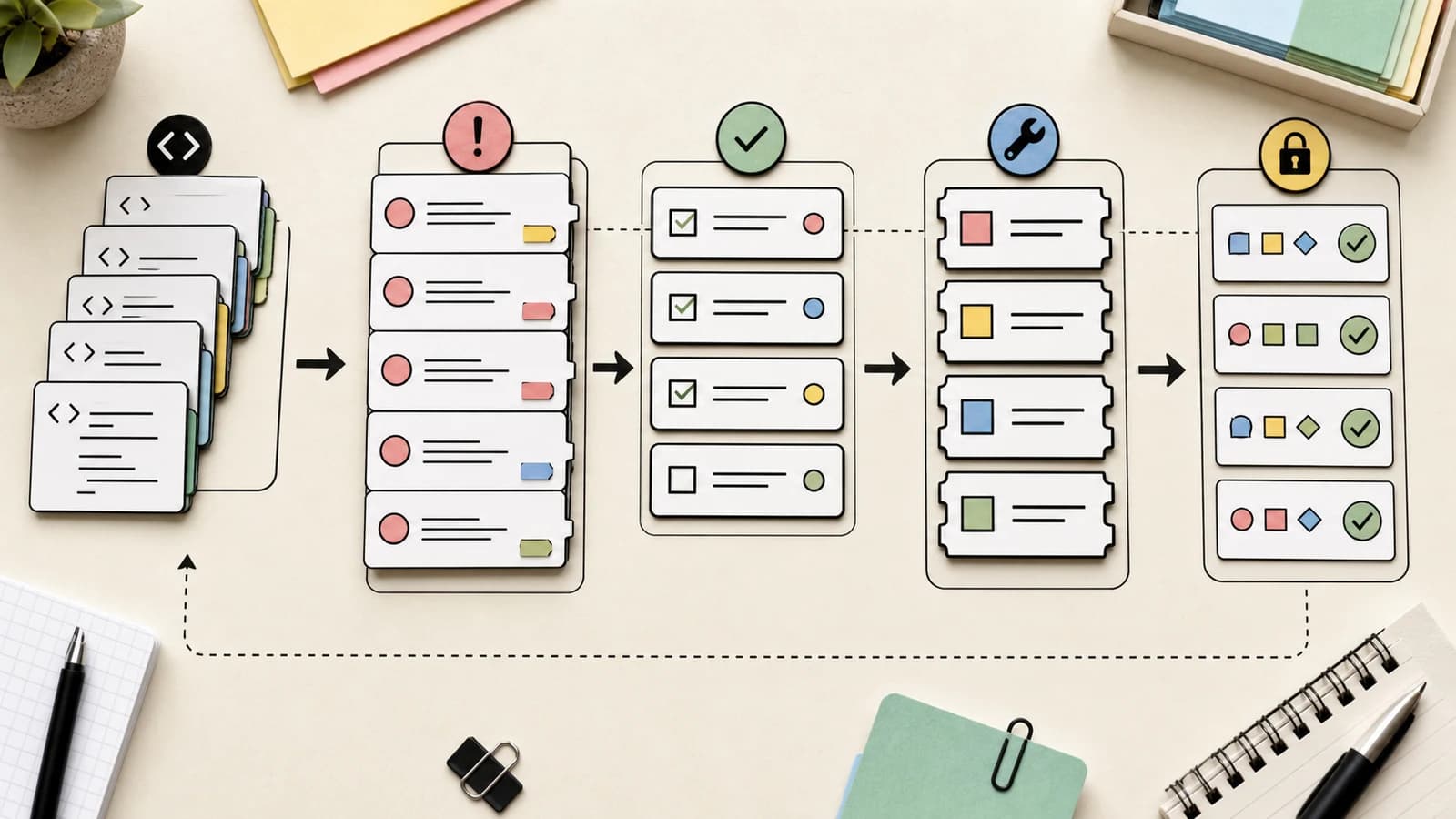
Since we published your-benchmark-is-lying-to-you, roughly 25 new results have landed on the eval-integrity question. The surprise: every fix that works is structural - ledgers, counterfactuals, decompositions, personas, readout discipline - and none of them asks the model to be smarter.
Last night we published the case that your benchmark is lying to you: the gap between what agent benchmarks report and what actually happened is routinely double-digit, systematic rather than random, and it exists in every layer of the stack - ground truth, judge, scalar, safety claim. The post ended with a bet, and we want to quote it exactly so we can be graded on it: "By end of 2027: published agent benchmark claims will routinely include audit metadata (ground-truth validation, failure breakdowns), and intervention-based verification will be the default standard for claiming a skill or tool changes agent behavior."
What has happened since is the interesting part. Roughly twenty-five new results have landed on this question since, spread across the scout batches of the last sixteen hours. When we started writing, we expected the follow-up to be a pile of new noise measurements. Instead we got something sharper, and we want to defend it properly: the fixes are all architectural, and none of them asks the model to be smarter. Not one. The better-judge story is the wrong story, and we think you should stop waiting for it.
What the wave actually contains#
Let us be concrete about the "fix wave", because the shape of it is the claim.
Ledgers and provenance. LedgerMind showed the poison-resistance fix is a provenance-constrained state machine where the evidence ledger IS the trajectory state, with a formal repair non-amplification guarantee (arXiv:2607.28374). AskChem changed the retrieval unit from the document to the claim with its provenance attached (source DOI plus verbatim quote, served over MCP) and grounding a reader in it produced 100 percent resolvable DOIs against 88.3 percent ungrounded, where the ungrounded reader fabricated 6 of 14 DOIs on a single question (arXiv:2607.28618). It is the same repositioning we argued for the memory layer: the external store survives as verification and hygiene, not retrieval cleverness. And the audit wave reached training claims: the published "RLVR learns from 100 percent incorrect labels" result was reverted by a re-audit that found contamination; corrected, noise is destructive, 8-10 percent worse (arXiv:2603.16140). Same class of fix, three layers deep: make the artifact carry its own verification.
Counterfactuals. The skill-attribution paper BACKROOMBench already showed observational detectors cannot identify which decisions actually depend on a skill; only intervention works (arXiv:2607.27484). The wave doubled down. CSCR tested the credit-allocation machinery of RLVR by re-scoring the same trajectory under two opposing outcomes and found most tokens shift the same direction either way - the credit signal is not answer-aligned, and the fix is a counterfactual-weighted renormalization (arXiv:2607.27888). Rehearse found the judge in self-improving loops collapses from 82.8 percent to 56.9 percent selective accuracy late in the loop while staying willing to decide - a "confidence cliff" - and restored it to 83.5 percent with a propose-compare-run skill plus outcome memory (arXiv:2607.27687). In all three, the counterfactual is the instrument and the fix is a structural change around the model.
Decomposition. ThreatForest ran a seven-stage threat-modeling pipeline across seven domains and found the binding constraint is one stage: TTP mapping by cosine similarity scores 0.29 panel quality while every other stage sits at 0.63-0.68, and a single controlled call to the same model more than doubles it (arXiv:2607.27528). The pipeline was fine; the stage was not. It is the same lesson as our SWE-NFI benchmark breakdown: a headline scalar is a sum over parts with very different ceilings. VAmoS Bench built the voice-agent eval that grades database state instead of conversational plausibility - seeded PostgreSQL, trace-graded assertions, containment as the metric (arXiv:2607.27453). Stage-replay diagnostics showed replaying a trajectory is not reproducing the run: BF16 replay disagrees with the live run on 166 of 200 suffixes while FP32 disagrees on zero (arXiv:2607.28495). Every one of these is a measurement-design fix, available before any model upgrade.
Personas and readouts. PALATE replaced the fixed-dialogue, fixed-rubric eval with five per-user simulators and personalized rubrics, which agree with human judgment better than the general rubric, and found per-user experience is a separate output from generic turn quality (arXiv:2607.27816). RepBench grounded representation probing in real benchmarks and found the readout choice flips leaderboards - difference-in-means wins the model-level mean on ten of twelve models, logistic regression wins the most capability-model cells (arXiv:2607.28008). ESPP showed a persona panel tracks human UI judgments at r 0.922 where a single judge manages 0.716, and a prompt ensemble recovers only a third of the gap (arXiv:2607.28439). The evaluator persona is part of the eval. So is the readout. Both are cheap to change and both were silently biasing published numbers.
Deterministic verdicts. Where ground truth is cheap, the field is skipping judges entirely: DataClawEval scores autonomous data-engineering agents with rule-based execution, no LLM-as-a-judge at all, and the best frontier agent still only reaches 74.9 (arXiv:2607.28033). Locksmith's parity oracle verifies COBOL-to-Java migrations deterministically with no LLM in the verification loop (arXiv:2607.28271). And VideoCoCo now plans video in executable Blender code that a deterministic simulator runs before a generative engine renders, converting physics consistency from an implicit property of prose into a checked property of code (arXiv:2607.27380). The deterministic bottom of the verification stack is the fastest-growing layer in the whole wave.
From the archive
Vercel AI Gateway Adds Team and Project Spend Budgets: The Cost-Cap Math for Agent Builders
Aug 1, 2026 • 5 min read
Vercel MCP Ships the 2026-07-28 Spec: The MCP Migration Clock Starts
Aug 1, 2026 • 7 min read
AGENTS.md Configuration Smells: 91% of Popular Repos Get One of Six Wrong
Jul 31, 2026 • 6 min read
AgentS4D: 66% of All Coding Agent Runs Were Unsafe Yet Still Completed
Jul 31, 2026 • 7 min read
Now the claim, stated plainly#
Here is what we think after cataloguing this: the residual noise in agent evaluation will close through architecture - ledgers, counterfactuals, decomposition, personas, readout discipline, deterministic verdicts - not through smarter judges. The model is the last thing anyone in this wave changed, and the papers that tested the model axis found it wanting. OSReward found dedicated reward models beat frontier generalist judges at 30-60 percent lower cost (arXiv:2607.28609) - specialization and placement beat raw capability, again. The diffusion-LM study found parameter-matched diffusion models are systematically overconfident and that "the model saw it but never routed it" isolates to a decoder routing step; the fix, the paper says, lives in the decoding loop, not in the model (arXiv:2607.27386). Even where a trained artifact is the fix - OSReward's reward model, SVR's verdict-plus-confidence policy, MIND's intent detector - it is small, specialized, and structurally anchored, not a frontier capability upgrade (arXiv:2607.28457, arXiv:2607.28103).
We are not saying models do not matter. We are saying the measurement problem does not want what the model market is selling. Every dollar spent on "just use the next model as judge" is a dollar spent on the wrong axis, and we can name the evidence: the fixes that moved numbers were all sub-frontier or structural, and the one honest test of the smarter-judge hypothesis - OSReward - failed it.
The counter-case deserves steel. Some fixes are trained artifacts, so "architectural, not model-side" is too tidy: the honest formulation is that the fixes are cheap, specialized, structurally-anchored artifacts sitting inside a determinism-first harness, not capabilities you wait for. The auditors are themselves LLM pipelines, so the infinite regress question is real - but LedgerMind's guarantee is structural, and Double Ratchet's anchored-reference discipline terminates the regress at a human-pinned set (arXiv:2607.12790). The whole wave is a week old, and a year from now some of these numbers will be revised; we will grade our own claims the same way. And it is possible the vendors adopt audit metadata so fast that "bare scalars" dies quietly - which would resolve our bet early and make this piece a museum piece. Fine. That is a win.
What developers should do#
This is the practical half of our baseline-receipts argument, updated with the week's evidence:
-
Quote the readout and the strata, or do not quote the number. RepBench means "steering works" without a readout method is unfalsifiable. PALATE means "users love it" without a persona breakdown is one person's opinion with a score attached. Two sentences of metadata turn a lie into a claim.
-
Instrument your judge over the loop's lifetime. Rehearse's cliff is the scariest result in the wave: the judge degrades while staying confident, and the loop keeps acting on it. If you run self-improving agents, track judge accuracy against known-answer probes on a schedule, not at setup. A canary judge is cheaper than a ruined loop.
-
Pin your replay harnesses. Stage-replay means any tool that rebuilds caches from saved traces - replay evals, trajectory inspection, agent debugging - silently inherits a precision knob that flips correctness labels. Pin cache construction and precision, not just tokens.
-
Anchor your metrics. Double Ratchet: a metric co-evolving with its own skills will game its own report. Keep a human-pinned anchor reference set; the moment the metric drifts from it, the metric is lying, and the skills trained on it do not care.
-
Run the counterfactual, always. BACKROOMBench, CSCR, and Rehearse all make the same demand: the question is not "did the number go up" but "what changes when the component is absent or its credit is reallocated". If you cannot run that probe, you do not know the component works.
-
Build the deterministic bottom first. VAmoS-style state-graded verdicts, parity oracles, rule-based execution where ground truth is cheap. The pattern in this week's verification products is judges on top of determinism, never judges alone.
-
Isolate stages before buying pipeline. ThreatForest: a pipeline score is a sum over stages with different ceilings. Profile the stages before adding pipeline complexity; the pipeline is usually already doing its job, and one embedding model is quietly the bottleneck.
The updated bet#
Our original bet, quoted at the top, stands: by end of 2027, published agent benchmark claims will routinely include audit metadata, and intervention-based verification will be the default standard for claiming a skill or tool changes agent behavior. Here is the new, sharper bet that this week's evidence produces: the residual noise will close through architecture, and the "better judge" storyline will not be what closes it. We are wrong if a benchmark's noise collapses purely because a next-generation judge is smarter, with no structural change - no ledger, no counterfactual, no decomposition, no readout discipline. We think that is unlikely, because the economics run the other way: architecture is already free, and every fix that worked this week was free.
And one more thing the wave settles for us. The honest fix for a lying benchmark was never a better scoreboard. It is a different shape of measurement entirely: smaller claims, checked by cheaper instruments, anchored to things that cannot move. That shape is buildable today, by you, with tools you already own. The next frontier model will not build it for you.
Continue Reading#
- Your Benchmark Is Lying to You
- Agent Evals Need Baseline Receipts
- SWE-NFI: The Benchmark That Catches What Coding Agents Miss
- Agent Memory Is Moving Into the Model
- AI Agent Evaluation Tools Compared 2026
- The Plateau Was the Instrument
- The Judge Is Now a System You Design - the architectural fix, matured into a judge design spec: persuasion-resistance, per-budget ranking curves, jury deliberation
- The Oracle Is Agreeing With Itself - the reference is the next fix site: correlated oracles measure self-agreement, independent resampling beats evolution, and an audit-and-placebo protocol becomes the standard for self-improvement claims
- 6 of 11 ASR Models Transcribe the Benchmark, Not the Audio - the same reference bug in speech: models reproduce erroneous transcripts at 18-30% and fingerprint datasets via acoustics, fixed in production with the same held-out discipline
Sources#
- LedgerMind: provenance-constrained state machine - arXiv
- AskChem: claim-level indexing with provenance - arXiv
- RLVR re-audit: the 100% noisy-label claim reverted - arXiv
- BACKROOMBench: intervention-based skill attribution - arXiv
- CSCR: counterfactual token-credit audit - arXiv
- Rehearse: the judge confidence cliff - arXiv
- ThreatForest: the embedding stage is the bottleneck - arXiv
- VAmoS Bench: voice agents graded on database state - arXiv
- Stage-replay divergence with KV cache precision - arXiv
- PALATE: person-aligned user simulators - arXiv
- RepBench: benchmark-grounded representation probing - arXiv
- ESPP: persona panels over single judges - arXiv
- DataClawEval: deterministic scoring without LLM judges - arXiv
- VideoCoCo: the executable artifact as chain of thought - arXiv
- OSReward: VLM judge leniency - arXiv
- Diffusion LM robustness is weight-dependent - arXiv
- SVR: self-verification as a learned compute-control policy - arXiv
- MIND: intent-aware memory poisoning defense - arXiv
- Double Ratchet: co-evolving metrics with anchored references - arXiv
- Locksmith Loop: deterministic parity verification - arXiv
Read next
Your Benchmark Is Lying to You
A wave of audits in the last two days measured the noise floor of agent benchmarks: misaligned ground truth, lenient model judges, and aggregate scalars that hide real failures. Here is what the numbers actually mean, what to trust, and how to buy agents without being played.
10 min readAgent Evals Need Baseline Receipts
Hex's data-agent lab shows the practical eval pattern AI teams should copy: compare candidates against stable baselines, keep receipts, and judge changes by task behavior.
8 min readSWE-NFI: The Benchmark That Catches What Coding Agents Miss
A new 188-task benchmark for non-functional improvements finds coding agents hit 70% on functional correctness but lag humans on refactors and structural changes - the quality gap that becomes tech debt.
6 min readShare
Developers Digest
Technical content at the intersection of AI and development. Building with AI agents, Claude Code, and modern dev tools - then showing you exactly how it works.
300+ videos30K+ GitHub stars850+ articles
Related Tools
AI Models

DeepSeek
Open-source reasoning models from China. DeepSeek-R1 rivals o1 on math and code benchmarks. V3 for general use. Fully op...
View ToolAI Models

Gemini
Google's frontier model family. Gemini 2.5 Pro has 1M token context and top-tier coding benchmarks. Gemini 3 Pro pushes...
View ToolInfrastructure

Together AI
Fastest inference for open-source models. 200+ models via unified API. Ranks #1 on speed benchmarks for DeepSeek, Qwen,...
View ToolAI Models

Claude Opus 4.7
Anthropic's flagship reasoning model. Best-in-class for coding, long-context analysis, and agentic workflows. 1M token c...
View ToolApps from Developers Digest
Related Guides
Guide
Run AI Models Locally with Ollama and LM Studio
Install Ollama and LM Studio, pull your first model, and run AI locally for coding, chat, and automation - with zero cloud dependency.
Getting StartedGuide
Chronicle Research Preview Setup Guide
Set up Codex Chronicle on macOS, manage permissions, and understand privacy, security, and troubleshooting.
Getting StartedGuide
Model Aliases - Claude Code
Use opus, sonnet, haiku, and best to switch models easily.
Claude CodeRelated Videos

Related Posts
10 min read
Research
Your Benchmark Is Lying to You
A wave of audits in the last two days measured the noise floor of agent benchmarks: misaligned ground truth, lenient mod...
8 min read
AI Agents
Agent Evals Need Baseline Receipts
Hex's data-agent lab shows the practical eval pattern AI teams should copy: compare candidates against stable baselines,...
6 min read
News
SWE-NFI: The Benchmark That Catches What Coding Agents Miss
A new 188-task benchmark for non-functional improvements finds coding agents hit 70% on functional correctness but lag h...

8 min read
Research
Agent Memory Is Moving Into the Model
A late-July research wave - native in-backbone memory, pretrained parametric memory at scale, memory reconstruction, and...

9 min read
Evals
AI Agent Eval Tools Compared: Braintrust vs Promptfoo vs DeepEval
A fair comparison of Braintrust, Langfuse evals, Promptfoo, DeepEval, Ragas, and OpenAI Evals: offline vs online evals,...
10 min read
Research
The Response Looked Right. The Work Was Not Done.
Across three independent benchmarks this week, agents claimed completion they had not earned: 75.5 percent of non-passin...
Build with the member tools

Get Smarter About AI Dev
New tutorials, open-source projects, and deep dives on coding agents - delivered weekly.
One email per weekReal code, not theoryFree forever