LFM2.5-2.6B: Liquid AI's On-Device Agent Model Runs at 220 Tokens/s in Under 2.5 GB
TL;DR
Liquid AI shipped LFM2.5-2.6B on August 4, 2026: a 2.6B open-weight model trained for agentic work inside real harnesses, decoding at 220 tokens/s on an M5 Max and 113 tokens/s on a Ryzen CPU. Here is how it was trained, what the benchmarks say, and how to run it.
On August 4, 2026, Liquid AI released LFM2.5-2.6B, an open-weight model whose pitch is simple: an agent that fits in 2.5 GB of memory, runs on a laptop CPU, and beats models four times its size on instruction following and tool use. The company measured 220 tokens/s decoding on an Apple M5 Max, 113 tokens/s on an AMD Ryzen AI Max+ 395, and around 30 tokens/s on a phone, all under 2.5 GB of memory. That combination, fast enough for interactive agent work with no cloud inference bill, is the reason this release matters.
Official Sources#
| Resource | Description |
|---|---|
| Liquid AI blog: LFM2.5-2.6B release post | Training pipeline, benchmark table, inference measurements |
| Hugging Face: LiquidAI/LFM2.5-2.6B model card | Architecture details, license, generation parameters |
| Hugging Face: LFM2.5-2.6B-Base | Pre-trained base model for fine-tuning |
| Liquid AI docs: agent harness guide | Serve the model and connect Hermes Agent, OpenClaw, or Pi |
| WebGPU browser demo | Research agent running in the browser, no setup |
What Shipped#
LFM2.5-2.6B is a 2.69B-parameter model with 30 layers (22 double-gated short convolution blocks and 8 GQA layers), a 128K vocabulary, and a 131,072-token context window. It was pre-trained on about 34 trillion tokens, then given a dedicated 128K context-extension phase. The base model and the agentic post-trained variant are both on Hugging Face under the LFM Open License v1.0, which allows commercial use for entities below $10M annual revenue and free use for non-profits and research.
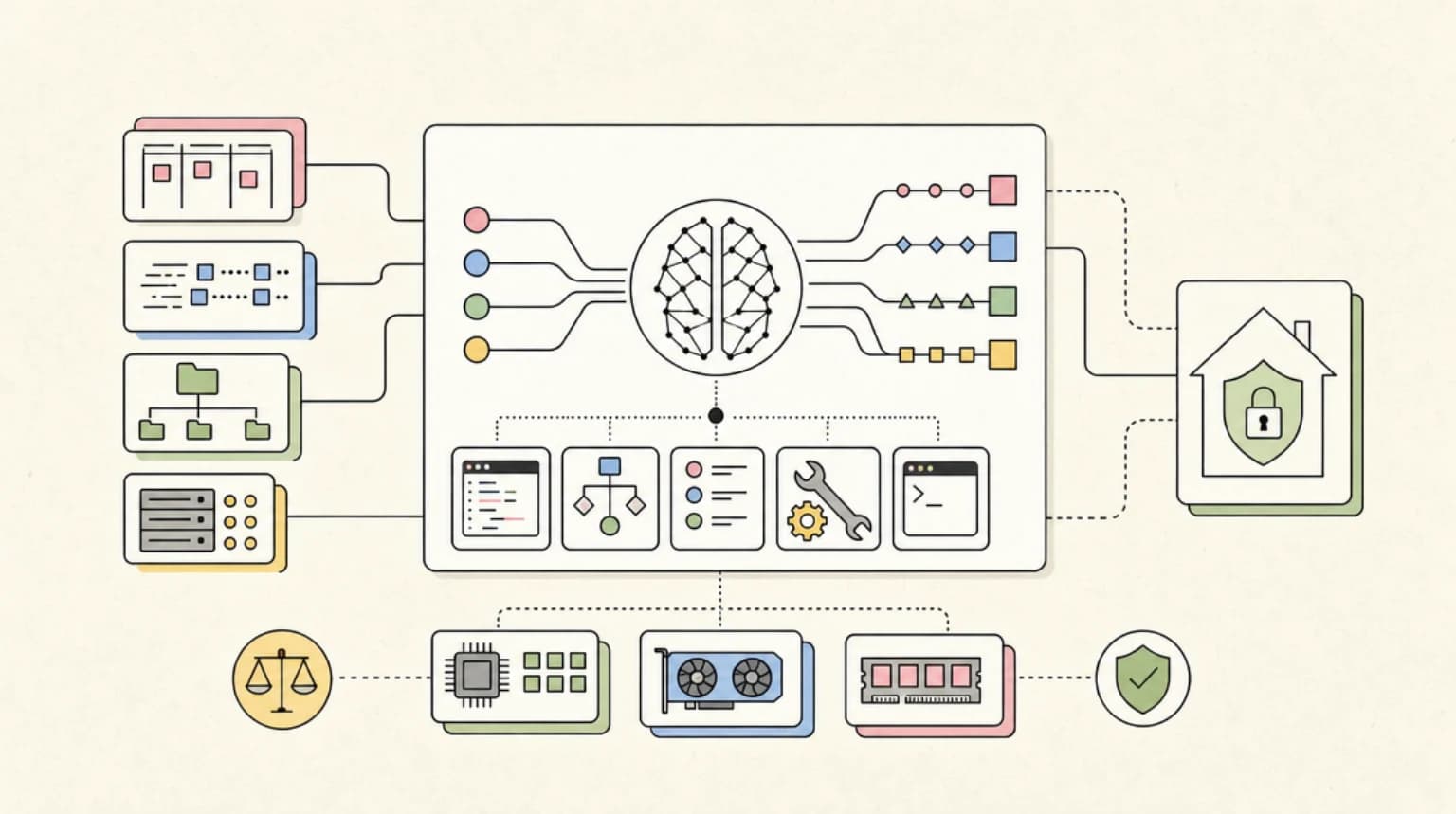
The interesting part is the post-training. Liquid AI describes four stages: two rounds of supervised fine-tuning weighted toward tool use, web search, and harness trajectories; per-domain teacher specialization trained with RL on verifiable rewards; multi-domain on-policy distillation (MOPD), where the student rolls out under its own policy and routed teachers give token-level feedback; and finally agentic RL. That last stage runs GRPO with an outcome-based reward combining an LLM-as-a-judge rubric, programmatic checks, and a hard safety gate, inside real harnesses like Hermes Agent and OpenClaw. A harness proxy captures token-level trajectories from those black-box environments, with consistency checks and a rollout routing replay pass to validate the training samples.
The Benchmarks#
Liquid AI evaluated LFM2.5-2.6B against models up to nearly four times its size: gemma-4-E2B-it (5.1B), gemma-4-E4B-it (8B), Qwen3.5-4B (4.7B), and Qwen3.5-9B (9.7B). Vendor numbers:
| Benchmark | LFM2.5-2.6B | gemma-4 E4B (8B) | Qwen3.5-9B |
|---|---|---|---|
| IFBench | 59.17 | 39.24 | 56.47 |
| Multi-IF | 80.07 | 77.35 | 62.55 |
| IFStruct | 85.49 | 76.65 | 78.50 |
| ToolSandbox | 77.83 | 65.00 | 76.44 |
| BFCLv4 | 56.88 | 46.39 | 60.13 |
| t3-Bench Banking | 5.67 | 4.12 | 5.15 |
| Claw-Eval (EN) | 62.85 | 58.02 | 66.53 |
| AIME25 | 51.87 | 34.27 | 56.07 |
| LiveCodeBench v6 | 59.41 | 63.77 | 69.86 |
The pattern is consistent with the training story: LFM2.5-2.6B leads every instruction-following benchmark here, and every tool-use benchmark except BFCLv4, where only the 9.7B Qwen edges ahead. On agentic tasks it beats both Gemma models and trades evenly with the Qwens. Coding is the one place larger models keep a clear lead, so for code-heavy agent work you would still reach for a bigger model. These are vendor-published numbers, evaluated with vLLM and the generation parameters stated in the post's footnote, so treat them as vendor claims rather than independent measurements.
Python
from transformers import AutoModelForCausalLM, AutoTokenizer

model_id = "LiquidAI/LFM2.5-2.6B"
model = AutoModelForCausalLM.from_pretrained(model_id, device_map="auto", dtype="bfloat16")
tokenizer = AutoTokenizer.from_pretrained(model_id)
From the archive
Next.js 16.3 Is Out: Instant Navigations, 90% Less Dev Memory, and Versioned Docs for AI Agents
Aug 5, 2026 • 7 min read
The Harness Is the New Cost Lever: Databricks' Benchmark and Pi's Context Discipline
Aug 5, 2026 • 6 min read
Prime Agent: A Self-Improving Coding Harness Where Everything Is Python
Aug 5, 2026 • 22 min read
The v0 API Is GA: Vercel Just Made Its App-Building Agent a Headless Service
Aug 5, 2026 • 6 min read
Serving and Speed#
Day-one support covers llama.cpp (GGUF), MLX, vLLM, SGLang, and ONNX. On GPU, Liquid AI measured nearly 15K output tokens/s at high concurrency on a single H100, roughly 1.3 billion tokens per day. On CPU, 113 tokens/s on a Ryzen laptop means a multi-step agent task that generates a few thousand tokens completes in seconds.
The setup path is an OpenAI-compatible endpoint plus a harness: serve the model locally, then point a harness at it. Liquid AI's docs cover Hermes Agent, OpenClaw, and Pi, and a WebGPU space on Hugging Face runs a research agent fully in the browser. Try that demo first: it is the fastest way to judge whether a 2.6B model suits your workload.
Can You Run It in OpenCode?#
Not yet. LFM2.5-2.6B is not in OpenCode's model registry, so there is no one-line opencode run --model path. The vendor route is the OpenAI-compatible endpoint: serve it with vLLM or llama.cpp, then configure it as a custom provider in OpenCode. If you are already on OpenCode, the closest first-party option remains DeepSeek V4 Flash for agent-heavy coding work, while LFM2.5-2.6B earns its place on the local/on-device lane.
Why It Matters#
The economics are the point. When a capable agent model runs locally, the marginal cost of an extra agent turn drops to zero, which changes what you run: background agents that churn through millions of tokens, parallel workers on the same machine, and private workloads that never leave the device. Our local LLM guide laid out the 2026 tradeoff between benchmark performance, hardware cost, and keeping code off third-party servers; this release moves the on-device lane forward on the agentic axis specifically, because it was trained inside real agent harnesses rather than on static chat data.
Two caveats keep it honest. First, coding ability is the weak spot at this size, so it is an agent model for research, writing, tool orchestration, and document workflows, not a code assistant. Second, the $10M revenue threshold in the license means a company above that line needs a commercial agreement, which matters for startups that grow into it.
Continue Reading#
- The Best Local Coding LLMs in 2026 - how on-device models compare for real workloads
- GLM 5.2 on a Slow Computer: Local Inference - what local inference actually costs in practice
- GLM 5.2 vs DeepSeek V4 vs Qwen3: Open Weights Coding Showdown - where the bigger open-weights models stand
- DeepSeek V4 Flash 0731: Release and OpenCode Guide - the agent-benchmark leader you can run today
- What Is an AI Coding Agent in 2026 - how harnesses and models fit together
- LFM2.5-VL-3B: Liquid AI''s 3B Vision Model Reads Screens, Grounds Objects, and Calls Tools on a Laptop
Sources#
- Liquid AI: LFM2.5-2.6B: Deploy Agents Everywhere - fetched August 5, 2026
- Hugging Face: LFM2.5-2.6B model card - fetched August 5, 2026
- Hugging Face: LFM2.5-2.6B LICENSE (LFM Open License v1.0) - fetched August 5, 2026
- Hugging Face blog: Deploy local agents everywhere with LFM2.5-2.6B - fetched August 5, 2026
- Liquid AI docs: agent harnesses guide
Read next
The Best Local Coding LLMs in 2026: Run Enterprise-Grade AI Without the Cloud
Choosing a local coding LLM in 2026 means balancing benchmark performance, hardware cost, and the compliance pressure to keep code off third-party servers. Here is what to run and on what hardware.
8 min readColibri: Running GLM 5.2 on a 32GB Laptop with Disk Streaming and Expert Offloading
A solo developer built a 1,300-line C inference engine that runs the 744B GLM 5.2 model on consumer hardware by streaming routed experts from disk. Here's how it works.
6 min readGLM-5.2 vs DeepSeek V4 vs Qwen3: The Open-Weights Coding Model Showdown (2026)
A data-rich, source-cited comparison of the open-weights coding models that matter in 2026: GLM-5.2, DeepSeek V4, Qwen3, and the new Kimi K3 frontier entrant. Benchmark table, per-token pricing, context windows, self-host footprint, and a clear pick-X-if decision matrix.
14 min readShare
Developers Digest
Technical content at the intersection of AI and development. Building with AI agents, Claude Code, and modern dev tools - then showing you exactly how it works.
300+ videos30K+ GitHub stars850+ articles
Related Tools
AI Coding

Droid
Factory AI's terminal coding agent. Runs Anthropic and OpenAI models in one subscription. Handles full tasks end-to-end...
View ToolAI Models

ChatGPT
OpenAI's flagship. GPT-4o for general use, o3 for reasoning, Codex for coding. 300M+ weekly users. Tasks, agents, web br...
View ToolAI Coding

Codex CLI
OpenAI's open-source terminal coding agent built in Rust. Runs locally, reads your repo, edits files, and executes comma...
View ToolAI CodingAgent
OpenAI Codex
OpenAI's coding agent for terminal, cloud, IDE, GitHub, Slack, and Linear workflows. Reads repos, edits files, runs comm...
View ToolApps from Developers Digest
Related Guides
Guide
Run AI Models Locally with Ollama and LM Studio
Install Ollama and LM Studio, pull your first model, and run AI locally for coding, chat, and automation - with zero cloud dependency.
Getting StartedGuide
Subagent Frontmatter - Claude Code
Configure model, tools, MCP, skills, memory, and scoping.
Claude CodeGuide
Getting Started with DevDigest CLI
Install the dd CLI and scaffold your first AI-powered app in under a minute.
Getting StartedRelated Videos
TRAE: Custom AI Agents That Actually Understand Your Codebase
Check out Trae here! https://tinyurl.com/2f8rw4vm In this video, we dive into @Trae_ai a newly launched AI IDE packed with innovative features. I provide a comprehensive demonstration...
Video·

Buzz: Open-Source Collaboration for Humans + AI Agents
Buzz by Block: Open-Source Slack-Style Collaboration for Humans + AI Agents (Demo & Setup) Check out Arcade: https://arcade.dev.plug.dev/xiDRwlA Repo: https://github.com/block/buzz The video introd...
Video·

Agents 101: How to Build and Deploy Anything with AI Agents
Build Anything with Vercel, the Agentic Infrastructure Stack Check out Vercel: https://vercel.plug.dev/cwBLgfW The video shows a behind-the-scenes walkthrough of how the creator rapidly builds and d...
Video·
Related Posts
8 min read
local llm
The Best Local Coding LLMs in 2026: Run Enterprise-Grade AI Without the Cloud
Choosing a local coding LLM in 2026 means balancing benchmark performance, hardware cost, and the compliance pressure to...
6 min read
News
Colibri: Running GLM 5.2 on a 32GB Laptop with Disk Streaming and Expert Offloading
A solo developer built a 1,300-line C inference engine that runs the 744B GLM 5.2 model on consumer hardware by streamin...
14 min read
open-weights
GLM-5.2 vs DeepSeek V4 vs Qwen3: The Open-Weights Coding Model Showdown (2026)
A data-rich, source-cited comparison of the open-weights coding models that matter in 2026: GLM-5.2, DeepSeek V4, Qwen3,...

7 min read
deepseek
DeepSeek V4 Flash 0731: The Official Release, Benchmarks, and How to Run It in OpenCode
DeepSeek shipped the official V4 Flash release on July 31, 2026. The re-post-trained 0731 build beats V4-Pro-Preview on...
13 min read
AI Agents
What Is an AI Coding Agent? The Complete 2026 Guide
Autocomplete wrote the line. Agents write the pull request. The shift from Copilot to Claude Code, Cursor Agent, and Dev...
7 min read
News
LFM2.5-VL-3B: Liquid AI's 3B Vision Model Reads Screens, Grounds Objects, and Calls Tools on a Laptop
Liquid AI released LFM2.5-VL-3B on August 12, 2026: a 3.1B open-weights vision-language model that averages 80.7 on Scre...
Build with the member tools

Get Smarter About AI Dev
New tutorials, open-source projects, and deep dives on coding agents - delivered weekly.
One email per weekReal code, not theoryFree forever