Next.js 16.3 Is Out: Instant Navigations, 90% Less Dev Memory, and Versioned Docs for AI Agents

TL;DR
Next.js 16.3 ships the biggest update since 16.0: opt-in Instant Navigations with partial prefetching, up to 90% less dev-server RAM, cached repeat builds up to 5.5x faster, native Node.js streams for SSR, and an AGENTS.md block that points coding agents at version-matched docs.
On August 3, the Next.js team released 16.3, which they call the biggest update since 16.0 landed last November. The headline is Instant Navigations, an opt-in suite that makes server-rendered apps feel as responsive as client-driven SPAs. But the release is wider than navigation: dev memory drops by up to 90%, repeat builds hit a filesystem cache, SSR uses native Node.js streams, and a version-matched AGENTS.md block now points coding agents at the docs that match your installed version. Here is what actually shipped and what it changes.
What shipped#
Instant Navigations. Two config flags, cacheComponents: true and partialPrefetching: true, switch on the new navigation model. The framework extracts reusable loading shells from any route, so a link click can render something instantly instead of blocking on the server. 'use cache' components can prerender UI into the client before a navigation, which is what makes the SPA-like feel possible without abandoning server rendering. Four tools support the model: Instant Insights, a devtools panel that surfaces any navigation that is not instant; Partial Prefetching, per-link control over how much of a target page is prefetched; a Navigation Inspector that pauses loads at the shell so you can see the exact loading sequence a user gets; and a Playwright instant() helper that fails a test when content that used to render instantly no longer does. Next.js plans to make these behaviors the default in a future major version, part of its stated direction: dynamic by default, no hidden caching.
Up to 90% less dev memory. Turbopack memory eviction plus disk caching for dev are now enabled by default. The numbers are concrete: vercel.com's dashboard went from 21.5GB to 2GB after compiling 50 routes, and nextjs.org from 4,600MB to 840MB. Long-running next dev sessions with hundreds of routes are the target.
Faster builds. The filesystem cache that sped up dev since 16.1 now applies to next build, enabled by default. Vercel reports 5.5x faster builds on CI in some projects: vercel.com/geist went from 30s cold to 5.5s cached, nextjs.org from 21s to 9.2s.
Native Node.js streams for SSR. The App Router rendering layer replaced web streams with native Node.js streams, removing a conversion step. Benchmarks show up to 22% more requests handled under load, with zero app code changes.
TypeScript 7 support. next build can now use TypeScript 7, the 10x faster native port, for type checking. Bump typescript to ^7 locally and it is picked up during the build.
Versioned docs for AI agents. Running next dev writes and maintains a version-matched AGENTS.md block in the project that points agents at the docs bundled inside node_modules. Agents get the documentation for the exact Next.js version installed, with no setup. Vercel is retiring the earlier Next Skills that existed to bring current docs to apps, and shipping first-party Skills for multi-step workflows, starting with next-dev-loop on skills.sh.
Smaller API surface wins. Custom error boundaries now work through catchError from next/error, with a retry() function that can refetch failed Server Components, and it no longer interferes with notFound or redirect. Root params arrived: next/root-params exposes params like [lang] from any Server Component without prop drilling. Turbopack now supports the Vite-compatible import.meta.glob for loading multiple files with HMR. Prefetch inlining bundles small prefetches into fewer requests, and immutable static assets can be reused across deploys without skew.
From the archive
The Harness Is the New Cost Lever: Databricks' Benchmark and Pi's Context Discipline
Aug 5, 2026 • 6 min read
Prime Agent: A Self-Improving Coding Harness Where Everything Is Python
Aug 5, 2026 • 22 min read
The v0 API Is GA: Vercel Just Made Its App-Building Agent a Headless Service
Aug 5, 2026 • 6 min read
Cloudflare's Agent Development Lifecycle: The ADLC Is Now a Platform Bet
Aug 4, 2026 • 7 min read
Why it matters for developers#
Three of these changes land with zero app-code changes: the memory cut, the build cache, and native streams. That makes 16.3 an upgrade-mostly-for-free release, and the perf numbers are measured, not vibes. 90% less dev RAM changes which laptops can run large Next.js projects, and a 5.5x CI build cache changes how often you can afford to run a build.
The Instant Navigations direction matters more than any single number. Next.js is betting that explicit, composable caching with 'use cache' plus client-side shell caching beats the old implicit cache model. The Playwright instant() helper is the most underrated part: it turns "this navigation used to be fast" into a regression test, which is the only way SPA-like performance survives refactors. And the ISR upgrade is worth calling out for content sites: a URL omitted from generateStaticParams now serves an instant loading shell to the first visitor, then upgrades to the prerendered page in the background.
The AI-agent angle is the one to watch if you use coding agents heavily. An AGENTS.md block that documents the installed version, maintained automatically by next dev, is a direct answer to the drift problem where agents read docs for the wrong Next.js version. It slots into the same pattern as the repo's own agent setup: the config file is part of the supply chain an agent reads first, so keeping it version-accurate matters. TypeScript 7 support also compounds for agents, since typechecking becomes fast enough to run on every agent edit.
How it fits the ecosystem#
The Rust-based React Compiler is experimental in 16.3 but worth tracking: it runs inside Turbopack instead of through Babel, and v0.app saw 34% faster cold and 46% faster warm time-to-ready-page. That is the same direction as the compiled-framework wave, just inside the mainstream framework. On Vercel specifically, 16.3 support is already live: upgraded apps see 45% fewer prefetch requests on average, 17% fewer CDN requests and 24% fewer bytes for static content, up to 60% lower global TTFB for frequently deployed projects, and a route-metadata layer about 2x faster at p99 with 10x fewer cache misses. PPR observability also launched, showing which requests serve static shells, dynamic content, or both.
Continue Reading#
- Astro vs Next.js 16 in 2026 - how the 16.x rewrite changes the framework comparison
- The AI App Stack on Next.js in 2026 - where Next.js sits in a modern agent-era stack
- Octane: The React Compiled Framework - compile-time React, the direction 16.3's Rust compiler points at
- Everything Vercel Shipped at Ship 26 - the platform's agent-era tooling wave
- Agent Config Files Are Executable Supply Chain - why the version-matched AGENTS.md block matters
- Kombai: AI That Beats Claude and Gemini on Front-End Tasks
Sources#
- Next.js 16.3 announcement - nextjs.org, August 3, 2026
- Vercel supports Next.js 16.3 - Vercel Blog, August 4, 2026
- Next.js 16.3: Instant Navigations - nextjs.org, July 2026
- Setting up Next.js for AI coding agents - Next.js docs
- Turbopack memory eviction - Next.js docs
Read next
Astro vs Next.js 16: Which to Choose in 2026
Astro 5 ships 0-15KB of JavaScript per page. Next.js 16 ships 85-250KB. Here is the honest 2026 breakdown of when each framework wins, with real config examples.
12 min readThe Next.js AI App Stack for 2026
The definitive full-stack setup for building AI-powered apps in 2026. Next.js 16, Vercel AI SDK, Convex, Clerk, and Tailwind - why each piece matters and how they fit together.
12 min readOctane: Inferno's Successor Compiles React's Programming Model Ahead of Time
Octane is a new MIT-licensed UI framework from Inferno's creator that compiles React-style hooks, Suspense, and actions to direct DOM code. No virtual DOM, no rules of hooks, no hand-maintained dependency arrays. Here is what shipped, the benchmark grid, and what it means for teams and AI agents.
7 min readShare
Developers Digest
Technical content at the intersection of AI and development. Building with AI agents, Claude Code, and modern dev tools - then showing you exactly how it works.
300+ videos30K+ GitHub stars850+ articles
Related Tools
InfrastructurePopular

Vercel
Deployment platform behind Next.js. Git push to deploy. Edge functions, image optimization, analytics. Free tier is gene...
View ToolInfrastructure

Next.js
The React meta-framework. App Router, Server Components, Server Actions, file-based routing, and first-class deployment...
View ToolAI FrameworksEssential
Vercel AI SDK
The TypeScript toolkit for building AI apps. Unified API across OpenAI, Anthropic, Google. Streaming, tool calling, stru...
View ToolAI FrameworksAgent UI

CopilotKit
Frontend stack for agent-native apps. React hooks, prebuilt copilot UI, AG-UI runtime, frontend tools, shared state, and...
View ToolRelated Guides
Guide
Claude Code Setup Guide
Configure Claude Code for maximum productivity -- CLAUDE.md, sub-agents, MCP servers, and autonomous workflows.
AI AgentsGuide
MCP Servers Explained
What MCP servers are, how they work, and how to build your own in 5 minutes.
AI AgentsGuide
Building Your First MCP Server
Step-by-step guide to building an MCP server in TypeScript - from project setup to tool definitions, resource handling, testing, and deployment.
AI AgentsRelated Videos

Build an AI Device with Groq, Llama 3, OpenAI, TTS, Whisper, Vision, Vercel AI SDK & Next.js
Repo: https://git.new/ai-pin Building an AI Assistant similar to the Humane AI Pin, the Rabbit R1 with Advanced Functionality from Scratch This video details the process of creating an AI...
Video·

Build a Next.JS Answer Engine with Vercel AI SDK, Groq, Mistral, Langchain, OpenAI, Brave & Serper
Building a Perplexity Style LLM Answer Engine: Frontend to Backend Tutorial This tutorial guides viewers through the process of building a Perplexity style Large Language Model (LLM) answer...
Video·

ChatHN: Next.JS, OpenAI Functions, Vercel AI SDK
In this video I will show you how to get up and running in just a few minutes with getting a Next.js chatbot that leverages the brand new vercel ai sdk as well as the OpenAI SDK. Huge shout...
Video·
Related Posts
12 min read
Astro
Astro vs Next.js 16: Which to Choose in 2026
Astro 5 ships 0-15KB of JavaScript per page. Next.js 16 ships 85-250KB. Here is the honest 2026 breakdown of when each f...
12 min read
Next.js
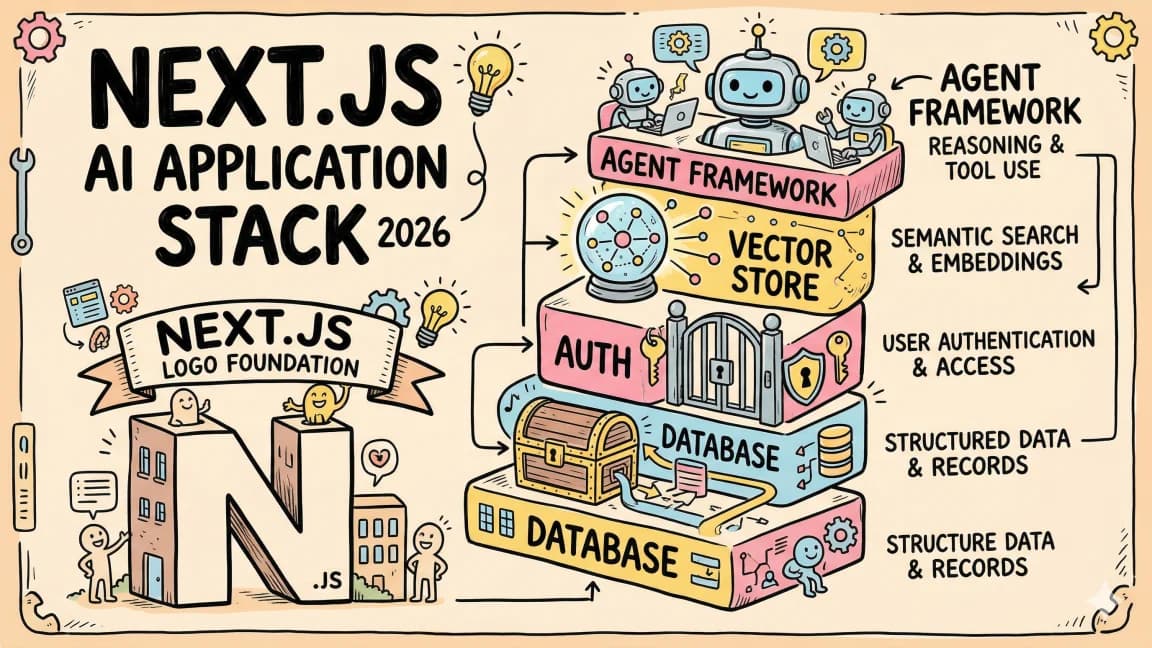
The Next.js AI App Stack for 2026
The definitive full-stack setup for building AI-powered apps in 2026. Next.js 16, Vercel AI SDK, Convex, Clerk, and Tail...
7 min read
News
Octane: Inferno's Successor Compiles React's Programming Model Ahead of Time
Octane is a new MIT-licensed UI framework from Inferno's creator that compiles React-style hooks, Suspense, and actions...

8 min read
Vercel
Everything Vercel Shipped at Ship 26 (June 2026)
At Vercel Ship 26 in London on June 17, 2026, Vercel shipped a wave of agent-era tooling: the open-source eve agent fram...

8 min read
AI Coding
Agent Config Files Are Executable Supply Chain
A Hacker News thread on config files that run code points at the next AI coding risk: agent hooks, skills, and editor ru...

6 min read
News
Vercel Sandbox Gets a Real Network Boundary: Why Egress Control Is the Missing Half of Agent Security
Vercel Sandbox now polices all outbound traffic on the host, outside the microVM, with SNI-based domain policies, CIDR r...
Build with the member tools

Get Smarter About AI Dev
New tutorials, open-source projects, and deep dives on coding agents - delivered weekly.
One email per weekReal code, not theoryFree forever