GitHub Malware Advisories Now Cover Eight Package Ecosystems

TL;DR
Dependabot's malware detection expands from npm to PyPI, Maven, RubyGems, NuGet, Go, crates.io, and PHP Composer by ingesting OpenSSF's malicious-packages data into the GitHub Advisory Database.
GitHub has expanded its malware advisory coverage from npm to all eight major package ecosystems. The GitHub Advisory Database now ingests reports from OpenSSF's malicious-packages repository, which means Dependabot malware alerts now cover npm, PyPI, Maven, RubyGems, NuGet, Go, crates.io, and PHP Composer. This is the first time an auto-published advisory can trigger a Dependabot alert.
What Changed#
Until now, GitHub's malware detection was npm-only. It ran through a separate, internal path built around GitHub's own detection of malicious npm packages, and Dependabot started flagging that malware in March 2026. Expanding that detection to eight ecosystems by building eight detection systems would have taken years, so the team built one importer instead.
The importer follows the same pattern as GitHub's existing repo-based advisory importers (RubySec for gems, RustSec for crates, PyPA for Python): walk the source repository's file tree, pick up files changed since the last run, and process each one. The new source is OpenSSF's malicious-packages repo, which launched in 2023 with over 15,000 reports in OSV format and has grown every day since, fed by community submissions and automated detection across the industry: typosquats, dependency-confusion packages, account takeovers, and malicious prebuilt binaries.
Before anything touches the database, each record is validated against the OSV schema. A record that fails validation is rejected and logged, not quietly patched up, because a "mostly valid" malware advisory is exactly the kind of thing that bites six months later.
The Hard Part Is the Data, Not the Format#
The interesting engineering is in normalization. Upstream ecosystem strings do not always match GitHub's (the repo says PyPI, the database says pip). OSV records list affected versions as discrete values where the Advisory Database thinks in ranges, and some records name no usable version at all. The details field is frequently empty, and when several sources report the same package, their write-ups get appended into one blob.
Reports also get retracted. The repo keeps an osv/withdrawn folder for advisories that turned out to be wrong, so the importer has to cope with a package being flagged on Monday and disavowed on Wednesday.
Then there is the round-trip problem. GitHub is itself a contributor to the OpenSSF repo: its own npm malware advisories flow upstream. A naive import would re-import GitHub's own data in a loop. The fix rides on OSV origin metadata: anything tagged ghsa-malware began with GitHub and is dropped before a feed entry is created. In live validation, more than half of the new npm reports flowing into the repo each month traced back to GitHub's own advisories and were skipped, so the importer picks up what GitHub genuinely did not know about.
From the archive
Meta Ships Muse Code and Muse Spark 1.2: A Terminal Agent With a 12x Cheaper Contributor Tier
Aug 6, 2026 • 7 min read
OpenAI Retunes GPT-5.6 Sol in ChatGPT and Makes Luna the Free Tier Default
Aug 6, 2026 • 7 min read
SkillSV: A Shapley Framework That Values the Lines Inside an Agent Skill
Aug 6, 2026 • 8 min read
The Plateau Was the Instrument
Aug 6, 2026 • 10 min read
Auto-Publish With Three Safety Layers#
One question dominated the security review: what happens if the upstream data goes bad? Malware advisories auto-publish with no human reading each one, and that is deliberate: when a package is stealing credentials right now, a review queue measured in days is a gift to the attacker. The report is close to binary (this package is hostile), and hours matter more than nuance.
Against that risk, the pipeline has three layers of protection:
- Batch caps. Each import run has a configurable ceiling on how many advisories it may create. Blow past it and the run does not trim to fit, it halts completely, publishes nothing, and pages the team with the exact count.
- Provenance. Every imported advisory traces back to the exact upstream commit in the malicious-packages repo, so during an incident the team can tell in minutes whether a bad advisory came from a legitimate but wrong upstream report or something more deliberate.
- Rollback. If a poisoned batch lands anyway, every batch is identifiable and revertible as a unit. One rollback, clean slate.
What This Means for You#
Malware alerts are opt-in. Enable them in your repository, organization, or enterprise security settings, and Dependabot matches your dependencies against malware advisories in the Advisory Database, including a backfill against existing advisories starting the moment you turn it on. For context on scale: Dependabot watches over 30 million repositories across 34 package ecosystems.
My take: the opt-in requirement is the right call, and the batch-cap design is the most underrated detail in the announcement. Supply-chain alerting systems that auto-publish need a circuit breaker, because a compromised upstream feed is exactly the scenario where the alert channel becomes part of the attack surface. Teams that enable this for PyPI and crates.io specifically close a real gap: Python and Rust supply chains have been the target of repeated malicious-package campaigns this year, and most developers only had npm covered.
How This Fits With the Rest of the Ecosystem#
This lands in a busy stretch for supply-chain security. The Mastra npm attack and the Miasma campaign showed how quickly malicious packages reach production, and the TanStack compromise demonstrated that agent workflows inherit every weak trust boundary in CI. GitHub's move to standardize on OpenSSF's shared data is a step toward the industry consolidating on one malicious-package dataset instead of every registry maintaining its own. The flip side of that consolidation is now explicit: anyone who ingests that feed needs the same provenance, caps, and rollback discipline GitHub just shipped. For agent-heavy teams, the alerting surface is also relevant to how agents handle dependency updates: agent workflows that touch CI and prompt-injection in open source are exactly where a compromised dependency does the most damage.
Continue Reading#
- Mastra npm Supply Chain Attack: What Happened and How to Protect Your AI Stack
- Miasma Supply Chain Attack: What AI Developers Need to Know
- TanStack's npm Compromise Is the CI Lesson Agent Teams Needed
- Reference Same-Repository Actions With Self Repository Syntax
- Why Prompt Injection Is the Supply Chain Problem of AI Development
- GitLost: How Researchers Tricked GitHub's AI Agent Into Leaking Private Repos
Sources#
Read next
Mastra npm Supply Chain Attack: 140+ AI Framework Packages Backdoored
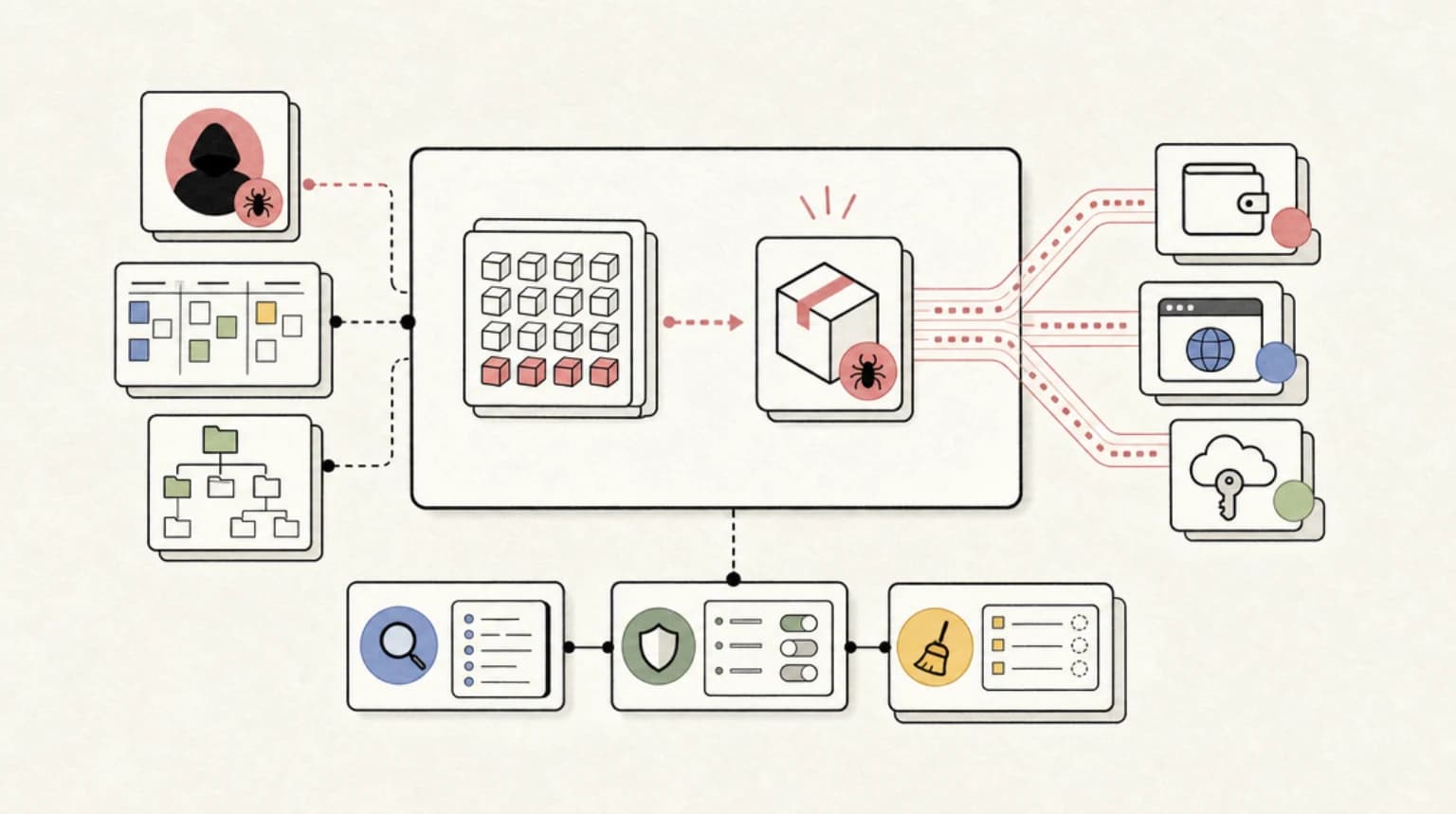
On June 17, 2026, attackers hijacked a dormant Mastra contributor account and pushed malicious versions of 140+ packages. The payload steals crypto wallets, browser data, and cloud credentials. Here is what happened, how to check your lockfile, and what to do if you installed an affected version.
7 min readThe Miasma Worm Is Targeting AI Developers: What You Need to Audit Now
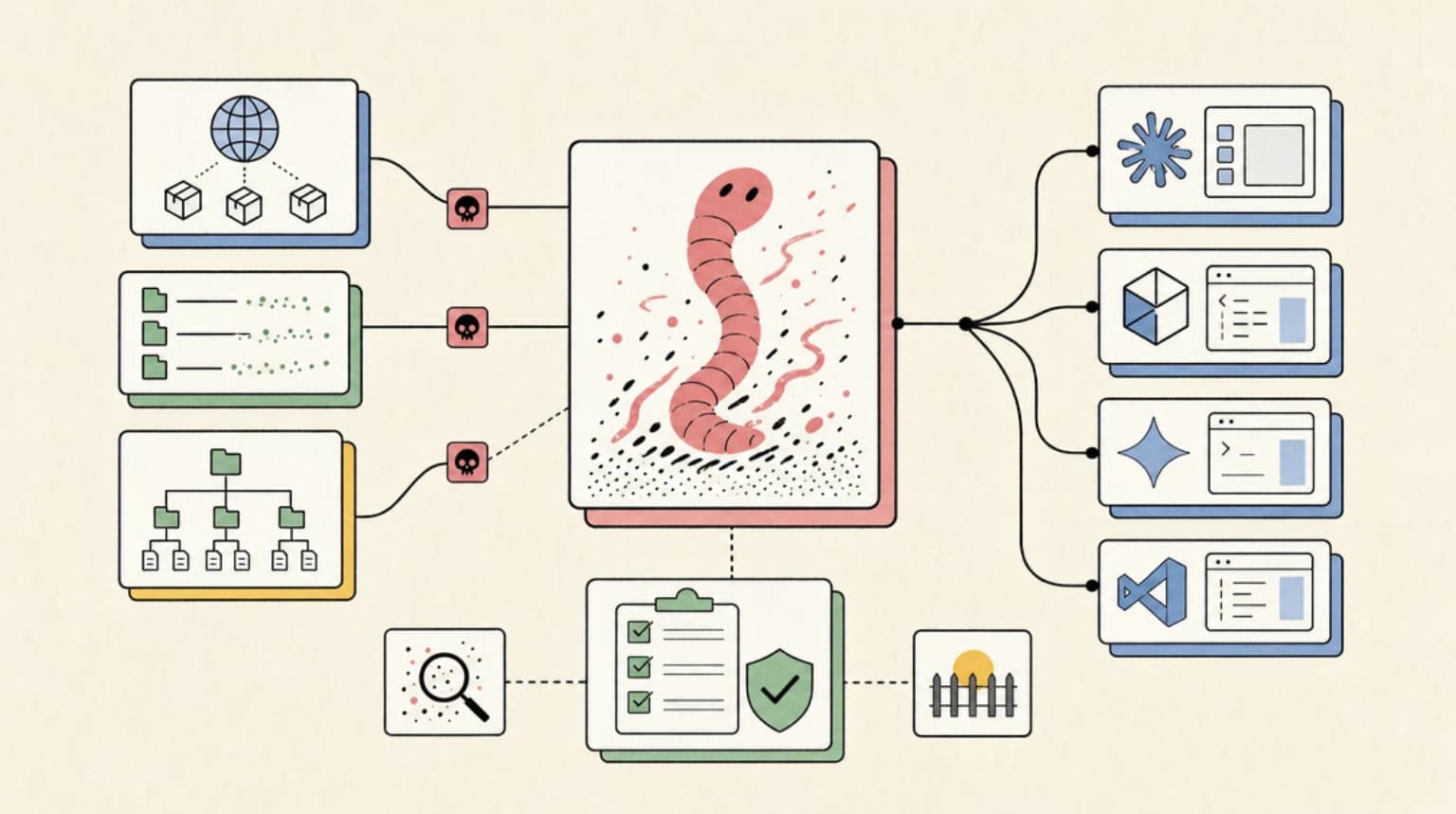
The Miasma worm has evolved from package registry poisoning to directly hijacking AI coding tools - if your team clones open-source repos and opens them in Claude Code, Cursor, Gemini CLI, or VS Code, you may already be compromised.
7 min readTanStack's npm Compromise Is the CI Lesson Agent Teams Needed
The TanStack npm incident was not just a package-security story. It was a reminder that AI agent workflows inherit every weak trust boundary in CI.
9 min readShare
Developers Digest
Technical content at the intersection of AI and development. Building with AI agents, Claude Code, and modern dev tools - then showing you exactly how it works.
300+ videos30K+ GitHub stars850+ articles
Related Tools
AI CodingAgent

OpenAI Codex
OpenAI's coding agent for terminal, cloud, IDE, GitHub, Slack, and Linear workflows. Reads repos, edits files, runs comm...
View ToolAI Coding328K views

GitHub Copilot
The original AI coding assistant. 77M+ developers. Inline completions in VS Code and JetBrains. Copilot Workspace genera...
View ToolAI FrameworksEssential

Vercel AI SDK
The TypeScript toolkit for building AI apps. Unified API across OpenAI, Anthropic, Google. Streaming, tool calling, stru...
View ToolAI Frameworks

LangChain / LangGraph
Most popular LLM framework. 100K+ GitHub stars. Chains, RAG, vector stores, tool use. LangGraph adds stateful multi-agen...
View ToolApps from Developers Digest
SaaS ProductsPopular
Fit
Log workouts, meals, and habits in plain English. Your progress shows up as a GitHub-style heatmap.
View AppSaaS Products
Overnight Agents
Spec out AI agents, run them overnight, wake up to a verified GitHub repo.
View AppDirectories
CLI Directory
Find the right CLI without trawling GitHub. Search, filter, install.
View AppRelated Guides
Guide
gh CLI Integration - Claude Code
Full GitHub CLI support for automated PR and issue workflows.
Claude CodeGuide
Routines (Web) - Claude Code
Managed scheduling on Anthropic infrastructure with API and GitHub triggers.
Claude CodeGuide
Claude Code Complete Course
A complete, citation-backed Claude Code course with setup, prompting systems, MCP, CI, security, cost controls, and capstone workflows.
ai-developmentRelated Videos
GitHub Copilot Spark Launch: New Rival to Cursor + v0? Full Update in 6 Minutes
Learn The Fundamentals Of Becoming An AI Engineer On Scrimba; https://v2.scrimba.com/the-ai-engineer-path-c02v?via=developersdigest Introducing GitHub Spark and Exciting GitHub Copilot Updates!...
Video·
Continue: Incredible Open Source Github Copilot Alternative. Use Groq + Llama-3, Ollama and more
Introducing Continue: The Open Source Alternative to GitHub Copilot for Coding The video introduces 'Continue,' an open source alternative to GitHub Copilot, designed to enhance coding with...
Video·

Google's Duet AI: A New Challenger to GitHub Co-Pilot?
In this video I take a look and demonstration using Duet AI, Google's new coding assistant within VS code. I show a quick example of setting up a making stock chart generator where it will...
Video·
Related Posts
7 min read
security
Mastra npm Supply Chain Attack: 140+ AI Framework Packages Backdoored
On June 17, 2026, attackers hijacked a dormant Mastra contributor account and pushed malicious versions of 140+ packages...
7 min read
Supply Chain Security
The Miasma Worm Is Targeting AI Developers: What You Need to Audit Now
The Miasma worm has evolved from package registry poisoning to directly hijacking AI coding tools - if your team clones...

9 min read
Security
TanStack's npm Compromise Is the CI Lesson Agent Teams Needed
The TanStack npm incident was not just a package-security story. It was a reminder that AI agent workflows inherit every...

6 min read
News
GitHub Actions Self-Repository Syntax: Reference Your Own Actions at the Running Commit
GitHub Actions added a $/ prefix that resolves a same-repository action or reusable workflow at the exact commit being r...

8 min read
AI Security
Open Source Has a Bot Problem: Prompt Injection in Contributing.md
AI coding agents now read repository docs, config, issues, and comments before opening pull requests. That turns CONTRIB...

8 min read
News
arrayref 0.3.10 Ran a Remote Payload at Build Time
On August 20, 2026, compromised arrayref 0.3.10 pulled in a proc-macro1 typosquat whose build script fetched a remote bi...
Build with the member tools

Get Smarter About AI Dev
New tutorials, open-source projects, and deep dives on coding agents - delivered weekly.
One email per weekReal code, not theoryFree forever