TanStack's npm Compromise Is the CI Lesson Agent Teams Needed
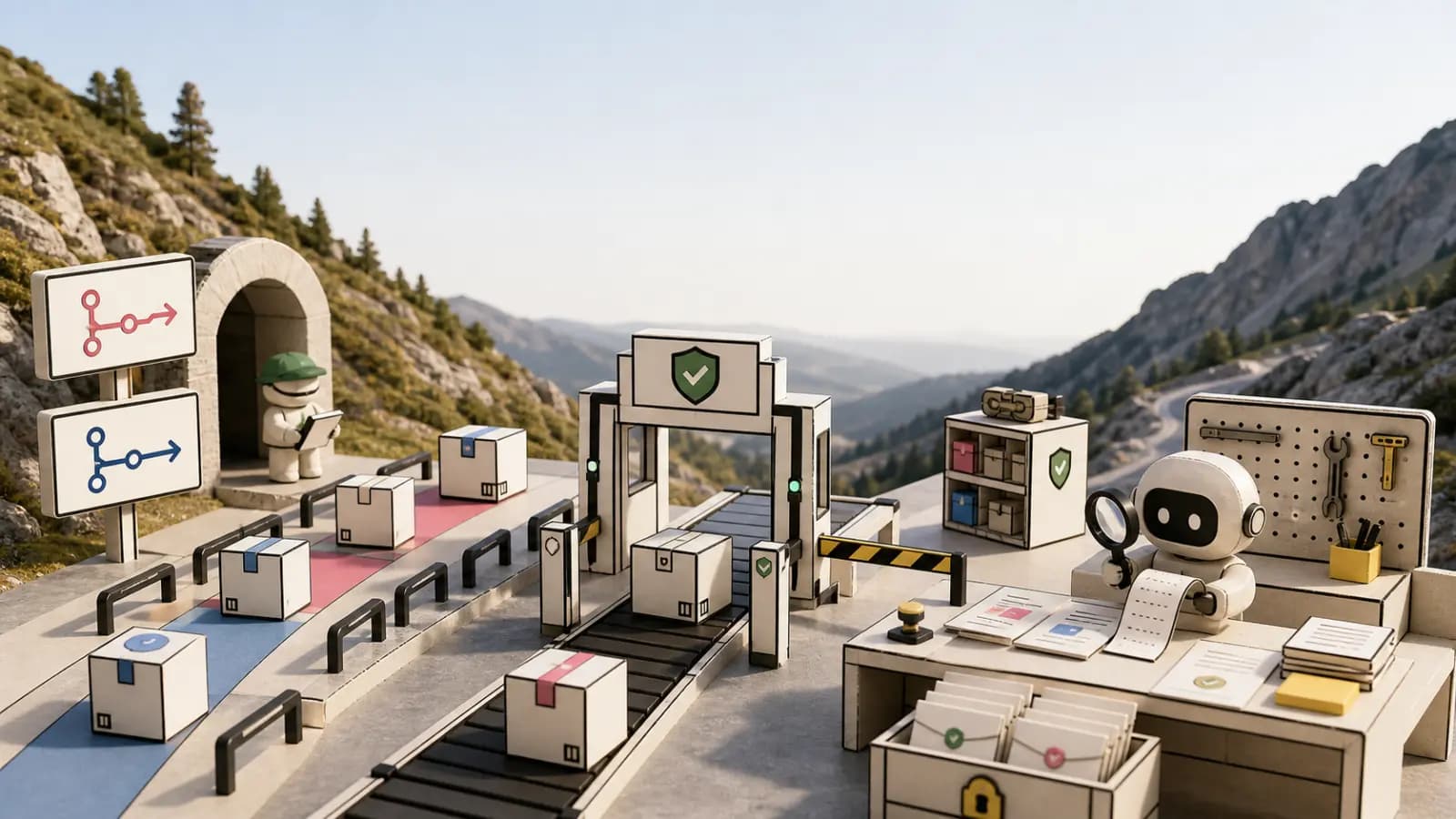
TL;DR
The TanStack npm incident was not just a package-security story. It was a reminder that AI agent workflows inherit every weak trust boundary in CI.
TanStack's May 11 npm postmortem is the kind of incident AI-heavy engineering teams should read slowly. The headline was a serious supply-chain compromise: malicious versions were published across dozens of @tanstack/* packages after an attacker chained GitHub Actions behavior, cache poisoning, and OIDC token extraction. The durable lesson is broader than TanStack.
If you are letting agents open pull requests, edit workflow files, run CI, or prepare releases, your agent program is now coupled to your CI trust model.
That is the same operational theme behind prompt injection in open source, agent receipts, and long-running agent harnesses. Agent output is not safe because the diff looks small. It is safe when the workflow around the diff has the right boundaries.
What Happened#
TanStack says the attacker chained three important primitives:
- a
pull_request_targetworkflow path that crossed the fork and base-repository trust boundary; - GitHub Actions cache poisoning across that boundary;
- OIDC token extraction from runner memory, which enabled npm publishing.
The exact details matter, but the pattern matters more: a CI workflow treated untrusted pull request context as if it could safely influence trusted release machinery.
That is the part agent teams should underline. Agents do not invent new categories of infrastructure risk every time. They amplify the old ones by increasing the number of PRs, workflow edits, dependency updates, and release-adjacent tasks moving through the system.
Why This Hits Agent Workflows Differently#
Classic CI security assumes human developers are the primary authors of risky changes. AI coding agents change the volume and shape of that work.
A team that runs Codex loops, Claude Code subagents, or GitHub-hosted coding agents will naturally delegate chores like:
- dependency refreshes;
- test fixture updates;
- workflow cleanups;
- release note generation;
- package publishing checks;
- flaky CI repair.
Those tasks feel boring, which is exactly why they get delegated. But boring does not mean low privilege. A one-line workflow change can matter more than a 2,000-line application diff.
The dangerous failure mode is not "the agent wrote bad TypeScript." It is "the agent made a plausible CI change that lets untrusted code reach a trusted credential boundary."
The Real Boundary Is Not Human vs AI#
The easy take is to say "do not let AI touch CI." That is too blunt.
The better boundary is trusted vs untrusted execution. A human can make the same mistake. An agent can make the same mistake faster. The fix is to design the release system so neither can accidentally turn a fork PR into a credentialed publish path.
For agent teams, that means release automation should be split into layers:
- Untrusted validation: test the proposed change without secrets and without publish rights.
- Reviewable artifact creation: build packages, diffs, previews, and SBOMs as artifacts.
- Trusted promotion: publish only from protected branches, protected environments, or manually approved release jobs.
- Receipt capture: record exactly which commit, workflow, token audience, package version, and actor performed the release.
That last point is where agent operations and security converge. A good agent FinOps system tells you what the agent spent. A good agent security system tells you what authority the agent touched.
From the archive
Codebase Graphs Are the New Agent Map
May 10, 2026 • 8 min read
Ruflo Is an Agent Meta-Harness. Treat the Star Count as a Warning Label.
May 10, 2026 • 8 min read
Claude Managed Agents Are Starting to Look Like Backend Jobs
May 9, 2026 • 9 min read
Agent-Native Backends Are the Next AI Coding Bottleneck
May 8, 2026 • 8 min read
pull_request_target Needs a Higher Bar#
pull_request_target exists for real reasons. It can run with base-repository context, which is useful for labels, comments, and some automation around external contributions.
But any workflow that combines pull_request_target, untrusted checkout behavior, caches, generated scripts, install steps, or release credentials deserves a hard review. This is not an agent-specific rule. It is a GitHub Actions trust-boundary rule.
Agent teams should make it explicit:
- agents may comment on external PRs;
- agents may summarize CI and review state;
- agents may propose workflow changes in a normal PR;
- agents may not create or modify credentialed publish paths without human review;
- agents may not merge changes that alter release credentials, OIDC audiences, package permissions, or protected environment rules.
That sounds bureaucratic until you compare it with the blast radius of a compromised package.
The Agent Review Checklist Should Include CI Authority#
Most AI code review checklists focus on code quality:
- Does it compile?
- Are tests passing?
- Is the implementation too broad?
- Did the agent delete something important?
After this incident, agent review needs an authority section too.
Ask these questions for every agent-authored PR that touches CI, dependencies, package publishing, install scripts, or repository settings:
- Does this change alter when secrets are available?
- Does it run untrusted code before a credentialed step?
- Does it restore caches across trust boundaries?
- Does it make package publishing easier without adding an approval gate?
- Does it change token permissions from read to write?
- Does it add dynamic script execution in a privileged job?
- Does it rely on labels, branch names, or filenames as a security control?
This is the same discipline as agent bugs moving up the stack. The bug is often not a bad line of code. It is a bad operating assumption.
Opposing View: This Is Just CI Security#
The opposing take is reasonable: TanStack's postmortem is about GitHub Actions and npm publishing, not AI agents. You do not need to mention agents to understand the vulnerability class.
That is true. The root cause lives in CI and release engineering.
But AI changes the exposure surface. More teams are now asking agents to maintain the exact files that define CI trust boundaries. More teams are also running background loops that wake up, inspect GitHub state, and push small changes without the same attention a senior engineer would give a release workflow.
So the agent angle is not "AI caused this." The agent angle is "agent adoption makes this category of mistake easier to repeat at scale."
The Practical Policy#
Here is the policy I would put into an agent runbook:
TXT
Agents may propose CI and release changes.
Agents may not merge or execute credential-affecting CI changes.
Any change touching package publishing, OIDC, secrets, environments, workflow permissions, caches, or pull_request_target requires human review.
Trusted publish jobs must run from protected branches or protected environments only.
Every release job must emit a receipt: commit, package, version, workflow, actor, token audience, and artifact hash.
That is not anti-agent. It is how you make agents boring enough to use.
What To Measure Next#
If your team is already running coding agents, track these metrics:
- agent-authored PRs that touch
.github/workflows; - agent-authored dependency and lockfile PRs;
- workflows that use
pull_request_target; - workflows with
id-token: write; - publish jobs without protected environment approval;
- release jobs that consume caches built from untrusted PR context;
- mean time from package publish to rollback.
Those numbers will tell you whether your agent system is increasing release risk or just increasing normal application throughput.
The Takeaway#
TanStack's incident should not make teams stop using agents. It should make teams stop treating CI as background plumbing.
AI agents inherit your trust boundaries. If those boundaries are fuzzy, agents will make the fuzziness visible. If the boundaries are explicit, agents can work inside them productively.
The next mature agent platform will not only generate code. It will understand workflow authority, ask for escalation before touching release paths, and leave receipts that make supply-chain review boring.
That is where this category has to go.
FAQ#
Was the TanStack incident caused by AI?#
No. TanStack's public postmortem describes a GitHub Actions and npm supply-chain compromise. The AI lesson is that coding-agent workflows often touch the same CI and release files, so teams need stronger trust-boundary policies before delegating those chores.
Should agents be banned from editing CI files?#
Not completely. Agents can propose CI changes, summarize workflows, and open reviewable PRs. They should not merge or execute changes that affect secrets, OIDC, package publishing, protected environments, or trusted release jobs without human approval.
What is the safest first agent security control?#
Start by blocking autonomous changes to .github/workflows, package publishing configuration, and repository secrets. Then add a review checklist for credential boundaries, cache behavior, OIDC token use, and protected environment rules.
Sources: TanStack npm supply-chain compromise postmortem, Hacker News discussion, GitHub Actions pull_request_target documentation, GitHub Actions OIDC hardening guide, npm package provenance documentation.
Continue Reading#
Read next
Agent Sandbox Architecture: How to Choose the Right Runtime Boundary
AI agents are getting their own computers. Here is how to choose a sandbox architecture: filesystem isolation, network policy, secrets boundaries, snapshots, and when shell access is overkill.
8 min readThe Agent Security Checklist I Use Before Connecting Tools
Before an AI agent gets tools, files, APIs, MCP servers, or deployment access, decide what it can read, write, call, log, and roll back.
8 min readSandboxed Agents Are Becoming the Team Control Plane
Runtime's Launch HN thread is a useful signal: teams do not just want isolated coding agents. They want a control plane for approvals, secrets, telemetry, review, and merge policy.
8 min readShare
Developers Digest
Technical content at the intersection of AI and development. Building with AI agents, Claude Code, and modern dev tools - then showing you exactly how it works.
300+ videos30K+ GitHub stars850+ articles
Related Tools
InfrastructureOpen source

E2B
Open-source cloud sandboxes for AI agents. Isolated environments that start in under 200ms, run code in Python, JavaScri...
View ToolAI Coding

Replit Agent
Full-stack AI dev environment in the browser. Describe an app, get a deployed project with database, auth, and hosting....
View ToolAI Frameworks
C
Composio
Gives AI agents access to 250+ external tools (GitHub, Slack, Gmail, databases) with managed OAuth. Handles the auth and...
View ToolAI Frameworks

OpenAI Agents SDK
Lightweight Python framework for multi-agent systems. Agent handoffs, tool use, guardrails, tracing. Successor to the ex...
View ToolApps from Developers Digest
Related Guides
Guide
Agent Teams - Claude Code
Coordinate multiple Claude Code instances with a shared task list.
Claude CodeGuide
Subagent Definitions as Teammates - Claude Code
Reuse custom subagent types as Agent Teams members.
Claude CodeGuide
Claude Code Setup Guide
Configure Claude Code for maximum productivity -- CLAUDE.md, sub-agents, MCP servers, and autonomous workflows.
AI AgentsRelated Videos

Buzz: Open-Source Collaboration for Humans + AI Agents
Buzz by Block: Open-Source Slack-Style Collaboration for Humans + AI Agents (Demo & Setup) Check out Arcade: https://arcade.dev.plug.dev/xiDRwlA Repo: https://github.com/block/buzz The video introd...
Video·

Agents 101: How to Build and Deploy Anything with AI Agents
Build Anything with Vercel, the Agentic Infrastructure Stack Check out Vercel: https://vercel.plug.dev/cwBLgfW The video shows a behind-the-scenes walkthrough of how the creator rapidly builds and d...
Video·
TRAE: Custom AI Agents That Actually Understand Your Codebase
Check out Trae here! https://tinyurl.com/2f8rw4vm In this video, we dive into @Trae_ai a newly launched AI IDE packed with innovative features. I provide a comprehensive demonstration...
Video·
Related Posts
8 min read
AI Agents
Agent Sandbox Architecture: How to Choose the Right Runtime Boundary
AI agents are getting their own computers. Here is how to choose a sandbox architecture: filesystem isolation, network p...
8 min read
AI Agents
AI Infrastructure Agents Need Spend Guardrails
The viral DN42 AWS bill story is funny until you realize the missing primitive: infrastructure agents need hard cloud-sp...

9 min read
AI Security
Security Agents Need Repro Harnesses, Not More Scan Prompts
Anthropic's open-source vulnerability harness shows where AI security work is going: reproducible exploit loops, separat...
8 min read
AI Security
The Agent Security Checklist I Use Before Connecting Tools
Before an AI agent gets tools, files, APIs, MCP servers, or deployment access, decide what it can read, write, call, log...
8 min read
AI Security
AI Security Scanners Move the Bottleneck to Triage
Anthropic's Project Glasswing update is a useful signal for developer teams: AI can find vulnerability candidates faster...
8 min read
AI Agents
Sandboxed Agents Are Becoming the Team Control Plane
Runtime's Launch HN thread is a useful signal: teams do not just want isolated coding agents. They want a control plane...
Build with the member tools

Get Smarter About AI Dev
New tutorials, open-source projects, and deep dives on coding agents - delivered weekly.
One email per weekReal code, not theoryFree forever