Mastra npm Supply Chain Attack: 140+ AI Framework Packages Backdoored
TL;DR
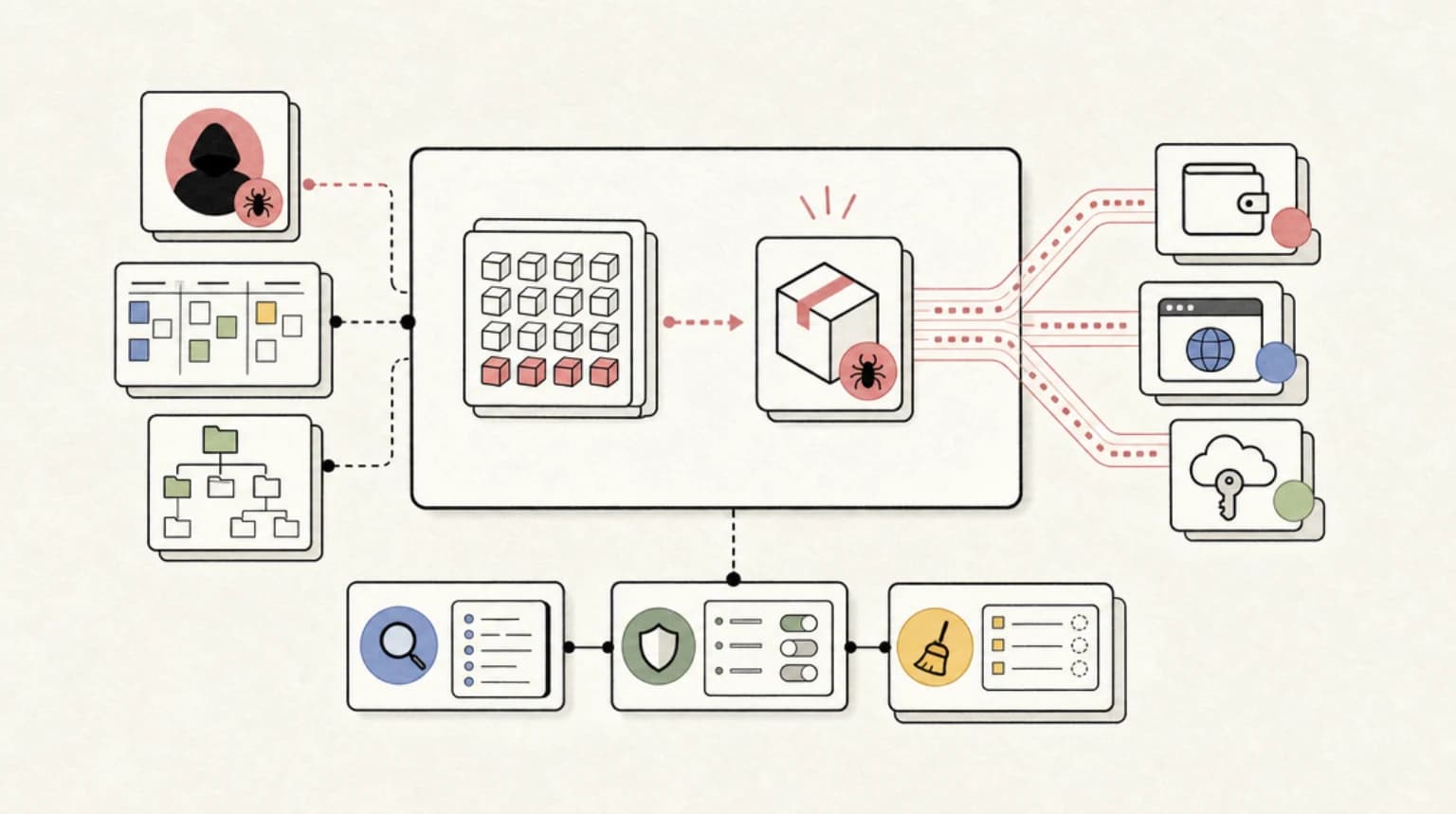
On June 17, 2026, attackers hijacked a dormant Mastra contributor account and pushed malicious versions of 140+ packages. The payload steals crypto wallets, browser data, and cloud credentials. Here is what happened, how to check your lockfile, and what to do if you installed an affected version.
Official Sources#
| Source | Description |
|---|---|
| Socket Security disclosure | Technical analysis from the team that detected the attack |
| Hacker News discussion | Community response and additional context |
| StepSecurity advisory | Mitigation guidance and persistence removal |
| SafeDep analysis | Scope takeover mechanics |
| Mend advisory | Enterprise remediation steps |
Last updated: June 17, 2026
If you use Mastra - the TypeScript AI agent framework - check your lockfile now. On June 17, 2026, attackers compromised 140+ packages in the @mastra/* npm scope and injected a remote access trojan that steals cryptocurrency wallets, browser data, and cloud credentials. The attack was active for approximately 88 minutes before detection, but the affected package versions may still be cached in your node_modules or CI pipelines.
This is not a theoretical risk. Mastra's @mastra/core package alone has over 918,000 weekly downloads. The framework is used for building AI agents that typically run in environments with access to LLM API keys, cloud provider credentials, and production databases - exactly the assets this malware targets.
What Happened: The Timeline#
June 16, 2026, 07:05 UTC - npm user sergey2016 published easy-day-js@1.11.21, a clean clone of the legitimate dayjs date library. No malicious code at this point - just a typosquat waiting to be weaponized.
June 17, 2026, 01:15-02:36 UTC - Attackers used the compromised account ehindero - a legitimate former Mastra contributor whose npm scope access was never revoked - to publish 141 malicious versions across the @mastra/* namespace. Each new version added a single dependency to package.json:
JSON
"dependencies": {
  "easy-day-js": "^1.11.21"
}
June 17, 2026, ~02:40 UTC - easy-day-js was updated to version 1.11.22 with the actual payload: a postinstall hook that downloads and executes a Node.js remote access trojan.
Within 6 minutes - Socket's dependency analysis flagged the malicious easy-day-js and automatically blocked installs for protected users.
June 17, 2026 - npm pulled the malicious versions from the highest-profile packages and reverted their latest tags to clean versions.
How the Attack Works#
The payload is a two-stage remote access trojan designed for persistence and data theft.
Stage 1: The Loader (setup.cjs)#
When you run npm install on an affected @mastra/* version, npm's postinstall hook executes node setup.cjs --no-warnings. This script:
- Disables TLS certificate validation
- Beacons to a command-and-control server at
23.254.164.92:8000 - Downloads the second-stage payload from
23.254.164.123:443 - Executes the payload as a detached background process
- Deletes itself to remove evidence
This all happens automatically during npm install, before you import any code.
Stage 2: The Implant (protocal.cjs)#
The second stage is a 41KB cross-platform Node.js implant that:
- Installs persistence across all operating systems:
- Windows: Run registry key
- macOS: LaunchAgent plist
- Linux: systemd user service
- Inventories 166 cryptocurrency wallet extensions including MetaMask, Phantom, Coinbase Wallet, and Trust Wallet
- Extracts browser history and stored data from Chrome, Edge, and Brave
- Collects host reconnaissance including hostname, username, installed software
- Establishes C2 tasking for arbitrary follow-on code execution
The persistence means the malware survives reboots and continues operating even after you remove the npm packages.
Am I Affected?#
Check your lockfile for any easy-day-js dependency or any @mastra/* package versions published between June 17, 2026 01:15 UTC and the npm takedown.
Terminal
# Check for easy-day-js anywhere in your lockfile
grep -r "easy-day-js" package-lock.json pnpm-lock.yaml yarn.lock 2>/dev/null

# Check for recent @mastra/* installs
npm ls | grep "@mastra" 2>/dev/null
If you find easy-day-js in your dependency tree, assume the machine is compromised.
High-Risk Scenarios#
You are at higher risk if you:
- Installed or updated any @mastra/* package on June 17, 2026
- Run Mastra agents in CI/CD environments with cloud credentials
- Store LLM API keys (OpenAI, Anthropic, etc.) in environment variables on affected machines
- Have cryptocurrency wallet extensions installed in any browser on the affected system
- Run Mastra in development environments alongside production credential access
From the archive
Microsoft's Work IQ APIs Hit GA: What Agent Builders Actually Get on June 16
Jun 17, 2026 • 7 min read
Model Routing Recipes: Practical Config Patterns to Cut AI Spend
Jun 17, 2026 • 11 min read
Omnigent: Databricks' Meta-Harness for Orchestrating Claude Code, Codex, and Custom Agents
Jun 17, 2026 • 8 min read
Codex Gets Computer Use in the EU - and a Clean Claude Code Import
Jun 17, 2026 • 7 min read
Immediate Remediation#
If you installed an affected version, treat the machine as compromised. This is not overcautious - the malware is specifically designed to persist and exfiltrate credentials silently.
1. Remove the Persistence Mechanism#
macOS:
Terminal
rm -f ~/Library/LaunchAgents/com.*.plist
launchctl list | grep -i "com\." | xargs -I {} launchctl remove {}
Linux:
Terminal
rm -f ~/.config/systemd/user/*.service
systemctl --user daemon-reload
Windows (PowerShell as admin):
POWERSHELL
Remove-ItemProperty -Path "HKCU:\Software\Microsoft\Windows\CurrentVersion\Run" -Name "*suspicious*"
2. Rotate All Credentials#
Assume exfiltration. Rotate immediately:
- npm tokens:
npm token revoke - GitHub tokens and SSH keys
- Cloud provider credentials (AWS, GCP, Azure)
- LLM API keys (OpenAI, Anthropic, Google AI)
- Any secrets in environment variables or .env files
3. Check Cryptocurrency Wallets#
If you have any crypto wallet browser extensions installed:
- Transfer funds to a new wallet generated on a clean device
- Use a fresh seed phrase - do not reuse the compromised one
- Assume any wallet that was active in the browser is compromised
4. Clean Your Node Modules#
Terminal
rm -rf node_modules package-lock.json
npm cache clean --force
npm install --ignore-scripts  # Install without running postinstall hooks
Then verify your lockfile contains no easy-day-js before allowing scripts to run.
Prevention: Lockfile Hygiene for AI Developers#
This attack highlights a pattern that will keep repeating: AI agent frameworks run with elevated privileges and extensive credential access. They are high-value targets.
Install with --ignore-scripts by Default#
Terminal
npm config set ignore-scripts true
This breaks some legitimate packages that need postinstall hooks (like esbuild or sharp), but it also breaks supply chain attacks. You can allowlist specific packages that genuinely need postinstall execution.
Use Lockfile Auditing#
Tools like Socket, Snyk, and npm audit catch many supply chain attacks. Socket specifically flagged this attack within 6 minutes of the malicious payload going live.
Audit Contributor Access#
The ehindero account was a former contributor whose access was never revoked. This is the most common path for scope takeover attacks. Review who has publish access to your npm packages quarterly.
Pin Dependencies#
Avoid ^ and ~ ranges for critical dependencies. A pinned version in your lockfile would not have automatically pulled the malicious update.
What This Means for AI Agent Security#
Mastra is not uniquely vulnerable - it just happened to be the target this time. Every AI agent framework that installs via npm (LangChain, Vercel AI SDK, CrewAI, etc.) has the same attack surface: postinstall hooks that run automatically during npm install.
The uncomfortable truth is that AI agent development environments are among the most valuable targets for supply chain attacks. They typically have:
- API keys for multiple LLM providers
- Cloud credentials for deployment
- Access to production data for testing
- Long-running processes with network access
If you are building AI agents, you need to treat your development environment with the same security posture as a production server. That means:
- Isolated environments for untrusted dependencies
- Credential rotation on a schedule, not just when incidents happen
- Dependency scanning in CI that fails builds on known-malicious packages
- Principle of least privilege for API keys and cloud access
FAQ#
What is the Mastra npm supply chain attack?#
On June 17, 2026, attackers compromised 140+ npm packages in the @mastra/* scope by hijacking a dormant contributor account. They injected a dependency on a typosquatted package (easy-day-js) that downloads and executes a remote access trojan during npm install. The malware steals cryptocurrency wallets, browser data, and cloud credentials.
How do I check if I am affected?#
Search your lockfile for easy-day-js: grep -r "easy-day-js" package-lock.json. If present, assume the machine is compromised. Also check for any @mastra/* packages updated on June 17, 2026.
What credentials should I rotate?#
Rotate npm tokens, GitHub tokens, cloud provider credentials (AWS/GCP/Azure keys), LLM API keys (OpenAI, Anthropic), and any secrets stored in environment variables. For cryptocurrency, transfer funds to a new wallet with a fresh seed phrase generated on a clean device.
How long was the attack active?#
The malicious packages were published between 01:15 and 02:36 UTC on June 17, 2026 - approximately 88 minutes. Socket detected the attack within 6 minutes of the payload activation. However, affected package versions may still exist in cached node_modules or CI artifacts.
Is Mastra safe to use now?#
npm has reverted the latest tags to clean versions. However, you should verify your lockfile contains no easy-day-js dependency and that your installed versions are from before June 17, 2026 or after the npm takedown.
How do I remove the malware persistence?#
The malware installs persistence mechanisms specific to each OS: LaunchAgents on macOS, systemd user services on Linux, and Run registry keys on Windows. See the remediation section above for removal commands.
How was the contributor account compromised?#
The attacker used the npm account ehindero, described as a former Mastra contributor whose scope access was never revoked. The exact compromise method (credential reuse, phishing, etc.) has not been publicly disclosed.
Why are AI agent frameworks targeted?#
AI agent frameworks run in development environments with access to LLM API keys, cloud credentials, and often production data. They are high-value targets because a single compromised package can harvest credentials for multiple cloud services, payment processors, and AI providers.
Continue Reading#
- Loop Engineering in 9 Minutes: Stop Prompting, Start Building Loops
- Mastra: Review and Setup Guide for TypeScript Agent Apps (2026)
- Mastra vs LangGraph.js: TypeScript Agent Frameworks Head to Head
- Perplexity Bumblebee: Developer Guide to the Open Source Supply Chain Scanner
Sources#
- Socket Security: Mastra npm packages compromised - Technical disclosure, June 17, 2026
- The Hacker News: 144 Mastra npm Packages Compromised - News coverage, June 17, 2026
- StepSecurity: Mastra npm Packages Compromised Using easy-day-js - Advisory, June 17, 2026
- SafeDep: Mastra npm Scope Takeover - Analysis, June 17, 2026
- Mend: Mastra npm Scope Takeover - Enterprise guidance, June 17, 2026
Read next
Agent Config Files Are Executable Supply Chain
A Hacker News thread on config files that run code points at the next AI coding risk: agent hooks, skills, and editor rules need review like executable dependencies.
8 min readThe Agent Security Checklist I Use Before Connecting Tools
Before an AI agent gets tools, files, APIs, MCP servers, or deployment access, decide what it can read, write, call, log, and roll back.
8 min readThe Miasma Worm Is Targeting AI Developers: What You Need to Audit Now
The Miasma worm has evolved from package registry poisoning to directly hijacking AI coding tools - if your team clones open-source repos and opens them in Claude Code, Cursor, Gemini CLI, or VS Code, you may already be compromised.
7 min readShare
Developers Digest
Technical content at the intersection of AI and development. Building with AI agents, Claude Code, and modern dev tools - then showing you exactly how it works.
300+ videos30K+ GitHub stars850+ articles
Related Tools
AI Frameworks

Mastra
TypeScript-first AI agent framework. Agents, tools, memory, workflows, RAG, evals, tracing, MCP, and production deployme...
View ToolAI Frameworks

LangChain / LangGraph
Most popular LLM framework. 100K+ GitHub stars. Chains, RAG, vector stores, tool use. LangGraph adds stateful multi-agen...
View ToolAI Frameworks

Pydantic
Python's de facto data validation library. Type-hint-driven models, fast Rust-based core (v2), and the foundation of Fas...
View ToolApps from Developers Digest
Related Guides
Guide
AI Agent Frameworks Compared: LangGraph vs CrewAI vs Mastra vs CopilotKit
Deep comparison of the top AI agent frameworks - LangGraph, CrewAI, Mastra, CopilotKit, AutoGen, and Claude Code.
AI AgentsGuide
Claude Code Setup Guide
Configure Claude Code for maximum productivity -- CLAUDE.md, sub-agents, MCP servers, and autonomous workflows.
AI AgentsGuide
MCP Servers Explained
What MCP servers are, how they work, and how to build your own in 5 minutes.
AI AgentsRelated Posts

8 min read
AI Coding
Agent Config Files Are Executable Supply Chain
A Hacker News thread on config files that run code points at the next AI coding risk: agent hooks, skills, and editor ru...
8 min read
AI Security
The Agent Security Checklist I Use Before Connecting Tools
Before an AI agent gets tools, files, APIs, MCP servers, or deployment access, decide what it can read, write, call, log...
7 min read
Supply Chain Security
The Miasma Worm Is Targeting AI Developers: What You Need to Audit Now
The Miasma worm has evolved from package registry poisoning to directly hijacking AI coding tools - if your team clones...

7 min read
security
Perplexity Bumblebee: Developer Guide to the Open Source Supply Chain Scanner
Bumblebee is Perplexity's open source scanner for detecting compromised packages, extensions, and MCP configs on develop...

7 min read
ai-agents
Arcade AI Agent Authorization: A Developer Guide
Arcade just raised $60M to become the secure action layer for production AI agents. Here is what their MCP runtime actua...
11 min read
claude-code
Claude Code Permissions: A Practical settings.json Guide for Allow, Deny, and Ask Rules
Stop the approval-fatigue prompts without going full YOLO mode. A hands-on guide to Claude Code's permission system - se...
Build with the member tools

Get Smarter About AI Dev
New tutorials, open-source projects, and deep dives on coding agents - delivered weekly.
One email per weekReal code, not theoryFree forever