Microsoft's Work IQ APIs Hit GA: What Agent Builders Actually Get on June 16
TL;DR
On June 16, 2026, Microsoft's Work IQ APIs reach general availability - a workplace intelligence layer that hands agents pre-assembled, permission-trimmed Microsoft 365 context instead of raw Graph calls. Here is what the four domains, three protocols, and consumption pricing mean for developers building enterprise agents.
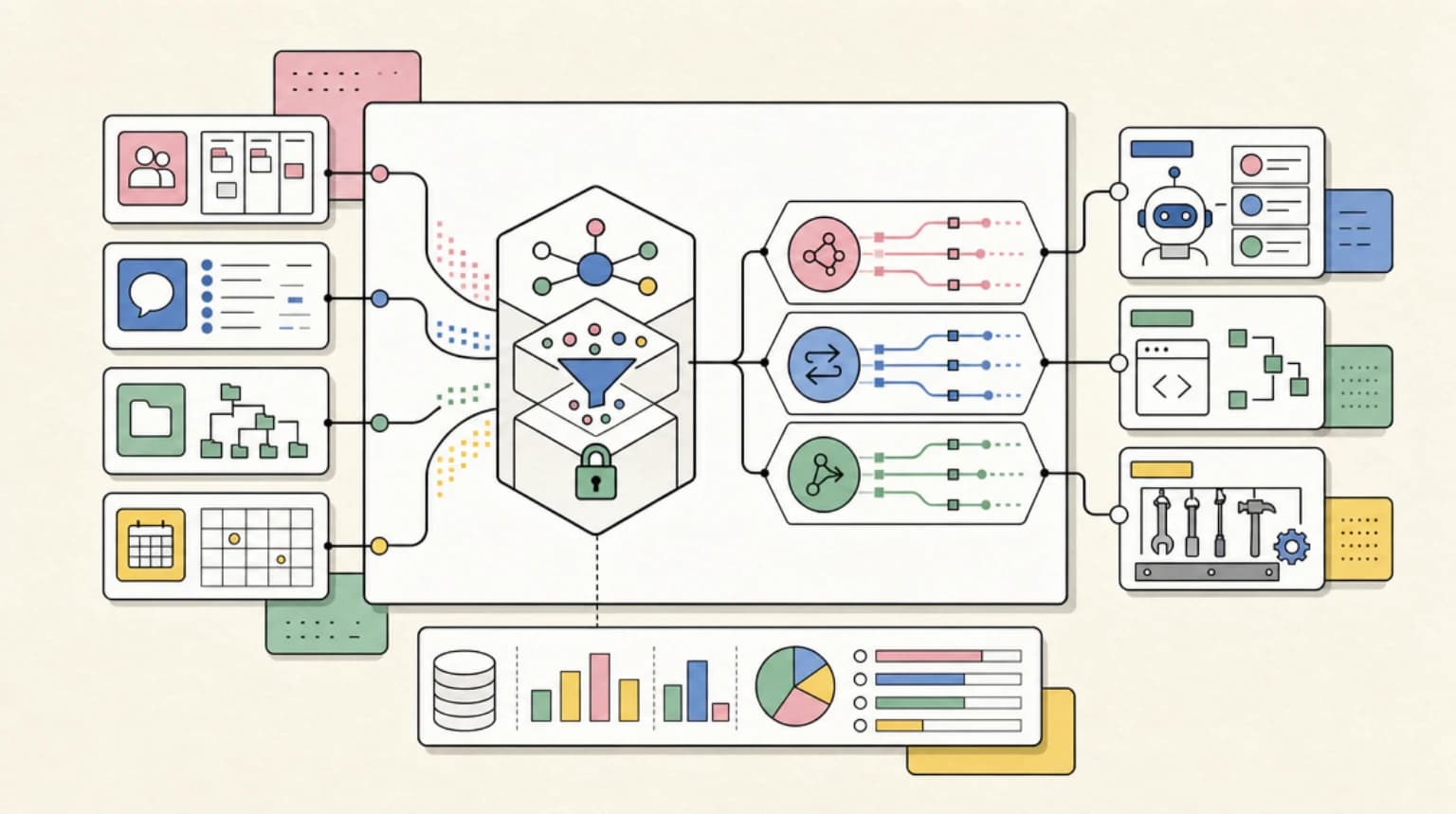
Most enterprise agents fail at the same place: getting grounded. An agent that needs to answer "what did my team decide about the Q3 launch" has to stitch together emails, a meeting transcript, a few chat threads, and a SharePoint doc - then trim all of it to what the current user is actually allowed to see. Today that means orchestrating dozens of raw Microsoft Graph calls and writing the permission logic yourself.
Microsoft's pitch with Work IQ is that you should stop doing that. Announced at Build 2026 on June 2 and reaching general availability on June 16, 2026, the Work IQ APIs expose a workplace intelligence layer that pre-assembles grounded, permission-scoped context and hands it back to your agent as a ready-to-use input.
Last updated: June 17, 2026
What Work IQ Is#
Microsoft describes Work IQ as "the workplace intelligence layer for agents, capturing how work actually happens across Microsoft 365, organizational systems and external sources: people, emails, documents, meetings and how they connect." The APIs give agents "programmatic access to this intelligence layer."
The framing in Microsoft's own announcement is blunt about why the old approach does not work for agents: "Traditional interfaces were designed for human interaction, but agents work differently. They need richer context, simpler tool surfaces, lower latency, and enterprise controls built in from the start." (Microsoft 365 Blog)
So instead of your agent calling Graph and reassembling context, it calls Work IQ, which returns the digested, permission-trimmed context it needs.
The Four Domains#
Per Microsoft's developer blog, the API is organized into four domains (Microsoft 365 Developer Blog):
- Chat - conversational access over agent-to-agent and REST surfaces.
- Context - internal assembly of grounded context across organizational data.
- Tools - 10 generic verbs that reach Microsoft 365 data, rather than hundreds of data-specific tools.
- Workspaces - persistent storage backed by SharePoint Embedded.
The "10 generic tools" detail is the one worth sitting with. Microsoft says the APIs "collapse functionality into just 10 generic tools with progressive disclosure through model context protocol (MCP), so developers do not need to teach agents hundreds of data-specific tools." Progressive disclosure means the agent discovers structure at runtime - a getSchema call lets agents "adapt automatically to new data and evolving scenarios without changes to the API surface."
From the archive
Model Routing Recipes: Practical Config Patterns to Cut AI Spend
Jun 17, 2026 • 11 min read
Omnigent: Databricks' Meta-Harness for Orchestrating Claude Code, Codex, and Custom Agents
Jun 17, 2026 • 8 min read
Codex Gets Computer Use in the EU - and a Clean Claude Code Import
Jun 17, 2026 • 7 min read
'The Orchestration Is the Product': What Perplexity's Aravind Srinivas Sees That the Model Labs Don't
Jun 17, 2026 • 11 min read
Three Protocols#
Work IQ ships across three access protocols, which is unusual breadth for a launch:
- A2A - agent-to-agent collaboration.
- A redesigned remote MCP server - the same MCP standard most agent frameworks already speak.
- REST API - for direct integration.
If you are already building MCP-native agents, this is the relevant hook: Work IQ is a remote MCP server you can point an existing agent at, rather than a proprietary SDK you have to adopt wholesale.
The Permission Model#
This is the part that matters most for anyone shipping into a regulated org. Microsoft describes a two-layer model: broad permissions establish access boundaries, and a Rego-based policy engine enforces context-aware rules on every request - evaluating resource paths, methods, user identity, and data content.
The operative line from the developer blog: "Actions are user scoped, meaning every request runs in the context of a specific user and only accesses what that user is allowed to see or do."
That is the explicit answer to the oversharing problem that has dogged enterprise RAG and Copilot deployments - where an agent surfaces a document the asking user was never supposed to see. Whether the enforcement holds up in practice is something teams will need to validate against their own tenants, but the design intent is clearly to make user-scoped access the default rather than an afterthought.
Pricing#
Work IQ is billed through a consumption-based model using Copilot Credits, a unified currency Microsoft is also extending to Copilot Studio and other AI services. Per Microsoft's materials, there is no separate Work IQ subscription, SKU, or per-user license, and billing is independent of Microsoft 365 Copilot licensing - meaning even users without a Copilot license can be billed consumptively when custom or third-party agents call the API.
Microsoft has not published per-unit Copilot Credit rates in the launch posts, so model your costs against the consumption meter once it is live rather than assuming a flat per-seat number.
Who Can Build With It#
The announcement references "developers and IT administrators" building agents, and a public preview is already available on GitHub ahead of the GA date, at github.com/microsoft/work-iq. The enterprise framing runs through everything - this is built for agents operating inside an organization's Microsoft 365 tenant, not consumer apps - but access is not described as gated to a closed partner set.
Should You Care?#
If you are building agents that need to reason over Microsoft 365 data - and a large share of enterprise agent projects do - Work IQ is worth evaluating now while it is in preview, before committing to a hand-rolled Graph orchestration layer you would have to maintain forever.
Three honest caveats:
- It is a lock-in surface. Work IQ is the connective tissue between your agent and Microsoft's data plane. Convenient, but it deepens your dependence on the Microsoft stack.
- Pricing is unproven. Consumption billing through Copilot Credits is flexible but unpredictable until you can measure real workloads. Budget conservatively.
- Speed and security claims are vendor-stated. Microsoft's adjacent "Web IQ" grounding stack claims "nearly 2.5x the speed of the next best alternative," and the user-scoped permission guarantees are Microsoft's own framing - verify both against your workloads and your compliance bar before you trust them in production.
For teams already deep in Microsoft 365, Work IQ removes a genuinely painful chunk of plumbing. For everyone else, it is a useful signal of where agent infrastructure is heading: less raw API stitching, more pre-grounded, permission-aware context delivered through MCP.
Continue Reading#
- Anthropic Buying Stainless Is About Agent Plumbing
- Claude Code as an HL7 to FHIR Migration Agent for Hospitals
- Claude Knowledge Work Plugins Turn Agent Setup Into Team Infrastructure
- GitHub Apps Can Now Be Installed at the Enterprise Level, Opening the Platform to Third-Party Integrators
- Microsoft's MAI Models and MoE Strategy: What Developers Need to Know for Copilot and Beyond
- Microsoft MXC Developer Guide 2026: Sandbox Your AI Agents at the OS Level
Sources#
Read next
Microsoft's MAI Models and MoE Strategy: What Developers Need to Know for Copilot and Beyond
Microsoft unveiled seven in-house MAI models at Build 2026, including MAI-Code-1-Flash now shipping in GitHub Copilot. Here is what the MoE architecture, training data, and Copilot rollout mean for your team's toolchain decisions in H2 2026.
7 min read271 MCP Servers Exist. These 5 Actually Make Claude Code Better.
Most MCP servers are noise. After shipping 24 apps with Claude Code, these are the five I reach for every time.
11 min readThe Agent Security Checklist I Use Before Connecting Tools
Before an AI agent gets tools, files, APIs, MCP servers, or deployment access, decide what it can read, write, call, log, and roll back.
8 min readShare
Developers Digest
Technical content at the intersection of AI and development. Building with AI agents, Claude Code, and modern dev tools - then showing you exactly how it works.
300+ videos30K+ GitHub stars850+ articles
Related Tools
AI Frameworks
C
Composio
Gives AI agents access to 250+ external tools (GitHub, Slack, Gmail, databases) with managed OAuth. Handles the auth and...
View ToolAI Frameworks

OpenAI Agents SDK
Lightweight Python framework for multi-agent systems. Agent handoffs, tool use, guardrails, tracing. Successor to the ex...
View ToolAI Frameworks

Mastra
TypeScript-first AI agent framework. Agents, tools, memory, workflows, RAG, evals, tracing, MCP, and production deployme...
View ToolAI Frameworks
A
Agency Swarm
Multi-agent orchestration framework built on the OpenAI Agents SDK. Define agent roles, typed tools, and directional com...
View ToolApps from Developers Digest
Developer Tools
DD Traces
See exactly what your agent did, locally. No cloud, no signup.
View AppDeveloper ToolsIn Progress
Skill Builder
Turn a one-liner into a working Claude Code skill. From idea to installed in a minute.
View AppDeveloper ToolsPlus $20/mo
Cost Tape Cloud
Know what each agent run cost before the bill arrives. Budgets and alerts included.
View AppRelated Guides
Guide
MCP Servers Explained
What MCP servers are, how they work, and how to build your own in 5 minutes.
AI AgentsGuide
Claude Code Setup Guide
Configure Claude Code for maximum productivity -- CLAUDE.md, sub-agents, MCP servers, and autonomous workflows.
AI AgentsGuide
Claude Code Complete Course
A complete, citation-backed Claude Code course with setup, prompting systems, MCP, CI, security, cost controls, and capstone workflows.
ai-developmentRelated Videos
TRAE: Custom AI Agents That Actually Understand Your Codebase
Check out Trae here! https://tinyurl.com/2f8rw4vm In this video, we dive into @Trae_ai a newly launched AI IDE packed with innovative features. I provide a comprehensive demonstration...
Video·

Buzz: Open-Source Collaboration for Humans + AI Agents
Buzz by Block: Open-Source Slack-Style Collaboration for Humans + AI Agents (Demo & Setup) Check out Arcade: https://arcade.dev.plug.dev/xiDRwlA Repo: https://github.com/block/buzz The video introd...
Video·

Agents 101: How to Build and Deploy Anything with AI Agents
Build Anything with Vercel, the Agentic Infrastructure Stack Check out Vercel: https://vercel.plug.dev/cwBLgfW The video shows a behind-the-scenes walkthrough of how the creator rapidly builds and d...
Video·
Related Posts
7 min read
Microsoft
Microsoft's MAI Models and MoE Strategy: What Developers Need to Know for Copilot and Beyond
Microsoft unveiled seven in-house MAI models at Build 2026, including MAI-Code-1-Flash now shipping in GitHub Copilot. H...

11 min read
MCP
271 MCP Servers Exist. These 5 Actually Make Claude Code Better.
Most MCP servers are noise. After shipping 24 apps with Claude Code, these are the five I reach for every time.
8 min read
AI Security
The Agent Security Checklist I Use Before Connecting Tools
Before an AI agent gets tools, files, APIs, MCP servers, or deployment access, decide what it can read, write, call, log...

8 min read
AI Coding
Codebase Graphs Are the New Agent Map
Graphify is trending because coding agents keep hitting the same wall: they can edit files, but they still need a durabl...
10 min read
MCP
Best MCP Servers in 2026: The Developer Shortlist
A practical ranked list of MCP servers worth installing first for Claude Code, Cursor, Copilot, Codex, and OpenCode: Git...
9 min read
MCP
MCP Apps vs Tool Calling vs Standalone UIs: Interactive Interfaces for Agent Tools Compared
MCP Apps shipped with the 2026-07-28 final spec - sandboxed interactive UIs for MCP servers. How they compare to standar...
Build with the member tools

Get Smarter About AI Dev
New tutorials, open-source projects, and deep dives on coding agents - delivered weekly.
One email per weekReal code, not theoryFree forever