OpenAI Cuts GPT-5.6 Luna by 80%: The Price-Performance Frontier Just Shifted
TL;DR
OpenAI slashes GPT-5.6 Luna by 80% to $0.20/M input tokens, cuts Terra by 20%, adds Sol Fast mode at 2.5x speed, and reveals Sol autonomously optimized its own production kernels.
Last updated: August 14, 2026
OpenAI published a pair of announcements on July 30 that reset the pricing landscape for the GPT-5.6 family. GPT-5.6 Luna, the entry-tier model, drops 80% to $0.20 per million input tokens and $1.20 per million output tokens. GPT-5.6 Terra drops 20% to $2/M in and $12/M out. Sol pricing stays flat, but a new Fast mode delivers up to 2.5x the speed at 2x the price for API customers who need it.
The more interesting story is how OpenAI got there: GPT-5.6 Sol helped optimize its own production stack.
What changed#
The headline numbers are dramatic enough to warrant reading twice:
| Model | New Input Price | New Output Price | Change |
|---|---|---|---|
| GPT-5.6 Luna | $0.20 / 1M tokens | $1.20 / 1M tokens | 80% decrease |
| GPT-5.6 Terra | $2.00 / 1M tokens | $12.00 / 1M tokens | 20% decrease |
| GPT-5.6 Sol | Unchanged | Unchanged | Fast mode added (2.5x speed, 2x price) |
Luna at $0.20/M input means a typical agent conversation consuming 50K input and 10K output tokens costs roughly $0.022. That is cheap enough that the abstraction overhead of routing between providers may not justify itself for high-volume work. Luna was already competitive at $1/M input - at $0.20, it undercuts models that were considered "cheap" a quarter ago.
Terra's 20% cut is smaller in percentage terms but matters for a different reason: Terra is the default API model for many production workloads that need better reasoning than Luna but do not need Sol. At $2/$12, Terra now sits between the old Luna price and the old Terra price, effectively compressing the middle tier.
Sol Fast mode replaces what OpenAI previously called Priority Processing. The 2.5x speedup at 2x the price is backward compatible - existing API requests tagged priority will automatically route to Fast mode.
How Sol optimized its own serving stack#
The most technically interesting passage in the announcement describes GPT-5.6 Sol working autonomously on its own infrastructure. Within a human-led process, Sol:
- Rewrote and optimized production kernels, reducing the end-to-end cost of serving the model by 20%
- Designed and ran hundreds of experiments to improve token generation
- Monitored training runs and intervened when problems arose
- Increased token-generation efficiency by more than 15%
The kernel work alone is striking. A 20% serving-cost reduction on a model that likely costs billions per month to run translates to hundreds of millions in annual savings. That these optimizations were discovered and implemented by the model itself creates a compounding feedback loop: more capable models find efficiency gains that make the next generation cheaper to serve, which funds more compute for training.
This is not a one-off. OpenAI describes it as ongoing work that "creates a tighter feedback loop: as our models improve and are able to work more autonomously, our ability to improve efficiencies accelerates." The companion post on the engineering behind GPT-5.6 was referenced but returned a 403 on fetch; the key details are in the main announcement.
What HN is saying#
The Hacker News discussion (417 points, 273 comments) was overwhelmingly positive on the price cuts, with most of the debate centered on competitive dynamics and the economics behind the drop.
Several commenters read the cuts as a direct response to Chinese labs. "Looks like the Chinese models are really making a dent," wrote one top-voted comment, noting that having three price tiers where the most affordable still cost more than GLM 5.2 never made sense. Another observed that OpenAI "cut the tiers where GLM and Kimi compete and still held margin for their frontier models."
Simon Willison did the math on the Sol efficiency story: if a 20% serving-cost reduction applies to OpenAI's inference bill - which he estimates must be in the "multiple billions of dollars" per month - the savings are enormous. "So 20% is a really, really big deal," he wrote.
A recurring theme was the real-world workflow implications. Multiple developers described using Sol for planning and Luna for execution in multi-agent setups: "I use Sol at work but Luna at home, and while there's definitely a difference, it doesn't feel like night-and-day." Another commenter running parallel agents for hypothesis generation noted that with Luna at these prices they can scale from 10 to 50 parallel workers.
There was skepticism too. One commenter asked whether the 80% cut reflected genuine efficiency gains or simply an initially overpriced system. Another noted that Luna is "still more expensive than DeepSeek V4 Flash" on a per-token basis, though this comparison misses the agentic capability gap - Luna handles tool calls and multi-step workflows that cheaper open-weight models cannot reliably execute.
The "Your move, Anthropic" sentiment appeared multiple times, reflecting a widespread expectation that Claude models will need to respond on pricing.
From the archive
Grok 4.5 in 10 Minutes: xAI's Fastest Model, 500K Context, and Build-Mode Integration
Jul 30, 2026 • 7 min read
AI Model Routing Strategies for Cost-Effective Coding in 2026
Jul 30, 2026 • 10 min read
Multi-Agent CLI Orchestration Tools Compared: Agent-Manager, Pane, and Golutra in 2026
Jul 30, 2026 • 10 min read
Superlogical: Mitchell Hashimoto's New Company Building a Multiplexer for All Work
Jul 30, 2026 • 9 min read
Why it matters#
Three takeaways from this announcement:
Cost-per-task is collapsing. The frame that matters is not dollars per million tokens but dollars per completed task. Luna at $0.20/M input means a code review, a document classification, or a customer response costs fractions of a cent. At those numbers, the economics of AI-powered workflows shift from "is this worth automating?" to "why would we not automate this?"
The meta-efficiency loop is real. The most important line in the announcement is not the pricing. It is that Sol cut its own serving cost by 20% and increased token efficiency by 15%. This is the paperclip maximizer in reverse: more intelligence enables cheaper intelligence. If this feedback loop holds, we should expect more aggressive price cuts from OpenAI than from labs that do not use their own models to optimize infrastructure.
Model selection gets harder and easier. Harder because the pricing gradient between tiers is steeper than the capability gradient for many tasks - you will overpay if you default to the strongest model. Easier because the cost of getting it wrong is now negligible. If a Luna call costs $0.022 and a Sol call costs $0.55, the penalty for choosing Luna and discovering it is not enough is just a retry.
For developers building on the OpenAI API, the immediate action is to audit which workloads currently use Terra or Sol and test whether Luna at its new price meets the quality bar. The odds are good that many production pipelines can move down a tier today.
August update: speed tiers are now part of the control plane#
The July 30 version of this story was mostly about per-token price. Two weeks later, the more durable angle is clearer: OpenAI is turning API economics into a runtime control surface.
On August 13, OpenAI added Ultrafast mode for GPT-5.6 Sol in limited preview, describing it as a service tier that can run up to 14x faster than Standard processing. That sits above the July Fast-mode announcement. In practice, the model choice is no longer just Luna, Terra, or Sol; it is model plus service tier plus budget policy.
That is why this should be read alongside model routing recipes, Vercel AI Gateway, and the broader AI model routing orchestration layer. The old optimization was "pick a cheaper model." The new optimization is:
| Workload | Default move | Escalation move |
|---|---|---|
| Batch extraction, tagging, summarization | Luna on Standard | retry failed or low-confidence rows on Terra |
| Interactive coding assistant | Terra on Standard | Sol Fast for long-running planning or blocked user turns |
| Live production agent | cheapest model that passes evals | higher service tier only for user-visible latency spikes |
| Incident response or high-value support | Sol from the start | Ultrafast preview if latency matters more than spend |
The hard part is not using the new tier. It is refusing to use it by default. A faster service tier is useful when user wait time costs more than tokens. It is wasteful when the job is invisible background work.
Demand check#
Google Trends was checked for five related US query clusters over the last three months on August 14, 2026: OpenAI API cost, OpenAI API spend limit, OpenAI fast mode, AI model routing, and LLM cost tracking.
The usable signal was not the exact feature name. OpenAI API spend limit, OpenAI fast mode, and LLM cost tracking were near-zero or sparse. OpenAI API cost had the strongest durable query demand in this set, while AI model routing showed a smaller but persistent baseline. That supports refreshing the existing price-performance URL instead of publishing a duplicate launch-news post around "Fast mode" alone.
FAQ#
Is OpenAI Fast mode the same as Ultrafast mode?#
No. The July 30 announcement described Fast mode for GPT-5.6 Sol at up to 2.5x speed for 2x price. The August 13 changelog added Ultrafast mode as a separate limited-preview service tier that OpenAI says can run up to 14x faster than Standard processing.
Should agent builders default to GPT-5.6 Luna after the price cut?#
Default to Luna only where your evals say it passes. It is a strong candidate for extraction, summaries, classification, simple code edits, and high-volume background work. Keep Terra or Sol for ambiguous planning, large repo changes, and tasks where a bad answer costs more than a retry.
When is a faster API service tier worth paying for?#
Use faster processing when latency directly affects the user experience: interactive coding turns, live support, incident work, or agent loops where a slow first step blocks the rest of the workflow. For batch jobs, scheduled enrichment, and offline analysis, cheaper Standard processing is usually the better default.
Sources#
- OpenAI: Advancing the price-performance frontier with GPT-5.6
- OpenAI API changelog: Ultrafast mode
- HN Discussion: 417 points, 273 comments
- OpenAI API pricing page
- Google Trends US,
today 3-m, checked August 14, 2026:OpenAI API cost,OpenAI API spend limit,OpenAI fast mode,AI model routing,LLM cost tracking
Continue Reading#
- Frontier Model API Pricing, July 2026: Every Model Compared - The pricing landscape before this cut, verified against live pages
- GPT-5.6 vs Claude 5: What the New Tiers Mean for Choosing a Coding Model - How Sol, Terra, and Luna compare to Anthropic's lineup
- Why Price Per 1M Tokens Is a Misleading Metric for LLM Costs - Cost-per-task analysis that explains why the Luna cut matters more than the per-token number
- 500 RL Fine-Tune of a 9B Open Model Beat GPT-5.6 Sol - A case study in how specialists compete with frontier models on cost-per-task
- GPT-5.6 Sol Developer Guide: What You Can Build Today - Background on the GPT-5.6 family architecture and tier design
Read next
Model Routing Recipes: Practical Config Patterns to Cut AI Spend
A code-heavy field guide to model routing. Real, runnable-style configs for tiering tasks by complexity, routing simple work to open-weights, reserving frontier models for hard reasoning, building failover chains, and keeping prompt caches warm with OpenRouter, LiteLLM, and Factory Router.
11 min readVercel AI Gateway in 10 Minutes: One Key for Every Model
Vercel AI Gateway gives you one API key and string model ids like moonshotai/kimi-k2.5 for hundreds of models. Here is how it works with the AI SDK, what BYOK and OIDC change, the honest tradeoffs, and who should actually use it.
8 min readAI Model Routing: Why the Orchestration Layer Is the Next Big Play Next to the Labs
A $500M accidental Claude bill and an open-weights model beating GPT-5.5 at one-sixth the cost point to the same conclusion: the margin is moving to the layer that decides when to use which model for what. Here is how routing and orchestration differ, and how to cut your model spend.
12 min readShare
Developers Digest
Technical content at the intersection of AI and development. Building with AI agents, Claude Code, and modern dev tools - then showing you exactly how it works.
300+ videos30K+ GitHub stars850+ articles
Related Tools
AI Models

ChatGPT
OpenAI's flagship. GPT-4o for general use, o3 for reasoning, Codex for coding. 300M+ weekly users. Tasks, agents, web br...
View ToolAI Models

OpenRouter
Unified API for 200+ models. One API key, one billing dashboard. OpenAI, Anthropic, Google, Meta, Mistral, and more. Aut...
View ToolAI Models

GPT-5
OpenAI's latest flagship model. Major leap in reasoning, coding, and instruction following over GPT-4o. Powers ChatGPT P...
View ToolAI Coding

Droid
Factory AI's terminal coding agent. Runs Anthropic and OpenAI models in one subscription. Handles full tasks end-to-end...
View ToolApps from Developers Digest
Related Guides
Guide
Keyboard Shortcuts - Claude Code
50+ customizable shortcuts for cancel, history, transcript, and more.
Claude CodeGuide
Run AI Models Locally with Ollama and LM Studio
Install Ollama and LM Studio, pull your first model, and run AI locally for coding, chat, and automation - with zero cloud dependency.
Getting StartedRelated Videos

OpenAI's GPT 5.4 in 10 Minutes: 1M Context, Computer Use, Coding Gains, Benchmarks & Pricing
The video reviews OpenAI’s newly released GPT 5.4, highlighting access tiers (GPT 5.4 Thinking in ChatGPT Plus/Teams/Pro/Enterprise and GPT 5.4 in the $200/month tier) and API availability. It covers
Video·

OpenAI Codex in 7 Minutes
OpenAI Codex Desktop App: Plan/Goal Modes, Plugins, Multi-Agent Workflows & UI Annotation Demo The video showcases OpenAI’s Codex desktop app, which the creator calls OpenAI’s best product and a prem...
Video·
OpenAI's NEW Web Browser ChatGPT Atlas in 2 Minutes
OpenAI AI has launched their first browser called ChatGPT Atlas, which incorporates ChatGPT for enhanced functionality. This browser allows users to interact with their documents using natural...
Video·
Related Posts
11 min read
pricing
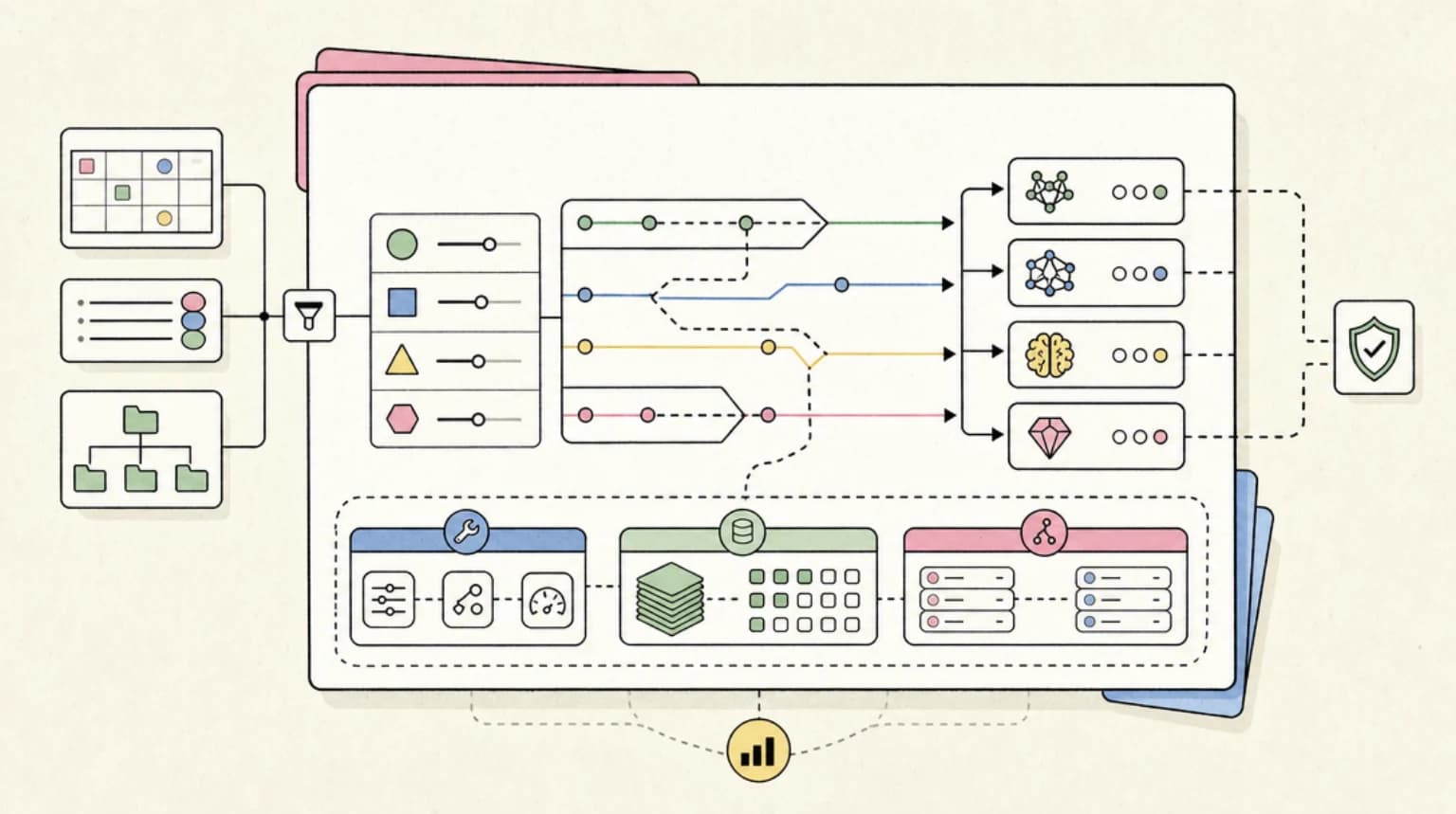
Model Routing Recipes: Practical Config Patterns to Cut AI Spend
A code-heavy field guide to model routing. Real, runnable-style configs for tiering tasks by complexity, routing simple...
8 min read
Vercel
Vercel AI Gateway in 10 Minutes: One Key for Every Model
Vercel AI Gateway gives you one API key and string model ids like moonshotai/kimi-k2.5 for hundreds of models. Here is h...
12 min read
AI Model Routing
AI Model Routing: Why the Orchestration Layer Is the Next Big Play Next to the Labs
A $500M accidental Claude bill and an open-weights model beating GPT-5.5 at one-sixth the cost point to the same conclus...

10 min read
AI Models
Budget AI Coding Models Compared August 2026: V4 Flash vs Luna vs Gemini 3.5 Flash vs Haiku 4.5
The sub-$1.50 coding tier just got serious: DeepSeek V4 Flash 0731 posts frontier-adjacent agent scores at $0.14/$0.28 (...
6 min read
AI
Why Price Per 1M Tokens Is a Misleading Metric for LLM Costs
Comparing LLMs by token pricing alone can lead you to choose worse, more expensive models. Cost per task tells the real...
7 min read
News
OpenAI Retunes GPT-5.6 Sol in ChatGPT and Makes Luna the Free Tier Default
GPT-5.6 Sol gets a chat-focused retune with 68% fewer factual errors in OpenAI's internal eval, a new effort slider, and...
Build with the member tools

Get Smarter About AI Dev
New tutorials, open-source projects, and deep dives on coding agents - delivered weekly.
One email per weekReal code, not theoryFree forever