Muse Spark Open Weights: 816B Model, Benchmarks, and How to Run It
TL;DR
Meta released Muse Spark Open weights on October 15, 2026: 816B total, 42B active, 1M context. Run recipes, hardware floor, license catch, and where it trails.
Meta released the weights for Muse Spark Open on October 15, 2026: an 816B-parameter mixture-of-experts model that activates 42B parameters per token, takes a 1M-token context, and ships under a custom license with a revenue trigger. The week's search spike for "muse spark open weights" tracks the launch, and the useful question for a builder is narrow: what do you need to serve it, and does it beat the Chinese open models you already run? On Meta's own table, it does not beat them on coding.
Official Sources#
| Resource | What it confirms |
|---|---|
| Meta AI Research announcement | Parameter counts, context, partners, license summary |
| Hugging Face model card | Architecture, hardware floor, benchmark table, safety results |
| Build with Muse Spark Open | Serving commands for SGLang, vLLM, TensorRT-LLM, llama.cpp and Unsloth |
| Muse Model License | The attribution and Model-as-a-Service terms |
What Shipped#
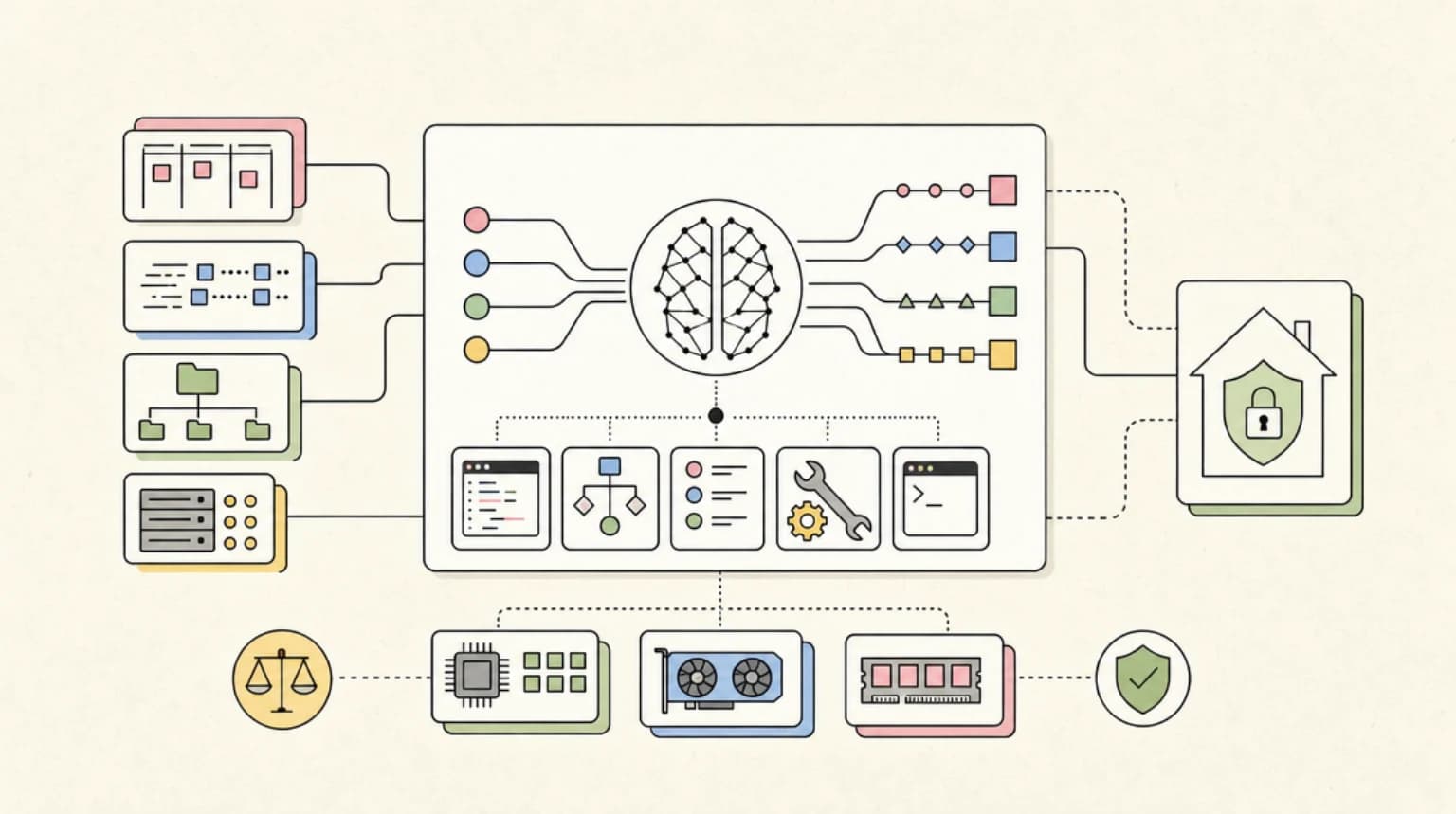
Per the model card, Muse Spark Open is a natively multimodal transformer with 62 layers, 256 experts and 8 active per token, accepting text, image, video and audio and producing text. Meta lists BF16 and NVFP4 checkpoints. The developer post says NVFP4 is about 530 GB (roughly a third of BF16) and serves on four Blackwell Ultra GPUs or eight H200s. The model card gives the floor as at least 700 GB of VRAM for NVFP4 and 2 TB for BF16.
This is the open-weight sibling of the closed Muse Spark line we covered in the Muse Spark 1.2 and Muse Code release. Our daily digest in September flagged the open-weights roadmap line as a tease; it is now real. It is a very different thing from Muse Glimmer 30B, which is the Apache 2.0 model that fits a 24 GB card.
Benchmarks (Vendor-Reported)#
Everything below is from Meta's model card, run at xhigh reasoning effort, and Meta chose the comparison set. Treat it as a vendor table, not an independent ranking.
| Benchmark | Muse Spark Open | GLM 5.3 | Kimi K3 | Qwen3.8-2.4T |
|---|---|---|---|---|
| Artificial Analysis Intelligence Index | 39 | 45 | 44 | 40 |
| MCP-Atlas | 89.2 | 84.2 | 82.3 | 84.5 |
| Terminal-Bench 2.1 | 76.4 | 83.9 | 85.0 | 82.0 |
| DeepSWE 1.1 | 60 | 67 | 68 | 57 |
| OSWorld Verified | 80.4 | - | 84.8 | - |
The pattern is consistent. Muse Spark Open leads on tool-calling (MCP-Atlas) and on a few knowledge and multimodal tests, and trails GLM 5.3 and Kimi K3 on the coding-agent rows (Terminal-Bench, DeepSWE) and on the aggregate Intelligence Index. If your workload is a coding agent, the table says to keep GLM 5.3 or Kimi K3 first and test Muse Spark Open as a tool-heavy alternative. The Ollama and Factory quotes in Meta's post praise tool-call selection, which fits the MCP-Atlas lead, but they are partner testimonials, not measurements.
How to Run It#
The developer post gives per-runtime commands. These are Meta's, copied for orientation; check the linked recipes before you rent hardware.
vLLM, NVFP4 on four GPUs with expert parallelism and the DSpark draft model:
vllm serve meta-models/Muse-Spark-Open-816B-A42B-NVFP4 \
    --tensor-parallel-size 4 \
    --enable-expert-parallel \
    --max-model-len 1048576 \
    --reasoning-parser muse \
    --tool-call-parser muse \
    --enable-auto-tool-choice
llama serve -hf ggml-org/Muse-Spark-Open-816B-A42B-GGUF:Q4_K_S
Unsloth Dynamic GGUF, which Unsloth says compresses to as little as 2-bit and fits the smallest version in about 300 GB of combined RAM and VRAM:
unsloth run --model unsloth/Muse-Spark-Open-816B-A42B-GGUF:UD-Q2_K_XL
SGLang, TensorRT-LLM and Apple MLX recipes are in the same post. The Mac route is two M5 Ultra Mac Studios with 512 GB each, or four with 256 GB each, linked over Thunderbolt 5. Reasoning effort defaults to xhigh; the card recommends high or xhigh for coding and agent work.
If you do not own a terabyte of memory, Meta lists hosted endpoints at Baseten, Fireworks AI, Groq (limited preview), Modal, Nebius, OpenRouter and Together AI. I did not verify per-token prices on any of them, so check each provider page. Pointing Claude Code or Codex at a Muse model is a separate setup question, covered in how to use Claude Code and Codex with Meta Muse.
The License Is the Catch#
The weights are free to use, modify, fine-tune and distill, with two conditions worth reading before you build on them. Derivatives must prominently display "Built with Muse Spark Open". And if you offer model outputs to third parties as a service (Model as a Service) and your aggregate gross revenue exceeds 20 million US dollars in any twelve months, you need a separate written agreement with Meta. The license says this does not apply to internal use or to using the model to power your own product that is not itself a model API. For a startup shipping an agent product, that is mild. For an inference host, it is the whole story.
What People Are Actually Saying#
On the Hacker News thread, which passed 590 points, the tone was welcoming but unexcited. One commenter said the model fits a niche of US companies that refuse to run Chinese models and want their own inference, and hoped Meta keeps releasing open weights. Another pushed back that a model running on an older gaming desktop already matches it on DeepSWE, which lines up with the 60 versus 67 and 68 gap in the vendor table. A third pointed out that Meta compared only against open-weight models, whereas GLM's launch compared against closed frontier models too, and said Chinese models such as GLM and DeepSeek still feel more useful. A fourth commenter simply objected to a lab announcement sitting on the front page.
On r/LocalLLaMA, the early reaction was about size: the Q4_K_XL Unsloth quant is about 506 GB, and one poster planned to compare it with a Q2 quant of Kimi K3 on their own rig. Nobody in the threads I read had published an independent benchmark yet.
What a Builder Does Monday#
- Read the license section above and decide if you are a Model-as-a-Service business. If you are not, the terms are workable.
- Do not buy hardware. Run your own agent task suite against one hosted endpoint (OpenRouter or Fireworks) and compare against whichever of GLM 5.3 or Kimi K3 you use now. The vendor table suggests the gap, if any, will show up on coding tasks.
- If your agent is tool-call-heavy (many MCP servers, parallel calls), that is where Muse Spark Open's MCP-Atlas lead should show. Test that specifically. For background on the protocol, see our MCP server primer.
- If you do want local, the realistic floor is 256 GB or more of unified memory for a 2-bit quant, and expect it to be slow and lossy. For a machine that fits one GPU, the best local coding LLMs are still the smaller models.
FAQ#
Is Muse Spark Open really open source?#
It is open weights, not open source in the OSI sense. The Muse Model License allows commercial use, fine-tuning and distillation, but requires a "Built with Muse Spark Open" notice and a separate agreement for large Model-as-a-Service businesses. Compare that with the Apache 2.0 license on Muse Glimmer 30B.
How much hardware does Muse Spark Open need?#
Meta's model card says at least 700 GB of VRAM for the NVFP4 checkpoint and 2 TB for BF16. The developer post lists four Blackwell Ultra GPUs or eight H200s for NVFP4. Unsloth says its smallest 2-bit GGUF fits in about 300 GB of combined RAM and VRAM.
Does Muse Spark Open beat GLM 5.3 and Kimi K3?#
Not on Meta's own table for coding. It scores 89.2 on MCP-Atlas against 84.2 for GLM 5.3 and 82.3 for Kimi K3, but trails both on Terminal-Bench 2.1 and DeepSWE 1.1 and on the Artificial Analysis Intelligence Index (39 versus 45 and 44). These are vendor-reported numbers.
Sources#
| Source | URL |
|---|---|
| Meta AI Research: Muse Spark Open | https://research.meta.ai/blog/muse-spark-open |
| Hugging Face model card | https://huggingface.co/meta-models/Muse-Spark-Open-816B-A42B |
| Meta developer post: Build with Muse Spark Open | https://dev.meta.ai/resources/blog/build-with-muse-spark-open |
| Hacker News discussion | https://news.ycombinator.com/item?id=50107379 |
| r/LocalLLaMA: Unsloth Muse Spark Open | https://www.reddit.com/r/LocalLLaMA/comments/1x6rcid/unsloth_muse_spark_open_is_out/ |
Last updated: October 16, 2026
Continue Reading#
- Muse Glimmer 30B: Meta's Open-Weight Local Agent Model, Benchmarks, and Hardware Reality - the Apache 2.0 sibling that fits a 24 GB card
- Meta Ships Muse Code and Muse Spark 1.2: A Terminal Agent With a 12x Cheaper Contributor Tier - the closed-weight release this one descends from
- The Best Local Coding LLMs in 2026: Run Enterprise-Grade AI Without the Cloud - what to run when you do not own a terabyte of memory
- Kimi K3 Weights Land on HuggingFace: 2.8T Open Frontier Model You Can Actually Download - the coding-benchmark leader Meta's table trails
- GLM-5.3 Free and Cheap: Every Route and Price (October 2026) - the other open model to test it against
Get the next deep dive like this in your inbox
One email a week on ai-agents and the rest of the AI dev stack. Free.
Read next on local and open-weight models
Muse Glimmer 30B: Meta's Open-Weight Local Agent Model, Benchmarks, and Hardware Reality
Meta open-sourced Muse Glimmer, a 30B Apache 2.0 multimodal agent model that runs in a 24GB envelope at up to 233 tok/s. MCP Atlas 75.5, SWE-Bench Verified 76.0, 131K context. Here is what the numbers actually say.
8 min readMeta Ships Muse Code and Muse Spark 1.2: A Terminal Agent With a 12x Cheaper Contributor Tier
Meta released Muse Code, a terminal coding agent, and Muse Spark 1.2 on August 5, 2026. The model co-trains with the harness, logs every call to a replay-safe event log, and offers a $0.10/$0.20 contributor tier if Meta may train on your data.
7 min readThe Best Local Coding LLMs in 2026: Run Enterprise-Grade AI Without the Cloud
Choosing a local coding LLM in 2026 means balancing benchmark performance, hardware cost, and the compliance pressure to keep code off third-party servers. Here is what to run and on what hardware.
8 min readNew here? Start with
Technical content at the intersection of AI and development. Building with AI agents, Claude Code, and modern dev tools - then showing you exactly how it works.