NVIDIA OpenShell Makes Agent Sandboxes a Policy Layer

TL;DR
OpenShell is NVIDIA's open-source runtime for running autonomous agents inside policy-enforced sandboxes. The interesting part is not another wrapper around a model. It is the move from prompt rules to infrastructure rules.
Official Sources#
| Source | Why it matters |
|---|---|
| NVIDIA/OpenShell | Primary repository, README, install path, policy model, SDK links, license |
| NVIDIA OpenShell blog | NVIDIA's launch framing for infrastructure-level agent security |
| OpenShell formal methods note | Research team's explanation of policy proving and what they learned |
| HN thread on OpenShell formal methods | Developer discussion around the formal-methods claim |
| r/LocalLLaMA OpenShell thread | Fresh local-agent community signal and early practitioner framing |
| Google Trends Explore | Mandatory demand check attempt |
Last updated: September 28, 2026. Google Trends was checked for agent sandbox, AI agent sandbox, coding agent sandbox, OpenShell NVIDIA, and AI coding agent across the United States over the last three months. Google returned HTTP 429 for this cluster, so no Trends numbers were used. The topic is framed around the durable AI coding agent and agent-security lane, with OpenShell as the current concrete source.
The most useful way to read NVIDIA OpenShell is not "NVIDIA shipped another agent framework." It is "the sandbox is becoming the product surface."
OpenShell is an open-source runtime for autonomous agents. It gives each agent an isolated sandbox, then checks filesystem, process, network, and credential access against policy before actions leave that sandbox. NVIDIA's README says agents can read files, install packages, call APIs, and use credentials, but only through the access a policy declares. Its blog post makes the same architectural point: security moves out of the model prompt and into the environment.
That matters because the agent-security story has been too prompt-shaped for too long. "Do not leak secrets" is a weak control when the agent can read .env, run shell commands, and post to the network. "This sandbox cannot read that file, cannot call that host, and cannot attach credentials to that request" is a different category of control.
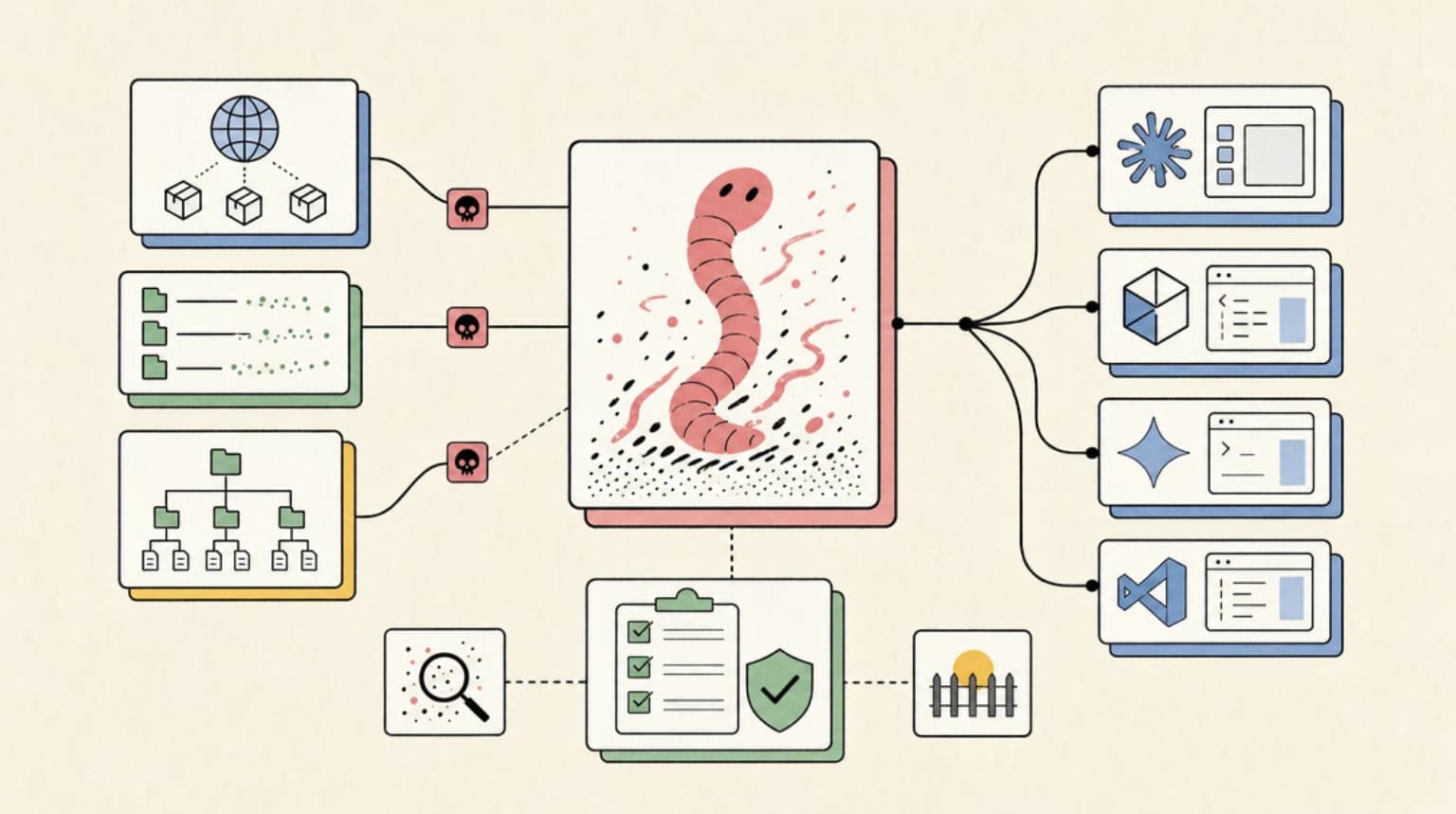
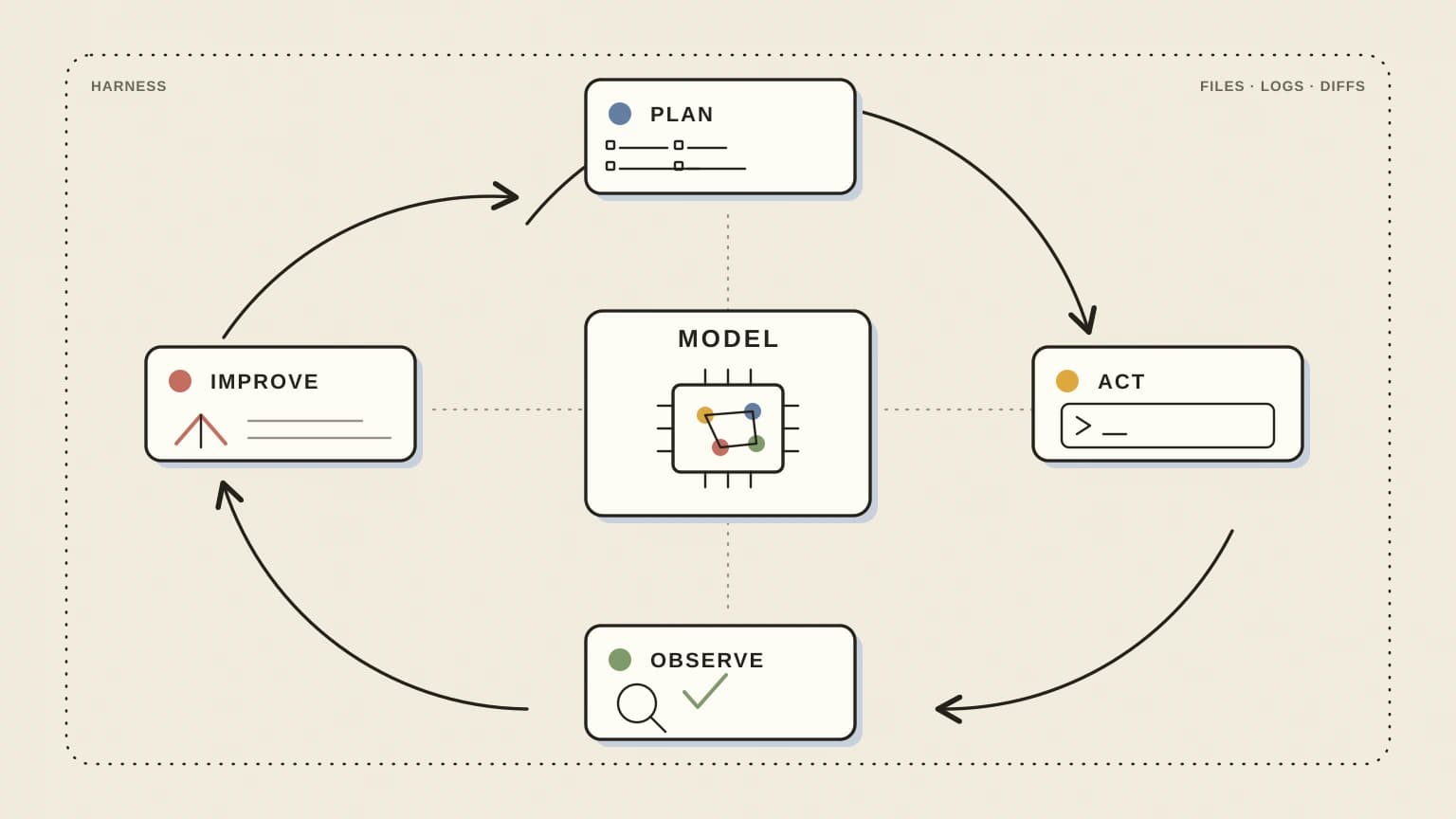
This is the same lesson from the Miasma supply-chain attack against AI developer tools: the dangerous boundary is often the developer runtime, not the model. It is also the practical version of the harness engineering thesis. If the harness is where agents become useful, the harness is also where the permission model has to live.
The Important Shift#
OpenShell is not trying to make agents safer by asking them to be better behaved. It is trying to make unsafe behavior fail at the runtime layer.
The README describes two core moves. First, the agent runs in an isolated sandbox with kernel-level policy checks for file access, system calls, and network connections. Second, policy changes can be reviewed with formal verification before they are applied, so risky new access waits for human review instead of silently expanding the sandbox.
That is the right abstraction for coding agents because a coding agent is not just a chatbot. It is a process tree with package installers, shell commands, API clients, local files, credentials, generated scripts, and sometimes subagents. You cannot secure that system only by editing the system prompt.
The most interesting phrase in NVIDIA's blog is "infrastructure-layer policy enforcement." That is where the market is heading. The agent can plan. The model can reason. The application can orchestrate. But the environment decides what is physically allowed.
Why Developers Should Care#
For an individual developer, OpenShell is appealing because it makes local agents less all-or-nothing. You can try a coding agent against a real project without giving it your whole machine and every credential in your shell environment.
For teams, the bigger appeal is governance. A policy can say:
- this agent may read the repository but not
~/.ssh; - this agent may call the package registry but not arbitrary hosts;
- this credential may only be attached to approved endpoints;
- this sandbox needs human approval before a new network path opens.
Those are reviewable controls. They are much easier to reason about than "the agent promised not to do that."
This also changes how we should think about agent skills. The new wave of Claude Code skills and agent plugins gives agents more reusable behavior. That is powerful, but it makes the runtime boundary more important, not less. A skill can teach an agent how to operate a tool. A sandbox policy decides whether the tool can touch production credentials.
What People Are Actually Saying#
The community signal is early but useful.
- On Hacker News, the September thread around OpenShell's formal-methods note centered on whether policy proving helps in real systems or only in carefully scoped policy languages. That is the right skepticism. Formal methods are strongest when the thing being proved is narrow and explicit.
- On r/LocalLLaMA, the practitioner framing was local and practical: move agents into a real sandbox policy, keep inference on existing hardware, and avoid treating prompt rules as security. The same thread also drew a line between the runtime and NVIDIA-specific hardware pieces.
- The counter-case is complexity. A sandbox gateway, policy language, credential provider, and approval loop are more moving parts than a bare CLI agent. Small teams may start with simpler container isolation and short-lived credentials before adopting a full runtime.
That split feels healthy. OpenShell should not be read as "install this and your agents are safe." It should be read as evidence that the control plane for agents is becoming a serious software category.
The Monday-Morning Builder Move#
The OpenShell README exposes the simplest trial path:
curl -LsSf https://raw.githubusercontent.com/NVIDIA/OpenShell/main/install.sh | sh
openshell sandbox create --name demo
I would not pipe an installer into sh on a production machine just because a README says so. For a real evaluation, clone the repository, read the install script, and run it in a disposable environment first.
The useful Monday exercise is not "replace your agent stack." It is to write down the policy you wish your agent runtime enforced:
agent: dependency-updater
filesystem:
  allow:
    - ./package.json
    - ./pnpm-lock.yaml
    - ./src/**
  deny:
    - ./.env*
    - ~/.ssh/**
network:
  allow:
    - registry.npmjs.org
    - api.github.com
credentials:
  github:
    allowEndpoints:
      - api.github.com
humanReview:
  requiredFor:
    - new network host
    - credentialed request to a new endpoint
Whether you express that in OpenShell, Docker, Kubernetes NetworkPolicy, a Vercel sandbox wrapper, or your own harness, the design exercise is the same: make agent authority explicit before the run starts.
That is also the missing piece in many open-source contribution policies. A repository can say "AI-generated contributions must disclose themselves," but the RepoComplianceBench study found agents rarely retrieve those rules on their own. Runtime policy is not a replacement for social policy, but it is a way to enforce the boundaries a prompt will skip.
What OpenShell Does Not Solve#
OpenShell does not make a malicious dependency safe. It cannot decide whether a generated patch is maintainable. It cannot prove that an agent's plan is product-correct. It does not remove the need for code review, CI, secret scanning, or outbound network monitoring.
It also introduces a new operational surface. Policy bugs matter. Gateway bugs matter. Bad defaults matter. A policy that accidentally allows broad file reads or wildcard network egress can create the same false confidence as a too-trusting prompt.
The formal-methods work is promising exactly because it acknowledges that policy drift is a real failure mode. If agents are going to ask for new capabilities as they work, then policy changes need their own review path. A runtime that can explain "this change grants access to a new credentialed endpoint" is more useful than a runtime that only says yes or no.
The Bigger Takeaway#
The next generation of coding agents will not be differentiated only by model quality. They will be differentiated by the harness around the model: context compaction, tool replay, skill systems, credential boundaries, audit logs, sandbox lifecycle, and recovery after failure.
OpenShell is interesting because it puts the permission boundary where developers can inspect it. That is the right direction.
Prompt rules are still useful. They teach the agent how to behave. But when an agent can run code, install packages, read files, and call APIs, behavior is not enough. Authority has to be typed, logged, reviewed, and enforced outside the model.
That is the agent-sandbox lesson worth carrying forward: do not ask the model to be the security boundary. Give it a boundary it cannot talk its way around.
FAQ#
What is NVIDIA OpenShell?#
NVIDIA OpenShell is an open-source runtime for autonomous AI agents. It runs agents inside isolated sandboxes and enforces policy over file access, system calls, network access, and credentials.
Is OpenShell only for NVIDIA hardware?#
The OpenShell README lists Linux, macOS on Apple Silicon, and Windows with WSL 2 as supported or experimental host paths, with Docker, Podman, or host virtualization. Some related NVIDIA ecosystem pieces may have separate hardware requirements, but the OpenShell runtime itself is not described as requiring a new NVIDIA server.
How is OpenShell different from a Docker container?#
A container isolates a process. OpenShell is trying to provide an agent-specific control plane around isolation: sandbox lifecycle, policy review, credential providers, network checks, SDKs, and formal review of policy changes.
Does OpenShell make coding agents safe?#
No single runtime makes agents safe. OpenShell addresses an important layer: what an agent process is allowed to touch. You still need code review, CI, dependency controls, secret scanning, logs, and human approval for risky changes.
Why does this matter for coding agents?#
Coding agents operate on real repositories with shell access, package managers, credentials, and network calls. A prompt cannot reliably enforce those boundaries. A runtime policy can make them explicit and auditable.
Continue Reading#
- The Miasma Worm Is Targeting AI Developers - why AI coding tools need runtime-level supply-chain defenses.
- Harness Engineering and the Path to Self-Improving AI - why the software around the model is where agent reliability compounds.
- Coding Agents Almost Never Read Open Source Contribution Rules - the policy-compliance gap that prompts alone do not close.
- Skills Are The New Agent Operating System - how reusable agent capabilities change the security boundary.
- Claude Code Superpowers Plugin Guide - how plugin and skill systems increase the need for clear runtime authority.
Sources#
- NVIDIA/OpenShell repository and README, fetched September 28, 2026. github.com/NVIDIA/OpenShell
- NVIDIA, "How Autonomous AI Agents Become Secure by Design With NVIDIA OpenShell" (March 23, 2026), fetched September 28, 2026. blogs.nvidia.com
- OpenShell Research, "What we have learned applying formal methods to control AI agents" (September 10, 2026), fetched September 28, 2026. nvidia.github.io
- Hacker News discussion, "What we have learned at OpenShell applying formal methods to control AI agents" (September 15, 2026), fetched September 28, 2026. news.ycombinator.com
- Reddit r/LocalLLaMA discussion, "NVIDIA shipped OpenShell..." (September 28, 2026), fetched September 28, 2026. reddit.com
- Google Trends query cluster attempted September 28, 2026:
agent sandbox,AI agent sandbox,coding agent sandbox,OpenShell NVIDIA, andAI coding agent; Google returned HTTP 429, so no numeric Trends data was used.
Get the next deep dive like this in your inbox
One email a week on AI Agents and the rest of the AI dev stack. Free.
Read next on AI coding tools
The Miasma Worm Is Targeting AI Developers: What You Need to Audit Now
The Miasma worm has evolved from package registry poisoning to directly hijacking AI coding tools - if your team clones open-source repos and opens them in Claude Code, Cursor, Gemini CLI, or VS Code, you may already be compromised.
7 min readCoding Agents Almost Never Read Open Source Contribution Rules: RepoComplianceBench Study
A new 106-issue benchmark across 49 repositories finds frontier coding agents rarely retrieve AI contribution rules on their own - and never refuse to contribute in AI-banned repositories, no matter the prompt. Disclosure and verification can be fixed; bans cannot.
6 min readHarness Engineering and the Path to Self-Improving AI
Lilian Weng argues self-improving AI won't start with models rewriting their weights - it starts with the harness. Here's what that means for developers building agents.
7 min readNew here? Start with
Technical content at the intersection of AI and development. Building with AI agents, Claude Code, and modern dev tools - then showing you exactly how it works.