OpenAI Daybreak Shows the AppSec Bottleneck Is Patching, Not Finding
TL;DR
OpenAI's Daybreak and Patch the Planet point at the real agentic AppSec shift: security agents only matter when they produce validated, reviewable patches maintainers can actually merge.
OpenAI's Daybreak work is easy to summarize badly.
The lazy version is: "AI finds vulnerabilities now."
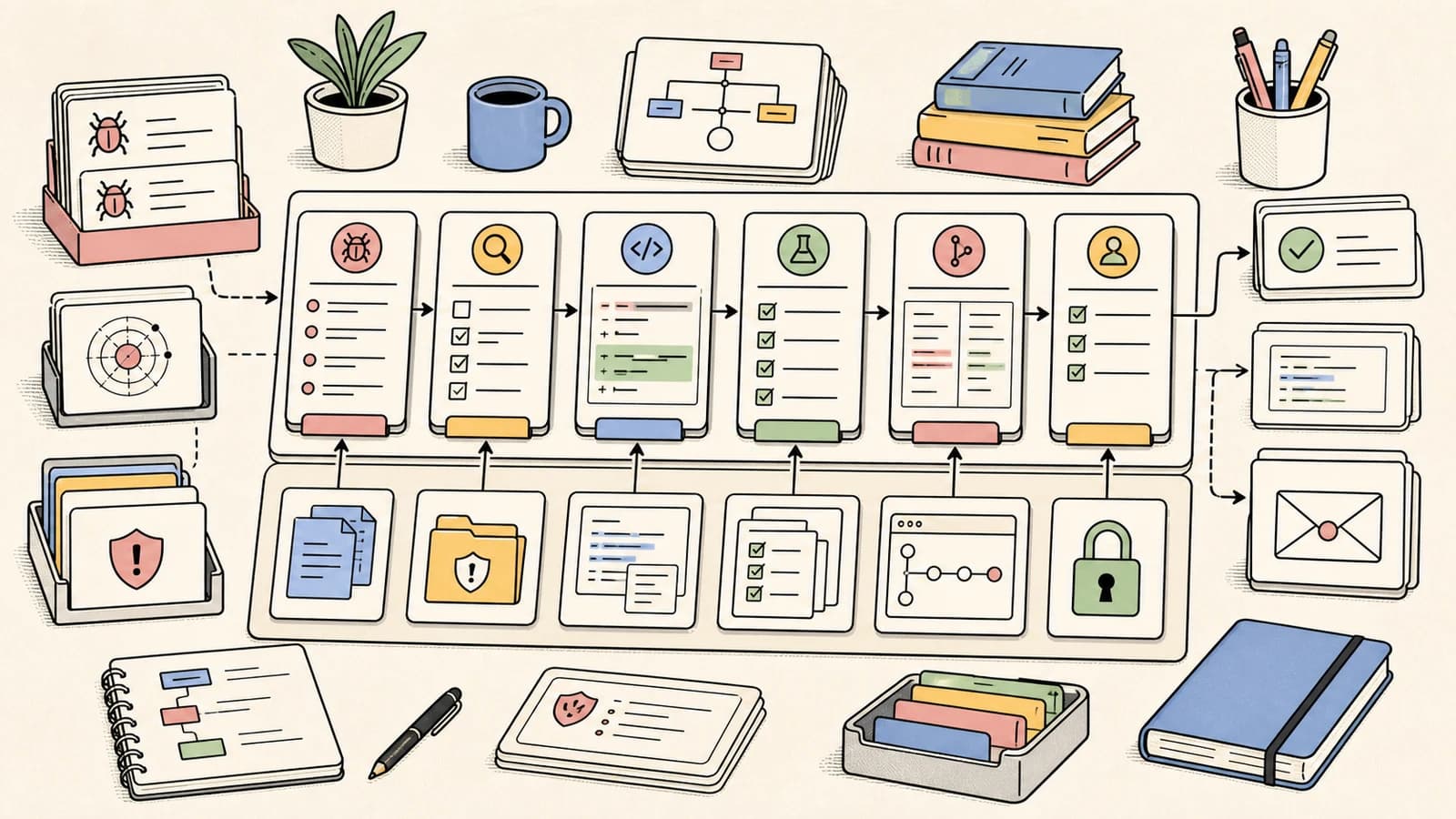
The more useful version for developers is different: OpenAI and Trail of Bits are trying to move AI-assisted security from finding bugs toward validating, patching, testing, and handing maintainers something they can trust.
That is the real AppSec bottleneck.
Last updated: June 23, 2026
OpenAI announced Patch the Planet on June 22, 2026 as part of Daybreak, built with Trail of Bits and other partners to help open-source maintainers find, validate, and fix vulnerabilities. The important word is not "find." It is "fix."
The Scarce Resource Is Maintainer Attention#
Security teams already know how to drown a project in findings.
Static analyzers do it. Dependency scanners do it. Bug bounty programs can do it. AI agents can do it faster.
The hard part is what happens after the finding appears:
| Stage | What usually breaks |
|---|---|
| validation | the report is plausible but not reproducible |
| triage | severity is unclear or duplicated |
| patching | the fix is invasive, incomplete, or style-incompatible |
| testing | the patch lacks a regression case |
| disclosure | the report skips project norms or private channels |
| review | maintainers spend more time interpreting the report than fixing the risk |
That is why Daybreak is worth covering after our post on the AI security triage bottleneck. That piece argued that finding more issues is not enough if humans cannot validate and route them. Daybreak pushes the next step: can the agent help close the loop with a useful patch?
Trail of Bits described the first week of Patch the Planet as 64 pull requests and 51 issues across 19 projects, with 37 patches already merged. OpenAI named early participant projects including cURL, NATS Server, pyca/cryptography, Sigstore, aiohttp, Go, freenginx, Python, and python.org.
Those numbers matter less as a scorecard than as a workflow clue. The unit of value is not a vulnerability count. It is a maintainer-acceptable change.
What Daybreak Is Actually Testing#
OpenAI says the broader Daybreak stack includes Codex Security, GPT-5.5-Cyber, human reviewers, partner researchers, and maintainer coordination.
The interesting system design is the wrapper around the model:
- scan real repositories
- use repository-specific context and threat models
- validate findings in isolated environments
- rank results by practical risk
- attach evidence
- suggest patches
- route findings through human review before maintainers see them
- coordinate disclosure when details are not ready to be public
That wrapper is the product.
For developers, the lesson is similar to long-running agents need harnesses. A security agent without a harness is just a louder scanner. A security agent with evidence, tests, review queues, and rollback paths can become part of the engineering system.
This also connects to agent evals need baseline receipts. A benchmark score is interesting, but a patching workflow needs receipts: the finding, the reproduction, the patch, the test, the review decision, and the final state.
Codex Security Is Not Just a Scanner#
OpenAI's Codex Security documentation describes workflows for scans, deep scans, pull request review, backlog triage, fixing findings, exporting, and tracking.
That scope matters because the developer value is not "run one more security tool." It is "turn a security queue into engineering work."
The best agentic AppSec workflow should be able to answer:
- What changed since the last scan?
- Which finding is reproducible?
- What is the minimal safe patch?
- Which test proves the patch?
- Which maintainer owns the review?
- Which issues were fixed, dismissed, duplicated, or still uncertain?
- What evidence can be exported into the team's existing tracker?
If the tool only produces a wall of warnings, it competes with every other noisy scanner. If it produces a narrow patch with evidence and tests, it competes with manual security engineering time.
That is a much better category.
From the archive
OpenMontage Shows the Real Future of AI Video: Agents, Not Editors
Jun 23, 2026 • 7 min read
Prompt Injection Is Really Role Confusion
Jun 23, 2026 • 8 min read
TikZ Editor Is a WYSIWYG LaTeX Figure Tool Built Almost Entirely by Codex
Jun 23, 2026 • 7 min read
Unlimited OCR: Baidu's Open-Source Solution for Long Document Parsing
Jun 23, 2026 • 6 min read
The Supply Chain Angle#
Open-source security is also a supply-chain problem.
We covered this in npm supply-chain trust boundaries for AI agents: agents are good at normalizing risky automation unless the workflow forces provenance, scope, and review. AppSec agents need the same discipline.
Patch generation is powerful, but it introduces new trust questions:
- Who authored the patch?
- Which model and toolchain produced it?
- Which tests were run?
- Which disclosure channel approved it?
- Did the patch introduce new behavior outside the reported issue?
- Is the fix minimal enough for maintainers to audit quickly?
Maintainers should not have to accept "AI found this" as evidence. They need a patch they can read, a reproduction they can run, and a review trail they can audit.
That is why the OpenAI and Trail of Bits framing around expert review is important. Patch the Planet is not positioned as fully automatic open-source fixing. The sources emphasize human review and maintainer control.
What Teams Can Copy Now#
Most engineering teams do not need GPT-5.5-Cyber or a global open-source campaign to copy the useful pattern.
They can start with a local security-agent loop:
- Pick one repo and one class of issue.
- Require a reproduction or evidence snippet before a finding enters the queue.
- Ask the agent for the smallest safe patch, not a broad refactor.
- Require a regression test or harness change with every fix.
- Route the patch through the same review queue as human code.
- Track fixed, duplicate, false positive, and needs-human-investigation states.
- Periodically compare agent findings against a baseline scanner and human review.
That maps neatly to AI coding agents need review queues. The queue is not bureaucracy. It is the place where agent output becomes accountable engineering work.
It also maps to the OpenAI Codex guide: the most useful agent workflows are specific, bounded, and reviewable. "Find security bugs" is too broad. "Reproduce this class of parser issue, propose the smallest patch, add a regression test, and leave evidence" is a workflow.
The Practical Take#
The best security agent is not the one that opens the most issues.
It is the one that closes the most real risk without exhausting the people who own the code.
That is why Daybreak is important. It points away from vanity vulnerability counts and toward a maintainer-aware AppSec system: evidence, validation, patch, test, disclosure, review, and tracking.
For developers building with agents, that is the template. Do not measure your security automation by how many warnings it can produce. Measure it by how many safe, understandable, well-tested changes humans are willing to merge.
FAQ#
What is OpenAI Daybreak?#
Daybreak is OpenAI's security initiative around AI-assisted cyber defense, including tools and programs such as Codex Security and Patch the Planet.
What is Patch the Planet?#
Patch the Planet is an OpenAI Daybreak initiative built with Trail of Bits to help open-source maintainers find, validate, and fix vulnerabilities with AI assistance and expert human review.
What is agentic AppSec?#
Agentic AppSec is application security work where AI agents help inspect code, validate findings, propose patches, run tests, and support review workflows rather than only generating static reports.
Should teams trust AI-generated security patches?#
Not blindly. AI-generated patches need reproduction evidence, tests, human review, maintainer control, and a clear audit trail before they should be merged.
Sources#
Read next
AI Security Scanners Move the Bottleneck to Triage
Anthropic's Project Glasswing update is a useful signal for developer teams: AI can find vulnerability candidates faster than humans can verify, disclose, patch, and ship them.
8 min readTanStack's npm Compromise Is the CI Lesson Agent Teams Needed
The TanStack npm incident was not just a package-security story. It was a reminder that AI agent workflows inherit every weak trust boundary in CI.
9 min readAI Coding Agents Move the Bottleneck to Review Queues
As coding agents get easier to delegate to, the scarce resource shifts from code generation to review capacity, CI minutes, environment reliability, and merge discipline.
8 min readShare
Developers Digest
Technical content at the intersection of AI and development. Building with AI agents, Claude Code, and modern dev tools - then showing you exactly how it works.
300+ videos30K+ GitHub stars850+ articles
Related Tools
AI CodingAgent

OpenAI Codex
OpenAI's coding agent for terminal, cloud, IDE, GitHub, Slack, and Linear workflows. Reads repos, edits files, runs comm...
View ToolAI Frameworks

OpenAI Agents SDK
Lightweight Python framework for multi-agent systems. Agent handoffs, tool use, guardrails, tracing. Successor to the ex...
View ToolAI Models
ChatGPT
OpenAI's flagship. GPT-4o for general use, o3 for reasoning, Codex for coding. 300M+ weekly users. Tasks, agents, web br...
View ToolAI Coding
Codex CLI
OpenAI's open-source terminal coding agent built in Rust. Runs locally, reads your repo, edits files, and executes comma...
View ToolApps from Developers Digest
Related Guides
Guide
Chronicle Research Preview Setup Guide
Set up Codex Chronicle on macOS, manage permissions, and understand privacy, security, and troubleshooting.
Getting StartedGuide
Claude Code Complete Course
A complete, citation-backed Claude Code course with setup, prompting systems, MCP, CI, security, cost controls, and capstone workflows.
ai-developmentGuide
Team Lead - Claude Code
Coordinator agent that assigns tasks and synthesizes findings.
Claude CodeRelated Videos
OpenAI Codex in 7 Minutes
OpenAI Codex Desktop App: Plan/Goal Modes, Plugins, Multi-Agent Workflows & UI Annotation Demo The video showcases OpenAI’s Codex desktop app, which the creator calls OpenAI’s best product and a prem...
Video·
OpenAI Codex in ChatGPT in 5 Minutes
In this video, we delve into OpenAI's latest release, Codex, a cloud-based software engineering agent designed for various coding tasks. Unlike tools like Cursor or Windsurf, Codex integrates...
Video·
OpenAI Open Sources Codex: The CLI Coding Agent
Exploring Codex: AI Coding in Terminal In this video, I explore Codex, a new lightweight CLI tool for AI coding that runs in the terminal. This tool, possibly a response to Anthropic's CLI,...
Video·
Related Posts
8 min read
AI Security
AI Security Scanners Move the Bottleneck to Triage
Anthropic's Project Glasswing update is a useful signal for developer teams: AI can find vulnerability candidates faster...
9 min read
Security
TanStack's npm Compromise Is the CI Lesson Agent Teams Needed
The TanStack npm incident was not just a package-security story. It was a reminder that AI agent workflows inherit every...
8 min read
AI Coding
AI Coding Agents Move the Bottleneck to Review Queues
As coding agents get easier to delegate to, the scarce resource shifts from code generation to review capacity, CI minut...
9 min read
AI Agents
Long-Running Agents Need Harnesses, Not Hope
A long-running coding agent is only useful if the environment around it can queue tasks, capture logs, checkpoint state,...
8 min read
AI Agents
Agent Evals Need Baseline Receipts
Hex's data-agent lab shows the practical eval pattern AI teams should copy: compare candidates against stable baselines,...
5 min read
OpenAI
OpenAI Codex: Terminal and Cloud AI Coding Agent
Codex works from the terminal, cloud tasks, IDEs, GitHub, Slack, and Linear. Here is how to use it and how it compares t...
Build with the member tools

Get Smarter About AI Dev
New tutorials, open-source projects, and deep dives on coding agents - delivered weekly.
One email per weekReal code, not theoryFree forever