The Router Era: Why Not Owning a Frontier Model Became an Advantage
TL;DR
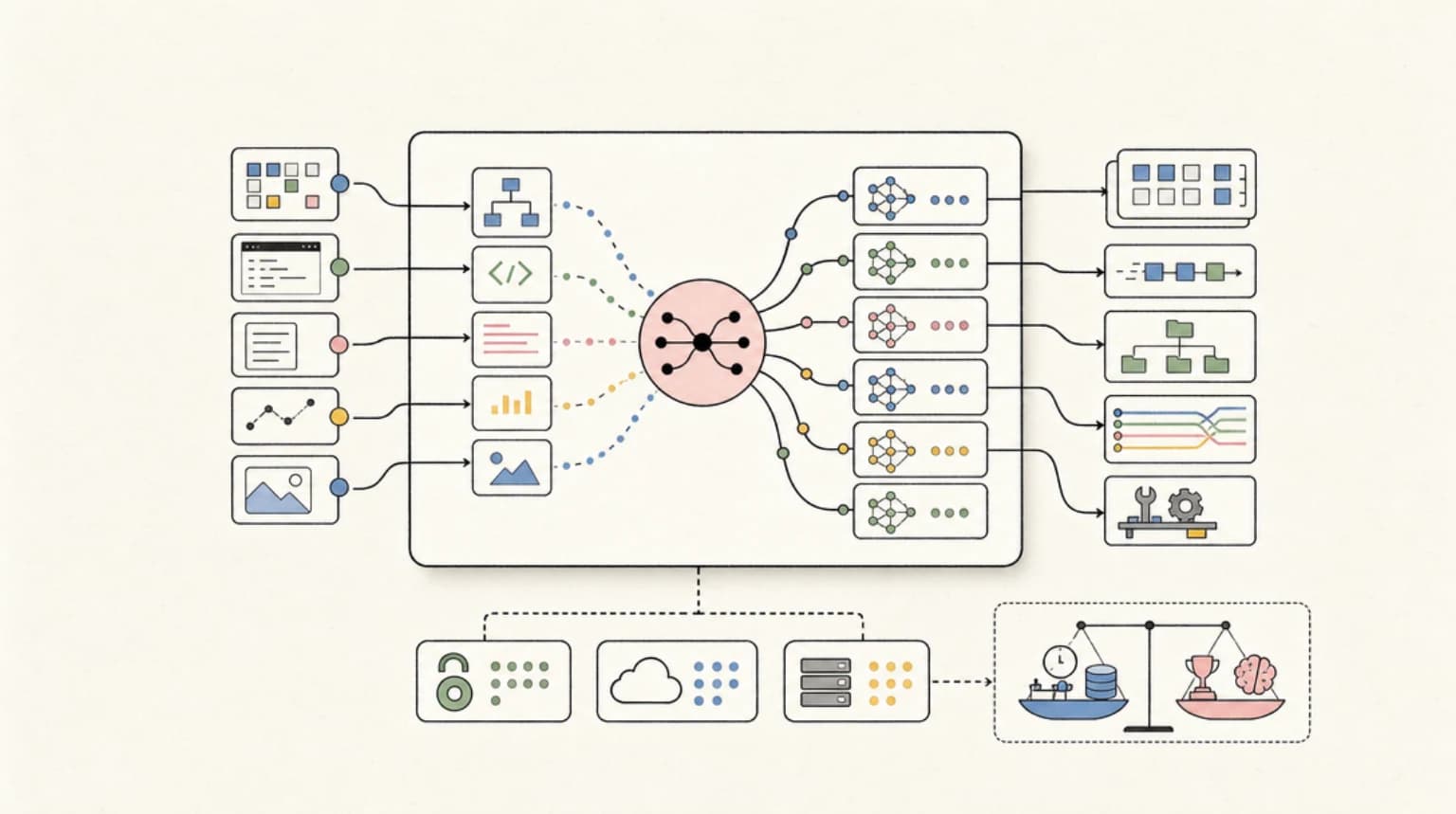
No single model wins every task anymore, and the companies that never trained one - Factory, Devin, Perplexity, Cursor, OpenCode - are turning that into a moat. This is how model routing works, why open weights and neoclouds make it cheap, and the honest counter-argument.
Official Sources#
| Source | What it covers |
|---|---|
| Factory: Factory Router | Documented automatic model-selection architecture |
| OpenRouter: How model routing works | Provider routing, price ceilings, fallback chains |
| a16z: The State of Generative Media 2026 | "No one model to rule them all," orchestration thesis |
| Simon Willison: GLM-5.2 | Concrete open-weights price spread across providers |
| SemiAnalysis: AI value capture | The counter-argument: value shifting back to labs |
For two years the assumed winners of the AI build-out were the labs with the best single model. That assumption is quietly breaking. By mid-2026 there is a top coding model, a top reasoning model, a top agentic-terminal model, a top open-weights model, and a top value model, and none of them are the same system. When capability fragments like that, the company that picks the right model per task can beat the company that owns any one model. Optionality becomes the product.
This post is about the layer that makes optionality real: the model router. It covers how routing actually works under the hood, why open weights and a new tier of GPU clouds make it cheap, who is building on it (Factory, Cognition's Devin, Perplexity, Cursor, Windsurf, OpenCode), and the honest case that this thesis is overstated.
Last verified: June 20, 2026.
No single model wins everything#
The clearest signal is the spread of per-task leaders. As of mid-June 2026, the independent and vendor-reported benchmark picture looks roughly like this, and the point is the diversity, not any one number:
- Reasoning and overall: Claude Opus 4.8 sits at the top of the Artificial Analysis Intelligence Index, and is also the most expensive at $5 / $25 per million tokens.
- Agentic terminal work: GPT-5.5 leads Terminal-Bench.
- Tool use: Kimi K2.7 Code posts the highest MCP-Mark score, reportedly ahead of Opus 4.8 on that specific benchmark, at a fraction of the price.
- Leading open weights: Z.ai's GLM-5.2 tops the open-weights Intelligence Index and ranks second on Code Arena's web-dev leaderboard.
- Value frontier: DeepSeek V4 and Gemini 3.1 Pro anchor the cheap-but-capable corner.
Cross-check any single figure against Artificial Analysis before quoting it, because vendor-reported scores drift. But the shape is not in dispute. a16z's State of Generative Media 2026 puts it bluntly: there is "no one model to rule them all," and enterprise production deployments already use a median of 14 different models. Their framing of the consequence is the thesis of this whole post: "The unit of work isn't one model, it's a workflow," and the orchestration layer "matters as much as the models themselves."
When releases land at the pace they did this June - several significant open-weights models in the first two weeks alone - betting your product on one model is a standing liability. Routing is how you stop betting.
What a model router actually does#
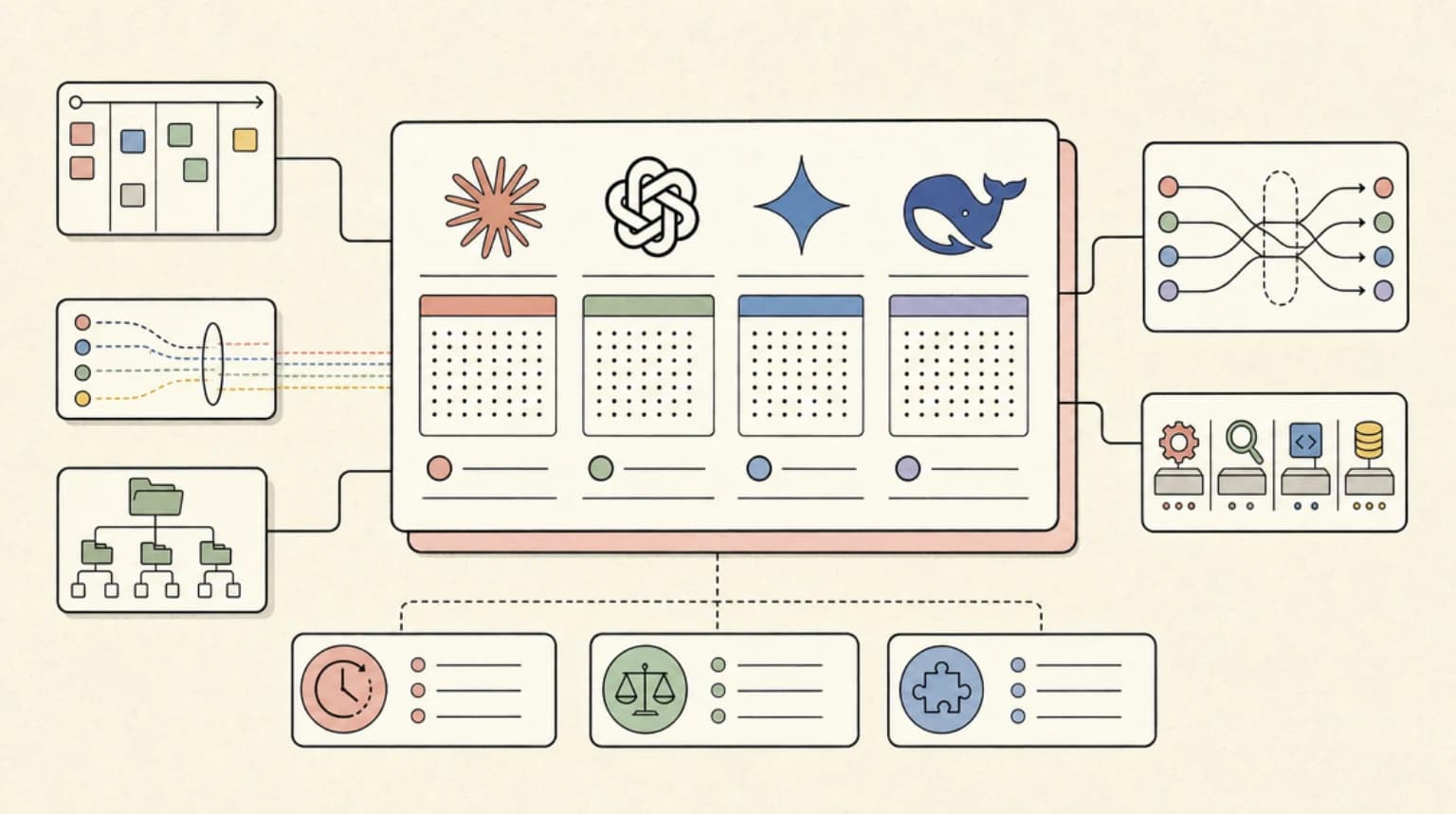
"Router" gets used loosely, so it helps to separate two distinct jobs, because most real systems do both:
- Model selection: given this task, which model should answer?
- Provider selection: given that model, which host should serve it, at what price and latency, with what fallback?
OpenRouter is the cleanest public example of the second job. Its June 2026 write-up describes routing every request across 70-plus providers while the caller controls "the provider order, the price ceiling, and the fallback chain." The motivating failure mode is stated plainly: "If Anthropic rate-limits you mid-traffic, your app shouldn't return a 500." Modes like :nitro (optimize latency) and :floor (optimize price) and an automatic fallback chain turn provider choice into a dial rather than a hard dependency.
Factory is a clear example of the first job, and its documentation is unusually specific about the mechanism. Factory Router runs a fast classifier (around two seconds) over the first user message, recent tool calls, and repository signals, then emits a quality-probability score per candidate model. Those signals are weighted - the message itself, recent tools, repo size, language mix, and difficulty - candidate models are sorted from cheapest to most expensive, and the cheapest model that clears a quality threshold wins. It also documents auto-failover across providers. Factory's own benchmarks claim it holds frontier pass rates while cutting cost by around 25 percent. Treat that figure as vendor-reported: it is measured on Factory's internal suites relative to Claude Opus, not independently verified.
The common pattern across both: spend a cheap model on easy tasks, escalate to an expensive one only when the work demands it, and never let a single provider outage take you down.
From the archive
How to Track SEC Filings and Insider Trades (and What Each Form Actually Means)
Jun 20, 2026 • 8 min read
DuckDB Internals: What Makes It So Fast
Jun 19, 2026 • 8 min read
Three Ways to Ignore Files in Git (Beyond .gitignore)
Jun 19, 2026 • 5 min read
GitHub Copilot Agent Finder: What ARD Means for Third-Party AI Tools in 2026
Jun 19, 2026 • 8 min read
The optionality advantage in practice#
The companies leaning hardest into this share a trait: none of them trained a frontier model, and they treat that as a feature.
- Cognition's Devin is explicitly model-agnostic. Cognition's own developer advocate framed the payoff after GLM-5.2 shipped: a model-agnostic platform gets "immediate access to the latest models as soon as they ship without having to lift a finger." That post also describes GLM-5.2 as free inside Devin at the time of writing. Worth a caveat: the exact terms of that "free" access (duration, caps) are not spelled out in a primary Cognition pricing doc, so confirm current terms on Devin's pricing page before planning around it. The structural point stands regardless - a model-agnostic agent adopts a new best-in-class model on day zero.
- Perplexity routes across proprietary, third-party, and open models, and its "Best" mode "automatically selects the ideal model for your query," with its in-house Sonar model handling the latency-sensitive path. Whatever you think of any one answer, the architecture is optionality by default.
- Cursor and Windsurf route across Claude, GPT, and Gemini and expose a per-task model picker, so a developer can send a refactor to one model and a tricky reasoning task to another. The contrast with first-party tools is the whole story: Claude Code is excellent and deliberately locked to Anthropic's models, which is a different bet than "use whoever is best this month."
- OpenCode is the open-source, model-agnostic coding agent in the same family. Because it points at any OpenAI-compatible endpoint, it lets an individual developer get the same optionality the platforms have - swap from a frontier model to GLM-5.2 on OpenRouter without changing tools. See the OpenCode developer guide for setup.
The through-line: when you are not married to a lab, every new model release is an upgrade you get for free instead of a competitor you have to answer.
Why open weights and neoclouds make it cheap#
Routing across labs would be a thin advantage if every model cost the same. Open weights break that, because anyone can host an open model and compete on price. The cleanest evidence comes from Simon Willison's June 17 write-up: GLM-5.2 was available "via OpenRouter, which has it from 9 different providers, almost all charging $1.40/M input and $4.40/M output. For comparison, GPT-5.5 is $5/$30 and Claude Opus 4.5 to 4.8 is $5/$25." Nine independent hosts converging on one low price for one open model is optionality and price competition in a single screenshot. The full provider and pricing breakdown is in the GLM-5.2 access guide.
The supply side of that competition is the "neocloud" tier - GPU clouds like CoreWeave, Lambda, Crusoe, Nebius, and inference specialists like Fireworks, Together, and DeepInfra that rent compute and serve open models against the hyperscalers. This is now a real market, not a fringe: CoreWeave alone reported quarterly revenue around $2.1 billion, roughly doubling year over year. More hosts racing to serve the same open weights is exactly what pushes per-token prices toward the floor. a16z's data backs the incentive: 58 percent of organizations name cost optimization as their primary criterion when choosing model infrastructure, ahead of raw availability or speed.
The honest counter-argument#
This thesis can be oversold, and a careful builder should hold the other side too.
- Value may be shifting back to the labs, not away. SemiAnalysis argues that agentic AI drove a step-change in the value of tokens, which can pull margin and leverage toward whoever trains the best models rather than the routing layer on top. If one lab opens a durable capability gap, optionality matters less.
- Falling per-token prices do not always mean falling bills. The "intelligence too cheap to meter" line is real at the unit level, but agentic workloads spend dramatically more tokens per task, so total cost can rise even as price per token drops. Routing helps here, but it is not a free lunch.
- Routing adds its own failure surface. A classifier that picks the wrong model, or silently downgrades a hard task to a cheap model to hit a cost target, can be worse than just using a strong default. The 25-percent-savings claims are vendor benchmarks; your mileage depends on your task mix.
- First-party lock-in buys real integration. Tools tied to one lab can co-design the model and the harness together. That tight coupling is a genuine advantage for some workflows, which is why Claude Code stays single-lab on purpose.
The balanced read: optionality is a strong structural position in a fragmented market, not a guaranteed win. It pays off most when no single model dominates - which describes mid-2026 well, and may or may not describe 2027.
What this means if you are building#
- Default to a router, not a model. Whether it is OpenRouter at the API layer, Factory's automatic selection, or a model-agnostic agent like OpenCode or Devin, design so swapping models is a config change, not a rewrite.
- Use the cheap-to-expensive escalation pattern. Send easy work to a cheap or open model and reserve frontier models for tasks that earn the cost. That is what the good routers do automatically.
- Keep a fallback chain. Provider outages and rate limits are routine. A documented fallback is cheap insurance.
- Re-benchmark on your own tasks monthly. With multiple significant models shipping per week, last month's best pick is an assumption worth re-testing.
The frontier labs will keep mattering. But the quiet winners of this phase may be the companies that never trained a model and instead got very good at choosing one.
FAQ#
What is an AI model router?#
A model router is a layer that decides which model should handle a given request and, often, which provider should serve it. Some routers select by task (cheap model for easy work, frontier model for hard work), and some select by provider (cheapest or fastest host, with automatic failover). Tools like Factory Router select by task; OpenRouter primarily routes across providers.
Why is being model-agnostic an advantage?#
Because no single model is best at everything in 2026, a model-agnostic tool can route each task to the strongest option and adopt new models the day they ship, without re-engineering. Platforms like Devin, Perplexity, Cursor, and OpenCode are built this way, which is how they offered GLM-5.2 access almost immediately after release.
How do open weights lower cost?#
When a model's weights are open, any provider can host it and compete on price. GLM-5.2, for example, was served by nine providers on OpenRouter at roughly $1.40 input and $4.40 output per million tokens, versus $5 / $25 to $30 for comparable closed models. Competition among hosts pushes the price toward the cost of compute.
What are neoclouds?#
Neoclouds are GPU-focused cloud providers - CoreWeave, Lambda, Crusoe, Nebius, and inference specialists like Fireworks, Together, and DeepInfra - that rent compute and serve open-weights models in competition with the hyperscalers. They are a big reason open-model inference keeps getting cheaper.
Is the optionality thesis guaranteed to win?#
No. The counter-case is real: value may shift back toward whoever trains the best models, total token spend can rise even as per-token prices fall, and routing adds its own failure modes. Optionality is strongest while capability stays fragmented, which describes mid-2026 but is not guaranteed to hold.
Continue Reading#
- AI Session Portability Compared 2026: OpenAI vs Anthropic vs Gemini
- Fugu Ultra's Frontier Performance Claim, Explained Without the Hype
- Sakana Fugu and the Case for Not Betting Everything on One Proprietary Model
- Sakana Fugu Ultra: The Model Router Making the Frontier Look Less Proprietary
Sources#
- Factory: Factory Router
- OpenRouter: How model routing works and provider selection docs
- a16z: The State of Generative Media 2026
- Simon Willison: GLM-5.2
- Perplexity: which AI models are included
- Devin (Cognition) pricing
- SemiAnalysis: AI value capture, the shift to model labs
- Artificial Analysis
- Network World: neoclouds challenge hyperscalers
Read next
Where to Run GLM-5.2 Free and Cheap: Every Provider Compared (2026)
GLM-5.2 ships under an MIT license, so it is hosted everywhere - and a few places run it for free or nearly free right now. Here is every way to access Z.ai's open-weights coding model, from OpenCode Go referral credits and Devin to the cheapest per-token routes on OpenRouter, Fireworks, and DeepInfra, plus local Ollama.
10 min readOpenCode Developer Guide: The Open Source AI Coding Agent with 160K Stars
OpenCode is the fastest-growing open-source AI coding agent - 160K GitHub stars, 7.5M monthly users, 75+ model providers. Here is how to set it up, configure models, and use it effectively in your workflow.
11 min readFrontier Model API Pricing, August 2026: Claude vs OpenAI vs Gemini vs DeepSeek
Same-day-verified llm api pricing august 2026: Claude Fable 5, GPT-5.6 Sol/Terra/Luna, Claude Sonnet 5, Gemini 3.5 Flash, and DeepSeek V4 compared per million tokens, plus the caveats that change the math.
11 min readShare
Developers Digest
Technical content at the intersection of AI and development. Building with AI agents, Claude Code, and modern dev tools - then showing you exactly how it works.
300+ videos30K+ GitHub stars850+ articles
Related Tools
AI ModelsOpen weights

DeepSeek V4
DeepSeek's open-weights frontier family, previewed April 24, 2026. V4-Pro is 1.6T total / 49B active params; V4-Flash is...
View ToolAI CodingOpen source
DeepSeek-TUI
Open-source terminal agent runtime with approval modes, rollback snapshots, MCP servers, LSP diagnostics, and a headless...
View ToolAI Models

ChatGPT
OpenAI's flagship. GPT-4o for general use, o3 for reasoning, Codex for coding. 300M+ weekly users. Tasks, agents, web br...
View ToolAI Models

OpenRouter
Unified API for 200+ models. One API key, one billing dashboard. OpenAI, Anthropic, Google, Meta, Mistral, and more. Aut...
View ToolApps from Developers Digest
Related Guides
Guide
Claude Code Setup Guide
Configure Claude Code for maximum productivity -- CLAUDE.md, sub-agents, MCP servers, and autonomous workflows.
AI AgentsGuide
MCP Servers Explained
What MCP servers are, how they work, and how to build your own in 5 minutes.
AI AgentsGuide
Run AI Models Locally with Ollama and LM Studio
Install Ollama and LM Studio, pull your first model, and run AI locally for coding, chat, and automation - with zero cloud dependency.
Getting StartedRelated Videos
Grok-2: xAI's New Frontier Model
In this video, I introduce the beta release of Grok 2 and Grok 2 Mini. I discuss the new models available on the X platform and their impressive performance, including their ranking on the...
Video·

Gemma 2 Aims for the Crown! Google's Latest Open-Weights 9B & 27B Models
Exploring Google's Advanced Gemma 2 AI Models and Exciting Updates In this video, I delve into Google's newly released Gemma 2 AI models, including the 9 billion and 27 billion parameter versions....
Video·

IDEFICS: A New Frontier in Multimodal Language Models
#IDEFECS #HuggingFace #gpt4 Links: https://huggingface.co/spaces/HuggingFaceM4/idefics_playground https://huggingface.co/models?other=multimodal https://huggingface.co/blog/idefics https://huggin...
Video·
Related Posts
10 min read
glm
Where to Run GLM-5.2 Free and Cheap: Every Provider Compared (2026)
GLM-5.2 ships under an MIT license, so it is hosted everywhere - and a few places run it for free or nearly free right n...
11 min read
opencode
OpenCode Developer Guide: The Open Source AI Coding Agent with 160K Stars
OpenCode is the fastest-growing open-source AI coding agent - 160K GitHub stars, 7.5M monthly users, 75+ model providers...
11 min read
pricing
Frontier Model API Pricing, August 2026: Claude vs OpenAI vs Gemini vs DeepSeek
Same-day-verified llm api pricing august 2026: Claude Fable 5, GPT-5.6 Sol/Terra/Luna, Claude Sonnet 5, Gemini 3.5 Flash...
9 min read
pricing
GLM-5.2 Cost Math: When Open-Weights Coding Models Actually Save You Money
Z.ai's GLM-5.2 lands as a 753B open-weights coding model that beats GPT-5.5 on SWE-bench Pro for roughly one-sixth the p...

12 min read
deepseek
Where to Run DeepSeek V4 Flash Free and Cheap: Every Provider Compared (2026)
DeepSeek V4 Flash pricing split into peak and off-peak rates in August 2026, while third-party hosts kept serving the ol...

9 min read
opencode
Ox Alpha on OpenCode: The Free Stealth Model, Specs, Privacy Split, and How to Run It
OpenCode dropped Ox Alpha as a free stealth model on August 20, 2026: 1M context, multimodal, near-unlimited for about a...
Build with the member tools

Get Smarter About AI Dev
New tutorials, open-source projects, and deep dives on coding agents - delivered weekly.
One email per weekReal code, not theoryFree forever