Sakana Fugu and the Case for Not Betting Everything on One Proprietary Model
TL;DR
Sakana Fugu makes a timely argument for model routing: frontier performance should come from swappable systems, not a hard dependency on one proprietary API.
Official Sources#
| Source | What it covers |
|---|---|
| Sakana Fugu release | Launch framing and single-vendor dependency argument |
| Sakana Fugu product page | Product behavior, model opt-out, pricing, availability |
| TRINITY paper | Evolved coordinator approach |
| Conductor paper | RL-trained orchestration over open and closed agents |
| Anthropic Fable/Mythos access update | Context for model access and policy risk |
The cleanest way to explain Sakana Fugu is this: it tries to make frontier AI feel less like a single proprietary dependency.
That does not mean Fugu is open source. It does not mean the underlying pool is fully open. It means the product's central design bet is routing. Instead of your app calling one model and hoping that provider stays available, affordable, permitted, and best-in-class, Fugu presents one API that can coordinate a swappable pool of models behind it.
For engineering teams, that is the interesting part. Model routing is moving from cost hack to architecture strategy.
Last updated: June 22, 2026.
The Problem With One-Model Architecture#
The single-model architecture is easy:
- Pick the best model.
- Put it behind your product.
- Add retries, caching, evals, and observability.
- Hope nothing material changes.
Something always changes. Prices move. context windows change. rate limits change. model behavior changes. access policies change. regional rules change. The model that is best this quarter may be second-best next quarter.
Sakana's launch leans directly into that reality. It points to recent model-access disruptions and argues that relying on one company for critical AI capability is a material vulnerability. That is a strong claim, but it is not abstract anymore. Model access is now an architecture risk.
Fugu's Answer: Orchestration Behind One API#
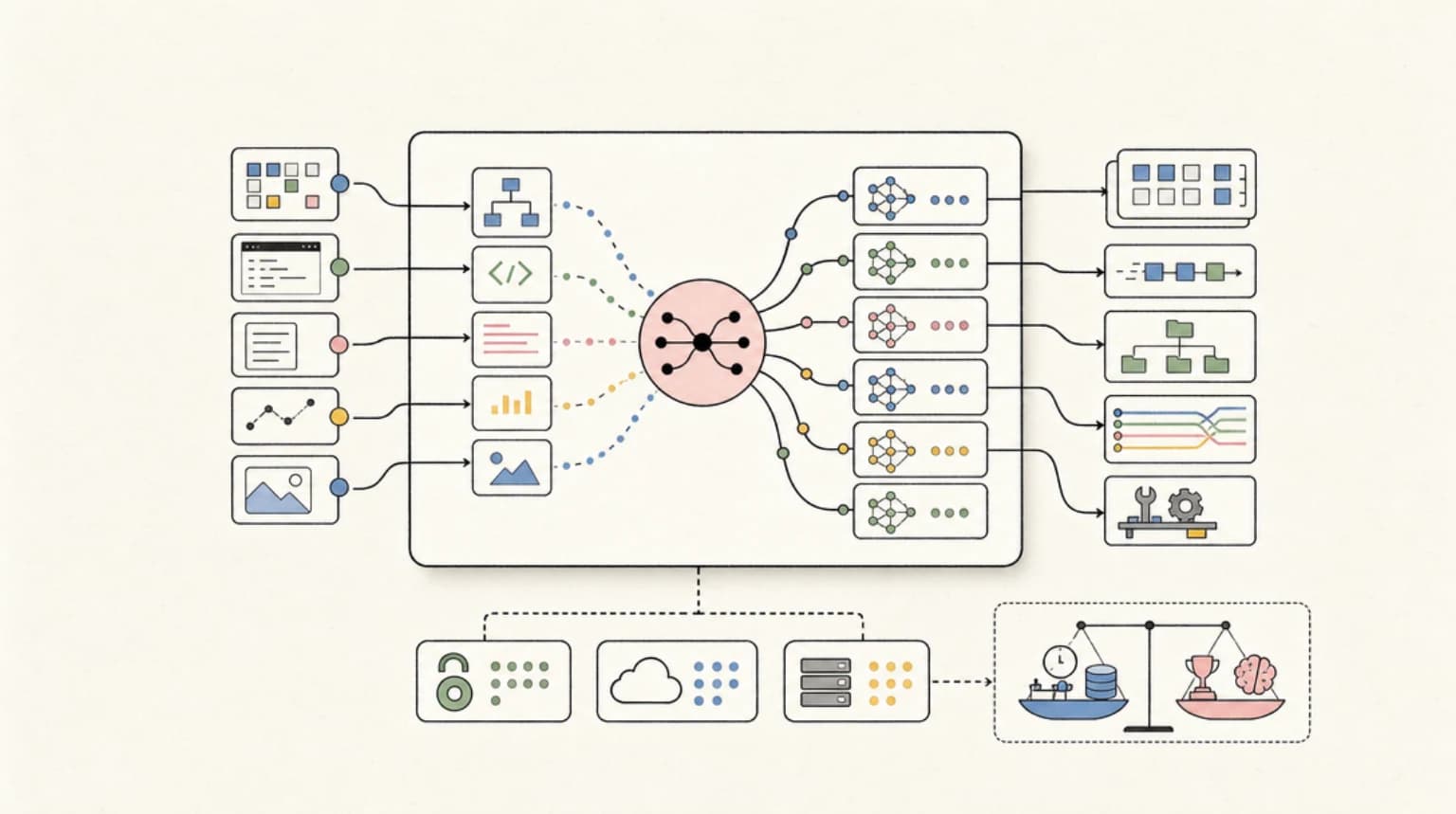
Fugu is designed to hide the complexity of a multi-model system behind a single OpenAI-compatible API.
Source image: Sakana Fugu product page.
The user sends one request. Fugu chooses whether to answer directly or coordinate multiple agents. It can select models, delegate subtasks, verify outputs, and synthesize the final result. Standard Fugu also lets users opt specific agents out of the pool for compliance or privacy requirements.
This is a meaningful difference from normal API abstraction. A basic provider gateway swaps one model for another. Fugu is trying to decide how models should collaborate.
Why Routing Beats Pure Proprietary Dependence#
The benefit of routing is not ideological. It is practical.
You can move around outages and access changes. If a provider becomes unavailable, a swappable pool can route elsewhere. A direct integration cannot.
You can match work to capability. Some tasks need a top reasoning model. Others need cheap summarization, retrieval cleanup, or code formatting. Routing can reserve expensive models for where they matter.
You can improve as the ecosystem improves. Sakana says Fugu can incorporate newer models over time, including open models and Sakana's own models. If the pool improves, the surface API can improve without each customer rebuilding orchestration logic.
You can separate application logic from model selection. Your product should not need 40 hand-coded branches for every provider, model, task type, and failure mode. A good routing layer makes the application smaller.
From the archive
The Frontier Performance Claim#
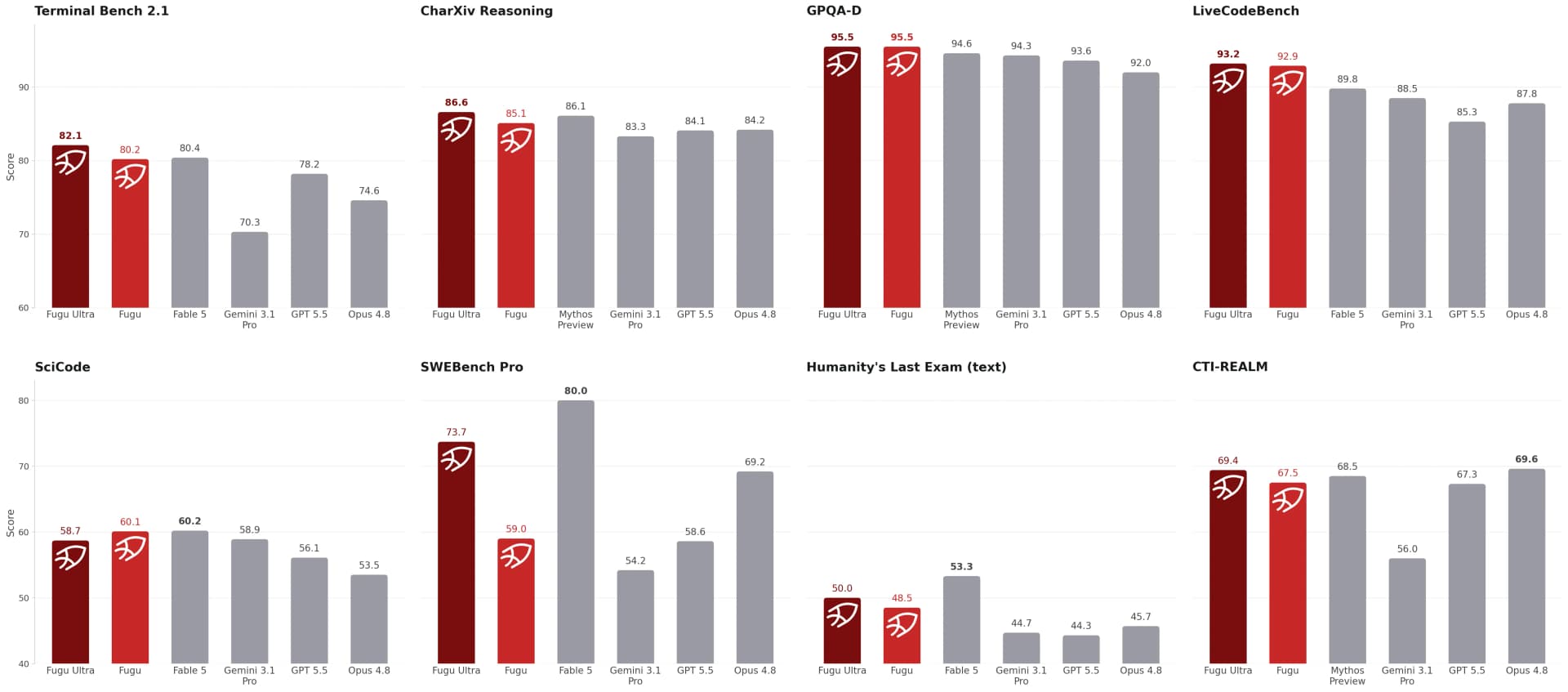
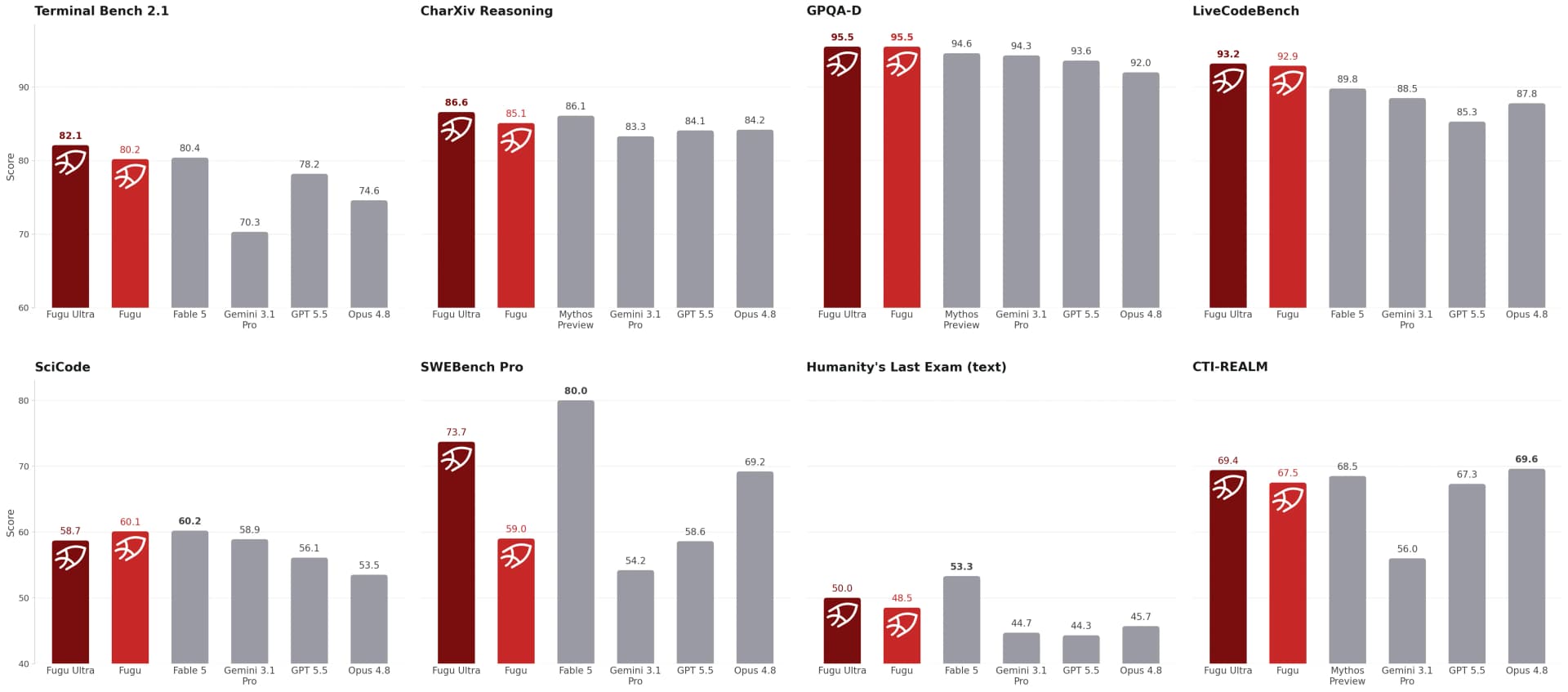
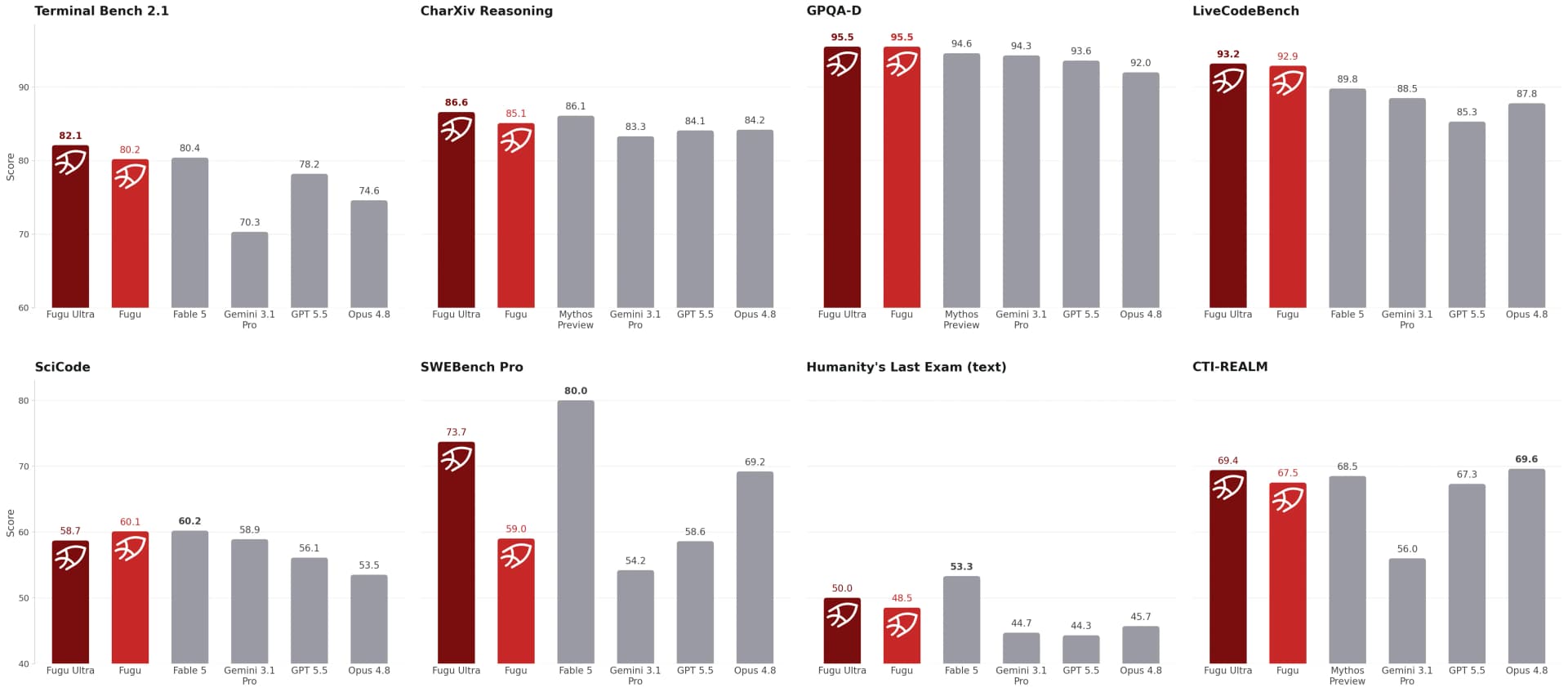
Sakana reports that Fugu Ultra reaches frontier-level performance across coding, reasoning, science, and agentic benchmarks.
Source image: Sakana Fugu release.
The detailed benchmark table shows strong results across SWE-bench Pro, TerminalBench 2.1, LiveCodeBench, GPQA-D, Humanity's Last Exam, SciCode, and long-context reasoning.
Source image: Sakana Fugu release.
The most honest interpretation is that Fugu makes routing competitive with the direct-frontier path for certain hard tasks. It does not prove routing is always better. The release relies partly on provider-reported baseline scores, and independent third-party evals will matter.
But the bar has moved. A routed system no longer looks like a second-tier fallback. It looks like a serious contender for high-end work.
The Novel Part: Learned Coordination#
The old way to build this is a hand-authored pipeline:
- send planning to Model A
- send execution to Model B
- send critique to Model C
- ask Model A to summarize
That works for demos. It gets brittle in production.
Sakana's research direction is learned coordination. TRINITY evolves a lightweight coordinator that assigns Thinker, Worker, and Verifier roles. Conductor trains a 7B coordinator with reinforcement learning to discover communication patterns and instructions for worker models.
That matters because the right workflow is task-dependent. A coding benchmark, a literature review, a cyber assessment, and a mechanical design task should not use the same agent topology.
The Tradeoffs#
Routing has real costs.
Opacity. If you cannot see which model handled which part of a request, auditing gets harder. This matters for regulated teams and for debugging quality regressions.
Latency. Multi-agent systems are slower than direct calls. Fugu exists for tasks where quality matters enough to spend more inference-time compute.
Cost. Fugu Ultra pricing is frontier-tier for heavy usage. Routing can reduce waste, but orchestration itself burns tokens.
Data governance. Standard Fugu includes model opt-out. Fugu Ultra is more quality-focused and less configurable. Teams with strict data policies need to check this before sending sensitive work.
New lock-in. A routing layer can reduce dependence on one model provider while increasing dependence on the orchestrator. That may be a good trade, but it is still a trade.
A Practical Routing Policy#
Use a routed system like Fugu when:
- the task has multiple phases
- correctness matters more than latency
- different model strengths are useful
- provider resilience matters
- you do not want to maintain orchestration yourself
Use a direct model call when:
- latency matters
- the task is simple
- the answer is easy to verify
- your compliance policy requires known model execution
- cost needs to be predictable per request
The mature architecture is not "everything through Fugu" or "never use routers." It is a policy:
| Workload | Default |
|---|---|
| Autocomplete and chat UI | Fast direct model |
| Routine summaries | Cheap direct model |
| Code review on important PRs | Routed model or frontier model |
| Research synthesis | Routed model |
| Security analysis | Routed model with strict scope |
| Regulated data | Direct approved model or self-hosted model |
What This Means for Open Models#
The open-model ecosystem benefits from routing because open models do not need to win every benchmark to be useful. They need to be excellent at some jobs, cheap enough to call often, and easy to swap into a larger system.
That is the deeper point. If AI architecture becomes routed, the winner is not only the single best proprietary model. The winner is the best portfolio: frontier models, open models, small specialists, verifiers, local models, and task-specific tools.
That is better for developers. It creates price pressure. It creates deployment options. It makes self-hosting and data residency more realistic. It also forces proprietary labs to compete on reliability and ecosystem fit, not only peak benchmark scores.
FAQ#
Does Sakana Fugu eliminate vendor lock-in?#
No. It changes the lock-in shape. You depend less directly on one model provider, but you depend more on Sakana's orchestration layer.
Is Fugu open source?#
No. Fugu is a commercial product. The open-model relevance is that it can route across a pool that may include open models, closed models, and future Sakana models.
Why not just use OpenRouter or LiteLLM?#
Gateways are useful for provider abstraction. Fugu is aiming at learned multi-agent coordination, not only model selection. For simple routing, a gateway may be enough.
Is opaque routing a problem?#
It can be. If you need to prove exactly which model saw which data, opaque routing is a compliance and debugging concern. Standard Fugu's model opt-out helps, but it does not make the system fully transparent.
When should teams avoid model routing?#
Avoid it for low-latency UI, simple deterministic tasks, highly regulated data paths, or any workflow where the orchestration overhead costs more than the quality gain.
Continue Reading#
- Factory Router, Explained: How Automatic Model Routing Cuts Coding-Agent Spend 20-25%
- GPT-5.5 in 7 Minutes: Benchmarks, Codex Agents, Context Window, and Pricing
- Fugu Ultra's Frontier Performance Claim, Explained Without the Hype
- Sakana Fugu Ultra: The Model Router Making the Frontier Look Less Proprietary
Sources#
- Sakana Fugu release - verified June 22, 2026
- Sakana Fugu product page - verified June 22, 2026
- TRINITY: An Evolved LLM Coordinator - verified June 22, 2026
- Learning to Orchestrate Agents in Natural Language with the Conductor - verified June 22, 2026
- SakanaAI/fugu technical report repository - verified June 22, 2026
- Anthropic Fable/Mythos access context - verified June 22, 2026
Read next
Sakana Fugu Ultra: The Model Router Making the Frontier Look Less Proprietary
Sakana Fugu Ultra is not just another giant model. It is a learned orchestration layer that routes work across expert models, matches frontier benchmark claims, and makes a serious case for multi-model AI systems.
10 min readGLM-5.2 Cost Math: When Open-Weights Coding Models Actually Save You Money
Z.ai's GLM-5.2 lands as a 753B open-weights coding model that beats GPT-5.5 on SWE-bench Pro for roughly one-sixth the per-token cost. Here is the real cost math, a worked cost-per-task example, and a when-to-use-which decision guide.
9 min readAI Coding Tools Pricing Comparison 2026
Complete pricing breakdown for every major AI coding tool. Claude Code, Cursor, Copilot, Windsurf, Codex, Augment, and more. Free tiers, pro plans, hidden costs, and what you actually get for your money.
12 min readShare
Developers Digest
Technical content at the intersection of AI and development. Building with AI agents, Claude Code, and modern dev tools - then showing you exactly how it works.
300+ videos30K+ GitHub stars850+ articles
Related Guides
Guide
Run AI Models Locally with Ollama and LM Studio
Install Ollama and LM Studio, pull your first model, and run AI locally for coding, chat, and automation - with zero cloud dependency.
Getting StartedGuide
Model Aliases - Claude Code
Use opus, sonnet, haiku, and best to switch models easily.
Claude CodeGuide
Model Picker (/model) - Claude Code
Interactive UI to switch models and effort sliders mid-session.
Claude CodeRelated Posts
10 min read
ai-models
Sakana Fugu Ultra: The Model Router Making the Frontier Look Less Proprietary
Sakana Fugu Ultra is not just another giant model. It is a learned orchestration layer that routes work across expert mo...
9 min read
pricing
GLM-5.2 Cost Math: When Open-Weights Coding Models Actually Save You Money
Z.ai's GLM-5.2 lands as a 753B open-weights coding model that beats GPT-5.5 on SWE-bench Pro for roughly one-sixth the p...

12 min read
AI Coding
AI Coding Tools Pricing Comparison 2026
Complete pricing breakdown for every major AI coding tool. Claude Code, Cursor, Copilot, Windsurf, Codex, Augment, and m...

10 min read
Aider
Aider vs Claude Code in 2026: Git-First Open Source vs Subagent Runtime
Updated 2026 comparison of Aider and Claude Code using official docs and current workflow patterns: architecture, contro...
11 min read
ai-benchmarks
Fugu Ultra's Frontier Performance Claim, Explained Without the Hype
Sakana says Fugu Ultra stands with Fable, Mythos, GPT-5.5, Gemini, and Opus by orchestrating models instead of being one...
11 min read
ai-models
The Router Era: Why Not Owning a Frontier Model Became an Advantage
No single model wins every task anymore, and the companies that never trained one - Factory, Devin, Perplexity, Cursor,...
Build with the member tools

Get Smarter About AI Dev
New tutorials, open-source projects, and deep dives on coding agents - delivered weekly.
One email per weekReal code, not theoryFree forever