Agentic AI Reliability Is a Systems Problem
TL;DR
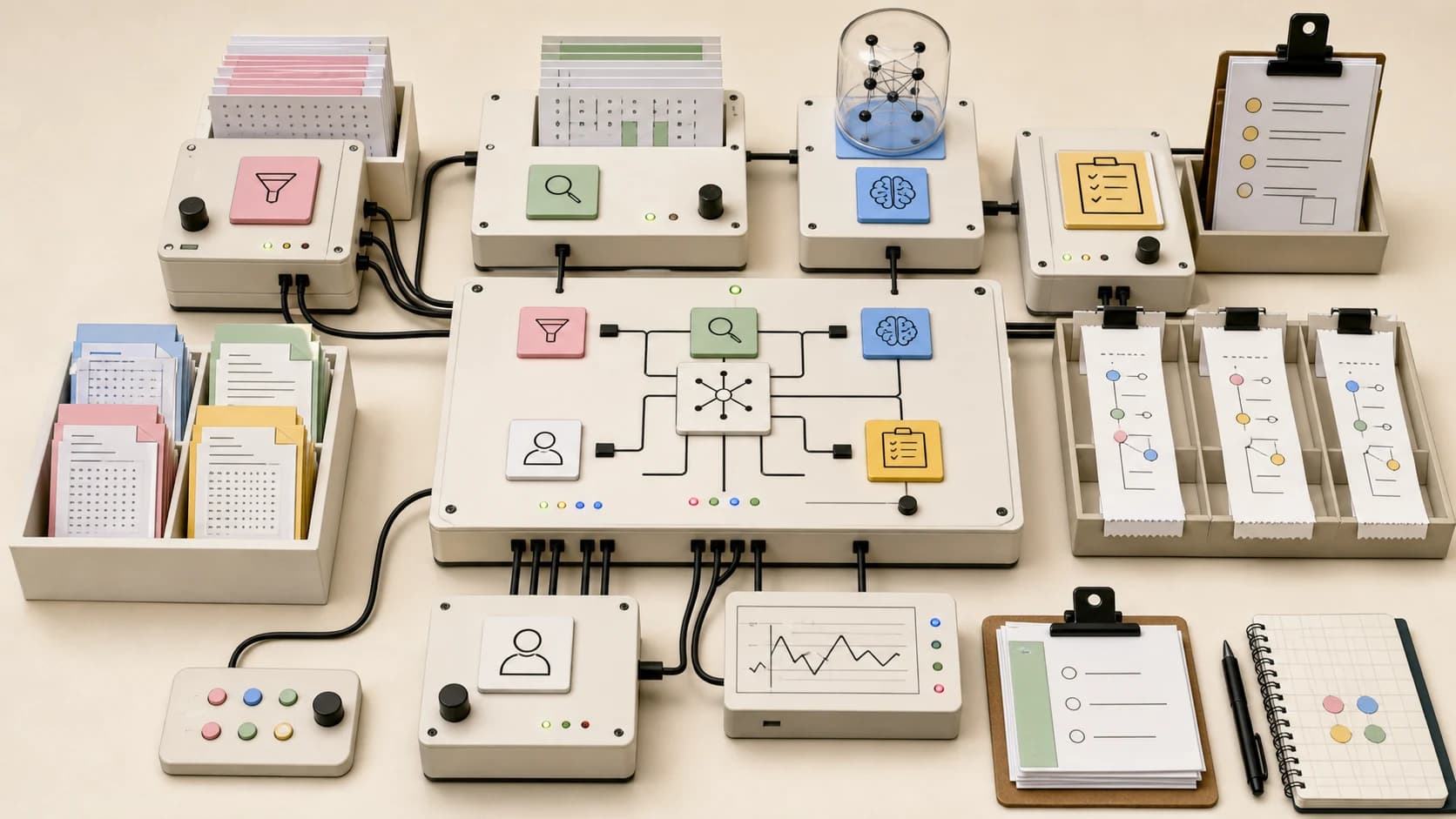
The Bayer and Thoughtworks PRINCE case study is a useful reminder that reliable agentic AI comes from context routing, traces, evals, monitoring, and human review, not from a better prompt alone.
Official Sources#
| Source | Link |
|---|---|
| Bayer/Thoughtworks case study | Building Reliable Agentic AI Systems |
| Hacker News discussion | HN discussion with 119 points |
| LangSmith evals documentation | LangSmith Evaluation |
| OpenAI Evals documentation | OpenAI Evals |
| OpenTelemetry semantic conventions | OpenTelemetry Spec |
Martin Fowler's site published a Bayer and Thoughtworks case study on building reliable agentic AI systems, and it is more useful than another model-release post because it shows what production reliability actually looks like.
The system, PRINCE, is a preclinical research assistant for Bayer. It combines agentic RAG and Text-to-SQL over decades of structured and unstructured research material, including PDF study reports. The interesting part for developers is not the pharma domain. It is the architecture vocabulary: context engineering, harness engineering, transparency, evaluation, monitoring, resilience, and human-in-the-loop review.
Last updated: June 22, 2026
The post also made the Hacker News front page today with 119 points and 29 comments when I checked, which is a useful signal. Developers are not only asking "which model is best?" anymore. They are asking how to make agents accountable enough to use inside real systems.
That is the right question.
The Takeaway#
Reliable agentic AI is a systems problem.
The PRINCE case study describes a system that evolved from keyword search into a natural-language research assistant. That path matters because the team did not simply drop a chat box on top of documents and call it done. They split the work into stages: clarify the user's intent, plan, retrieve evidence, validate sufficiency, synthesize an answer, expose traceable sources, monitor behavior, and keep humans in the loop for high-consequence work.
That maps directly to the pattern we keep seeing in developer tools. A coding agent that edits one file can look magical with a thin prompt. A coding agent that touches auth, migrations, tests, docs, release notes, and production rollout needs a harness.
For more on the failure math, see the agent reliability cliff. For the eval side, pair this with baseline receipts for agent evals. The Bayer case study is the same story from an enterprise RAG system instead of a codebase.
Context Engineering Is the First Reliability Layer#
The case study frames context engineering as shaping what information each model receives, what it does not receive, and how information moves between specialized steps.
That is a better framing than "give the model more context."
Long context windows are useful, but they also make it easier to hide stale instructions, irrelevant documents, duplicated chunks, and contradictory history inside the prompt. Agent reliability improves when context is intentionally routed:
| Context question | Production version |
|---|---|
| What does the user mean? | Clarify intent before retrieval or tool use |
| What evidence is needed? | Separate planning from retrieval |
| What should be excluded? | Keep noisy context out of worker steps |
| What evidence was used? | Attach citations, traces, and source receipts |
| What changed during the run? | Persist intermediate state outside the model |
That is the same reason agent context reduction keeps becoming more important. The goal is not smaller prompts for their own sake. The goal is a context path you can inspect and debug.
If a production agent gives a wrong answer, "the model saw a lot of documents" is not enough. You need to know which documents, why they were selected, which intermediate claim they supported, and where the system decided the evidence was sufficient.
From the archive
AI Coding Agents Move the Bottleneck to Review Queues
Jun 21, 2026 • 8 min read
How to Use GLM 5.2 and Other Custom Model Providers in Codex
Jun 21, 2026 • 9 min read
There Are No Instances in ATProto - Dan Abramov Explains the Architecture
Jun 20, 2026 • 7 min read
Cloudflare Temporary Accounts: Let Agents Deploy Without OAuth Flows
Jun 20, 2026 • 6 min read
Reflection Is a Gate, Not a Vibe#
The PRINCE architecture includes a reflection agent for data validation and sufficiency. That is the part most demo agents skip.
Reflection gets weak when it means "ask the model if it feels confident." It gets useful when it has a job:
- check whether retrieved evidence actually answers the question;
- identify missing studies, documents, tables, or entities;
- force a retry when evidence is too thin;
- mark uncertainty instead of smoothing it away;
- block synthesis when the answer would be overconfident.
For coding agents, the equivalent is a review gate between "I edited files" and "ship it." Did tests run? Did the diff touch the intended files? Did the agent change behavior outside the requested surface? Did it preserve user work? Did it leave a receipt a reviewer can trust?
That is why long-running agents need harnesses, not just better prompts. The harness owns state, retries, checkpoints, logs, and stop conditions. The model makes decisions inside that frame.
Evals Need Realistic Fixtures#
The Bayer system is grounded in a real enterprise problem: structured metadata, unstructured PDF reports, domain-specific terminology, fragmented systems, and regulatory pressure. That combination is exactly where generic benchmarks stop being useful.
The lesson for developer teams is to build realistic fixtures before arguing about model choice.
For an agentic RAG product, a realistic fixture might include:
- documents with overlapping but not identical claims;
- stale metadata that conflicts with source documents;
- tables that require entity normalization;
- questions that require refusing or asking for clarification;
- expected answers with source-level evidence requirements.
For a coding agent, the fixture is a fake but realistic repo: auth, billing, migrations, flaky tests, feature flags, partial docs, and a bug that cannot be solved by one grep.
This is where baseline receipts matter. Do not only score the final answer. Compare the candidate run against the current production baseline and keep the trajectory evidence: prompt version, model version, retrieved sources, tool calls, retries, latency, cost, and human review notes.
Monitoring Is Part of the Product#
The Fowler article calls out monitoring as part of building trust in a production LLM system. That should be obvious, but agent products still often treat logs as an afterthought.
A useful monitoring surface for an agentic system should answer:
| Signal | Why it matters |
|---|---|
| Retrieval coverage | Shows whether the agent is using the right evidence pool |
| Reflection failures | Reveals where evidence is insufficient or validation is too strict |
| Retry counts | Finds loops before they turn into spend incidents |
| Human override rate | Shows where automation is not earning trust |
| Citation quality | Separates grounded answers from fluent answers |
| Cost and latency by step | Makes reliability tradeoffs visible |
This is the production version of the same instinct behind Claude API reliability and error handling. Resilience is not one retry wrapper. It is a set of signals that tell you when the system is drifting, looping, skipping evidence, or asking humans to clean up too much.
The Skeptical Read#
There is a fair opposing view: this is a lot of machinery.
If you are building a small internal assistant, do you really need intent clarification, planning, retrieval, reflection, synthesis, evals, monitoring, and a human review loop? Maybe not. Sometimes the right answer is a plain search box, a deterministic workflow, or a normal database report.
The practical dividing line is consequence.
If the agent's output is low-risk, easy to inspect, and cheap to rerun, keep the system boring. If the output influences regulated work, production code, customer decisions, money movement, security, or medical/legal interpretation, the harness stops being optional.
The better criticism is not "agents do not work." It is "agents only work when the surrounding system narrows the task, verifies the evidence, and makes failure visible."
That is a useful bar.
A Developer Checklist#
Before shipping an agentic workflow, ask these seven questions:
- What exact context is allowed into each step?
- Where does intermediate state live outside the model?
- What evidence must be present before synthesis?
- Which failures trigger retry, escalation, or stop?
- What trace does a reviewer see after the run?
- What baseline does a candidate change have to beat?
- Which actions always require human approval?
If those answers are vague, the system is still a demo.
FAQ#
What is agentic AI reliability?#
Agentic AI reliability is the ability of a multi-step AI workflow to produce correct, grounded, reviewable results across real tasks, not just a successful demo. It depends on context routing, tool boundaries, verification, retries, monitoring, and human escalation.
What is context engineering?#
Context engineering is the practice of deciding what information a model receives, what it does not receive, and how context moves between steps. It is important because more context can make agents less reliable if the information is noisy, stale, or unauditable.
Do agentic RAG systems need evals?#
Yes, if they influence real decisions. Evals should use realistic fixtures, compare candidate changes against a stable baseline, and preserve receipts for retrieved evidence, tool calls, costs, latency, and human review.
When should a team avoid an agentic architecture?#
Avoid agentic architecture when a deterministic workflow, search interface, report, or conventional application flow solves the problem with less ambiguity. Use agents when the workflow genuinely requires planning, retrieval, judgment, synthesis, and adaptation.
Continue Reading#
- Harness Handbook Shows the Missing Map for Coding Agents
- Image Token Compression Is a Real Agent Cost Lever
- Vector Database Comparison for RAG and AI Agents
Sources#
- Building Reliable Agentic AI Systems, Martin Fowler / Thoughtworks / Bayer, checked June 21, 2026.
- Hacker News front-page discussion data for the article, checked June 21, 2026.
- Hacker News item for "Building reliable agentic AI systems", checked June 21, 2026.
- LangSmith evaluation documentation, checked June 22, 2026.
- OpenAI Evals documentation, checked June 22, 2026.
- OpenTelemetry semantic conventions, checked June 22, 2026.
Read next
The Agent Reliability Cliff: Why Your 10-Step Chain Only Succeeds 20% of the Time
The math of agent pipelines is brutal. 85% reliability per step compounds to about 20% at 10 steps. Here is why long chains collapse in production, and the six patterns the field has converged on to fight the decay.
9 min readAgent Evals Need Baseline Receipts
Hex's data-agent lab shows the practical eval pattern AI teams should copy: compare candidates against stable baselines, keep receipts, and judge changes by task behavior.
8 min readThe 98% Context Reduction Pattern
Efficient agents do not stuff every tool result into the model context. They keep intermediate state in code, files, and execution environments, then return compact summaries and receipts.
8 min readShare
Developers Digest
Technical content at the intersection of AI and development. Building with AI agents, Claude Code, and modern dev tools - then showing you exactly how it works.
300+ videos30K+ GitHub stars850+ articles
Related Tools
AI Frameworks

OpenAI Agents SDK
Lightweight Python framework for multi-agent systems. Agent handoffs, tool use, guardrails, tracing. Successor to the ex...
View ToolAI Frameworks

Mastra
TypeScript-first AI agent framework. Agents, tools, memory, workflows, RAG, evals, tracing, MCP, and production deployme...
View ToolRelated Guides
Guide
Claude Code Complete Course
A complete, citation-backed Claude Code course with setup, prompting systems, MCP, CI, security, cost controls, and capstone workflows.
ai-developmentGuide
Extended Thinking - Claude Code
Toggle with Alt+T. Claude reasons through complex problems before responding.
Claude CodeRelated Posts

9 min read
AI Agents
The Agent Reliability Cliff: Why Your 10-Step Chain Only Succeeds 20% of the Time
The math of agent pipelines is brutal. 85% reliability per step compounds to about 20% at 10 steps. Here is why long cha...

8 min read
AI Agents
Agent Evals Need Baseline Receipts
Hex's data-agent lab shows the practical eval pattern AI teams should copy: compare candidates against stable baselines,...

8 min read
Context Engineering
The 98% Context Reduction Pattern
Efficient agents do not stuff every tool result into the model context. They keep intermediate state in code, files, and...
9 min read
AI Agents
Long-Running Agents Need Harnesses, Not Hope
A long-running coding agent is only useful if the environment around it can queue tasks, capture logs, checkpoint state,...

10 min read
Claude
Claude API Reliability: Error Handling Best Practices
The defensive patterns that keep Claude integrations alive in production. Retry shapes, backoff with jitter, circuit bre...
8 min read
AI Agents
Harness Handbook Shows the Missing Map for Coding Agents
A July 2026 paper from Tencent Hunyuan turns agent harnesses into behavior-level maps. The useful lesson for builders is...
Build with the member tools

Get Smarter About AI Dev
New tutorials, open-source projects, and deep dives on coding agents - delivered weekly.
One email per weekReal code, not theoryFree forever