Briefing · Sunday, August 23, 2026
MCP's New Roadmap, Why Your Local LLM Isn't Dumb, GPT-5.6 Cuts Prices
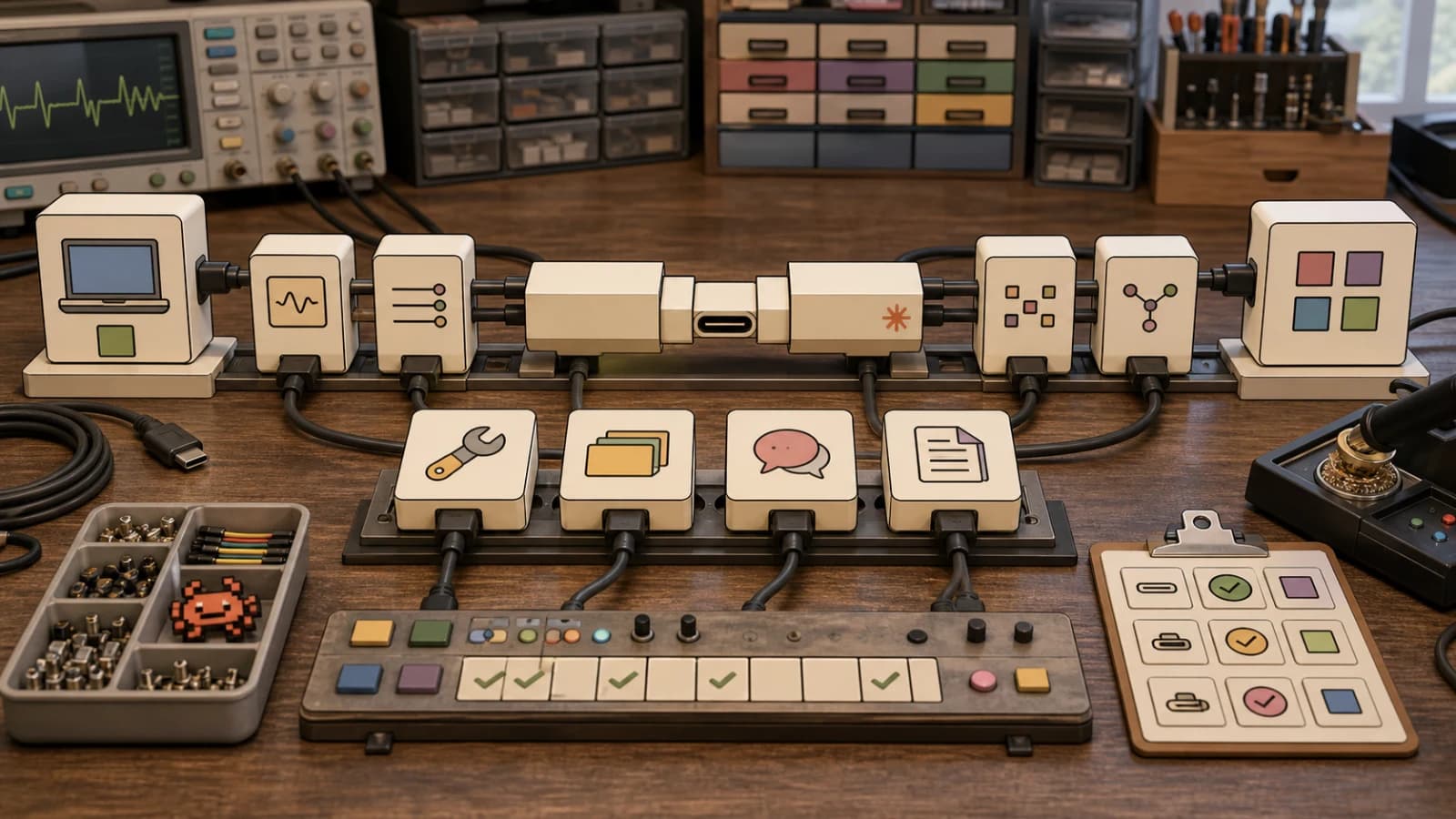
Good morning. It's Sunday, August 23, and we're covering the Model Context Protocol's next five priority areas, a series of experiments that prove your local LLM's "dumbness" is often the inference stack's arithmetic, and OpenAI cutting GPT-5.6 Sol input prices by 20 percent. Plus: ATProto finally opens the door to private data, and your Kobo e-reader can now run signed Rust apps.
The Level1Techs inference-divergence thread held 357 points overnight, and the MCP roadmap post earned 133 comments in its first day. Here is the signal, sourced.
In today's brief:
- MCP's maintainers publish a five-priority roadmap: streaming agentic messaging, one HTTP transport, agent identity, better tool primitives, and SDK ergonomics
- A 100k-token bakeoff shows attention backends and quantized KV caches flip top-1 tokens - and break tool calls
- ATProto Spaces alpha launches: non-public data with access control but no confidentiality
- GPT-5.6 Sol drops to $4/$20 per million tokens, promo through at least November 21
- Cobalt turns the Kobo Clara into a signed-app platform with a one-file Rust SDK
THE BIG ONE
MCP Publishes Its Next Roadmap: Streaming Events, Agent Identity, One Transport
The Model Context Protocol's maintainers, David Soria Parra and Den Delimarsky, published the protocol's updated roadmap (209 points, 133 comments) on Friday, and it reads as a straight list of what agents need once they run unattended. Five priority areas, each with a named set of Core Maintainers and a Working Group: agentic messaging primitives, HTTP-native transport unification and hardening, agent identity and enterprise-ready security, improved primitives, and SDK developer experience.
Two changes in the upcoming cycle are worth a careful read for anyone running servers today. First, agentic messaging: MCP's standard request-and-response pattern no longer fits long-running loops, so the roadmap centers server-initiated events - webhooks and channels - so clients do not poll for results, plus a composition review across the Agents, Transports, and Triggers & Events Working Groups, and maturing the Tasks extension (SEP-2663) toward the main specification. Second, transport: the July 2026 spec made a remote MCP server "no different from any other HTTP workload," and the next push is to unify that same Streamable HTTP transport over stdio for local servers, collapsing two code paths into one.
The security work is the most enterprise-shaped. Authorization today assumes "a person approving access in a browser," which is the wrong model when callers are cloud workloads acting for an absent user, or delegating narrower authority to sub-agents. The roadmap commits to finalizing Demonstrated Proof of Possession (DPoP) and driving adoption, an opinionated Workload Identity Federation path, and standard token exchange, with continued engagement at the IETF OAuth and WIMSE working groups. And for tool-heavy servers, a progressive discovery effort means a server can expose a small entry point and reveal more of its catalog as the conversation narrows - the goal is to stop charging the model for a hundred tools before the user asks anything. SEPs inside these areas get expedited review; the live roadmap page names the responsible maintainers for each.
Our coverage: the 2026 MCP primer explains what the protocol is if you are new to it, and the MCP servers roundup covers the server ecosystem this roadmap is trying to tame.
Why it matters: every priority in the list - push-based events, proof-of-possession, workload identity, progressive discovery - is the plumbing agents need to run as infrastructure rather than as attended CLI sessions, and the protocol is now explicitly building for that world.
MACHINE LEARNING
Why Your Local LLM Feels Dumber Than It Is: A 100k-Token Evidence Chain
A Level1Techs thread (357 points, 127 comments) by forum member thr3e is doing something most "local LLM is bad" debates never do: measuring where the dumbness comes from. Using Qwen3.6-27B on an RTX PRO 6000 with pinned nightly vLLM builds, he replayed a roughly 100,000-token real agent workstream with forced teacher decoding and captured logits at scale. The baseline finding is unsettling: rerunning the same model with the same backend produces bit-for-bit identical logits, but swap the attention CUDA kernel and the math quietly changes. Across the three vLLM attention backends (FlashAttention 2, Flash Inference, Triton), top-1 token disagreements appeared in content-dependent clusters - and FA2 produced a repeatable wrong tool call targeting the wrong Cisco interface, then ran the wrong command to recover from its own mistake.
Test 2 isolated KV-cache quantization. Leaving weights and activations untouched, int8 KV cache initially recovered from flipped tokens while int4 "did not" - with a fully reproducible tool-calling error. Test 3 ran a five-way weight-quant bakeoff against the BF16 reference: official FP8, INT8 W8A16, NVIDIA NVFP4, and AWQ W4A16. The INT8 build (W8A16 with unquantized GDN projections) was the cleanest; NVIDIA's NVFP4 mixed checkpoint came in dead last at roughly 50 percent top-1 flips by 88k context - the thread's running joke is "FP4 is a lie." Both 4-bit quants botched tool calls, executing show run where the correct command was show arp. Tensor parallelism added its own chaos: TP1 handled a tool call, TP2 failed, TP4 succeeded - the usual NCCL suspects.
Part 3 applied the same harness to "abliterated" Qwen3.8 derivatives. Stock Qwen3.8's vision and MTP tensors were hashed byte-for-byte identical across all four remixes, so all divergence comes from language-weight edits - and the AEON recipe produced 36 structurally invalid branch futures in one prompt, including a port corrupted to 543ql and a .tenant hostname mangled from a token Stock picked at p=0.99996. The practical advice is the actionable core: use the sampler settings on the model card (temperature too low is why your Qwen loops in THINK output), treat model-card KLD numbers without disclosed methodology as uninterpretable, and judge a local setup with long-context tool-calling evals on your own workload, not three zero-shot prompts. Per the author, the H200 and B200 runs are done and a distributable test harness is coming.
Our coverage: the open-weights serving bakeoffs and the Qwen 3 guide frame the hardware and model side of running these stacks yourself.
Why it matters: once inference arithmetic is an axis of correctness, "the model is dumb" becomes a diagnosis with a fix - and quantized KV caches, attention kernels, and TP counts belong on the checklist before blaming the checkpoint.
PLATFORMS
ATProto Spaces Alpha: The Biggest Update Since Launch Brings Private Data
The AT Protocol published the Spaces alpha announcement (145 points on HN) on Thursday: non-public data whose absence, the Bluesky team argues, has been the protocol's biggest gap since launch. By design, every record on atproto today is public and rebroadcast by a global firehose. Spaces are a new primitive - a "miniature atproto network" gated by a space authority: a plain DID (often the account itself) that decides which other DIDs may read. Records live in per-space permissioned repos on the author's PDS, and because there is no relay rebroadcasting space data, applications sync directly from PDS hosts with a lighter-weight, real-time sync protocol. The documentation is explicit that spaces give you access control, not confidentiality: the data is not encrypted, and anything inside a space is readable by anyone granted access.
The release is genuinely playable today. Bluesky hosts an alpha PDS (invite code from your BPS account), the TypeScript @atproto packages are published under the alpha npm tag, a reference PDS distribution ships as ghcr.io/bluesky-social/atproto:pds-spaces-alpha, and a sample app - bulletin.my, a bulletin board where only your followers can post sticky notes - runs against it with source on GitHub. The ecosystem has already started implementing the spec without waiting: ZDS in Zig, atproto-crates and rsky PDSes in Rust, and HappyView as an AppView framework. Multiple Bluesky engineers described it as the biggest atproto update since the protocol launched. The caveats are sized appropriately: no security review yet, no backups, destructive migrations possible, the alpha PDS will be deleted, and the goal is a real launch later this year. Do not upload anything you cannot lose.
Our coverage: what the ATProto code forge means for developers covers the protocol's direction from the Tangled migration angle.
Why it matters: spaces are the piece that lets settings, drafts, subscription-only feeds, and invite-only communities live on a portable-identity protocol instead of inside one vendor's silo - and for developers, alpha SDKs plus a hosted PDS mean the build path is open right now.
MODELS
GPT-5.6 Sol: 20 Percent Off Input, 33 Percent Off Output - Through November
OpenAI's GPT-5.6 Sol model page (89 points on HN) now shows promotional pricing: $4 per million input tokens, $0.40 cached input, and $20 per million output - a 20 percent input and 33 percent output reduction against GPT-5.5's $5/$0.50/$30, with the promo marked valid through at least November 21, 2026. Sol is the family's frontier tier, roughly the unsuffixed tier of earlier GPT-5 families; gpt-5.6 as a model alias routes to it. The rest of the contract matters for agent workloads: a 1,050,000-token context window with 922,000 max input tokens and 128,000 output, reasoning effort levels from none to max, and a heavy-context penalty clause - prompts over 272,000 input tokens price the entire request at 2x input and 1.5x output rates.
On the Responses API the model carries the full agent tool shelf: web_search, file_search, code_interpreter, hosted_shell, apply_patch, skills, computer_use, mcp, and tool_search. There is no fine-tuning, no embedding, no realtime, and no image generation on this tier - it is deliberately a doing-things model, not a content model. The comparison table against GPT-5.4 ($2.50/$15) shows pricing is headed where agent economics keep pushing it: the frontier falls while the workload's token consumption rises, and cached input stays at a tenth of list.
Our coverage: the DeepSeek V4 economics deep-dive and the coding-tools pricing matrix give the comparison points for what $4/$20 means in the current market.
Why it matters: a frontier model at $20 per million output tokens makes the arithmetic for agent fleets noticeably cheaper overnight, and the November deadline means teams should price the promo window into their roadmaps - or the 2x long-context surcharge into their token bills.
TOOLING
Your Kobo Runs Signed Rust Apps Now: The Cobalt Platform
The week's biggest-points story (645 points) is a hobby-scale platform play: Cobalt is an open-source application platform for Kobo e-readers - a launcher, a signed App Store, a Rust SDK, and a runtime that runs every app as "its own unprivileged process" on stock hardware. You install it once over USB on a supported reader (fully tested: Clara BW N365, Elipsa 2E N605, Clara HD N249), and after that every app installs, updates, and removes over Wi-Fi, with signatures verified before launch. A reboot returns the device to the stock Kobo reader, and the platform itself also updates over Wi-Fi; the USB cable is only ever needed once.
The app list reads like a small dev-tool ecosystem on e-ink: an arXiv reader that renders preprint HTML with math and tables, a Hacker News client with full comment threads, an OPDS feed reader, a terminal with immediate-send keys, an audiobook studio, and - the one that went viral on the thread - Sidekick, which pairs with Claude Code over the local network and sends approve-or-deny questions to the e-ink panel, so you can gate a coding agent's actions from a device that weighs 174 grams. The SDK is aggressively minimal: one Rust file per app, declarative screens, and capability-gated requests - apps do not open device resources, they ask, and a refusal comes back as a value the app can handle. Store transactions are recovery-safe, app releases publish independently of platform releases, and contributing an app is a pull request with a photo or GIF of it running. AGPL-3.0, with device support threads for the Libra, Clara Colour, and Aura waiting on testers.
Why it matters: e-ink panels are a credible third screen for agent operations - cheap, distraction-free, and always-on - and Cobalt's signature-verified, over-the-air app model is a small but complete reference for shipping code to constrained devices.
TOOLS WORTH A LOOK
- llm 0.33 (OSS) - Simon Willison's CLI updated to the OpenAI Python library 3.x on the
httpx2client, per-call--keysupport for embeddings, repeatable-ttemplates that combine model config with prompts (llm -t lhigh -t pelican), and areasoning_summaryoption for Responses API models. - Munder Difflin (free OSS for individuals /
$39per month cloud tier, 281 points) - an agent harness that wraps 12 CLI agents (Claude Code, Codex, OpenCode, Gemini CLI, Kimi, Grok, Qwen, Copilot, Cursor and more) into always-on "clones" on your own laptop, with local-first execution, an encrypted clone-to-clone message channel, and a shared org memory. - MartyPC (OSS, 117 points) - a cross-platform cycle-accurate emulator of 8088-era PCs written in Rust, built for observing every detail of early DOS-era hardware.
WHAT ELSE IS HAPPENING
- ElevenLabs, TwelveLabs, ThirteenLabs... (401 points): a survey of 100 number-plus-"labs" companies, annotated for AI-ness, asks why the startup-naming scheme ate the entire number line - and quietly reasembles the state-of-the-internet in table form.
- Anthropic appears to be A/B testing reduced effort levels in Claude Code (191 points): a screenshot-report of a
/effortdrawdown in the Claude Code hit parade - worth watching if you bill tokens per run. - NanoGPT Speedrun Frontier (101 points): Prime Intellect ran 153 autonomous runs across 18 frontier models on the nanoGPT optimizer speedrun - Fable 5 via Claude Code closed 81.7 percent of the human record gap in 8.7 agent-days, with traces for 41 curated trajectories published.
- Wi-Fi 8 is the first wireless upgrade in years that isn't chasing speed (103 points): reliability, determinism, and managed-home-network goals take priority over raw rates for the first time in the standard's recent history (9 min read).
- More than just code review: Simon Willison's note that the key skill with coding agents is instructing changes confidently and verifying them correctly - line-by-line review was never the whole job.
- JIT Compiling Code in 5us (66 points): Michael Malis's writeup on shrinking JIT entry overhead to microseconds, the project the Dan Luu essay called "formerly worth a team, now a weekend."
Every link above goes to a primary source or our sourced coverage. Tomorrow's brief lands when the news does - subscribe to get it by email.
Get the next one in your inbox
The daily brief, delivered. Free, unsubscribe anytime.