Agent Workflows as Code: Why State Machines Beat Prompt Checklists
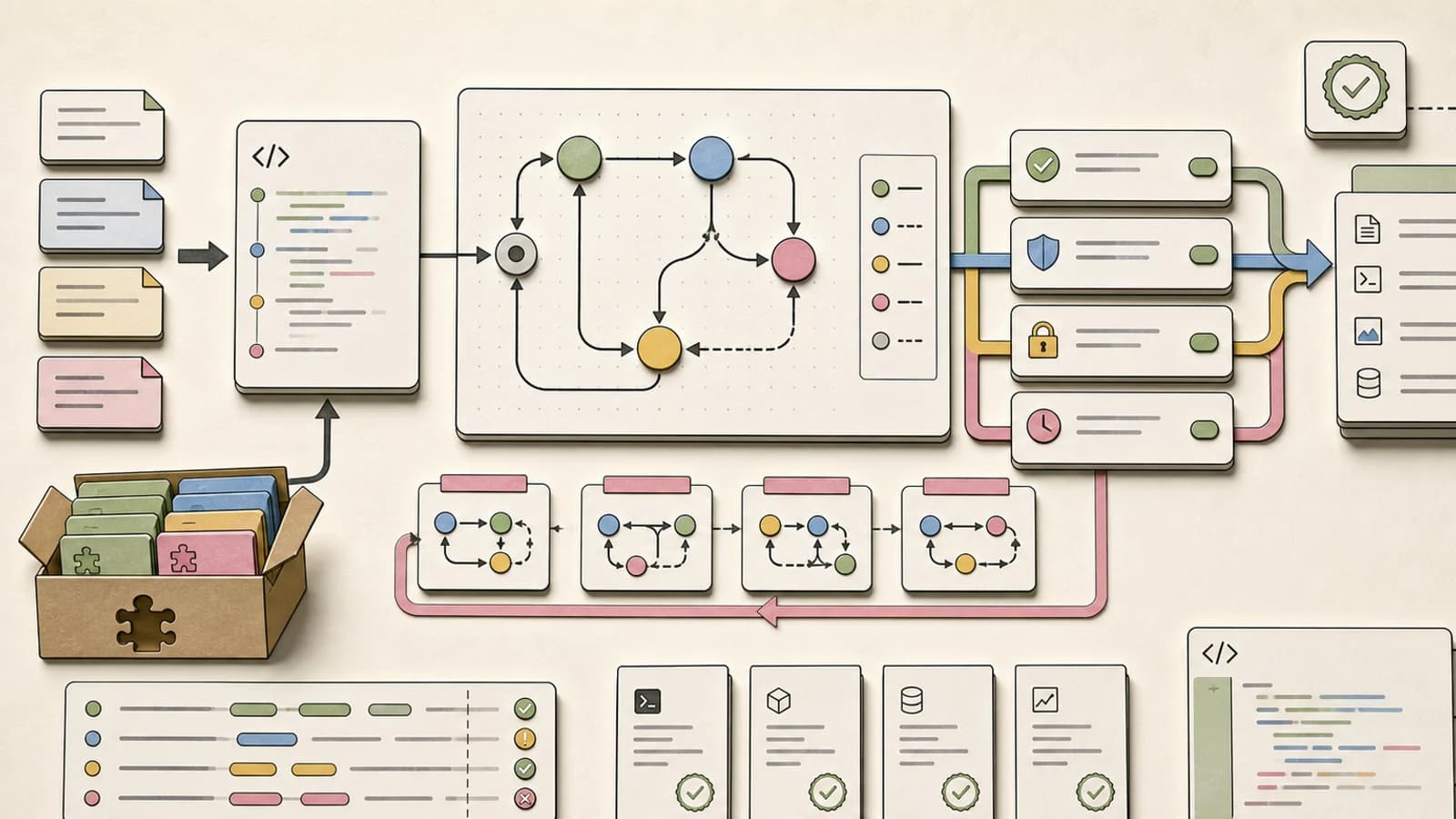
TL;DR
Aharness, LangChain's custom harness pattern, and OpenAI's code-first migration all point to the same next step: agent processes need typed gates, validated evidence, and controlled transitions.
Official Sources#
| Source | Description |
|---|---|
| Aharness GitHub | Workflow harness for Codex with finite state machine enforcement |
| OpenAI Agents SDK docs | Official SDK for building production agents with typed tools and state |
| LangChain custom agent harness | Middleware patterns for retries, policies, and human approvals |
| XState documentation | State machine library referenced in the post |
| LangGraph docs | Graph-based agent orchestration with state nodes |
Prompts can describe a workflow. They cannot enforce one.
That is the sharp lesson from the latest agent tooling wave. OpenAI is moving production agent work away from hosted visual surfaces and toward the Agents SDK. LangChain is writing about custom harnesses as the scaffolding around the model. Aharness, a new Codex-focused project on GitHub and Hacker News, makes the argument more explicit: encode coding-agent workflows as finite state machines with typed gates, validated evidence, controlled transitions, repair paths, and inspectable logs.
That is the right direction.
The next useful abstraction is not a longer prompt. It is a workflow runtime the agent cannot casually ignore.
Last updated: June 27, 2026
What Is New Here#
The fresh signal is Aharness, described as a workflow harness for Codex. Its pitch is narrow and practical: agent workflows should be finite state machines written in TypeScript, with states that define what Codex may do next and transitions that require validated exits.
The Show HN thread frames the problem directly: models are capable enough for longer autonomous work, but process drift and context management are now the failure modes. Prompts and skills describe the process; they do not enforce it.
That is the distinction worth writing down.
It also fits the larger context from the last few days:
- OpenAI Agent Builder and Evals are on a shutdown path, which pushes production agent logic toward code and repo-owned evals.
- LangChain's custom agent harness post argues that production agents need middleware for retries, policies, human approvals, cost limits, and task-specific scaffolding.
- OpenAI's Agents SDK docs emphasize typed application code, direct tool control, custom storage, state, guardrails, human review, and observability.
The direction is consistent: serious agent workflows are becoming software artifacts.
The Take: Process Belongs in Runtime, Not Prompt Memory#
A prompt checklist can say:
Text
Plan first.
Only edit the requested files.
Run tests.
Attach evidence.
Stop if tests fail twice.
Ask before risky changes.
That is better than nothing. It is also easy for an agent to forget, reinterpret, or satisfy with a weak summary.
A workflow runtime can enforce:
- the agent cannot leave planning until it submits an accepted plan;
- implementation cannot start until scope is declared;
- verification cannot pass without command output;
- repair can only loop a fixed number of times;
- final reporting cannot happen until evidence is attached;
- risky actions require a human gate.
That is a different class of control.
This is the same reason long-running agents need harnesses. The model can do more work now. The surrounding system has to decide what counts as a valid move.
Why Finite State Machines Fit Agent Work#
A finite state machine sounds academic until you map it to a coding-agent run.
| State | Allowed exits | Evidence required |
|---|---|---|
| intake | accept task, request clarification, reject task | task contract |
| plan | approve plan, revise plan | scoped plan and file boundaries |
| implement | move to verify, request tool approval | diff summary |
| verify | pass, fail, repair | command output and failing logs |
| repair | retry verify, escalate, stop | fix attempt and retry count |
| final | close run | receipt with changes, checks, risks |
That is already how good human-led agent sessions work. The difference is whether the structure lives in the operator's head or in code.
State machines give agent runs three useful properties:
Controlled transitions. The agent can only move to states the workflow exposes. If there is no direct path from intake to final, the agent cannot skip planning and verification by writing a confident closeout.
Typed submissions. Each state can require a specific shape of evidence: a plan object, a file list, a command transcript, a test result, or a risk note. Natural language becomes input to a verifier, not the verifier itself.
Repair paths. Failure can be part of the workflow instead of an exception. A failed test can move the run to repair with a retry budget, or to escalation if the same failure repeats.
That makes the workflow inspectable after the fact. You can ask where the run stalled, which gate failed, which evidence was missing, and whether the agent followed the process.
From the archive
AI's Affordability Crisis Is Really an Agent Cost Accounting Problem
Jun 23, 2026 • 8 min read
Armin Ronacher on The Coming Loop and Why Agent-Driven Code Still Needs Human Comprehension
Jun 23, 2026 • 9 min read
Cerebras Stock Is a Public Test of AI Inference Demand
Jun 23, 2026 • 7 min read
Claude Outages Are a Workflow Design Problem
Jun 23, 2026 • 7 min read
Skills Still Matter, But They Are Not Enough#
This is not an argument against skills.
Skills are useful because they package operating knowledge. A good skill can teach an agent how your team debugs flaky tests, writes release notes, reviews migrations, or handles UI QA. That is why skills beat prompts for repeatable work.
But a skill is still mostly instruction. It tells the agent what good looks like.
A workflow runtime tells the agent what moves are allowed.
You want both:
AGENTS.mdfor repo context;- skills for reusable methods;
- MCP and CLI tools for observation and action;
- state machines for process control;
- eval receipts for outcome comparison.
That is the stack the post-visual-builder world is converging on.
Where LangChain's Harness Pattern Fits#
LangChain's custom harness post uses different language, but the problem is similar. The post defines a harness as scaffolding around the model that connects it to the real world. It specifically calls out middleware for retries, fallbacks, policy enforcement, PII handling, approval gates, steering, cost limits, and prompt caching.
That is harness thinking.
The useful part is "task-harness fit." A customer service agent, coding agent, data agent, and legal review agent should not share one generic runtime. They need different gates, tools, logs, and failure paths.
State machines are one way to make that fit explicit. Middleware is another. LangGraph is another. The common point is that process moves out of invisible prompt wording and into something engineers can inspect.
This is where agent eval receipts matter. Once the workflow is code, you can compare versions:
- Did the new gate reduce bad final reports?
- Did typed evidence increase pass rates?
- Did repair loops save human review time or burn tokens?
- Did stricter transitions make exploratory work worse?
Those are answerable questions.
The Opposing Take: State Machines Can Overfit the Work#
The strongest objection is also correct: not every agent task should be a state machine.
Some work is exploratory. Research, debugging, discovery, architecture search, and incident response often start without a known path. If you force those into a rigid workflow too early, you get process theater: the agent fills boxes instead of thinking.
That is the risk.
The answer is not to wrap everything in a finite state machine. The answer is to encode the parts of the workflow that should not be ambiguous.
Good candidates:
- migration checklists;
- release note generation;
- dependency upgrade review;
- security triage;
- code review receipts;
- frontend QA loops;
- eval replay workflows;
- deploy closeout checks.
Bad candidates:
- open-ended research;
- early product exploration;
- ambiguous architecture discovery;
- first-pass debugging where the failure mode is not known.
Use dynamic agent behavior for discovery. Use state machines for commitments.
A Practical Pattern#
If I were turning a prompt checklist into an agent workflow, I would start with four files:
Text
workflows/
  bugfix.fsm.ts
  bugfix.schema.ts
  bugfix.evals.jsonl
  README.md
The finite state machine owns the legal transitions. The schema file owns typed submissions. The eval file owns representative tasks. The README explains when to use the workflow and when not to.
For teams that already version prompts, this should feel like the next step after Prompt Versioning with Promptlock. Prompt diffs show what instructions changed. Workflow diffs show what the agent is allowed to do with those instructions.
The key gates:
| Gate | What it prevents |
|---|---|
| accepted task contract | vague work entering the run |
| scoped plan | broad diffs before agreement |
| declared file list | silent ownership expansion |
| verification output | fake "tests passed" summaries |
| bounded repair loop | endless retry token burn |
| final receipt | unreviewable closeouts |
This is not heavy process. It is the minimum scaffolding that keeps a capable agent from wandering.
What To Watch Next#
The interesting race is not whether Aharness specifically wins. It is whether the pattern spreads.
Watch for:
- workflow packages shared like npm modules;
- agent harnesses with typed submission schemas;
- CI checks that verify agent workflow definitions;
- visualizers that render state-machine runs for human review;
- eval suites that compare workflow versions, not only model versions;
- integrations that let Codex, Claude Code, Cursor, and custom agents consume the same process definitions.
That last point matters. The durable artifact should not be "a prompt that works in one chat app." It should be a workflow definition that survives model and UI churn.
The agent ecosystem is slowly relearning a very old software lesson: if a process matters, put it in code.
FAQ#
What does "agent workflows as code" mean?#
It means encoding the agent process in versioned software artifacts instead of relying only on natural language prompts. The workflow can define states, allowed transitions, evidence requirements, retry limits, tool policies, and final receipts.
Why use a state machine for coding agents?#
State machines make the run inspectable and enforceable. They prevent agents from skipping required stages, require evidence before transitions, and make failures route through defined repair or escalation paths.
Are skills the same as workflows as code?#
No. Skills package operating knowledge and reusable instructions. Workflows as code enforce the process around the skill: when it runs, what evidence it must produce, what transitions are allowed, and when the run stops.
When should I avoid state-machine agent workflows?#
Avoid rigid workflows for early exploration, open-ended research, and ambiguous debugging. Use them when the process is known and the cost of skipping steps is high: releases, migrations, security triage, code review receipts, eval replay, and deploy checks.
Is Aharness only for Codex?#
Aharness is currently framed around Codex workflows, but the broader idea is not Codex-specific. Any coding-agent stack can benefit from typed gates, controlled transitions, repair paths, and inspectable evidence.
Continue Reading#
- Ruflo Is an Agent Meta-Harness. Treat the Star Count as a Warning Label.
- Chat SDK Adds Durable Approvals: Agent Workflows That Wait For a Human
Sources#
Read next
OpenAI Agent Builder and Evals Are Shutting Down: Move the Agent Stack Into Code
OpenAI's June deprecations put Agent Builder, hosted Evals, and reusable prompts on a November 30 shutdown path. Here is the practical migration plan: Agents SDK, repo-owned prompts, and eval receipts.
8 min readLong-Running Agents Need Harnesses, Not Hope
A long-running coding agent is only useful if the environment around it can queue tasks, capture logs, checkpoint state, verify behavior, limit cost, and recover from failure.
9 min readAgent Evals Need Baseline Receipts
Hex's data-agent lab shows the practical eval pattern AI teams should copy: compare candidates against stable baselines, keep receipts, and judge changes by task behavior.
8 min readShare
Developers Digest
Technical content at the intersection of AI and development. Building with AI agents, Claude Code, and modern dev tools - then showing you exactly how it works.
300+ videos30K+ GitHub stars850+ articles
Try These Tools
Related Tools
AI CodingAgent

OpenAI Codex
OpenAI's coding agent for terminal, cloud, IDE, GitHub, Slack, and Linear workflows. Reads repos, edits files, runs comm...
View ToolAI FrameworksAgent UI

CopilotKit
Frontend stack for agent-native apps. React hooks, prebuilt copilot UI, AG-UI runtime, frontend tools, shared state, and...
View ToolAI Frameworks

LangChain / LangGraph
Most popular LLM framework. 100K+ GitHub stars. Chains, RAG, vector stores, tool use. LangGraph adds stateful multi-agen...
View ToolAI Frameworks

Mastra
TypeScript-first AI agent framework. Agents, tools, memory, workflows, RAG, evals, tracing, MCP, and production deployme...
View ToolApps from Developers Digest
SaaS Products
Overnight Agents
Spec out AI agents, run them overnight, wake up to a verified GitHub repo.
View AppDeveloper Tools
Agent Hub
Every coding agent in one window. Stop alt-tabbing between Claude, Codex, and Cursor.
View AppDeveloper ToolsIn Progress
Skill Builder
Turn a one-liner into a working Claude Code skill. From idea to installed in a minute.
View AppRelated Guides
Guide
Claude Code Setup Guide
Configure Claude Code for maximum productivity -- CLAUDE.md, sub-agents, MCP servers, and autonomous workflows.
AI AgentsGuide
Claude Code Complete Course
A complete, citation-backed Claude Code course with setup, prompting systems, MCP, CI, security, cost controls, and capstone workflows.
ai-developmentGuide
Building Your First MCP Server
Step-by-step guide to building an MCP server in TypeScript - from project setup to tool definitions, resource handling, testing, and deployment.
AI AgentsRelated Videos

Buzz: Open-Source Collaboration for Humans + AI Agents
Buzz by Block: Open-Source Slack-Style Collaboration for Humans + AI Agents (Demo & Setup) Check out Arcade: https://arcade.dev.plug.dev/xiDRwlA Repo: https://github.com/block/buzz The video introd...
Video·
Agents 101: How to Build and Deploy Anything with AI Agents
Build Anything with Vercel, the Agentic Infrastructure Stack Check out Vercel: https://vercel.plug.dev/cwBLgfW The video shows a behind-the-scenes walkthrough of how the creator rapidly builds and d...
Video·
Zed: The Open Source Agentic IDE - Use Claude Code, Codex & Gemini CLI in one place
Check out Zed here! https://zed.dev In this video, we dive into Zed, a robust open source code editor that has recently introduced the Agent Client Protocol. This new open standard allows...
Video·
Related Posts
8 min read
OpenAI
OpenAI Agent Builder and Evals Are Shutting Down: Move the Agent Stack Into Code
OpenAI's June deprecations put Agent Builder, hosted Evals, and reusable prompts on a November 30 shutdown path. Here is...
9 min read
AI Agents
Long-Running Agents Need Harnesses, Not Hope
A long-running coding agent is only useful if the environment around it can queue tasks, capture logs, checkpoint state,...
8 min read
AI Agents
Agent Evals Need Baseline Receipts
Hex's data-agent lab shows the practical eval pattern AI teams should copy: compare candidates against stable baselines,...
24 min read
AI Agents
Flue: The Agent Harness Framework and Why It Feels Different
A long-form technical read on Flue from Fred K Schott, with deeper comparisons against OpenAI Agents, Vercel AI SDK, Goo...

9 min read
AI Coding
Why Skills Beat Prompts for Coding Agents in 2026
The coding-agent workflow is maturing past giant hand-written prompts. The winning pattern in 2026 is a control stack: p...
8 min read
AI Agents
Harness Handbook Shows the Missing Map for Coding Agents
A July 2026 paper from Tencent Hunyuan turns agent harnesses into behavior-level maps. The useful lesson for builders is...
Build with the member tools

Get Smarter About AI Dev
New tutorials, open-source projects, and deep dives on coding agents - delivered weekly.
One email per weekReal code, not theoryFree forever