Claude Outages Are a Workflow Design Problem
TL;DR
Claude outages and 529 overloads expose whether your AI coding workflow has checkpoints, receipts, model-switch paths, and small enough task slices to survive provider degradation.
Claude outages are easy to treat as vendor news.
That is usually the least useful angle.
The better question for developers is: what happens to your workflow when Claude.ai, Claude Code, or the Claude API degrades for an hour?
If the answer is "everything stops and nobody knows what state the agent was in," the fragile part is not only the provider. It is the workflow.
Last updated: June 23, 2026
Anthropic's status page currently reports its major services as operational, but June 2026 has already had several posted incidents, including elevated Claude.ai error rates, elevated errors across multiple models, elevated API error rates, and a June 18 service disruption on Claude services. The point is not to single out Claude. The point is that Claude is a normal production dependency.
Production dependencies need fallback plans.
This Is Not Just an API Retry Problem#
We already have a Claude API reliability playbook for retry logic, rate limits, backoff, request IDs, and error handling.
This post is about a different layer: the AI coding workflow.
When Claude Code or the API degrades, your team needs answers to questions like:
| Question | Why it matters |
|---|---|
| What was the agent doing? | prevents duplicated work and unsafe restarts |
| What files changed? | lets a human review or resume elsewhere |
| Which checks passed? | separates useful progress from partial output |
| What model was in use? | helps distinguish capacity, quality, and cost issues |
| Can the task move to another model? | keeps low-risk work moving |
| Is there a checkpoint? | avoids losing a long session |
| Should the run stop? | prevents noisy retries and token burn |
That is a workflow design problem.
529 Is Not Your Usage Limit#
Anthropic's API docs distinguish 529 overloaded_error from 429 rate_limit_error.
That distinction matters. A 429 usually means your request hit a rate or usage boundary. A 529 means the service is temporarily overloaded. Claude Code's error docs say it retries transient failures with exponential backoff before surfacing an error, and repeated 529s indicate temporary API capacity issues across users, not necessarily your personal limit.
The practical response is different:
- For
429, reduce usage, respect rate-limit headers, queue work, or raise limits. - For
529, wait, retry with backoff, check status, and consider switching models if the issue is model-specific.
But neither response solves the whole coding-agent problem. A retry loop cannot tell you whether the agent's half-finished refactor is safe.
That is where the agent reliability cliff starts to matter. The model can be good most of the time and still create operational trouble when a long task fails at the wrong moment.
The Workflow That Survives an Outage#
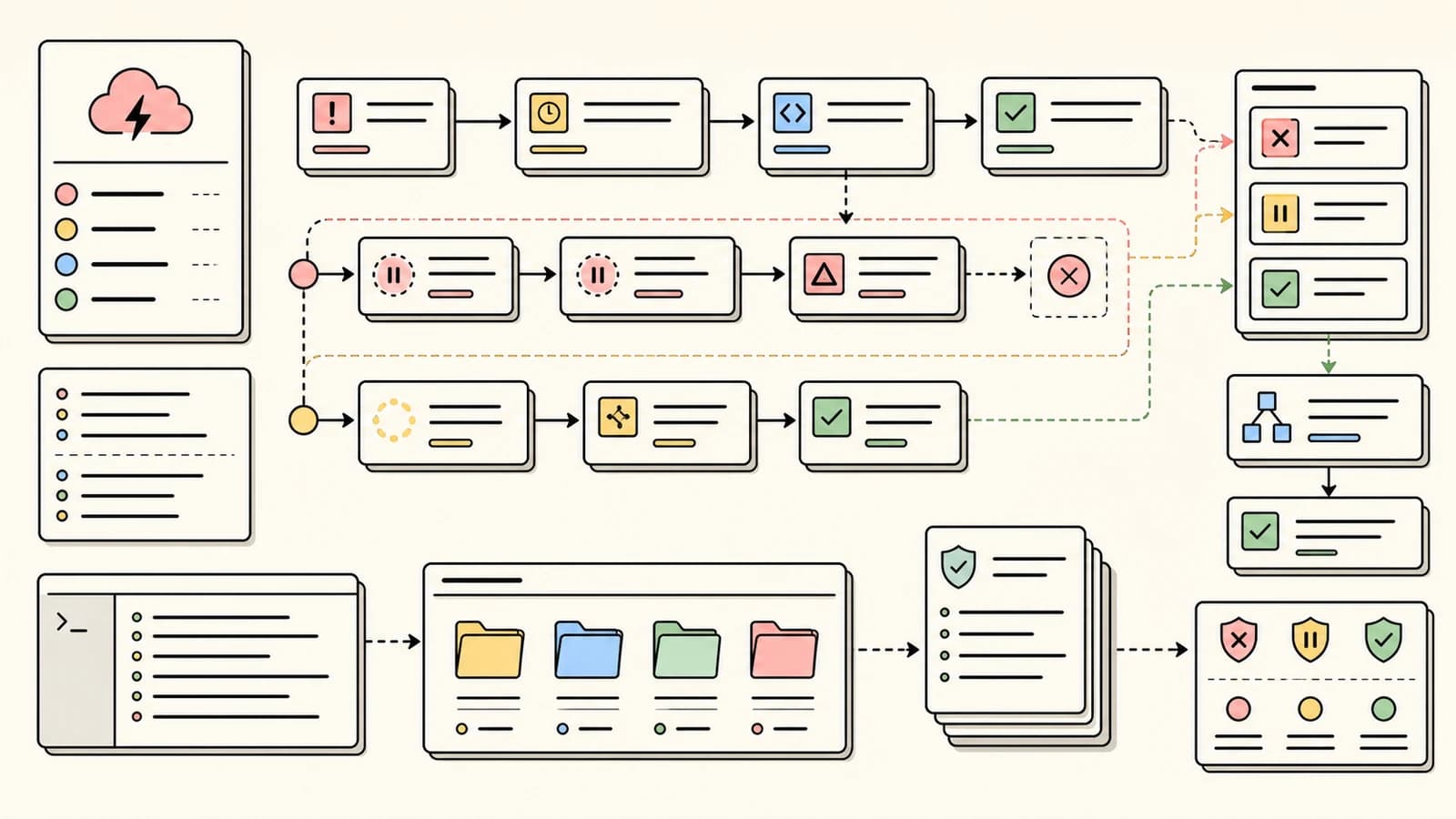
A resilient Claude workflow has four layers.
1. Small task slices#
Do not put a whole migration, redesign, test suite rewrite, and deploy into one giant Claude session.
Use slices:
- one module
- one route
- one test family
- one content post
- one dependency upgrade
- one review pass
Small slices are easier to checkpoint, hand off, or rerun with another model.
2. Receipts after every meaningful step#
Claude should leave evidence:
- commands run
- files changed
- tests passed
- tests skipped
- screenshots captured
- source links used
- assumptions made
- next action recommended
This is why agent swarms need receipts. If the provider degrades, receipts let another agent or human resume without guessing.
3. Model-switch paths#
Anthropic's Claude Code docs recommend using /model to switch models when capacity is model-specific.
That is useful, but only if the task can tolerate a model switch. Some work can move:
- summarizing logs
- drafting docs
- simple tests
- small refactors
- repetitive cleanup
Some work should wait:
- risky security changes
- ambiguous architecture calls
- subtle UI review
- migrations with data risk
- tasks where the original context is too large to reconstruct
This is where model dependency risk and model routers as optionality become practical. Multi-provider fallback is not magic. Schemas, tools, context formats, and behavior differ. The workflow needs to say which tasks can switch and which should pause.
4. Local artifacts#
If all useful state lives inside a chat session, you are fragile.
Keep state in the repo:
- task notes
- TODO files
- test output
- screenshots
- patch files
- issue links
- source citations
- deploy evidence
This is the same reason long-running agents need harnesses. The agent's value should survive the session.
From the archive
Anthropic Claude Tag Turns Slack Into a Shared Agent Workspace
Jun 23, 2026 • 8 min read
Codex-Maxxing: How to Run Long-Running Codex Workflows Without Losing the Plot
Jun 23, 2026 • 8 min read
Cybersecurity Skills for AI Agents Are Becoming Runtime Infrastructure
Jun 23, 2026 • 8 min read
Envoy AI Gateway 1.0 Makes LLM Routing an Infrastructure Decision
Jun 23, 2026 • 8 min read
A Claude Outage Playbook for Coding Teams#
Use this as a simple operating rule.
| Event | Team response |
|---|---|
| Claude.ai degraded | pause exploratory chat, keep repo-local work moving |
| Claude Code 529s | wait, check status, switch model only for safe slices |
| API elevated errors | queue user-facing work, retry with jitter, preserve request IDs |
| long agent session fails | inspect diff, logs, and receipts before restarting |
| model quality regression | reduce task scope, add tests, compare against baseline |
| repeated failures | stop the run and write a handoff note |
The point is not to avoid every outage. The point is to avoid losing the thread.
For Claude Code specifically, that means your CLAUDE.md, AGENTS.md, or project instructions should include:
- when to stop retrying
- how to record progress
- which commands prove the work
- which files are in scope
- which tasks may switch models
- what evidence must be in the final answer
The Claude Code usage limits playbook covers the capacity and burn-rate side. The Claude token burn observability post covers monitoring. This post is the operational layer around both.
The Practical Take#
Claude outages do not mean "never depend on Claude."
They mean "do not make Claude the only place your work exists."
The resilient workflow is boring:
- smaller tasks
- visible checkpoints
- local artifacts
- request IDs
- saved diffs
- model-switch rules
- stop conditions
- human review
When Claude is healthy, that structure makes agents more productive. When Claude degrades, it keeps the work recoverable.
That is the difference between an AI coding habit and an AI coding system.
FAQ#
Is Claude down right now?#
Check Anthropic's official status page for the current state. This post is about designing workflows that survive degraded Claude.ai, Claude Code, or API availability.
What is a Claude 529 error?#
Anthropic documents 529 overloaded_error as temporary overload, distinct from a 429 rate_limit_error. It can happen during high traffic across users.
Should I switch models during a Claude outage?#
Only for safe, bounded task slices. Model switching is useful for docs, summaries, small fixes, and repetitive work. Risky migrations, security changes, and ambiguous architecture work may be better paused.
How do I make Claude Code work resilient?#
Use small tasks, repo-local notes, clear stop conditions, saved diffs, test evidence, model-switch rules, and final receipts that let another agent or human resume.
Continue Reading#
- LivePlan: Monitoring and Corrective Steering for Coding Agents, Without the LLM Tax
- Anthropic Sonnet 4.5 in Claude Code
- Stop Means Stop: New Paper Finds Agent Approval Gates and Cancellation Leak in Six Frameworks
Sources#
Read next
Claude API Reliability: Error Handling Best Practices
The defensive patterns that keep Claude integrations alive in production. Retry shapes, backoff with jitter, circuit breakers, fallback chains, and the observability you need to debug at 3am.
10 min readThe Agent Reliability Cliff: Why Your 10-Step Chain Only Succeeds 20% of the Time
The math of agent pipelines is brutal. 85% reliability per step compounds to about 20% at 10 steps. Here is why long chains collapse in production, and the six patterns the field has converged on to fight the decay.
9 min readLong-Running Agents Need Harnesses, Not Hope
A long-running coding agent is only useful if the environment around it can queue tasks, capture logs, checkpoint state, verify behavior, limit cost, and recover from failure.
9 min readShare
Developers Digest
Technical content at the intersection of AI and development. Building with AI agents, Claude Code, and modern dev tools - then showing you exactly how it works.
300+ videos30K+ GitHub stars850+ articles
Related Tools
AI Models

Claude Opus 4.7
Anthropic's flagship reasoning model. Best-in-class for coding, long-context analysis, and agentic workflows. 1M token c...
View ToolProductivityNew
A
AgentCanvas
A hosted infinite canvas your headless AI agents drive over MCP. Any MCP-speaking agent - Claude Code, Codex, Cursor, or...
View ToolAI CodingDaily Driver

Claude Code
Anthropic's agentic coding CLI. Runs in your terminal, edits files autonomously, spawns sub-agents, and maintains memory...
View ToolAI ModelsDaily Driver
Claude
Anthropic's AI. Opus 4.6 for hard problems, Sonnet 4.6 for speed, Haiku 4.5 for cost. 200K context window. Best coding m...
View ToolApps from Developers Digest
Developer ToolsIn Progress
Subagent Studio
Design subagents visually instead of editing YAML by hand.
View AppDeveloper Tools
Agent Hub
Every coding agent in one window. Stop alt-tabbing between Claude, Codex, and Cursor.
View AppDeveloper ToolsIn Progress
Skill Builder
Turn a one-liner into a working Claude Code skill. From idea to installed in a minute.
View AppRelated Guides
Guide
Claude Code Setup Guide
Configure Claude Code for maximum productivity -- CLAUDE.md, sub-agents, MCP servers, and autonomous workflows.
AI AgentsGuide
Claude Code Complete Course
A complete, citation-backed Claude Code course with setup, prompting systems, MCP, CI, security, cost controls, and capstone workflows.
ai-developmentGuide
Migrating from Cursor to Claude Code
A concrete step-by-step guide to moving your development workflow from Cursor to Claude Code - settings, rules, keybindings, and the habits that transfer.
Getting StartedRelated Videos

Streamline Your Git Workflow with GitKraken and Claude Code
Try out GitKraken here: https://gitkraken.cello.so/myw3K67IkCr to get 50% GitKraken Pro. In this video, we explore GitKraken, a robust Git GUI that not only visualizes your Git repository...
Video·

10x Design in Claude Code and Codex
Try Higgsfield: https://higgsfield.ai/s/higgsfield-general-campaign-developersdigest-juDMTi AI coding agents can build entire websites in minutes, but the default results often still look generic and...
Video·

Open Design: Turn Websites into Design Assets for Cursor & Claude Code
Open Design: Open-Source n8n App That Turns Any Website into a Brand Kit, Design System, HTML + Images The video introduces Open Design, an MIT-licensed full-stack template that combines AI and n8n a...
Video·
Related Posts

10 min read
Claude
Claude API Reliability: Error Handling Best Practices
The defensive patterns that keep Claude integrations alive in production. Retry shapes, backoff with jitter, circuit bre...

9 min read
AI Agents
The Agent Reliability Cliff: Why Your 10-Step Chain Only Succeeds 20% of the Time
The math of agent pipelines is brutal. 85% reliability per step compounds to about 20% at 10 steps. Here is why long cha...
9 min read
AI Agents
Long-Running Agents Need Harnesses, Not Hope
A long-running coding agent is only useful if the environment around it can queue tasks, capture logs, checkpoint state,...
8 min read
AI Coding
AI Chat Fatigue Is a Workflow Design Bug
A front-page Hacker News essay about being tired of AI answers points at a real developer problem: chat is too easy to l...
9 min read
Claude Code
Claude Code Usage Limits in 2026: The Practical Playbook for Pro and Max Teams
A practical operational guide to Claude Code usage limits in 2026: plan behavior, API key pitfalls, routing choices, and...
8 min read
Claude Code
Claude Code Token Burn Is an Observability Problem
The latest Claude Code cache-burn debate is not just a quota complaint. It is a reminder that coding agents need cache-h...
Build with the member tools

Get Smarter About AI Dev
New tutorials, open-source projects, and deep dives on coding agents - delivered weekly.
One email per weekReal code, not theoryFree forever