AI Chat Fatigue Is a Workflow Design Bug
TL;DR
A front-page Hacker News essay about being tired of AI answers points at a real developer problem: chat is too easy to launder into fake work. The fix is verifiable workflows, not more conversational polish.
The newest AI fatigue post on Hacker News is not really about hating AI.
It is about being forced to talk to answer-shaped objects when you asked for judgment.
On May 27, 2026, Orchid's essay "I'm tired of talking to AI" was high on the Hacker News front page. The story is simple: the author found suspicious GitHub repositories, asked AI what to do, got nothing useful, then saw humans reply with the same generic AI answer. In another example, a business owner responded to a real business question by forwarding ChatGPT screenshots that did not answer the question.
That hits a nerve because developers see this failure mode every week. The model output may be fluent, but nobody owns it. Nobody checked it. Nobody connected it to the actual system. It becomes a way to avoid thinking while looking responsive.
The useful take is not "stop using AI." The useful take is: stop treating chat as the work product.
If you have been following the DevDigest agent reliability thread, this belongs beside long-running agents need harnesses, constraint decay in coding agents, codebase maps for coding agents, and agent swarms need receipts. The problem is not that AI can talk. The problem is that teams keep accepting talk where they need evidence.
Last updated: May 27, 2026. Verify product docs, commands, and claims against the linked sources before standardizing a workflow.
Official Sources#
| Source | What to verify |
|---|---|
| Orchid Files: I'm tired of talking to AI | The original argument and examples of AI answers replacing human judgment |
| Hacker News discussion | Opposing views, developer reactions, detector skepticism, and workplace examples |
| Beyond the Prompt: Claude Code | Current practitioner writeup on Claude Code workflows, skills, subagents, and verification habits |
| Claude Code documentation | Official Claude Code concepts, memory, sessions, permissions, and workflow docs |
| Anthropic: Claude Code best practices | Official workflow guidance for explore-plan-code, verification, and context management |
| OpenAI Codex documentation | Codex agent workflow, cloud tasks, CLI usage, and review surfaces |
If you only need the fastest decision path:
- For reliability: Long-running agents need harnesses
- For repo context: Coding agents need codebase maps
- For team setup: Claude knowledge work plugins
- For tool selection: AI coding tools comparison matrix
The News Hook#
The Orchid essay is short, but the HN discussion around it is useful because it splits into two camps.
One camp says the internet is filling with generated replies, bot content, AI-written articles, and business communication that feels like nobody read the question. This group is not objecting to autocomplete. They are objecting to social and professional interactions where an AI answer is passed along as if it were a person taking responsibility.
The other camp says AI is still useful when you intentionally use it for bounded work: explaining unfamiliar terms, checking statements, drafting reports, generating alternatives, or operating as a coding assistant with tests. In other words, the frustration is not "LLMs exist." The frustration is "I asked a human for accountability and got a pasted answer."
That distinction matters for developer teams.
There is a huge difference between:
- "The agent ran the failing test, changed three files, reran the test, and produced a diff."
- "The agent wrote a confident paragraph about how the bug might be fixed."
- "A manager pasted that paragraph into a ticket and called it a plan."
Only the first one is a workflow.
The Take: Chat Is the Wrong Final Artifact#
Chat is a good interface for intent capture. It is a weak interface for proof.
The output developers should care about is not the answer. It is the changed repository state, the passing check, the linked source, the failing test that now passes, the reproduced incident, the benchmark result, the screenshot, the migration plan, the diff review, or the note that a human decision is still needed.
AI chat fatigue is what happens when teams collapse all of those artifacts back into prose.
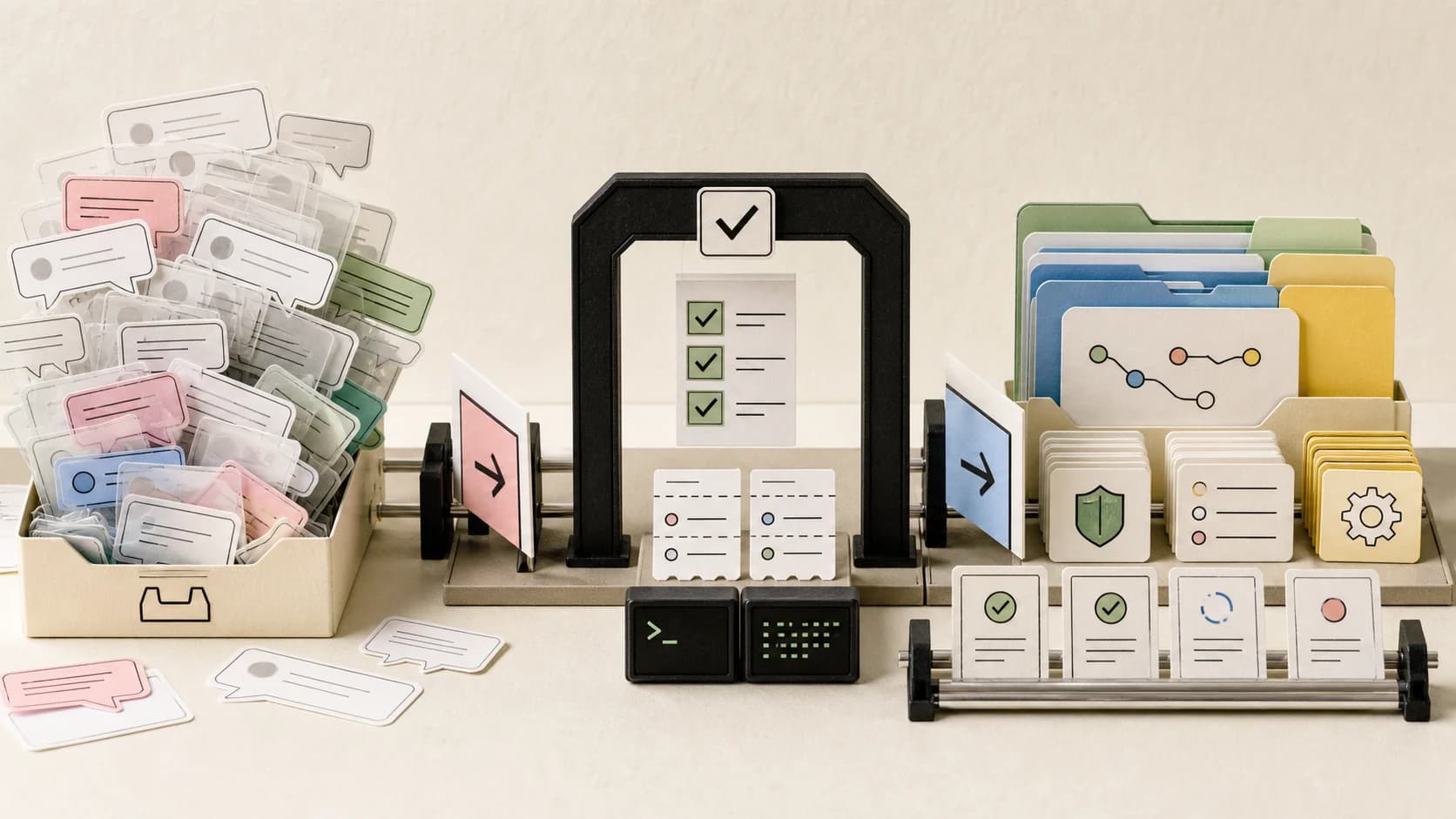
That is why the best agent workflows are getting less chat-shaped. Claude Code, Codex, Cursor, Zed, OpenCode, and adjacent tools are all moving toward the same operational model:
- Read the repo.
- Build a plan.
- Run tools.
- Change files.
- Verify with commands.
- Show the diff.
- Ask for review only where judgment is needed.
The chat is still there, but it is not the deliverable. It is the control surface.
This is also why agent skills, plugins, and repo maps are more interesting than prompt collections. They move instructions out of one-off conversation and into durable infrastructure.
Why Developers Are Especially Sensitive to This#
Software has unusually fast feedback loops.
If an LLM invents a business answer, it may take days or months for the damage to surface. If it invents a function name, TypeScript complains immediately. If it misunderstands a route, the test fails. If it changes the wrong file, git shows the diff.
That is why developers can feel both things at once:
- AI chat on the open internet feels increasingly exhausting.
- AI coding agents inside a real repo can be genuinely useful.
The difference is not the model. The difference is the harness.
A coding workflow can attach model output to files, commands, logs, tests, screenshots, and review. A random AI answer in a comment thread usually has none of that. It asks you to trust the shape of language.
This is the same reason AI code review is useful only when it points at concrete lines and failure modes. "Looks good" is not review. "This path skips auth when userId is missing, here is the file and test case" is review.
The Anti-Pattern: Answer Laundering#
The best phrase for the failure is answer laundering.
Someone has a question they do not understand. They ask a model. The model produces a plausible answer. The person forwards it into a human workflow. The confidence of the prose hides the fact that no understanding was added.
In software teams, answer laundering shows up as:
- Tickets filled with generic implementation plans that do not reference the codebase.
- PR descriptions that claim verification but do not include command output.
- Architecture docs generated from prompts instead of source inspection.
- Security triage that repeats remediation boilerplate without reproducing the finding.
- Support replies that sound polished but ignore the user's actual state.
- Meeting notes that convert uncertainty into clean bullet points too early.
The fix is not to ban AI from those workflows. The fix is to make every AI contribution carry receipts.
For a coding agent, that means changed files, tests, logs, and a diff.
For research, that means primary-source links and a clear line between verified facts and interpretation.
For support, that means user-specific state and an escalation path.
For planning, that means open questions that remain open until a human answers them.
What a Better AI Workflow Looks Like#
The strongest Claude Code practitioner writeups are converging on a few practical rules:
- Explore before editing.
- Put project rules in files, not memory.
- Use skills and subagents for repeated workflows.
- Run tests and linters before claiming success.
- Capture mistakes back into instructions.
- Keep humans responsible for acceptance, not every keystroke.
That is not magic. It is basic engineering discipline applied to AI output.
For example, a good bug-fix prompt should not be:
Fix the auth bug.
It should be closer to:
Reproduce the auth bug first. Add or identify the failing test. Make the smallest code change that passes it. Run the focused test, then run the relevant typecheck. Summarize the diff and any remaining risk.
The second version makes it harder for the model to hand back a paragraph and pretend the work is done.
Teams should encode that pattern into their tools. Put it in AGENTS.md, CLAUDE.md, a Codex instruction file, a project skill, a PR template, or a CI gate. The exact surface matters less than the invariant: no answer without a verification path.
A Practical Checklist for Teams#
Use this as a quick audit for your AI developer workflow.
For every AI-generated plan:
- Does it name actual files, commands, owners, or systems?
- Does it separate facts from assumptions?
- Does it list open questions instead of filling them with guesses?
- Can a reviewer tell what evidence produced the plan?
For every AI-generated code change:
- Is there a diff?
- Did the agent run a focused check?
- Did it say which check failed or was skipped?
- Is the test output or screenshot linked in the closeout?
- Can a human reject the change without reverse-engineering the conversation?
For every AI-generated public answer:
- Is it grounded in sources?
- Is it specific to the user's question?
- Does it disclose uncertainty where the source does not support certainty?
- Would the answer still be valuable if the reader knew a model helped draft it?
If the answer is no, you do not have an AI productivity problem. You have an accountability problem.
Where This Fits With Claude Code and Codex#
Claude Code and Codex are useful precisely because they can leave the chat box.
Claude Code has project instructions, memory files, skills, subagents, MCP servers, permission modes, and editor integrations. Codex has local CLI workflows, cloud tasks, repository context, and reviewable diffs. Different products, same direction: move from fluent conversation to inspectable work.
That is why the current wave of Claude plugins, Codex automation, agent channels, and codebase knowledge graphs matters. The winning interface is not "a better chatbot." It is a better operating loop around the chatbot.
The model can still be wrong. The harness should make wrongness visible early.
The Bottom Line#
AI chat fatigue is not just cultural backlash. It is feedback from a broken workflow.
When a model's answer replaces a person's attention, people get angry. When a model's output is attached to a test, a diff, a source, and a human acceptance step, it becomes useful leverage.
So the practical advice is simple: stop rewarding answer-shaped work.
For developer teams, the next productivity jump will not come from asking AI to sound more human. It will come from making AI output less final until it has passed through the same evidence gates as every other engineering artifact.
Frequently Asked Questions#
Is AI chat fatigue the same as being anti-AI?#
No. Most of the useful criticism is about accountability, not model usage. Developers are often happy to use AI for bounded work when the output is attached to files, tests, sources, or reviewable diffs.
How should teams prevent AI answer laundering?#
Require receipts. Plans should cite source files or sources. Code changes should include diffs and checks. Research should link primary sources. Support answers should include customer-specific state or escalation notes.
Are coding agents less vulnerable to this than general chatbots?#
They can be, but only when they run inside a harness. A coding agent with repo access, tests, permissions, and review is different from a chatbot producing advice. Without verification, it can still produce confident nonsense.
What is the best first workflow improvement?#
Add a rule that every AI-assisted code closeout must include the changed files, the exact command run, whether it passed, and any skipped verification. That one habit catches a large share of fake progress.
Get the next deep dive like this in your inbox
One email a week on AI Coding and the rest of the AI dev stack. Free.
Read next on Claude Code
Long-Running Agents Need Harnesses, Not Hope
A long-running coding agent is only useful if the environment around it can queue tasks, capture logs, checkpoint state, verify behavior, limit cost, and recover from failure.
9 min readConstraint Decay Is the Coding Agent Bug Nobody Can Prompt Around
A new arXiv paper shows coding agents can pass loose backend tasks, then fall apart when architecture, database, and ORM constraints pile up. The fix is not longer markdown. It is executable constraints.
8 min readCoding Agents Need Codebase Maps, Not Bigger Prompts
GitHub is suddenly full of codebase knowledge graph projects for Claude Code, Codex, Cursor, and other agents. The useful version is not a pretty graph. It is a map that changes planning, editing, and review.
8 min readTechnical content at the intersection of AI and development. Building with AI agents, Claude Code, and modern dev tools - then showing you exactly how it works.