CLI-Anything Turns Any Software Into an Agent-Ready Command Line
TL;DR
CLI-Anything auto-generates a tested CLI harness from source code so AI agents can drive desktop software that has no agent-ready interface.
Last updated: May 24, 2026
Why a 40,000-Star CLI Generator Is Trending Right Now#
AI coding agents are increasingly capable at writing and reasoning over code, but they still hit the same wall: most installed software has no structured interface they can drive. GIMP does not expose a REST API. Blender does not speak MCP. LibreOffice Writer does not accept JSON tool calls. Agents that need to invoke these applications fall back to fragile GUI automation or just give up.
HKUDS/CLI-Anything reached 40,000 stars this week with an answer to that problem. The project runs a 7-phase automated pipeline against a software codebase and produces a tested, agent-ready CLI harness - complete with a REPL mode, JSON output, and a SKILL.md file so agents can discover and invoke the generated interface. The 4,773 stars added this week alone suggest developers are recognizing the pattern: the missing piece between capable agents and real-world software is a structured command surface.
What It Does#
CLI-Anything describes itself as "making ALL software agent-native." The core idea is that most professional applications expose their functionality through internal APIs or scripting hooks, but that surface is buried under GUIs and rarely documented in a form an agent can use. The pipeline bridges that gap by reading source code and generating a structured CLI.
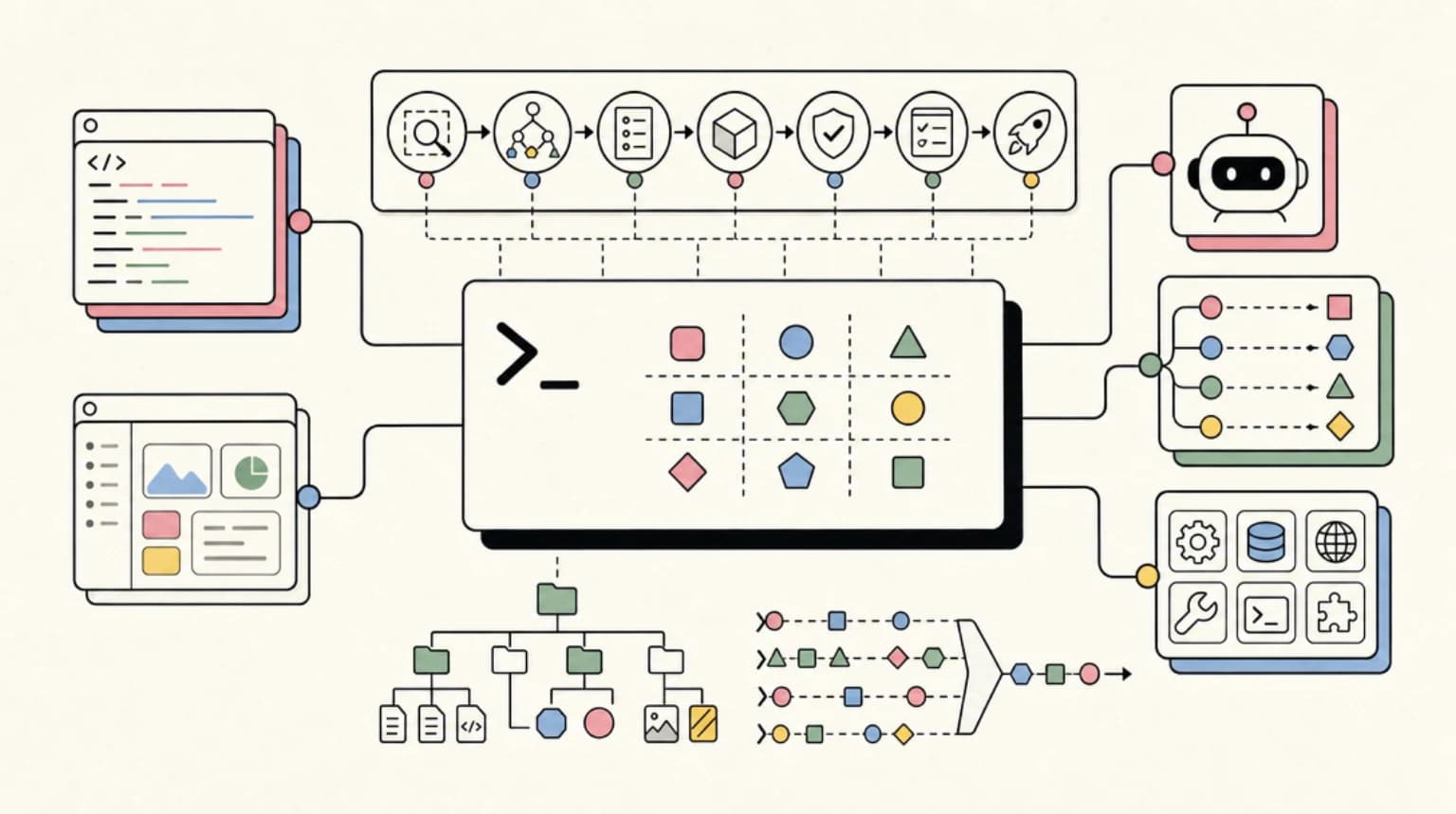
The 7-phase pipeline works as follows:
- Analyze - scans source code and maps GUI actions to the underlying APIs they call
- Design - architects command groups, models state, and defines output formats
- Implement - builds a Click-based CLI with REPL mode, JSON output, and undo/redo support
- Plan Tests - creates a TEST.md with unit and end-to-end test plans
- Write Tests - implements the full test suite from the plan
- Document - updates TEST.md with actual test results
- Publish - generates
setup.pyand installs the harness to PATH
A half-step between phases 6 and 7 generates a SKILL.md file so agent discovery systems like SkillHub and ClawHub can index and distribute the harness.
The repository ships 40+ pre-built CLIs covering applications including GIMP (107 tests), Blender (208 tests), Inkscape (202 tests), LibreOffice (158 tests), OBS Studio (153 tests), Audacity (161 tests), ComfyUI (70 tests), and Godot Engine (24 tests). Total test coverage across all harnesses is 2,330 tests - 1,732 unit, 579 end-to-end, and 19 Node.js - with a reported 100% pass rate. The Apache 2.0 license means the harnesses can be used and redistributed in commercial projects.
Install and Try It#
This kind of agent-native command surface is part of a broader pattern we track in the AI coding tools comparison matrix. The fastest path is through CLI-Hub, the project's package manager for pre-built harnesses:
pip install cli-anything-hub
Once installed, CLI-Hub exposes four commands:
cli-hub list                # browse all available harnesses
cli-hub search blender      # search by keyword
cli-hub install blender     # install a pre-built CLI
cli-hub launch blender      # run the installed CLI
To generate a new harness from source code, the Claude Code plugin is the recommended entry point:
/plugin marketplace add HKUDS/CLI-Anything
/plugin install cli-anything
/cli-anything <path-to-software-or-repo>
The primary command is /cli-anything. Refinement and sub-commands use the :subcommand form, for example /cli-anything:refine. Older builds may show /cli-anything:cli-anything as the entry point - both map to the same pipeline.
For direct documentation, the project hosts a companion site at clianything.cc with HARNESS.md, QUICKSTART.md, and PUBLISHING.md guides.
Who Should Use It#
The clearest use case is for developers who want AI coding agents to drive real desktop tools as part of longer workflows. If you are building an agent that needs to process audio in Audacity, render 3D assets in Blender, or export documents from LibreOffice as part of a pipeline, CLI-Anything provides a tested harness that exposes those operations as structured commands rather than brittle GUI clicks.
Creative developers building multi-tool agent pipelines will benefit most immediately. The pre-built CLIs cover the core open-source creative stack, so there is no pipeline generation cost for common applications - just cli-hub install and you have a testable interface.
Researchers and tooling engineers who need to make in-house software accessible to agents will find the 7-phase generation pipeline useful for custom harnesses. The project requires source code access, so it works best with open-source applications or internal codebases you own.
Teams evaluating how much of their workflow can be handed to agents will also find CLI-Anything useful as an audit tool. The SKILL.md output makes each generated harness discoverable by agent skill systems, which means you can build a catalog of what your agents can do across your installed software stack.
Connection to the DevDigest Ecosystem#
The DevDigest CLI directory at clis.developersdigest.tech tracks agent-compatible command-line tools - CLI-Anything generated harnesses are a natural extension of that surface. An agent that can consult the CLI directory, install the relevant harness via cli-hub install, and then drive the target application has a meaningfully wider action space than one limited to web APIs and code manipulation.
The SKILL.md generation step also connects to skills.developersdigest.tech. CLI-Anything harnesses that publish their SKILL.md to SkillHub or ClawHub become discoverable by skill-aware agents, which is exactly the distribution model that skill registries are designed to support. If you are building a Claude Code skill set and need your agent to invoke desktop software, a CLI-Anything harness with a published SKILL.md is currently one of the cleaner integration paths available.
MCP users will notice the design parallels with MCP server tool exposure. CLI-Anything does not wrap MCP directly, but the structured command surfaces it generates could be wrapped as MCP tools - the JSON output mode is designed with exactly that downstream use in mind. The mcp.developersdigest.tech registry would be a natural home for MCP-wrapped CLI-Anything harnesses as the ecosystem matures. For background on how that registry model works, see our complete guide to MCP servers.
Honest Assessment#
The pre-built CLIs are the strongest argument for trying CLI-Anything. They are well-tested and cover real tools with real coverage numbers, not toy demos. If Blender, GIMP, or LibreOffice is in your workflow, pip install cli-anything-hub and cli-hub install is a low-friction test.
The generation pipeline is more conditional. The project requires source code access - closed-source or binary-only applications will produce harnesses with substantially lower coverage and reliability. The project documentation is explicit about this: "when software only provides compiled binaries, harness quality and coverage will degrade substantially." Iterative refinement via /cli-anything:refine may be needed, and frontier-class models (Claude Sonnet 4.6, Claude Opus 4.7, or GPT-5 class) are recommended for generation quality - cheaper models produce weaker results.
The 100% test pass rate across 2,330 tests is impressive, but those tests cover the harness behavior, not the underlying application. A test that confirms blender --render scene.blend exits zero is not the same as confirming the render output is correct. Teams building production pipelines should add their own integration checks on top of the harness.
At 40,000 stars and Apache 2.0, this is worth watching as the standard for agent-facing CLI generation. The pattern - source analysis, structured interface generation, skill discovery - is likely to be replicated in other tooling ecosystems regardless of whether CLI-Anything itself becomes the dominant implementation.
FAQ#
Do I need the source code to use CLI-Anything?#
Only for generating a new harness. Pre-built CLIs installed through cli-hub install work without touching source. Generating a new harness for your own software does require source code access, and closed-source or binary-only targets produce lower-coverage harnesses.
What applications already have pre-built CLIs?#
The repository ships 40+ pre-built harnesses, including GIMP, Blender, Inkscape, LibreOffice, OBS Studio, Audacity, ComfyUI, and Godot Engine, each with its own test suite.
Does CLI-Anything replace MCP servers?#
No. It generates a structured CLI, not an MCP server. The JSON output mode is designed so the resulting harness could be wrapped as MCP tools, but that wrapping is a separate step.
What license is CLI-Anything released under?#
Apache 2.0, which permits use and redistribution of the generated harnesses in commercial projects.
References#
- HKUDS/CLI-Anything on GitHub
- CLI-Hub documentation and companion site
- GitHub Trending - daily
- GitHub Trending - weekly
- DevDigest CLI directory
- DevDigest Skills directory
- DevDigest MCP registry
Continue Reading#
Get the next deep dive like this in your inbox
One email a week on Trending and the rest of the AI dev stack. Free.
Read next on Claude Code
Headroom: Compress Agent Tool Output Before It Reaches the LLM
Headroom compresses AI agent tool outputs, logs, and files before they reach the LLM, claiming 60-95% token savings with benchmarked accuracy. How it works.
8 min readReverse Engineer Anything (REA): What the MCP Server Does and Where the Line Is
REA (Reverse Engineer Anything) is an MIT-licensed MCP server that lets Claude Code, Codex or Cursor inspect binaries, Electron apps and APKs. How to try it.
7 min readGoose: The Open Source AI Agent With 70+ MCP Extensions
Goose is an open-source Rust AI agent with a desktop app, CLI, and API that works across 15+ LLM providers and 70+ MCP extensions. Here is where it fits.
8 min readTechnical content at the intersection of AI and development. Building with AI agents, Claude Code, and modern dev tools - then showing you exactly how it works.