Reasonix Shows the Next Coding Agent Fight Is Cache Discipline
TL;DR
Reasonix hit Hacker News with a DeepSeek-native pitch: keep long coding sessions cheap by designing the agent loop around prefix caching. The interesting question is when cache efficiency helps quality, and when it fights the harness.
The most interesting part of Reasonix is not that it is another terminal coding agent.
The interesting part is that it makes cache discipline the product thesis.
Reasonix describes itself as an open-source, DeepSeek-native coding agent for the terminal, engineered around DeepSeek's prefix cache so long coding sessions stay cheap. It supports MCP, plan mode, a cache-first loop, and an MIT license. The project hit the Hacker News front page recently because that pitch lands in the exact place developers are feeling pain: coding agents are useful, but long sessions quietly burn money.
Last updated: May 26, 2026. Verify DeepSeek caching details and Reasonix capabilities against the official sources before you rely on them for cost control.
Official Sources#
| Source | What to verify |
|---|---|
| Reasonix project page | Current features, install steps, and stated design goals |
| Reasonix GitHub repository | Current code, licenses, and roadmap issues |
| DeepSeek API documentation | Pricing, context limits, and request requirements |
| DeepSeek context caching guide | How caching works and what breaks cache hits |
If you only need the fastest decision path:
- Pricing decision hub: /pricing
- Side-by-side tool comparisons: /compare
- Cost containment: Managed agent cost control
That makes Reasonix a good excuse to talk about a broader shift. The next coding-agent fight is not only model quality. It is whether the harness can keep stable context stable.
If you are already watching agent bills, pair this with the overnight agent FinOps post, Claude Code token burn and cache observability, and the AI coding tools pricing comparison. Agent cost is increasingly a runtime architecture problem, not a monthly-plan footnote.
The News Hook#
Reasonix's public page frames the product around three ideas:
- a DeepSeek-native terminal agent
- first-class MCP support
- a loop shaped to preserve prefix-cache hits across long sessions
The Hacker News thread was large because developers understood the economic claim immediately. If the same repository instructions, tool definitions, file summaries, and planning context get resent every turn, a cache hit can make the difference between "run the agent all afternoon" and "stop before this gets stupid."
Commenters shared cache-hit dashboards and token-billing receipts from long sessions. That is the demand signal. Developers are already routing coding harnesses through cheaper model APIs, watching cache-hit counters, and asking which layer actually deserves credit.
The Take: Cache Hits Are a Harness Feature#
Prefix caching is easy to misunderstand.
At the provider level, a prefix cache rewards repeated request prefixes. Keep the stable parts of the prompt byte-identical, append new work at the end, and the provider can reuse the cached computation for the prefix. Change the wrong thing near the top, reorder tool definitions, rewrite the system prompt, or shuffle context blocks, and the cache hit can disappear.
At the agent level, that means cost is affected by boring implementation details:
- how tool definitions are ordered
- whether project instructions stay byte-stable
- whether file context is appended or rewritten
- whether compaction changes the stable prefix
- whether the agent loop inserts status summaries before or after cached content
- whether retries preserve the same request shape
That is why Reasonix is interesting. It treats cache preservation as a first-class harness behavior instead of hoping the model provider handles everything invisibly.
This is the same systems lesson from terminal agents as portable runtime surfaces. The model matters, but the loop around the model decides how expensive, debuggable, and repeatable the session becomes.
The Counterargument#
The strongest pushback in the HN thread was also the most useful: cache-first is not automatically quality-first.
Experienced harness builders pointed out that tools like OpenCode, Aider, Claude Code, Codex, Cursor, and similar agents do not accidentally break cache prefixes. Sometimes they mutate context because the new shape works better. A fresh plan, rewritten summary, reordered context, or narrower file set can improve task success even if it costs more tokens.
That means "append-only because cache" is too simplistic.
A good coding harness has to decide when cache stability is worth preserving and when the prompt should be reshaped for correctness. If the agent is stuck, repeating a cheap cached prefix may just make the wrong loop cheaper. If the repo changed materially, preserving old context can become stale-context debt. If a tool schema changed, byte-stability is not a virtue.
The real product question is not "does this agent maximize cache hits?"
The better question is:
Does this agent know when cache hits are helping and when they are hiding failure?
What Developers Should Measure#
If you are evaluating Reasonix, DeepSeek through another harness, or any cache-aware coding stack, do not stop at token price.
Measure per completed task:
- Cache-hit rate. How many input tokens hit cache after the first turn?
- Cache-bust causes. Which prompt blocks changed and why?
- Wall-clock latency. Cheap is less useful if the model reasons for too long on every turn.
- Review cost. Did lower token cost produce lower-quality patches that cost more human time?
- Retry count. Did the harness cheaply repeat the same bad strategy?
- Fresh-context recovery. When the agent gets stuck, does a fresh plan improve outcome enough to justify the cache miss?
This is where the free Claude Code model gateway tradeoffs become concrete. Model routing is not just "send easy work to the cheap model." You need task-level receipts showing cost, cache, retries, test status, and review defects.
The Practical Pattern#
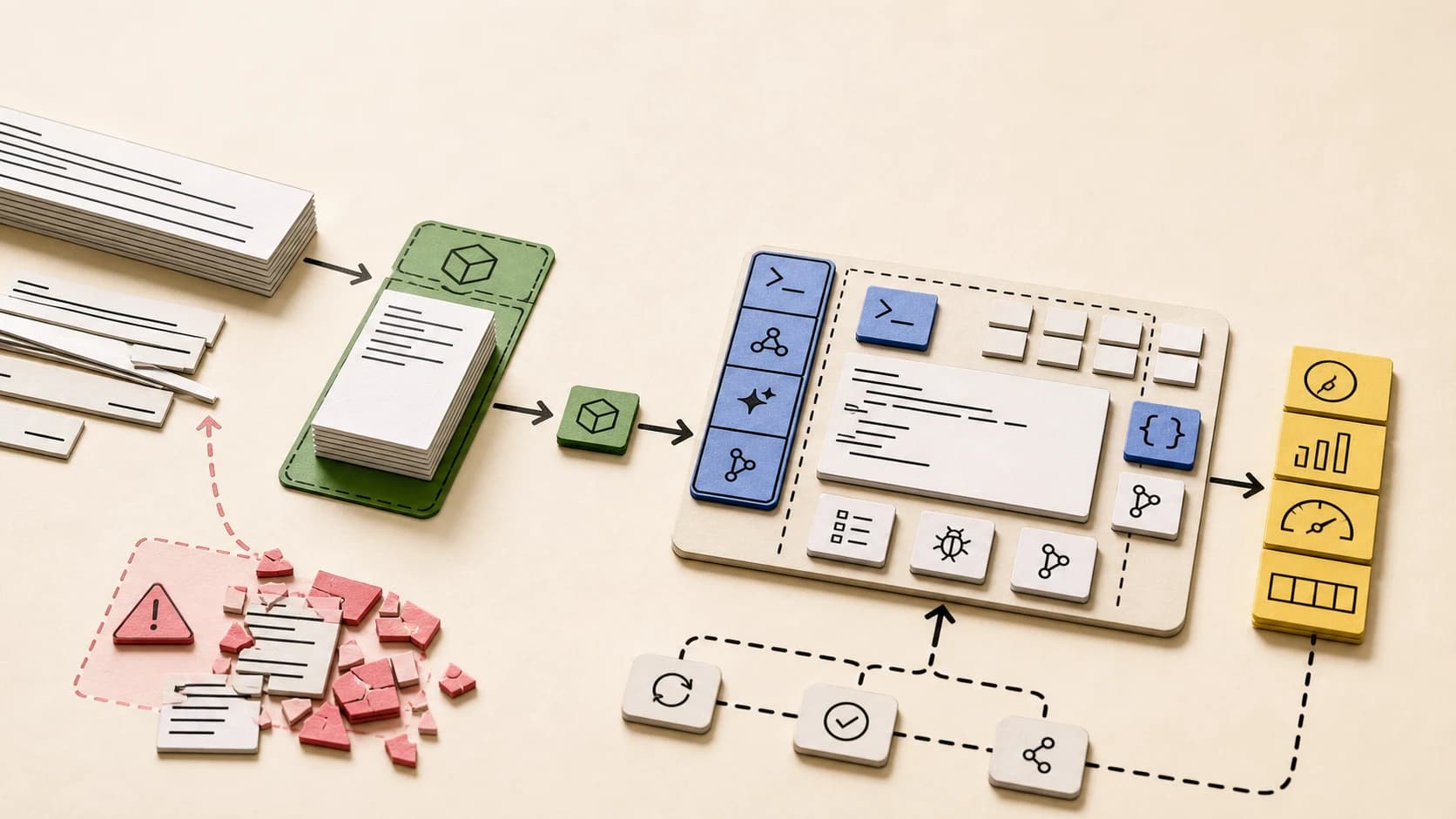
For a cache-aware coding agent, split context into lanes.
Stable prefix lane. System instructions, tool schemas, repo rules, durable architecture docs, and stable project summaries. Keep this byte-stable as long as possible.
Working set lane. The files, diffs, test output, and task notes for the current run. This can change, but it should change intentionally.
Scratch lane. Temporary hypotheses, failed attempts, and noisy logs. This should not poison the stable prefix.
Recovery lane. When the loop stalls, explicitly decide whether to preserve cache or pay for a fresh plan.
That model is more useful than a blanket rule. Stable things should be cached. Unstable things should be isolated. Failed reasoning should not become permanent just because it is cheap to reuse.
Where DeepSeek Fits#
DeepSeek keeps showing up in developer workflows because the economics are hard to ignore. For budget-sensitive coding sessions, a lower-cost model with strong cache behavior can expand the amount of agent work you are willing to run.
But it should be routed deliberately. Use DeepSeek-style low-cost loops for:
- broad repo reading
- mechanical edits
- first-pass implementation attempts
- repeated test-fix cycles with clear errors
- exploratory branches where human review is expected
Use a stronger or more specialized model when:
- architecture judgment is the core task
- the codebase has hidden constraints
- the patch affects auth, billing, data deletion, or security
- the first two cheap loops disagree or stall
- review cost is likely to dominate token cost
That is the routing lesson from AI coding tools pricing: cheapest token is not the same thing as cheapest successful change.
Why This Is Worth Writing About#
Reasonix may or may not become the agent developers use every day. The durable idea is bigger than the project.
Coding agents are turning prompt shape into infrastructure. The order of blocks, the stability of tool definitions, the placement of summaries, and the boundary between durable context and scratch space now affect cost and quality directly.
That is new enough to matter.
The next generation of coding agents will not only advertise better models. They will advertise better context economics: cache-aware loops, explicit cache-bust reasons, per-task cost traces, and recovery policies that know when to throw the cache away.
That is the post: cache hits are not a billing detail anymore. They are part of the coding-agent harness.
Sources#
- Reasonix project page
- Reasonix GitHub repository
- Hacker News discussion
- DeepSeek API documentation
- DeepSeek context caching guide
Frequently Asked Questions#
What is Reasonix?#
Reasonix is an open-source terminal coding agent built around DeepSeek. Its public pitch emphasizes prefix-cache efficiency, MCP support, plan mode, and a cache-first loop for lower-cost long coding sessions.
What is prefix caching?#
Prefix caching lets a model provider reuse computation for repeated request prefixes. If stable prompt content stays identical across turns, later requests can be cheaper and faster. If the prefix changes, the cache benefit can disappear.
Why does prefix caching matter for coding agents?#
Coding agents repeatedly send project rules, tool definitions, file summaries, plans, diffs, and test output. If stable context is cached, long sessions can become much cheaper. If the harness constantly rewrites the prefix, cost rises quickly.
Is cache-first always better?#
No. Sometimes a coding agent should reshape context, start a fresh plan, or drop stale assumptions even if that breaks cache. The goal is not maximum cache hit rate. The goal is lowest cost per correct, reviewable change.
How should teams evaluate cache-aware coding agents?#
Track cache-hit rate, cache-bust causes, retry count, test status, wall-clock time, review defects, and cost per merged change. Token price alone misses the expensive part: failed loops and human review.
Get the next deep dive like this in your inbox
One email a week on AI Coding and the rest of the AI dev stack. Free.
Read next on AI coding tools
The $400 Overnight Bill: Why Managed Agents Need FinOps Now
Five managed-agent providers, five pricing models, zero unified cost attribution. If you're running agents overnight, you need FinOps you don't have yet.
13 min readClaude Code Token Burn Is an Observability Problem
The latest Claude Code cache-burn debate is not just a quota complaint. It is a reminder that coding agents need cache-hit telemetry, spend ceilings, and repro-grade usage logs.
8 min readFree Claude Code Is Really a Model Gateway Bet
The trending Free Claude Code repo is not just about avoiding API bills. It points at a bigger developer-tool pattern: model gateways for AI coding agents.
7 min readNew here? Start with
Technical content at the intersection of AI and development. Building with AI agents, Claude Code, and modern dev tools - then showing you exactly how it works.