CodeNib Makes Repository Context a Data System
TL;DR
CodeNib's July paper argues that coding agents should stop rediscovering the same repo through grep and reads. Repository context is becoming compiled infrastructure.
Every serious coding agent eventually burns time on the same boring loop: search the repo, open files, follow symbols, forget half of it, compact, then do it again.
That is not just a context-window problem. It is a data-systems problem.
Last updated: August 24, 2026
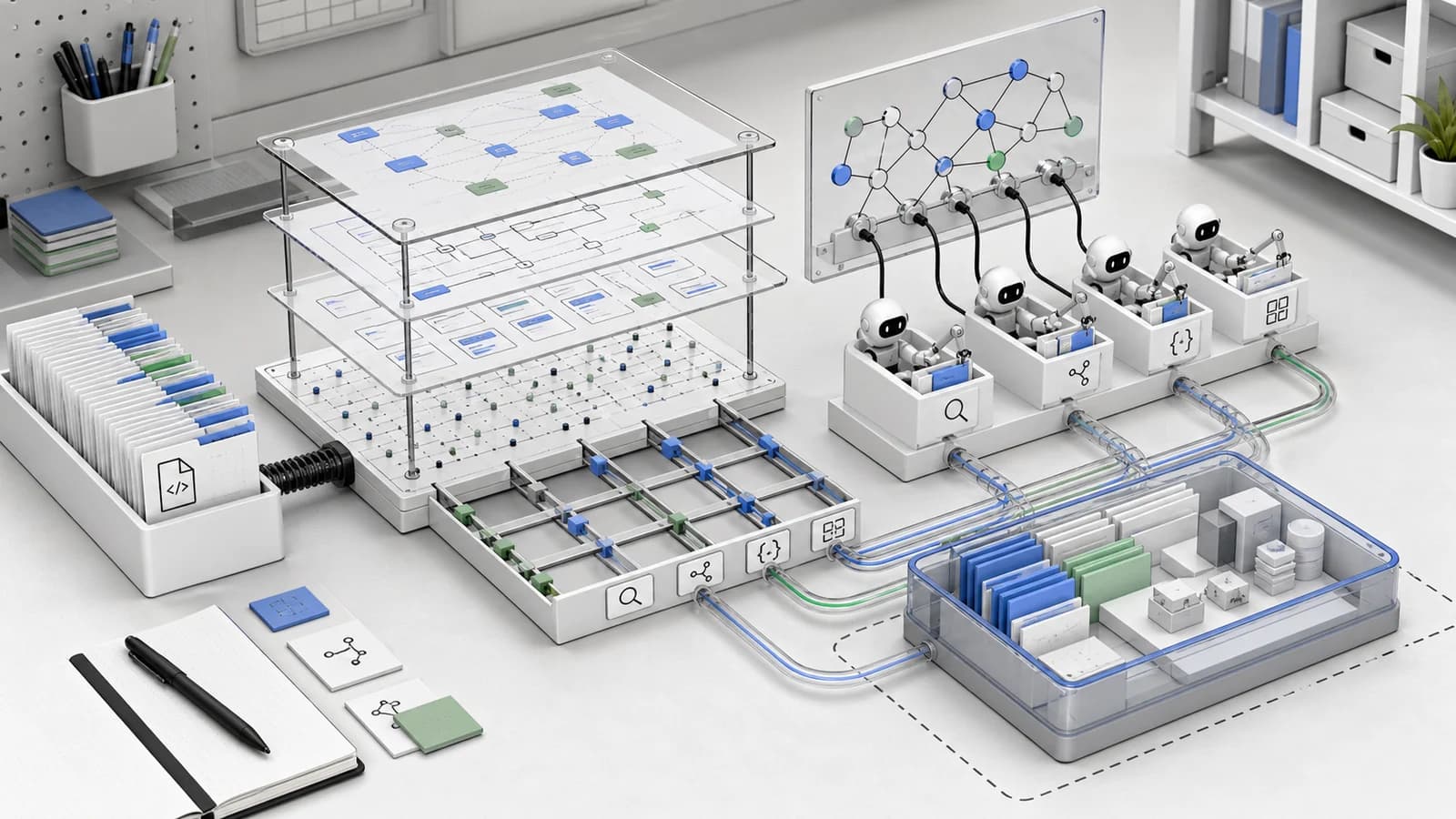
CodeNib is interesting because it treats repository context as compiled infrastructure instead of conversational scratch work. The July paper describes lexical, dense, graph, and navigation views built per repository commit, then served back to agents as bounded, source-linked context. In plain English: stop making every agent rediscover the codebase from raw files.
If you have been following the arc from agent context reduction to codebase knowledge graphs for coding agents, this is the same trend getting more concrete. The agent still reasons. The repo context becomes a maintained service with manifests, validity boundaries, and citations.
Why This Paper Is Worth a Post#
Hugging Face surfaced CodeNib in its July papers page as a coding-agent item from SysEvol AI Research, with the paper page listing it as a top daily paper and linking the arXiv, project site, and GitHub repo. That is a good discovery signal, but it is not the demand signal.
Google Trends was checked on August 24, 2026 for CodeNib, repository context, coding agents, Dockerless verifier, SWE-bench, coding agent verification, Harness Handbook, agent harness, StateAct, computer use agents, and GUI agents across a US three-month window. Exact CodeNib interest was zero in the returned rows. Broader clusters had visible demand: coding agents stayed active, and agent harness showed stronger relative interest than exact paper names. So this is not a launch-hype article. It is a category article: repository context is becoming a first-class agent runtime layer.
That distinction matters. The unsafe claim would be "developers are searching for CodeNib." The safer claim is that developers are searching for coding-agent and harness topics, while CodeNib gives us a strong primary-source case study for where that category is going.
The Problem: Agents Keep Rebuilding a Mental Index#
Most coding agents see a repo through small actions:
- search for a term
- read a file
- inspect nearby imports
- ask for another file
- run tests
- repeat after the next edit
That works for a single bug. It gets expensive when the agent is long-running, when multiple agents share a repo, or when a project has enough structure that raw search gives plausible but incomplete answers.
The CodeNib paper names three practical failures in that loop. Disconnected indexes, language servers, and task-local histories force repeated discovery. They also hide lifecycle costs. A team may know that the model is spending tokens, but not how much of that spend is repeated repository navigation rather than actual problem solving.
That is the same failure mode behind long-running agents needing harnesses. A harness is not only retries and logs. It is also the system that decides what repo evidence the model sees, how fresh that evidence is, and whether the next edit invalidates it.
What CodeNib Builds#
CodeNib builds reusable views per repository commit:
- lexical search for direct text and BM25-style retrieval
- dense retrieval for semantic matches
- structural views for symbols, definitions, references, imports, and calls
- navigation views that can serve source ranges back to the agent
The project site frames the implementation as "lexical, dense, and graph views of the repo, from one compile," with affected views repaired incrementally when supported changes happen. It also exposes the context layer to agents over MCP with bounded budgets and source-linked citations.
That MCP detail is important. An MCP server by itself is not a strategy. We covered that in MCP servers vs Agent Skills: the server gives access, while the workflow around it decides what the agent should do. CodeNib is an example of a server where the access is not a SaaS API or database table. The access is a maintained representation of the codebase.
In the GitHub README, CodeNib describes a quickstart that builds BM25 plus a source-linked symbol graph and registers an MCP server with installed Codex and Claude Code clients. That is the right product shape for agent infrastructure: the coding agent does not need to know how the index was built. It needs tools that return bounded evidence with file and line receipts.
From the archive
Thinking in Python: Bruce Eckel Revives His 2008 Book With Claude in 2026
Aug 24, 2026 • 7 min read
Codex Computer History Turns Repeated Work Into Reusable Skills
Aug 23, 2026 • 8 min read
Coding Agents Tripled PRs. Total Dev Time Still Went Up
Aug 23, 2026 • 7 min read
fx in Practice: Setup, Scripting, and Subagents
Aug 23, 2026 • 9 min read
The Numbers to Take Seriously#
The paper reports three numbers that are worth carrying forward, with caveats attached.
First, when incremental outputs match an independent rebuild, graph updates are 8.7x faster and vector updates are 25.4x faster at the median. That is not a universal "CodeNib is 25x faster" claim. It is a conditional lifecycle result: selected incremental updates, counted when they match rebuild correctness.
Second, on a static-navigation subset that matched normalized live-server locations, the median live/static latency ratio was 4.7x across 63% of 1,000 requests. Again, the subset is the point. This is evidence that precomputed views can beat live navigation for compatible requests, not proof that language servers are obsolete.
Third, across five models, selected context policies preserved localization quality with 50-87% fewer trajectory tokens than paired grep/read. This is the part agent teams should underline. The win is not only latency. It is fewer navigation tokens spent to reach the same useful place in the repo.
That is exactly where skills beating prompts becomes more than an instruction-design argument. Skills, MCP servers, context ledgers, and repo indexes all serve the same control-plane goal: shrink the model's active burden to the smallest useful evidence set.
The Opposing View: Grep Still Wins More Often Than People Admit#
There is a grounded counterargument here: most teams do not need a repository context service on day one.
For a small TypeScript app, rg, sed, TypeScript language services, and a good AGENTS.md file may beat an indexing stack on simplicity. They are transparent, already installed, easy to debug, and hard to make stale. If your agent tasks are short, single-repo, and human-supervised, compiled repository views can become another moving part.
There is also a trust problem. A stale graph can be worse than no graph because it returns confident structure that no longer matches the tree. CodeNib addresses that with manifests, source fingerprints, capabilities, and validity boundaries, but those boundaries are the product. Any team copying the idea should copy the invalidation discipline, not just the demo.
The practical rule is simple: add a repository-context layer when repeated navigation is showing up in your traces, not because it sounds advanced. If your agents keep reopening the same files across tasks, if multiple workers are paying the same discovery cost, or if review depends on source-linked receipts, then the index starts earning its keep.
How I Would Use This in a Real Agent Stack#
I would not start by replacing the agent's normal file tools.
I would start with three read-only tools:
Text
repo.search(query, budget)
repo.symbol(name)
repo.context(files_or_symbols, token_budget)
Each result should include file paths, line ranges, commit identity, view freshness, and why the tool chose that evidence. The agent can still fall back to raw file reads before editing. The context service becomes the scout, not the authority.
Then I would log whether the agent actually uses the evidence:
- Did the returned file get edited?
- Did the cited source range appear in the final explanation?
- Did the agent still run broad grep afterward?
- Did the task spend fewer context tokens than the baseline?
- Did review get easier because the answer had receipts?
That is the difference between infrastructure and vibes. CodeNib is compelling because it measures the repository-context lifecycle, not only a final benchmark score.
The Takeaway#
The next useful coding-agent layer is not another giant prompt. It is compiled, inspectable repo context.
CodeNib may or may not become the tool teams standardize on, but the shape is right: build reusable views per commit, expose them through bounded tools, attach citations, track validity, and measure lifecycle cost. That is how coding agents move from "read files until something works" to "ask the codebase for the smallest trustworthy evidence set."
For developers building agent systems, the lesson is immediate: treat repository context like infrastructure. Version it. Invalidate it. Cite it. Measure it. Then let the model spend its reasoning budget on the change, not on rediscovering the map.
FAQ#
What is CodeNib?#
CodeNib is an open-source multi-view repository context system for coding agents. It builds lexical, dense, graph, and navigation views of a codebase, then serves bounded, source-linked context to agents through tools including MCP.
Is CodeNib a replacement for grep or a language server?#
No. The stronger interpretation is that CodeNib complements raw search and language-server navigation. It precomputes and maintains reusable views so agents can spend fewer tokens rediscovering repo structure, while still falling back to direct file reads when needed.
Why does repository context matter for coding agents?#
Coding agents repeatedly search, read, and navigate the same codebase. In long-running or multi-agent workflows, that repeated discovery burns tokens, hides lifecycle cost, and can make outputs harder to review. A repository-context layer gives agents smaller, cited evidence sets.
Did Google Trends show demand for CodeNib?#
Exact CodeNib demand returned zero in the August 24, 2026 US three-month check. Broader query clusters such as coding agents and agent harness showed visible demand, so the article frames CodeNib as a category signal rather than a proven search-demand topic by itself.
When should a team add a repository-context service?#
Add one when traces show repeated navigation cost, multiple agents are rediscovering the same repo, or reviewers need source-linked receipts. For small, supervised projects, raw search plus a good project instruction file may be enough.
Continue Reading#
- Agent Context Reduction Pattern - how to keep raw logs and repeated evidence out of the active model window.
- Codebase Knowledge Graphs for AI Coding Agents - the broader structure-first context layer.
- Long-Running Agents Need Harnesses, Not Hope - the operational wrapper around serious agent work.
- Why Skills Beat Prompts for Coding Agents in 2026 - why workflow knowledge needs structure outside the model.
- MCP Servers vs Agent Skills - where tool access ends and agent workflow begins.
Sources#
- Hugging Face Papers monthly page for July 2026, fetched August 24, 2026: huggingface.co/papers/month/2026-07
- Hugging Face paper page for CodeNib, fetched August 24, 2026: huggingface.co/papers/2607.25431
- CodeNib arXiv abstract, submitted July 28, 2026, fetched August 24, 2026: arxiv.org/abs/2607.25431
- CodeNib project site, fetched August 24, 2026: codenib.ai
- CodeNib GitHub repository, fetched August 24, 2026: github.com/sysevol-ai/CodeNib
- Google Trends via
pytrends, checked August 24, 2026 for CodeNib, repository context, coding agents, Dockerless verifier, SWE-bench, coding agent verification, Harness Handbook, agent harness, StateAct, computer use agents, and GUI agents.
Read next
The 98% Context Reduction Pattern
Efficient agents do not stuff every tool result into the model context. They keep intermediate state in code, files, and execution environments, then return compact summaries and receipts.
8 min readCoding Agents Need Codebase Maps, Not Bigger Prompts
GitHub is suddenly full of codebase knowledge graph projects for Claude Code, Codex, Cursor, and other agents. The useful version is not a pretty graph. It is a map that changes planning, editing, and review.
8 min readLong-Running Agents Need Harnesses, Not Hope
A long-running coding agent is only useful if the environment around it can queue tasks, capture logs, checkpoint state, verify behavior, limit cost, and recover from failure.
9 min readShare
Developers Digest
Technical content at the intersection of AI and development. Building with AI agents, Claude Code, and modern dev tools - then showing you exactly how it works.
300+ videos30K+ GitHub stars850+ articles
Related Tools
AI Frameworks
C
Composio
Gives AI agents access to 250+ external tools (GitHub, Slack, Gmail, databases) with managed OAuth. Handles the auth and...
View ToolAI CodingFree

Gemini CLI
Google's open-source coding CLI. Free tier with Gemini 2.5 Pro. Supports tool use, file editing, shell commands. 1M toke...
View ToolAI CodingOpen source

DeepSeek-TUI
Open-source terminal agent runtime with approval modes, rollback snapshots, MCP servers, LSP diagnostics, and a headless...
View ToolAI Coding

Replit Agent
Full-stack AI dev environment in the browser. Describe an app, get a deployed project with database, auth, and hosting....
View ToolApps from Developers Digest
Related Guides
Guide
Claude Code Complete Course
A complete, citation-backed Claude Code course with setup, prompting systems, MCP, CI, security, cost controls, and capstone workflows.
ai-developmentGuide
MCP Servers - Claude Code
Connect external tools and data sources via the open MCP standard.
Claude CodeGuide
MCP Tool Search - Claude Code
Deferred tool loading reduces context overhead for large MCP suites.
Claude CodeRelated Videos
Related Posts

8 min read
Context Engineering
The 98% Context Reduction Pattern
Efficient agents do not stuff every tool result into the model context. They keep intermediate state in code, files, and...
8 min read
AI Coding
Coding Agents Need Codebase Maps, Not Bigger Prompts
GitHub is suddenly full of codebase knowledge graph projects for Claude Code, Codex, Cursor, and other agents. The usefu...
9 min read
AI Agents
Long-Running Agents Need Harnesses, Not Hope
A long-running coding agent is only useful if the environment around it can queue tasks, capture logs, checkpoint state,...

9 min read
AI Coding
Why Skills Beat Prompts for Coding Agents in 2026
The coding-agent workflow is maturing past giant hand-written prompts. The winning pattern in 2026 is a control stack: p...

10 min read
MCP
MCP Servers vs Agent Skills: Which to Build in 2026
A decision framework for 2026: MCP servers give an agent access to a live system, Agent Skills teach it how to do a task...

8 min read
AI Agents
DataFlow-Harness Shows Why Agents Need Editable Pipelines
The DataFlow-Harness paper is a useful reminder that coding agents should not just emit scripts. For data work, the dura...
Build with the member tools

Get Smarter About AI Dev
New tutorials, open-source projects, and deep dives on coding agents - delivered weekly.
One email per weekReal code, not theoryFree forever