Running Fable 5 Agent Fleets in Production: The Operations Guide
Fable 5 Agent Fleets
7 parts- 1Fable 5 Is Back: The Anthropic Model the Government Switched Off
- 2Orchestrating a Fleet of Agents with Fable 5
- 3The Economics of Agent Fleets: Fable 5 Orchestrators, Sonnet 5 Workers
- 4Refusals at Fleet Scale: Building Fable 5 Agents That Do Not Silently Fail
- 5Long-Horizon Agents: What Fable 5's 1M Context and Memory Actually Unlock
- 6Running Fable 5 Agent Fleets in Production: The Operations GuideCurrent
- 7Fable 5 vs Opus 4.8: Which Should Orchestrate Your Agents?
TL;DR
Standing up a fleet of Fable 5 agents is the easy part. This is the operations layer - data retention rules, refusal-rate alerting, effort tuning, observability, and availability planning - that keeps the fleet running.
Part 2 of the Fable 5 agent fleets series. Part 1, Fable 5 Is Back: The Anthropic Model the Government Switched Off, covered what the model is and how it returned. Part 3, Fable 5 vs Opus 4.8: Which Should Orchestrate Your Agents?, is the model-selection decision. This post is about everything between "the model works" and "the fleet runs in production" - the operational surface that most launch write-ups skip.
Writing the agent loop is the part everyone does (if you are still designing that layer, start with how to coordinate multiple AI agents). The part that decides whether your fleet survives a quarter is the operations layer around it: compliance constraints on which model can even run, alerting on classifier behavior, cost dials, observability, and a fallback design that assumes the frontier model can disappear. Fable 5 makes each of these sharper than a normal model rollout, because of how it shipped and how it came back.
The 30-day retention requirement is a fleet-wide constraint, not a footnote#
Fable 5 requires 30-day data retention. It is not available to zero-data-retention (ZDR) organizations. This is not a preference you tune - it is a hard availability gate, and it has a specific consequence for fleet design.
If your organization runs under a ZDR agreement, Fable 5 is simply off the table for every agent in the fleet. Your workers must run on Opus 4.8 or Sonnet - models with no such restriction. There is no partial mode where the orchestrator uses Fable 5 and the ZDR boundary holds; the request either goes to an API that retains data for 30 days or it does not.
Practical implications for operators:
- Confirm your retention posture before you architect the fleet. If you are ZDR, design entirely around Opus 4.8 and Sonnet. Do not build a Fable 5 orchestrator you cannot legally run.
- Segment by data class. If only part of your workload can tolerate 30-day retention, you may run Fable 5 on that segment and keep ZDR-bound work on Opus 4.8. That is two model routes, two audit trails, and a routing rule that must be enforced in code, not convention.
- Document the boundary. Compliance reviewers will ask why one model path retains data and another does not. Have the retention requirement written down and mapped to specific agent roles.
The takeaway: retention is an input to your architecture diagram, decided before the first agent runs, not a setting you flip later.
Classifier false positives are an operational metric#
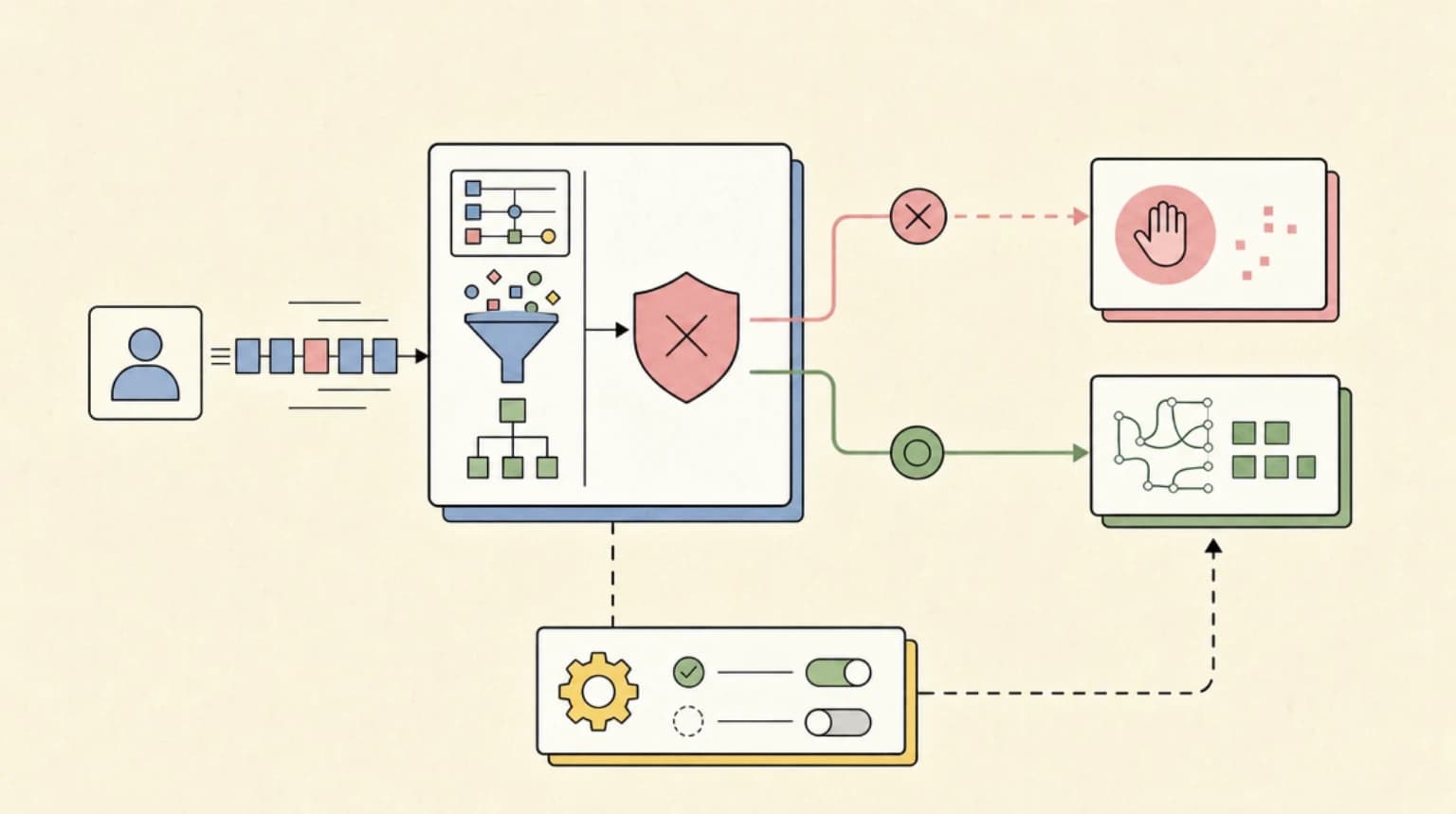
On its return, Fable 5 ships with a new safety classifier that blocks the specific reported jailbreak technique in more than 99 percent of cases. The stated tradeoff is more false positives on benign coding and debugging. For a single-shot chat app that is an annoyance. For a fleet running thousands of agent turns, it is a metric you have to watch.
When the classifier refuses, Fable 5 returns stop_reason: "refusal" as a normal 200 response, not an HTTP error. A fleet that only alerts on 4xx and 5xx codes will treat a wave of refusals as a wave of successful-but-empty completions. Silent degradation is worse than a loud failure, because your agents keep "succeeding" while producing nothing.
Treat refusal rate as a first-class operational signal:
- Emit a metric on every
refusalstop reason. Tag it by agent role and task type so you can see which workloads trip the classifier. - Alert on refusal-rate spikes. A sudden climb usually means either a classifier update on Anthropic's side or a change in your prompts that pushed benign requests into blocked territory. Both are things you want to know within minutes, not at the end of a billing cycle.
- Track the fallback rate alongside it. Every refusal should be handled by a fallback (see below). Refusal rate and fallback success rate together tell you whether the safety net is holding.
If your refusal rate is climbing and your fallback path is quietly absorbing it, your fleet is still working but is no longer running on the model you think it is. That is exactly the kind of drift observability exists to catch.
Effort is the fleet's cost and quality dial#
Fable 5 has adaptive thinking always on. You cannot turn it off. You control depth with the effort parameter. For a fleet operator, effort is the single most direct lever between spend and output quality, and it should be set per agent role, not globally.
A reasonable pattern:
- Low effort for routing, triage, and classification agents. These make fast, cheap decisions and hand off. Deep thinking here mostly burns output tokens.
- Higher effort for the agents doing the genuinely hard reasoning - long-horizon planning, multi-step migrations, complex synthesis. This is where Fable 5's edge shows up and where the tokens are worth it.
- Tune against real traces, not guesses. Set an effort level, run a representative batch, and look at both quality and token spend before you lock it in. The right level is workload-specific.
Because thinking is always on and raw chain-of-thought is never returned, you cannot inspect the reasoning to decide whether effort is set right. You judge it by outputs and cost. That makes disciplined measurement more important, not less.
Observability essentials for a Fable 5 fleet#
You cannot operate what you cannot see. A Fable 5 fleet needs, at minimum, visibility into the following.
- Per-agent token spend. Input and output tokens broken out by agent role and task. Output at $50 per 1M is where cost concentrates, so watch output tokens especially.
- Per-task budgets. Fable 5 exposes task budgets as a beta capability. Use them to cap spend on individual long-running tasks so a single runaway agent cannot quietly consume the day's budget. A budget that halts a task is a controlled failure; an unbounded loop is not.
- Refusal and fallback rates. Covered above. These are the health signals unique to running a classifier-gated frontier model in a fleet.
- Output truncation at 128K. Fable 5 caps output at 128K tokens per request. Long-horizon agents that generate large artifacts can hit this ceiling and return truncated results that look complete. Instrument for responses that stop at the limit and design your agents to chunk or checkpoint work rather than emit one enormous completion.
- Latency and long-running request behavior. Deep-thinking, high-effort requests take longer. Fleet schedulers and timeouts have to accommodate that, or you will kill useful work mid-thought.
None of this is exotic, but all of it has to exist before you scale past a handful of agents. A fleet without per-agent cost and refusal visibility is a fleet you are operating blind.
Availability risk is a design principle, not an afterthought#
Here is the lesson the June episode taught for free. Fable 5 launched on June 9, 2026, and on June 12 a US government export-control directive forced Anthropic to suspend it for every user. It did not come back until the end of the month. A frontier model, at the top of the stack, went dark overnight for reasons that had nothing to do with your code, your contract, or your usage.
For a fleet operator the conclusion is blunt: model-agnostic fallback wiring is a design principle, not an optimization you add later. Assume the model your fleet depends on can vanish, and build so the fleet degrades instead of dying.
Concretely:
- Route through an abstraction, never call the model directly from agent logic. Every agent should ask a routing layer for "the orchestrator model," not hardcode
claude-fable-5. Swapping the underlying model should be one config change. - Wire Opus 4.8 as the standing fallback. It is already the model Fable 5 falls back to on refusal, and it has no retention restriction. A well-built Opus 4.8 path is a prerequisite for running Fable 5 anyway, so you are not doing extra work - you are doing the work in the right order.
- Handle refusals as a first-class control-flow branch. Anthropic supports retrying refusals via a server-side
fallbacksparameter, SDK middleware, or your own logic. You are not billed if the model refuses before producing output. Build the fallback branch on day one; do not treat it as an edge case. - Rehearse the switch. Periodically run the fleet on the fallback model to confirm it actually works. A fallback you have never exercised is a hope, not a plan.
The teams that were hurt least by the June suspension were the ones whose fleets already treated model choice as a swappable input. That is the entire design lesson: build for substitution before you need it.
The pre-production checklist#
Before you point a fleet at Fable 5 in production, confirm:
- Retention posture is known; if ZDR, the fleet is built on Opus 4.8 or Sonnet instead
- Every agent calls a model-routing abstraction, never a hardcoded model id
- Opus 4.8 is wired as the standing fallback and has been tested end to end
- Refusal (
stop_reason: "refusal") is handled as a control-flow branch, not an error - Refusal rate and fallback rate are emitted as metrics with alerts on spikes
-
effortis set per agent role and validated against real traces - Per-agent token spend is visible, with output tokens tracked closely
- Task budgets (beta) cap spend on long-running tasks
- Truncation at the 128K output ceiling is instrumented and agents checkpoint long work
- Timeouts accommodate high-effort, long-running requests
If all ten hold, you have an operations layer, not just an agent loop. That is the difference between a demo and a fleet.
Continue to Part 3, Fable 5 vs Opus 4.8: Which Should Orchestrate Your Agents?, for the model-selection decision that sits underneath all of this.
Frequently Asked Questions#
Can I run a Fable 5 fleet under zero-data-retention?#
No. Fable 5 requires 30-day data retention and is not available to zero-data-retention organizations. A ZDR fleet must run its agents on Opus 4.8 or Sonnet, which carry no such restriction.
How do I detect when Fable 5 refuses a request in a fleet?#
Fable 5 returns stop_reason: "refusal" as a normal 200 response, not an HTTP error. Instrument your fleet to emit a metric on every refusal stop reason, tagged by agent role, and alert on refusal-rate spikes. A fleet that only watches HTTP status codes will miss refusals entirely.
What should I use as the fallback model for a Fable 5 fleet?#
Opus 4.8. It is already the model Fable 5 falls back to on refusal, it has no retention restriction, and building a working Opus 4.8 path is a prerequisite for running Fable 5 safely. Wire it as the standing fallback and rehearse the switch periodically.
How does the effort parameter affect fleet costs?#
Adaptive thinking is always on in Fable 5 and cannot be disabled; you control its depth with the effort parameter. Lower effort on routing and triage agents to save output tokens, and reserve higher effort for genuinely long-horizon reasoning. Tune the level per agent role against real traces, since output tokens at $50 per 1M are where spend concentrates.
Sources#
- Anthropic, Claude Fable 5 and Claude Mythos 5
- Anthropic, Redeploying Fable 5
- Anthropic Docs, Introducing Claude Fable 5 and Claude Mythos 5
Get the next deep dive like this in your inbox
One email a week on Fable 5 and the rest of the AI dev stack. Free.
Read next on Claude Code
Fable 5 vs Opus 4.8: Which Should Orchestrate Your Agents?
The orchestrator is the most important model choice in an agent fleet. A fair head-to-head between Fable 5 and Opus 4.8 for that role, with a decision matrix by run length, budget, compliance, and refusal-handling tolerance.
8 min readThe Economics of Agent Fleets: Fable 5 Orchestrators, Sonnet 5 Workers
One expensive orchestrator plus many cheap workers beats an all-frontier fleet for most workloads. Here is the decision-intent cost math with verified Fable 5, Sonnet 5, and Opus 4.8 prices, plus the Sonnet 5 tokenizer caveat that changes worker cost.
8 min readRefusals at Fleet Scale: Building Fable 5 Agents That Do Not Silently Fail
Fable 5 refusals come back as a 200 response, not an error. At fleet scale, that quietly corrupts entire runs. Here is how to detect, fall back, and treat refusal rate as a health metric.
9 min readTechnical content at the intersection of AI and development. Building with AI agents, Claude Code, and modern dev tools - then showing you exactly how it works.