Flue and the Agent Harness Layer
TL;DR
Flue is trending because it names the part of agent infrastructure that is becoming product-critical: the programmable harness around the model.
Flue is on Hacker News today with a clean pitch: "Agent = Model + Harness."
That framing is more useful than another round of "agents are workflows" discourse.
The model is no longer the whole product. For developer-facing agents, the valuable layer is increasingly the harness around the model: sandboxing, tools, skills, session state, typed outputs, triggers, deployment targets, and control over privileged commands.
That is why Flue is interesting even if the first reaction is skepticism.
The Hacker News thread had the obvious pushback: what problem does this solve, why not ask Claude Code to write the boilerplate, how is it different from Mastra, and why TypeScript again?
Those are fair questions. They also point straight at the category.
The serious agent stack is splitting into layers.
The harness is the product surface#
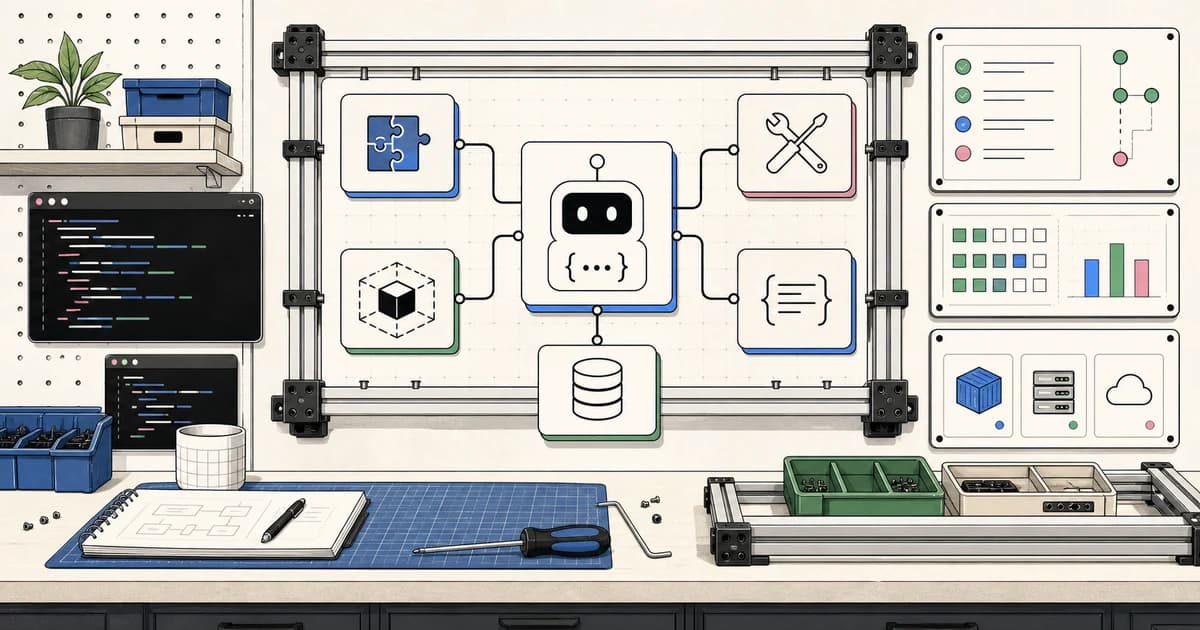
Flue describes itself as a TypeScript framework for building agents with a built-in harness. The examples are not just chat completions. They show agents with webhook triggers, virtual sandboxes, mounted knowledge bases, session persistence, roles, typed result schemas, command definitions, local CI access, and remote MCP tools.
That matters because a production agent is not a prompt. It is a controlled environment where a model can act.
A useful agent framework has to answer boring questions:
- Where does the agent run?
- What files can it see?
- Which tools are allowed?
- Which secrets are hidden from the model?
- What state persists between sessions?
- What result shape is required?
- What happens when the model loops?
- How does the final artifact get inspected?
Most AI SDKs make it easier to call a model. A harness framework tries to make it easier to operate the model.
That distinction is the same pattern behind ML Intern's domain-agent loop and Open Design's artifact wrapper. The wrapper is where the product starts to have opinions.
Why "just generate the boilerplate" is not enough#
The strongest skeptical take is that a coding agent can already generate the scaffolding for a support bot, triage bot, or CI agent. So why introduce a framework?
That argument is right for demos and wrong for repeatable systems.
Boilerplate is only painful once. Operational consistency is painful every day.
If every team asks an agent to freestyle its own sandbox layer, command policy, result validation, trace format, and deployment glue, the organization gets a pile of almost-compatible one-off agents. They may work, but they are hard to audit, hard to reuse, and hard to compare.
A harness framework creates a standard shape:
- agents live in known files
- skills and context are discoverable
- prompts can return typed results
- privileged commands can be wrapped
- local and remote sandboxes share an interface
- deployment targets are part of the framework contract
That is the part you do not want a model inventing differently every time.
The model can still write the agent logic. The framework should own the dangerous edges.
From the archive
The TypeScript bet is pragmatic, not sacred#
The other obvious complaint is that agent infrastructure does not need to be TypeScript.
True. Go, Python, Rust, and C# all have strong claims here.
But TypeScript has one practical advantage: the agent product surface is already web-shaped. Webhooks, dashboards, auth, background jobs, edge deployments, schema validation, SDKs, and frontend previews all live comfortably in the TypeScript ecosystem.
Flue's pitch is not "TypeScript is the only good agent language." It is closer to "agent applications are becoming web applications with a model-driven worker inside."
That is a credible lane.
The risk is that JavaScript fatigue makes every framework look like more framework. The way around that is not louder marketing. It is sharper defaults, smaller examples, and evidence that the harness removes real operational work.
The key design choice is control#
The most important examples in the README are not the flashy ones.
They are the command-control examples.
Flue shows a CI triage agent where privileged CLIs such as gh and npm are connected through command definitions. Secrets are kept in trusted code, not dumped into the model context. Commands can be granted to a specific skill call. Results can be schema-validated.
That is the right direction.
The next wave of agent systems will not be trusted because the model is polite. They will be trusted because the harness narrows what the model can do, records what happened, and returns structured evidence.
That fits the broader lesson from agent swarms needing receipts: orchestration without reviewable outputs becomes theater fast.
Agents need autonomy, but they need bounded autonomy. The harness is where those bounds live.
The opposing view#
The fair opposing view is that this category can become premature abstraction.
If your agent is one script that summarizes an issue and posts a comment, a full framework may be too much. You can use the model provider SDK, a queue, a few shell commands, and a JSON schema.
There is also a real risk that agent frameworks compete on concepts instead of outcomes. Roles, skills, sandboxes, sessions, traces, MCP tools, and deploy targets can sound like progress while hiding the simple question: did the agent complete the task more reliably?
That is the bar Flue and similar frameworks have to clear.
The useful version is not "Next.js for agents" as a slogan. The useful version is:
- fewer hand-rolled wrappers
- clearer command permissions
- repeatable deployment
- better state handling
- typed artifacts
- easier review
- lower cost per agent session
If those do not show up, the framework is decoration.
What builders should copy#
Even if you do not adopt Flue, the pattern is worth stealing.
When building an internal or external agent product, define the harness explicitly:
- Trigger: what starts the agent?
- Workspace: what can it read and write?
- Tools: what operations are available?
- Secrets: what never enters model context?
- Skills: what reusable procedures guide the run?
- State: what survives between sessions?
- Result: what structured artifact must come back?
- Evidence: what logs, diffs, traces, or screenshots prove the work?
That list is more important than the framework brand.
The same structure applies to code review agents, support agents, documentation agents, QA agents, and database migration agents. A model is useful when it is inside a workflow that constrains and verifies it.
My take#
Flue is early, and the skepticism is healthy.
But the phrase "agent harness" is a good handle for where the category is going.
The model layer is powerful and increasingly interchangeable. The product value is moving into the harness: the controlled runtime, the workflow contract, the artifact shape, and the operational guardrails.
That is why Flue is worth watching.
Not because every team needs a new TypeScript framework tomorrow. Because serious agents need more than prompts, and the harness is where serious starts.
Continue Reading#
Read next
ML Intern Shows Where Coding Agents Are Heading: Domain Tools, Not Generic Chat
Hugging Face's ml-intern is trending because it narrows the agent loop around one domain: papers, datasets, model training, Hub traces, and ML shipping workflows.
8 min readOpen Design Shows the Next Agent Wrapper
Open Design is trending because it turns Claude Code, Codex, Cursor, Gemini, and other CLIs into a design engine. The useful lesson is not design automation. It is artifact-first agent wrappers.
8 min read7 AI Agent Orchestration Patterns Every Developer Should Know
From single-agent baselines to multi-level hierarchies, these are the seven patterns for wiring AI agents together in production. Each with a decision rule, an implementation sketch, and the tradeoffs that actually matter.
10 min readShare
Developers Digest
Technical content at the intersection of AI and development. Building with AI agents, Claude Code, and modern dev tools - then showing you exactly how it works.
300+ videos30K+ GitHub stars850+ articles
Related Tools
AI CodingDaily Driver

Claude Code
Anthropic's agentic coding CLI. Runs in your terminal, edits files autonomously, spawns sub-agents, and maintains memory...
View ToolAI CodingAgent

OpenAI Codex
OpenAI's coding agent for terminal, cloud, IDE, GitHub, Slack, and Linear workflows. Reads repos, edits files, runs comm...
View ToolAI CodingOpen source

DeepSeek-TUI
Open-source terminal agent runtime with approval modes, rollback snapshots, MCP servers, LSP diagnostics, and a headless...
View ToolAI Coding

Windsurf
Codeium's AI-native IDE. Cascade agent mode handles multi-file edits autonomously. Free tier with generous limits. Stron...
View ToolApps from Developers Digest
Developer ToolsIn Progress
Agent Benchmark Lab
Compare AI coding agents on reproducible tasks with scored, shareable runs.
View AppDeveloper ToolsPlus $20/mo
Agent Eval Bench Plus
Score every coding agent on your own tasks. Catch regressions in CI.
View AppDeveloper ToolsIn Progress
agentfs
Give your agents a filesystem that branches like git. Crash-safe by default.
View AppRelated Guides
Guide
Building Your First MCP Server
Step-by-step guide to building an MCP server in TypeScript - from project setup to tool definitions, resource handling, testing, and deployment.
AI AgentsGuide
AGENTS.md - Claude Code
Define custom subagent types within your project's memory layer.
Claude CodeGuide
Claude Code Setup Guide
Configure Claude Code for maximum productivity -- CLAUDE.md, sub-agents, MCP servers, and autonomous workflows.
AI AgentsRelated Videos
OpenAI's New TypeScript Agents SDK
Getting Started with OpenAI's New TypeScript Agents SDK: A Comprehensive Guide OpenAI has recently unveiled their Agents SDK within TypeScript, and this video provides a detailed walkthrough...
Video·

I Gave My Agents a Voice… And It’s Wildly Useful
Make Your AI Coding Agents Talk: Natural Voice Replies with the Rime CLI Check out Rime: https://rime.plug.dev/u8AOkAH The video demonstrates a simple way to make AI coding agents respond in human-s...
Video·

Buzz: Open-Source Collaboration for Humans + AI Agents
Buzz by Block: Open-Source Slack-Style Collaboration for Humans + AI Agents (Demo & Setup) Check out Arcade: https://arcade.dev.plug.dev/xiDRwlA Repo: https://github.com/block/buzz The video introd...
Video·
Related Posts

8 min read
AI Coding
ML Intern Shows Where Coding Agents Are Heading: Domain Tools, Not Generic Chat
Hugging Face's ml-intern is trending because it narrows the agent loop around one domain: papers, datasets, model traini...

8 min read
AI Coding
Open Design Shows the Next Agent Wrapper
Open Design is trending because it turns Claude Code, Codex, Cursor, Gemini, and other CLIs into a design engine. The us...
10 min read
AI Agents
7 AI Agent Orchestration Patterns Every Developer Should Know
From single-agent baselines to multi-level hierarchies, these are the seven patterns for wiring AI agents together in pr...
9 min read
AI Coding
Skills Are the New Agent Operating System
GitHub trending is full of agent skill frameworks. The real shift is not bigger prompts or more agents. It is turning te...
8 min read
AI Coding
jcode and the Coding Agent Harness Wars
jcode is trending because it competes on a less glamorous but important agent metric: how cheap it is to keep many codin...
8 min read
AI Coding
The 10 Best AI Coding Tools in 2026
From terminal agents to cloud IDEs - these are the AI coding tools worth using for TypeScript development in 2026.
Build with the member tools

Get Smarter About AI Dev
New tutorials, open-source projects, and deep dives on coding agents - delivered weekly.
One email per weekReal code, not theoryFree forever