jcode and the Coding Agent Harness Wars
TL;DR
jcode is trending because it competes on a less glamorous but important agent metric: how cheap it is to keep many coding sessions alive.
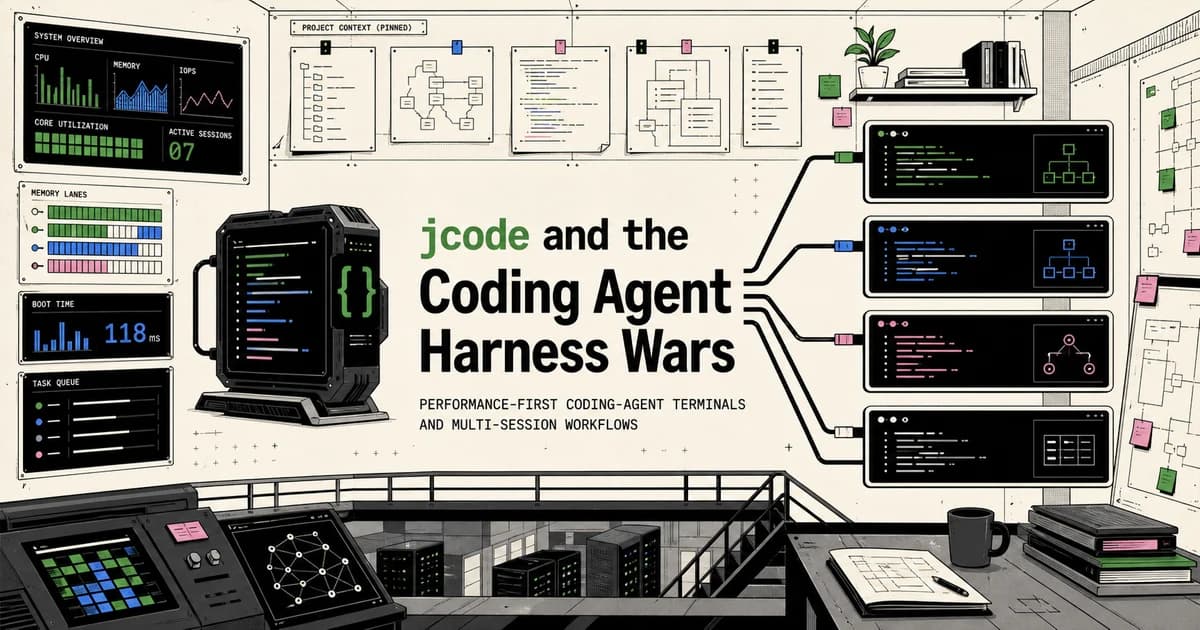
jcode is trending on GitHub with a very specific pitch: a next-generation coding agent harness built for multi-session workflows, customizability, and performance.
The README leads with numbers most agent tools avoid: memory use, time to first frame, time to first input, and extra RAM per added session.
That is the interesting part.
Most coding-agent launches compete on intelligence, model support, and workflow demos. jcode competes on the physics of running a lot of agent sessions at once.
That may sound narrow. It is not.
If agents become normal development infrastructure, performance stops being a nice detail and becomes product strategy.
Coding agents are becoming runtimes#
The first generation of AI coding tools felt like smart chat boxes connected to a repo.
The next generation feels more like local runtimes:
- multiple sessions
- persistent memory
- embeddings
- file watching
- background work
- terminals
- tool permissions
- project context
- replayable conversations
- model routing
Once you have that shape, resource use matters.
A single agent session can be expensive but tolerable. Ten sessions across a large repo, each with state, tools, embeddings, and a live UI, is a different operating model.
That is where jcode's README is making a concrete claim. It frames performance as an enabler for multi-session work, not as benchmark theater.
This connects directly to overnight agent workflows. If you want agents running in parallel while you sleep, you need more than good prompts. You need low-friction session management and cheap enough runtime overhead to leave work in progress.
The harness layer keeps getting clearer#
jcode calls itself a coding agent harness. That is the same language showing up in Flue's agent harness framing, but aimed at a different surface.
Flue is about programmable agents you can deploy. jcode is about the local coding-agent environment itself.
The common thread is that people are no longer satisfied with "model plus shell."
They want a harness that owns:
- how sessions start
- how context persists
- how tools are exposed
- how many jobs can run
- how memory scales
- how fast the UI responds
- how easy it is to customize behavior
That is where agent products are becoming infrastructure products.
The model can write code. The harness decides whether that coding loop is ergonomic enough to use all day.
From the archive
Performance is a UX feature#
Agent speed is usually discussed as model latency. That is only part of the experience.
Developer tools also have local latency:
- launch time
- terminal responsiveness
- session switching
- indexing overhead
- memory growth
- extra cost per concurrent task
- how quickly the tool accepts the next instruction
When those are slow, developers stop treating the agent as a working environment and go back to one-off prompts.
jcode's emphasis on time to first frame and time to first input is a useful reminder that coding agents inherit expectations from terminals and editors, not just chat apps.
If the tool feels heavy before the model even starts thinking, it loses trust.
That is especially true for agent workflows where the human is supervising many tasks. A slow control surface makes parallelism feel expensive, even when the model work is useful.
The opposing view#
The fair skeptical read is that local performance does not matter if the model is still the bottleneck.
If a task takes ten minutes because the model explores, edits, tests, and revises, shaving hundreds of milliseconds from startup can sound irrelevant.
That skepticism is partly right.
For one-off deep tasks, model quality, tool reliability, and test feedback matter more than interface launch time.
But multi-session workflows change the math.
When an agent tool becomes something you keep open, reuse, script, and fan out across tasks, overhead compounds. Memory per session matters. Startup time matters. Switching cost matters. The cost of leaving ten agents alive matters.
The mistake is treating performance as a substitute for reliability. It is not.
Performance is the floor that lets reliability work at scale.
Why this matters for product builders#
If you are building an agent product, jcode points at a set of questions worth asking early:
- How much memory does an idle session use?
- How much does each additional session cost?
- Can users keep multiple tasks alive without relaunching everything?
- Is project context shared, copied, or recomputed?
- Can the agent resume without rebuilding its whole mental model?
- Does the tool feel instant before the model call starts?
- What happens when a session stalls?
These questions are not as exciting as "which model is best?"
They are more durable.
Model rankings will keep changing. Runtime ergonomics, state management, and session economics will matter regardless of which model is winning this month.
That is also why the agent reliability cliff is not just a model problem. Reliability lives in the surrounding system: the harness, the receipts, the evaluation loop, and the cost of retrying.
The benchmark trap#
There is one caution.
Agent-tool benchmarks can become marketing fast.
Memory numbers depend on platform, configuration, embeddings, repo size, plugins, UI state, and whether a session is doing real work. Startup numbers are even easier to overfit.
So the useful conclusion is not "jcode is definitively faster than every other tool in every condition."
The useful conclusion is that jcode is competing on the right axis.
Agent tools should publish resource behavior. They should explain idle cost, active cost, multi-session cost, and what features change the numbers. Developers can handle nuance. They just need the facts.
My take#
jcode is interesting because it treats the coding agent as a long-lived developer runtime instead of a one-shot assistant.
That is where the category is going.
The winner will not be the tool with the loudest demo. It will be the tool that can keep many useful agent loops alive, make them cheap to supervise, preserve context without bloat, and return evidence that the work actually happened.
Performance alone will not make an agent trustworthy.
But without performance, multi-agent workflows stay theoretical.
That is why jcode is worth watching. It is a reminder that the coding-agent wars are not only about models. They are about harnesses, session economics, and the developer experience around sustained delegation.
Continue Reading#
Read next
Flue and the Agent Harness Layer
Flue is trending because it names the part of agent infrastructure that is becoming product-critical: the programmable harness around the model.
8 min readOpen Design Shows the Next Agent Wrapper
Open Design is trending because it turns Claude Code, Codex, Cursor, Gemini, and other CLIs into a design engine. The useful lesson is not design automation. It is artifact-first agent wrappers.
8 min readShip Code While You Sleep: The Overnight Agent Workflow
How to spec agent tasks that run overnight and wake up to verified, reviewable code. The spec format, pipeline, and review workflow.
11 min readShare
Developers Digest
Technical content at the intersection of AI and development. Building with AI agents, Claude Code, and modern dev tools - then showing you exactly how it works.
300+ videos30K+ GitHub stars850+ articles
Related Tools
AI CodingDaily Driver

Claude Code
Anthropic's agentic coding CLI. Runs in your terminal, edits files autonomously, spawns sub-agents, and maintains memory...
View ToolAI CodingAgent

OpenAI Codex
OpenAI's coding agent for terminal, cloud, IDE, GitHub, Slack, and Linear workflows. Reads repos, edits files, runs comm...
View ToolAI CodingOpen source

DeepSeek-TUI
Open-source terminal agent runtime with approval modes, rollback snapshots, MCP servers, LSP diagnostics, and a headless...
View ToolAI Coding

Kimi Code
Open-source terminal coding agent from Moonshot AI. Powered by Kimi K2.5 (1T params, 32B active). 256K context window. A...
View ToolApps from Developers Digest
Developer ToolsIn Progress
Agent Benchmark Lab
Compare AI coding agents on reproducible tasks with scored, shareable runs.
View AppDeveloper ToolsPlus $20/mo
Agent Eval Bench Plus
Score every coding agent on your own tasks. Catch regressions in CI.
View AppDeveloper Tools
Agent Hub
Every coding agent in one window. Stop alt-tabbing between Claude, Codex, and Cursor.
View AppRelated Guides
Guide
Claude Code Setup Guide
Configure Claude Code for maximum productivity -- CLAUDE.md, sub-agents, MCP servers, and autonomous workflows.
AI AgentsGuide
MCP Servers Explained
What MCP servers are, how they work, and how to build your own in 5 minutes.
AI AgentsGuide
Building Your First MCP Server
Step-by-step guide to building an MCP server in TypeScript - from project setup to tool definitions, resource handling, testing, and deployment.
AI AgentsRelated Videos
OpenAI Open Sources Codex: The CLI Coding Agent
Exploring Codex: AI Coding in Terminal In this video, I explore Codex, a new lightweight CLI tool for AI coding that runs in the terminal. This tool, possibly a response to Anthropic's CLI,...
Video·
Zed: The Open Source Agentic IDE - Use Claude Code, Codex & Gemini CLI in one place
Check out Zed here! https://zed.dev In this video, we dive into Zed, a robust open source code editor that has recently introduced the Agent Client Protocol. This new open standard allows...
Video·
I Gave My Agents a Voice… And It’s Wildly Useful
Make Your AI Coding Agents Talk: Natural Voice Replies with the Rime CLI Check out Rime: https://rime.plug.dev/u8AOkAH The video demonstrates a simple way to make AI coding agents respond in human-s...
Video·
Related Posts
8 min read
AI Coding
Flue and the Agent Harness Layer
Flue is trending because it names the part of agent infrastructure that is becoming product-critical: the programmable h...
8 min read
AI Coding
Open Design Shows the Next Agent Wrapper
Open Design is trending because it turns Claude Code, Codex, Cursor, Gemini, and other CLIs into a design engine. The us...
11 min read
AI Agents
Ship Code While You Sleep: The Overnight Agent Workflow
How to spec agent tasks that run overnight and wake up to verified, reviewable code. The spec format, pipeline, and revi...

9 min read
AI Agents
The Agent Reliability Cliff: Why Your 10-Step Chain Only Succeeds 20% of the Time
The math of agent pipelines is brutal. 85% reliability per step compounds to about 20% at 10 steps. Here is why long cha...

8 min read
AI Coding
ML Intern Shows Where Coding Agents Are Heading: Domain Tools, Not Generic Chat
Hugging Face's ml-intern is trending because it narrows the agent loop around one domain: papers, datasets, model traini...
5 min read
Aider
Aider vs Claude Code: Open Source vs Commercial AI Coding CLI
Aider is open source and works with any model. Claude Code is Anthropic's commercial agent. Here is how they compare for...
Build with the member tools

Get Smarter About AI Dev
New tutorials, open-source projects, and deep dives on coding agents - delivered weekly.
One email per weekReal code, not theoryFree forever