Mastra vs LangGraph.js: TypeScript Agent Frameworks Compared
TL;DR
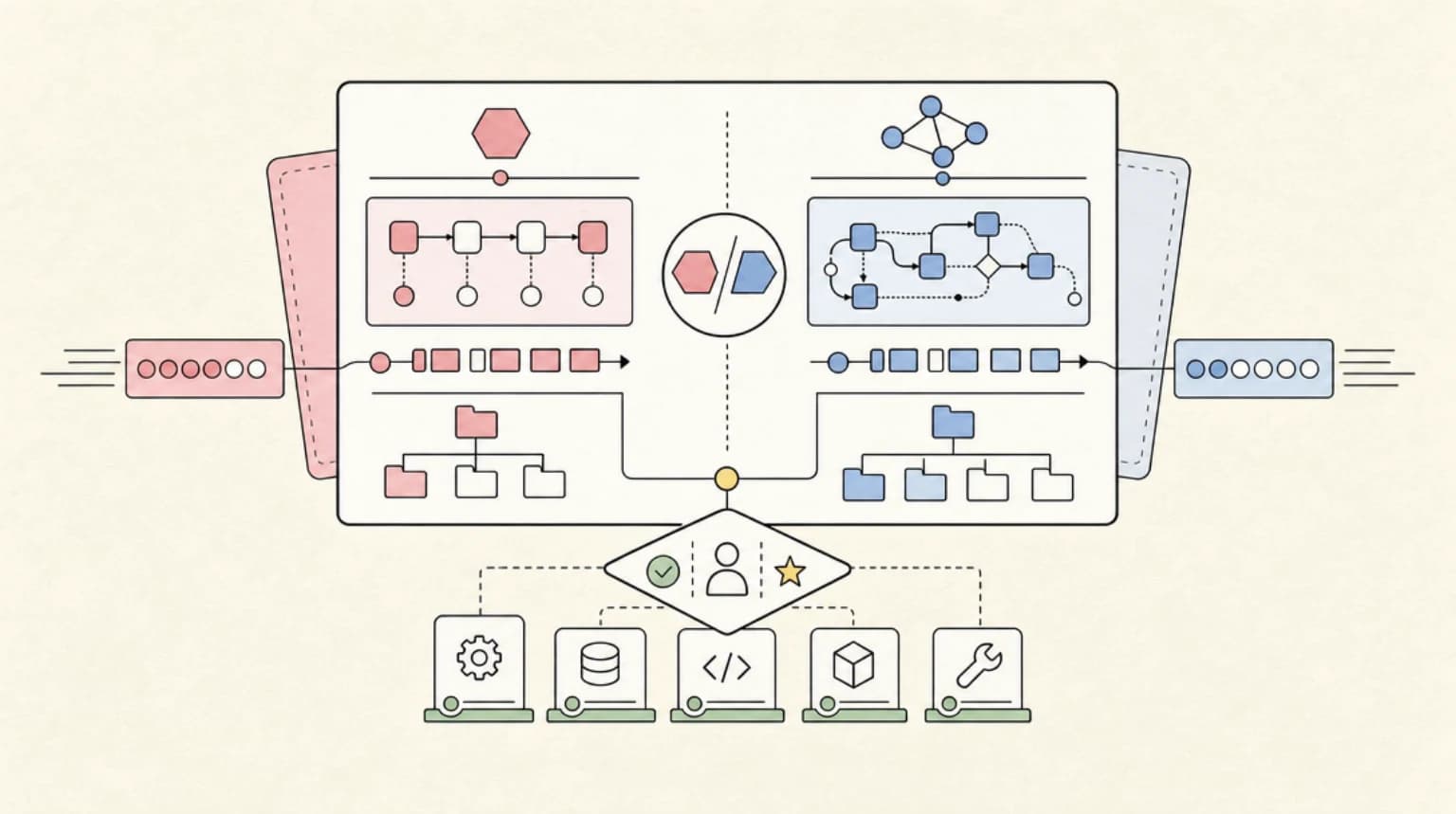
Both Mastra and LangGraph.js are serious TypeScript agent frameworks - but they start from opposite philosophies.
The TypeScript agent ecosystem has matured fast. Two years ago your choices were "use the Python library and suffer" or "roll your own." Now you have real options with real production deployments behind them. Mastra and LangGraph.js sit at the center of those options, and they attract very different kinds of builders.
Mastra pitches itself as a full-featured TypeScript framework - batteries included, studio UI included, model router included. LangGraph.js pitches itself as a low-level orchestration runtime - graph primitives, durable execution, and maximum control. Neither pitch is dishonest. The question is which one matches how you think about the problem you are solving.
Last updated: June 16, 2026
What Each Framework Actually Is#
Before the comparison gets useful, it helps to be precise about the category each tool occupies.
Mastra is a framework for building AI-powered applications. You get an Agent class, a createWorkflow / createStep API, a built-in model router covering 3000+ models from OpenAI, Anthropic, Groq, Google, Cerebras, Mistral, and others, memory, voice, channels for Slack, Discord, and Telegram, guardrails, structured output, and a local dev studio at localhost:4111. You scaffold a project with npm create mastra@latest and you are running in minutes. The docs describe the goal as "everything you need to prototype fast and ship with confidence."
LangGraph.js is a low-level orchestration runtime. It gives you a directed graph - StateGraph, nodes, edges, START, END - and the infrastructure to run that graph durably: persistence across failures, human-in-the-loop interrupts, streaming at every layer, time-travel debugging, and comprehensive memory. The docs are explicit: "LangGraph is very low-level, and focused entirely on agent orchestration." It does not abstract prompts or architecture. It sits alongside LangChain (agent harness), LangSmith (observability and deployment), and Deep Agents (a higher-level harness built on LangGraph).
These are not competing at the same layer. Mastra is closer to a complete platform. LangGraph.js is closer to a runtime primitive you build a platform on top of.
Developer Experience#
Getting started with Mastra takes one command:
npm create mastra@latest
You pick a project name and a model provider. You get a working project with a local dev server and Studio UI. Studio gives you a visual graph view of workflows, an auto-generated input form from your schemas, live step-by-step execution status, and time-travel replay for debugging completed runs. For teams that want to move fast and show stakeholders something real, this matters.
LangGraph.js setup is also straightforward:
npm install @langchain/langgraph @langchain/coreBut the "hello world" reveals the abstraction level immediately. You define a StateSchema, write a node function, wire START to your node and your node to END, compile, invoke. There is no scaffold, no studio, no default model. You are working with graph primitives from line one. That is a feature if you want control; it is friction if you want to ship a customer-facing assistant in a sprint.
Mastra's agent definition is terse, taken directly from the docs:
import { Agent } from '@mastra/core/agent'

export const testAgent = new Agent({
  id: 'test-agent',
  name: 'Test Agent',
  instructions: 'You are a helpful assistant.',
  model: 'openai/gpt-5.5',
})
LangGraph.js has no equivalent Agent shorthand at the framework level. You compose one from graph nodes and edges, or you use LangChain's agent utilities that sit on top of LangGraph.
Workflows and Orchestration#
This is where the comparison gets most interesting.
Mastra workflows are a first-class feature with a builder pattern. Each step carries typed inputSchema and outputSchema (Zod, Valibot, and ArkType all work). Steps share state through an explicit stateSchema. Workflows can suspend, resume, restart from the last active step, and be composed as nested child workflows. The execution result is a discriminated union on status - success, failed, suspended, tripwire, paused - which makes exhaustive handling in TypeScript natural. Workflow runners like Inngest handle managed infrastructure for longer-running jobs.
LangGraph.js builds orchestration out of graph topology. A workflow is a StateGraph with typed state, nodes that process state transitions, and edges (including conditional edges) that route between nodes. The Pregel-inspired execution model means you can express cycles naturally - something linear step chains handle awkwardly. Human-in-the-loop is a first-class interrupt primitive that pauses graph execution at any node and waits for external input. This is powerful for review workflows, approval chains, or any agentic loop where you need to hand control back to a human at a defined point.
Both handle the "agent as a workflow step" pattern. Both handle parallel branches. LangGraph's graph model has more expressive power for complex, non-linear flows - cycles, conditional routing, multi-agent handoffs through shared state. Mastra's step model is easier to read and reason about for linear and mostly-linear processes.
Memory and State#
Mastra includes a memory system covering both short-term conversation context and long-term cross-session persistence. Agents configured with memory can recall prior context, maintain preferences, and accumulate knowledge across runs. Memory is opt-in and configurable at the agent level.
LangGraph.js treats memory as a core capability - short-term working memory for ongoing reasoning and long-term memory across sessions. The graph state is the primary persistence mechanism, and LangGraph's checkpointing infrastructure means state survives failures and can be resumed mid-graph. The time-travel capability (listed explicitly in the LangGraph.js docs sidebar) lets you replay from any checkpoint. For long-running, stateful workflows this checkpointing story is particularly strong.
Observability and Deployment#
Mastra provides logging and telemetry through instance configuration. Studio handles local visibility. For production, Mastra supports deployment to workflow runners and integrates with standard observability tooling.
LangGraph.js has LangSmith as its native observability layer. Set LANGSMITH_TRACING=true and you get execution traces, state transition visualization, and runtime metrics. LangSmith Studio adds a visual agent builder. LangSmith Deployment handles hosting. For teams that need enterprise-grade observability with minimal custom plumbing, the LangSmith ecosystem is a real advantage.
Head-to-Head#
| Feature | Mastra | LangGraph.js |
|---|---|---|
| Install to working agent | npm create mastra@latest, ~2 min | Manual setup, graph primitives required |
| Model router | Built-in, 3000+ models | Bring your own via LangChain or direct SDK |
| Workflow model | Typed steps with .then() chaining | Directed graph (StateGraph, nodes, edges) |
| Cycles / non-linear flow | Nested workflows, limited cycles | First-class via graph edges |
| Human-in-the-loop | Workflow suspend/resume, agent approval | First-class interrupt primitive |
| Memory | Built-in, short and long-term | Built-in via graph state + checkpointing |
| Time-travel debugging | Studio replay | Built-in LangGraph primitive |
| Local dev UI | Mastra Studio (localhost:4111) | None built-in |
| Observability | Instance-level logging + telemetry | LangSmith (traces, evaluation, deployment) |
| Voice / channels | Built-in (Slack, Discord, Telegram, voice) | Not built-in |
| Schema validation | Zod, Valibot, ArkType | Bring your own |
| Primary abstraction level | Application framework | Orchestration runtime |
Who Should Pick Which#
Pick Mastra if:
- You are building a customer-facing product and want to ship fast
- Your team is comfortable with TypeScript but not necessarily with graph theory
- You want voice, Slack/Discord channels, and a Studio UI without stitching them together yourself
- You are embedding agents inside an existing Next.js, SvelteKit, or Hono app
- Your workflow patterns are mostly linear or lightly branching
Pick LangGraph.js if:
- You need maximum control over execution topology - cycles, conditional routing, complex multi-agent handoffs
- Human-in-the-loop interrupts are a core design requirement, not an afterthought
- Your team is comfortable thinking in graph terms and wants the flexibility that entails
- You need the full LangSmith observability and deployment stack, or are already invested in the LangChain ecosystem
- You are building for enterprise use cases where durable execution and auditability are non-negotiable
These are not mutually exclusive at the organization level. Some teams use Mastra for product-facing agents and LangGraph.js for complex internal automation pipelines where they need tighter control. The model router difference alone - Mastra gives you 3000+ models out of the box, LangGraph.js makes you configure providers yourself - is enough of a DX gap that greenfield projects often start with Mastra and only reach for LangGraph.js when they hit specific orchestration requirements.
The Honest Verdict#
Mastra wins on developer experience, batteries included, and time to first working product. LangGraph.js wins on expressive power, the depth of its human-in-the-loop and checkpointing story, and the LangSmith observability ecosystem.
If you are a solo developer or small team shipping a product, Mastra is probably where you start. If you are a platform team building agent infrastructure that other engineers will build on top of, LangGraph.js gives you the primitives to design exactly what you need.
Both are legitimately production-ready in 2026, which is a sentence that could not have been written about the TypeScript agent ecosystem eighteen months ago.
FAQ#
What is the difference between Mastra and LangGraph.js?#
Mastra is a full-featured TypeScript application framework with a built-in model router, Studio UI, workflows, memory, and integrations for voice and chat channels. LangGraph.js is a low-level orchestration runtime that represents agent logic as a directed graph with durable execution, human-in-the-loop interrupts, and state persistence. Mastra prioritizes developer experience and fast time-to-ship; LangGraph.js prioritizes control and expressive power for complex agent topologies.
Is Mastra production-ready in 2026?#
Yes. Mastra is used in production by Replit, Fireworks, Medusa, SoftBank, and others as of mid-2026. It supports workflow runners like Inngest for managed infrastructure, suspend and resume for long-running workflows, and full TypeScript type inference through its schema-first step and workflow APIs.
Can I use LangGraph.js without LangChain?#
Yes, explicitly. The LangGraph.js documentation states it "can be used without LangChain" and that LangChain is included in examples for convenience, not as a requirement. You can bring any model provider via direct SDK integration and use LangGraph.js purely as the orchestration runtime.
Which TypeScript agent framework has better multi-agent support?#
Both support multi-agent systems. Mastra offers supervisor agents, agents as tools, and multi-agent network patterns with a coordinator pattern. LangGraph.js supports multi-agent handoffs through shared graph state and conditional edge routing. Mastra's multi-agent patterns are more prescriptive and easier to get started with; LangGraph.js gives you more flexibility in how agents communicate and share state. For teams building multi-agent pipelines as a platform primitive, LangGraph.js is typically the stronger choice.
Official Sources#
| Resource | URL | Last Verified |
|---|---|---|
| Mastra Documentation | mastra.ai/docs | June 16, 2026 |
| Mastra API Reference | mastra.ai/reference | June 16, 2026 |
| Mastra Agents Overview | mastra.ai/en/docs/agents/overview | June 16, 2026 |
| LangGraph.js Overview | docs.langchain.com/oss/javascript/langgraph/overview | June 16, 2026 |
| LangGraph.js API Reference | langchain-ai.github.io/langgraphjs/reference | June 16, 2026 |
| LangSmith Observability | docs.langchain.com/langsmith/home | June 16, 2026 |
Continue Reading#
- Apache Burr vs LangGraph vs CrewAI: Choosing an AI Agent Framework in 2026
- Mastra npm Supply Chain Attack: 140+ AI Framework Packages Backdoored
- Mastra: Review and Setup Guide for TypeScript Agent Apps (2026)
- The TypeScript AI Agent Stack in Mid-2026: Mastra vs Vercel AI SDK vs OpenAI Agents SDK vs LangGraph.js
- Mastra - features, pricing, and alternatives on one page
- Intro to Agents 101 course - build the same agent with Mastra, the Vercel AI SDK, eve, or Deep Agents
- What's New in Mastra (Late 2026): Harness, AgentController GA, Eval Gates and MCP 2.x
Get the next comparison like this in your inbox
One email a week on ai-agents and the rest of the AI dev stack. Free.
Read next on AI coding tools
The TypeScript AI Agent Stack in Mid-2026: Mastra vs Vercel AI SDK vs OpenAI Agents SDK vs LangGraph.js
The TypeScript AI agent stack compared - Mastra, Vercel AI SDK, OpenAI Agents SDK and LangGraph.js, which layer each covers, and how to pick or combine them.
10 min readManaged Agents vs LangGraph vs Rolling Your Own: Who Should Run Your Agent Loop in 2026
Managed agents vs LangGraph vs a DIY while-loop - compare state, sandboxing, cost, lock-in and compliance to decide who should run your agent loop in 2026.
9 min readAI Coding Tools Pricing Comparison 2026
AI coding tools pricing, verified Sep 28, 2026: Claude Code, Codex, Cursor, Copilot, Antigravity, Windsurf and more. Free tiers, pro plans and hidden costs.
12 min readNew here? Start with
Technical content at the intersection of AI and development. Building with AI agents, Claude Code, and modern dev tools - then showing you exactly how it works.