Microsoft's CLI Coding Agent Study: The Rollout Pattern Teams Should Copy
TL;DR
A Microsoft field study found that CLI coding-agent adoption spreads through peers and managers, while adopters merged roughly 24% more pull requests. The lesson is not to buy more seats. It is to instrument rollout, retention, cost, and review quality from day one.
| Research notes | |
|---|---|
| Microsoft CLI-agent field study | arXiv:2607.01418 |
| Long-Horizon-Terminal-Bench | arXiv:2607.08964 |
| Hugging Face paper page | Long-Horizon-Terminal-Bench on Hugging Face |
| GitHub Copilot CLI GA | GitHub changelog, February 25, 2026 |
| AgenticDataBench | Hugging Face paper page |
| Google Trends check | US 3-month cluster succeeded for Claude Code, Codex, GitHub Copilot, Copilot CLI, and Cursor AI; follow-up clusters hit 429 rate limits |
Last updated: July 13, 2026
Microsoft just published the most useful enterprise coding-agent paper of the summer, and the headline is not simply "agents make people faster."
The paper studies Microsoft's early-2026 rollout of Claude Code and GitHub Copilot CLI across tens of thousands of engineers. The abstract reports three findings that matter for any platform team planning a serious agent rollout:
- First use spread through social networks.
- Retention correlated more with coding activity than demographics.
- Adopters merged roughly 24% more pull requests than they otherwise would have, using merged PRs as the output proxy.
That is a real signal. It is also easy to overread.
Merged pull requests are not product value. They are not maintainability. They are not security posture. They are not reviewer load. The interesting takeaway is narrower and more practical: enterprise coding-agent rollout is measurable if you treat it like a product launch inside your engineering org, not like a software-license procurement event.
If you are already comparing Claude Code, Codex, and GitHub Copilot CLI, this is the missing layer. The question is no longer only which agent is better. It is how your team introduces agents, who keeps using them, what work changes, and whether the review system can absorb the extra output.
The Study In Plain English#
The paper, "Adoption and Impact of Command-Line AI Coding Agents," looks at two related questions.
First, who tries Copilot CLI and who keeps using it? Microsoft had a large eligible population for Copilot CLI, while Claude Code access was narrower and moved through a managed program. That made Copilot CLI cleaner for the adoption analysis.
Second, what happens to merged pull-request output among engineers using Claude Code or Copilot CLI? The authors compare observed output against counterfactual baselines and also look within engineers across weeks with and without tool use.
The strongest claims are careful:
- Adoption was social. Peers, skip-level peers, and direct managers using Copilot CLI all predicted whether an engineer tried it.
- Prior IDE Copilot usage helped predict trying Copilot CLI, but did not cleanly predict retention.
- More active engineers were more likely to keep using it.
- Adopters merged roughly 24% more PRs across the four-month window.
- The paper explicitly acknowledges merged PRs are only a proxy for output.
That last caveat matters. A merged PR is a visible, countable unit of engineering activity. It is not automatically customer value. It does not prove the diff was small, well-tested, secure, or worth merging.
Still, this is much better than vibes. Most coding-agent debates are screenshots, anecdotes, or benchmark leaderboard arguments. This study uses real enterprise telemetry over time.
The Rollout Lesson: Adoption Is Social#
The most operational finding is that adoption spread through visible peers and managers.
That matches how developers actually change tools. Most engineers do not adopt a terminal agent because procurement sends a launch email. They adopt it when someone near them shows a concrete workflow:
- "I used it to reproduce the flaky test before patching."
- "I had it split this migration into reviewable PRs."
- "I saved the prompt and receipt in the issue."
- "Here is where it failed and what I changed."
That is why a serious rollout should start with visible working examples, not generic enablement decks.
The practical sequence is:
- Pick a few high-trust teams with real backlog pressure.
- Instrument their workflows before rollout.
- Publish short internal examples with the prompt, diff, tests, cost, and reviewer notes.
- Encourage managers to use the tool in visible but bounded ways.
- Measure retention separately from first use.
First use is curiosity. Retention is workflow fit.
The paper's split between adoption and retention is the part many enterprises miss. A tool can spike because everyone wants to try it. It can still fail if the second-week experience is slow, expensive, noisy, or hard to review.
The Counterargument: PR Lift Can Be Misleading#
A 24% merged-PR lift sounds decisive. It is not enough by itself.
More merged PRs can mean:
- more small useful changes
- more automation of boring maintenance
- faster bug fixes
- better documentation upkeep
- thinner PRs that reviewers can approve quickly
It can also mean:
- more churn
- more duplicated helpers
- more shallow tests
- more reviewer fatigue
- more low-value code moving through the system
That is why this study pairs so well with today's Hugging Face paper signal. Long-Horizon-Terminal-Bench, submitted to Hugging Face's daily papers today and posted on arXiv last week, tests agents on 46 long-horizon terminal tasks across categories like software engineering, experiment reproduction, multimodal analysis, games, and scientific computing.
The benchmark's headline is sobering: long terminal tasks are still hard. The authors report that agents average millions of tokens, hundreds of episodes, and long execution windows per task, while even the strongest tested model remains far from reliable completion at strict thresholds.
So the enterprise lesson is not "agents work, roll them out everywhere."
The lesson is: agents are now useful enough to move enterprise output metrics, but still unreliable enough that the measurement system has to include review quality, cost, and long-task failure modes.
What To Instrument Before You Buy Seats#
If you are rolling out CLI coding agents, measure four layers from the start.
1. Adoption#
Track who tries the tool, when, and through which enablement path. Separate organic use from manager-led pilots, training sessions, and mandated migrations.
The Microsoft paper suggests social exposure matters. That means you should measure it intentionally:
- team-level adoption
- manager usage
- peer examples shared
- internal docs opened
- recorded demos watched
Do not treat adoption as a single org-wide percentage. Averages hide where the workflow is actually taking root.
2. Retention#
Retention is the useful metric. Define it before rollout.
Microsoft used early sustained activity as its retention proxy: using Copilot CLI on at least 5 of the 14 days after first use. Your threshold may differ, but the shape is right. A developer who tries an agent once because it is new has not adopted it.
Better retention metrics:
- active days in the first two weeks
- repeated use across different task categories
- voluntary use after the pilot ends
- use in code review follow-up, not just first draft generation
- use alongside receipts and tests
Retention tells you whether the agent joined the workflow or stayed a demo.
3. Output#
Merged PRs are a reasonable first output metric because they exist in every GitHub organization. But they need companions.
Track:
- merged PR count
- PR size
- files touched
- review cycles
- time to merge
- reverted PRs
- post-merge defects
- test coverage changes
- reviewer time
The agent can increase output while hurting maintainability. You need the surrounding metrics to know which version you have.
This is the same point behind AI code review becoming the bottleneck. The scarce resource shifts from code generation to verification.
4. Cost#
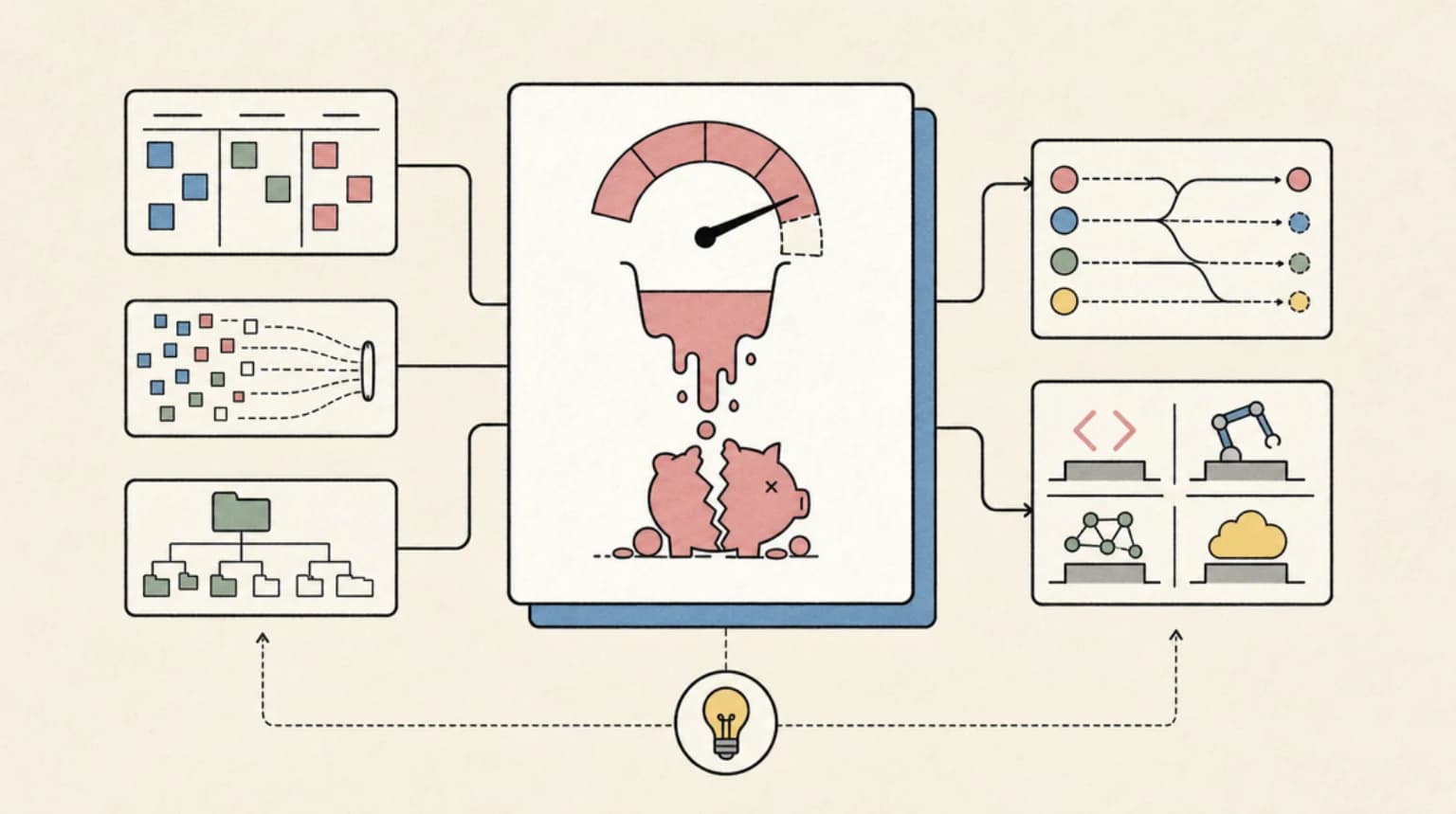
CLI agents make cost spiky because a single task can load a repository, run tools, retry, summarize, and spawn long reasoning loops.
That connects directly to the enterprise AI coding budget blowouts problem. You cannot evaluate ROI if you know PR lift but not cost per accepted change.
At minimum, track:
- cost per active user
- cost per merged PR touched by an agent
- cost per reviewable accepted change
- cost by task type
- top percentile users
- failed-session spend
The expensive sessions are not automatically waste. Senior engineers doing hard migrations may spend more because the work is more valuable. The point is attribution, not punishment.
The Benchmark Lesson: Long Tasks Need Partial Credit#
Long-Horizon-Terminal-Bench is worth watching because it evaluates what ordinary developer benchmarks often miss: partial progress on tasks that take many steps.
That maps to real coding-agent work. A terminal agent might not finish a migration, but it may still:
- reproduce the issue
- identify the right files
- write a partial test
- isolate a bad dependency
- document the failing command
- rule out a dead path
Binary pass/fail hides that value. Pure PR count hides the opposite problem: a PR can merge while the agent skipped the hard part.
The better enterprise scorecard borrows from both worlds:
- Did the agent reach a reviewable final state?
- If not, did it leave useful partial progress?
- Did it preserve evidence?
- Did it avoid unnecessary changes?
- Did it spend within the task budget?
- Could a human resume from the receipt?
That is why Dockerless-style coding-agent verification and baseline receipts for agent evals matter. The future is not one global leaderboard. It is task-specific evidence.
The Practical Rollout Playbook#
For a 100-engineer org, I would not start with every seat enabled.
Start with three pilot lanes:
| Lane | Good first tasks | Why |
|---|---|---|
| Maintenance | dependency bumps, failing tests, small refactors | easy to review, measurable, low product ambiguity |
| Documentation and examples | README fixes, API examples, migration notes | high acceptance rate, low runtime risk |
| Bug reproduction | repro scripts, failing tests, log triage | forces evidence before code |
Avoid starting with broad product features. That is where agents can create plausible but hard-to-review diffs.
Then require every agent-assisted PR to include a receipt:
Agent used:
Task:
Files changed:
Tests run:
Commands that failed:
Cost or usage estimate:
Reviewer focus:
Known risks:
This looks bureaucratic until the fifth agent PR lands in one afternoon. Then it becomes the only way review stays sane.
What This Means For Tool Choice#
The Microsoft paper should make teams less religious about tool choice and more serious about rollout design.
Claude Code, Copilot CLI, Codex, Cursor, and open-source agents will keep leapfrogging each other. The durable advantage is not picking the permanent winner. It is building an adoption and verification system that can absorb model churn.
Use GitHub Copilot CLI when GitHub-native governance matters. Use Claude Code when local terminal orchestration and model quality are the priority. Use Codex when managed agent tasks and cloud workspaces fit the workflow. Use cheaper or local agents when the task is bounded and the failure mode is acceptable.
But use the same measurement contract across all of them:
- adoption
- retention
- output
- review quality
- cost
- evidence
That is the real takeaway from Microsoft's study.
CLI coding agents are past the novelty stage. They are not magic. They are an engineering system now, and engineering systems need instrumentation.
FAQ#
What did Microsoft's CLI coding-agent study find?#
Microsoft's July 2026 arXiv paper studied an early-2026 rollout of Claude Code and GitHub Copilot CLI across tens of thousands of engineers. It found that first use spread strongly through peers and managers, retention was tied more to coding activity than demographics, and adopters merged roughly 24% more pull requests than they otherwise would have.
Does a 24% pull-request lift prove coding agents are worth it?#
No. It is a strong output signal, but merged PRs are only a proxy. Teams still need to measure PR size, review time, revert rate, defect rate, cost per accepted change, and whether the agent left evidence that makes review easier.
Why does social adoption matter for coding agents?#
Developers copy workflows they can see. A manager or peer showing a concrete agent-assisted task is more persuasive than a launch email. The Microsoft study found peer and manager usage predicted first use, which means internal examples and visible champions are part of the rollout system.
How should teams measure coding-agent retention?#
Define retention before rollout. A useful starting point is repeated use during the first two weeks, such as active use on several working days after first trial. Also track whether developers keep using the agent after pilots end and whether they use it for review follow-up, not just initial code generation.
How does Long-Horizon-Terminal-Bench change the evaluation story?#
Long-Horizon-Terminal-Bench tests agents on long terminal workflows with partial credit instead of only final pass/fail. That matters because real coding-agent work often produces useful intermediate evidence even when the final task is not complete. Enterprise scorecards should measure partial progress, receipts, and resumability.
Should enterprises standardize on one coding agent?#
Sometimes. Standardization helps with governance, billing, audit trails, and support. But it can hide capability gaps. Most teams should start with a common measurement contract across tools, then route tasks to Claude Code, Copilot CLI, Codex, Cursor, or local agents based on workflow fit and risk.
Sources#
- Emerson Murphy-Hill, Jenna Butler, and Alexandra Savelieva, Adoption and Impact of Command-Line AI Coding Agents, arXiv, submitted July 1, 2026. Fetched July 13, 2026.
- Zongxia Li et al., Long-Horizon-Terminal-Bench, arXiv, submitted July 9, 2026. Fetched July 13, 2026.
- Hugging Face, Long-Horizon-Terminal-Bench paper page, submitted to Daily Papers July 13, 2026. Fetched July 13, 2026.
- GitHub, GitHub Copilot CLI is now generally available, February 25, 2026. Fetched July 13, 2026.
- Hugging Face, AgenticDataBench paper page, submitted July 3, 2026. Fetched July 13, 2026.
Get the next deep dive like this in your inbox
One email a week on AI Coding and the rest of the AI dev stack. Free.
Read next on Claude Code
Enterprise AI Coding Budget Blowouts: What Uber and Microsoft Teach Us
Uber burned through its entire 2026 AI tools budget by April. Microsoft is canceling Claude Code licenses company-wide. What enterprise teams can learn from the first major AI coding tool budget crises.
8 min readGitHub Copilot Coding Agent and CLI: Why GitHub Is Back in the Agent Race
GitHub Copilot is moving from autocomplete into asynchronous coding agents, terminal workflows, MCP, skills, and model choice. Here is what changed in 2026.
8 min readAI Code Review Is the New Bottleneck
Coding agents make code faster than teams can review it. The next advantage is not bigger prompts. It is review systems that force reproduction, small diffs, tests, and receipts.
8 min readTechnical content at the intersection of AI and development. Building with AI agents, Claude Code, and modern dev tools - then showing you exactly how it works.