Mistral Shieldstral: A 3B Open-Weight Policy-Adaptive Moderation Model That Beats Models 7x Its Size
TL;DR
Shieldstral is a 3B-parameter Apache 2.0 multimodal safety classifier that takes your moderation policy as a plain-language question at inference time, scores content 0-1 in a single forward pass, and runs on one 16GB GPU. It beats 12B-20B guard models on text safety and sets state of the art on multimodal benchmarks.
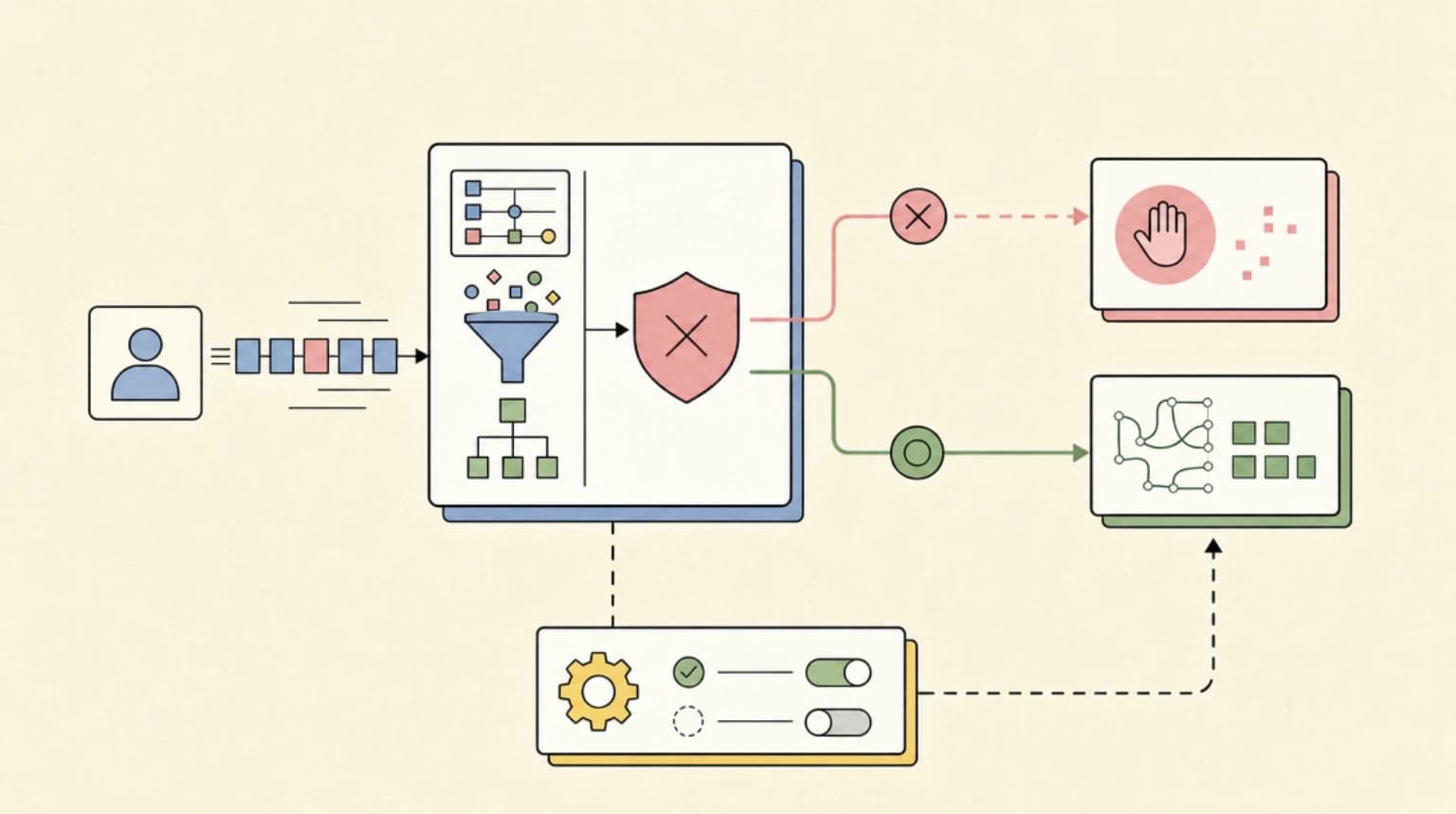
Mistral released Shieldstral 1.0 on August 4, 2026: a 3B-parameter, Apache 2.0, multimodal safety classifier that beats open guard models up to 7x its size on text safety and sets a new state of the art on multimodal moderation, all while running on a single 16GB GPU. The headline mechanic is not the size, though. It is that your moderation policy no longer lives in the weights. You write it as a plain-language question at inference time, and the model returns a calibrated 0-1 safety score from one forward pass.
That turns content moderation from a retraining problem into a configuration problem: one checkpoint, any policy, no fine-tuning. Here is what shipped, what the numbers actually say, and how to run it yourself.
Official Sources#
| Resource | Description |
|---|---|
| Mistral announcement | Release notes, highlights, and training details |
| Technical report (arXiv) | Data recipe, 54.1M samples, policy adaptability eval |
| Hugging Face model card | Full benchmark tables, usage examples, vLLM setup |
| Mistral models overview | Official model listing |
What Shipped#
Shieldstral is built on Ministral-3-3B-Base-2512 with a native Pixtral vision encoder. It frames content moderation as binary question answering. Every request has three parts:
<Instruct>: the evaluation context and strictness level<Query>: one yes/no question that is your policy, for example "Does this content promote physical violence?"<Document>: the content to judge, a prompt, a response, a prompt-response pair, or an image with optional text
Cover: Mistral AI (from the announcement)
At inference the model reads only the yes and no logits and softmax-normalizes them into a continuous safety score, so you can threshold at 0.5, tune the cutoff per surface, or rank by confidence. One interface covers text, image, and text-plus-image content across prompt classification, response moderation, refusal detection, and toxicity screening. The model card lists 12+ supported languages and recommends staying within the 32K training range despite the theoretical 256K context.
The weights are Apache 2.0, released as part of Mistral's Open Secure AI Alliance membership. The model is gated on Hugging Face: you agree to Mistral's terms at download time.
The Numbers#
F1 scores from the official model card. Shieldstral and ShieldGemma use a 0.5 threshold; GPT-OSS-Safeguard-20B runs with high reasoning effort and Nemotron-3.5 with none, so treat cross-model rows with the usual harness caveats:
| Benchmark | Shieldstral-3B | Best competitor (size) |
|---|---|---|
| HarmBench prompt | 99.4 | GPT-OSS-Safeguard-20B: 94.5 |
| ToxicChat prompt | 84.1 | GPT-OSS-Safeguard-20B: 79.8 |
| WildGuardTest prompt | 88.1 | Qwen3Guard-8B: 88.2 |
| Aegis v2 response | 87.2 | Nemotron-3.5-4B: 84.9 |
| XSTest refusal | 94.6 | GPT-OSS-Safeguard-20B: 94.9 |
| VLGuard multimodal | 97.7 | OmniGuard-7B: 88.5 |
| UnsafeBench multimodal | 81.8 | OmniGuard-7B: 72.6 |
| PolyGuard prompt (multilingual) | 84.6 | GPT-OSS-Safeguard-20B: 83.0 |
The one benchmark where Shieldstral loses its namesake is LlavaGuard (72.0 vs 81.4 for LlavaGuard-7B), and GPT-OSS-Safeguard-20B still edges it on several response-classification rows. The pattern: a 3B model sits at or above 7B-20B models on most axes, with the widest gaps on multimodal and on HarmBench, where it scores 99.4.
The technical report is where the interesting work shows. Mistral trained on 54.1M samples, then engineered discrimination rather than memorization: contrastive pairs where a rewrite violates exactly one policy among several deliberately similar siblings, so the model learns policy boundaries instead of a fixed label set. The ablation tells the story: base Ministral-3B sits at 37.8 F1, public safety data gets it to 61.1, and the generated taxonomy data carries it to 84.4. The eval taxonomy is also deliberately divergent from training (73 training categories vs 52 eval categories with different names and boundaries), which is the strongest test of the "adapts to policies it never saw" claim.
From the archive
Self-Improving Applications Are Now Cheaper Than Hiring: The Claude Code and Codex Closed Loop
Aug 4, 2026 • 12 min read
Give Your Coding Agent a Voice: Dictate Prompts with Wispr Flow
Aug 4, 2026 • 9 min read
@cloudflare/computer: an Agent Runtime That Treats a Container as a Tool, Not a Home
Aug 3, 2026 • 7 min read
Cloudflare Runs Kimi and GLM at Scale: FP8 KV Caches, INT4 Weights, and a Cache Safety Net
Aug 3, 2026 • 7 min read
Cost and Deployment#
There is no per-token Shieldstral rate on the pricing page as of today, and none is needed: the whole point of 3B open weights is that you host it. The model fits in 16GB of VRAM in BF16, so a single consumer GPU or a small cloud instance covers it.
Terminal
pip install vllm --upgrade
vllm serve mistralai/Shieldstral-1.0-3B --max-model-len 32768
One design constraint matters for throughput: this is a single-token classifier. The model emits only the yes or no token, so a moderation call is one forward pass and the request loop is cheap, versus a reasoning-heavy guardrail that generates paragraphs per verdict. The card also documents llama.cpp and transformers paths and an Axolotl fine-tune example if you want to bake a specific policy into the weights anyway.
A note on our setup: Shieldstral is not a coding model and is not available through OpenCode, so there is no OpenCode section in this post. It belongs in front of your own prompts and responses, not in the agent loop.
What Developers Are Saying#
The thread around the release split into three camps. The practical crowd reads it as the missing piece for indie platforms: image-sharing apps, community tools, and AI features that previously needed a trust and safety pipeline to launch at all, now have a self-hosted first-pass filter on hardware they already own, with a human review tier behind it. The economics get called out repeatedly: finally a lab other than the usual suspects pricing for cost instead of margin on a small model.
The skeptical camp concentrates on two questions. First, how much policy adaptability is real: is it genuinely flexible with arbitrary rulesets, or does it collapse back into the same fixed moderation style when pushed? The divergent training and eval taxonomies in the report are the strongest evidence so far, but the honest answer is that "one policy per query, rephrased as a question" works best inside the harm-taxonomy space it was trained on. Second, the black-box concern: a model that returns a single calibrated number is easy to wire in and hard to audit, which matters when an automated decision blocks a user. There is also the expected regulatory-framing pushback, treating any moderation model as a censorship pipeline regardless of deployment.
Why It Matters#
This is the second narrow, single-purpose, open-weight model Mistral has shipped in a month, after Robostral Navigate for robotics. The strategy is becoming explicit: stop chasing the frontier with giant MoEs and win surfaces with small specialized models. Moderation is the best-fit surface yet: the task is narrow, the stakes are high, and the incumbents are either closed APIs with opaque rules or 9B-20B open models heavier than the task deserves.
The deeper shift is architectural. Guardrails have been a separate judgment layer with their own fixed taxonomy, which is why refusal and safeguard behavior keeps breaking in surprising places. Shieldstral collapses the policy into the prompt, which is powerful and fragile at once. Powerful because one checkpoint serves every product surface with a different strictness level, and a policy change is a deploy, not a training run. Fragile because your safety posture now inherits all the failure modes of prompt engineering: phrasing sensitivity, accidental loopholes, drift, and a threshold to calibrate per surface. The trust problem in silent guardrails does not disappear because the model is small; it just moves into your config file.
For a team shipping an agent or a community product today, the practical read is simple. A 97.7 F1 multimodal first-pass filter, Apache 2.0, on a 16GB GPU, with your policy as a sentence: the cost floor for doing basic moderation properly just dropped to nearly zero. Whether policy-in-the-prompt is a feature or a liability depends on how much you trust your own query engineering.
FAQ#
What is Shieldstral?#
Mistral's 3B-parameter multimodal safety classifier, released August 4, 2026 under Apache 2.0. It classifies prompts, responses, and images against a natural-language policy supplied at inference time, returning a calibrated 0-1 safety score.
How is Shieldstral different from LlamaGuard or ShieldGemma?#
Shieldstral takes the policy as a plain-language question per call, so one checkpoint adapts to new policies without retraining. LlamaGuard-4 and ShieldGemma train a fixed harm taxonomy into the weights. At 3B it is also roughly a quarter to a third of the size of those models and runs on a single 16GB GPU.
What hardware does Shieldstral need?#
16GB of VRAM in BF16, per the official model card. Serve it with vLLM 0.26.0 or newer via vllm serve mistralai/Shieldstral-1.0-3B --max-model-len 32768; llama.cpp and transformers are also supported.
How do I get a safety score from Shieldstral?#
Call the chat endpoint with max_tokens=1 and token logprobs, then softmax the yes and no logits. The model card ships a reference implementation that returns (score, is_flagged) for any threshold.
What benchmarks does Shieldstral lead?#
Multimodal VLGuard at 97.7 F1 and UnsafeBench at 81.8, HarmBench prompt classification at 99.4, and ToxicChat at 84.1, against open guard models up to 20B. It trails GPT-OSS-Safeguard-20B on several response-classification rows and loses to LlavaGuard-7B on the LlavaGuard benchmark.
Sources#
| Source | URL |
|---|---|
| Mistral announcement: Introducing Shieldstral | https://mistral.ai/news/shieldstral/ |
| Technical report: Shieldstral | https://arxiv.org/abs/2607.25857 |
| Model card: mistralai/Shieldstral-1.0-3B | https://huggingface.co/mistralai/Shieldstral-1.0-3B |
| Base model: Ministral-3-3B-Base-2512 | https://huggingface.co/mistralai/Ministral-3-3B-Base-2512 |
| Mistral models overview | https://docs.mistral.ai/getting-started/models/models_overview/ |
Last updated: August 4, 2026
Continue Reading#
- Fable 5 Safeguards and Refusal Architecture - how a frontier lab structures guardrails today
- The Silent Guardrails Trust Problem - why invisible safety layers erode trust
- Mistral Robostral Navigate - Mistral's other narrow open-weight specialist
- Agents4D: Runtime Safety Benchmark - measuring agent safety at runtime
- AI Infrastructure Needs Spend Guardrails - guardrails beyond content, for cost and compute
Read next
Why Fable 5 Refuses Your Cybersecurity Queries (And How the Fallback Works)
Claude Fable 5 routes blocked queries to Opus 4.8 rather than refusing outright - but the fallback is not automatic for API users and requires explicit configuration. Here is the complete developer guide to the refusal architecture.
8 min readFable 5's Hidden Guardrails: What Developers Need to Know About Silent Degradation
Anthropic's Claude Fable 5 includes undisclosed interventions that silently degrade responses for certain ML development tasks - no fallback notice, no refusal, just worse answers.
7 min readMistral Releases Robostral Navigate: An 8B Robotics Navigation Model
Mistral's new 8B parameter model enables robots to navigate complex environments using only a camera and natural language commands. Here's what it does, how it works, and what the benchmarks actually mean.
5 min readShare
Developers Digest
Technical content at the intersection of AI and development. Building with AI agents, Claude Code, and modern dev tools - then showing you exactly how it works.
300+ videos30K+ GitHub stars850+ articles
Related Tools
AI Models

Mistral
European open-weight models. Mistral Large for complex tasks, Mistral Small for speed, Codestral for code. Strong multil...
View ToolAI Models

OpenRouter
Unified API for 200+ models. One API key, one billing dashboard. OpenAI, Anthropic, Google, Meta, Mistral, and more. Aut...
View ToolAI Models

Qwen3-Coder
Alibaba's flagship open-weight coding model. 480B total parameters, 35B active (MoE). Native 256K context, scales to 1M....
View ToolLocal AI

Jan
Open-source ChatGPT alternative that runs 100% offline. Desktop app with local models, cloud API connections, custom ass...
View ToolApps from Developers Digest
Directories
AI Models
Pick a model in 30 seconds. Built for the answer, not the marketing.
View AppDirectories
Demos
Try AI models in the browser before paying for a single token.
View AppDirectoriesIn Progress
modelpick
Answer a few task questions and get a practical model recommendation with cost and latency tradeoffs.
View AppRelated Guides
Guide
Run AI Models Locally with Ollama and LM Studio
Install Ollama and LM Studio, pull your first model, and run AI locally for coding, chat, and automation - with zero cloud dependency.
Getting StartedGuide
Model Aliases - Claude Code
Use opus, sonnet, haiku, and best to switch models easily.
Claude CodeGuide
Model Picker (/model) - Claude Code
Interactive UI to switch models and effort sliders mid-session.
Claude CodeRelated Videos

Gemma 2 Aims for the Crown! Google's Latest Open-Weights 9B & 27B Models
Exploring Google's Advanced Gemma 2 AI Models and Exciting Updates In this video, I delve into Google's newly released Gemma 2 AI models, including the 9 billion and 27 billion parameter versions....
Video·
Codestral: Mistral AI's FIRST Coding Model
Empowering developers and democratising coding with Mistral AI. In this video, I explore CodeStraw, the latest coding model from Mistral AI designed for code generation tasks. Learn about...
Video·

Mistral Large: The Latest Flagship Model from Mistral AI
In the video, I provide a concise overview of Mistral AI's flagship model, 'Mistral Large,' highlighting its key functionalities, such as advanced function calling, multilingual capabilities,...
Video·
Related Posts
8 min read
Claude
Why Fable 5 Refuses Your Cybersecurity Queries (And How the Fallback Works)
Claude Fable 5 routes blocked queries to Opus 4.8 rather than refusing outright - but the fallback is not automatic for...
7 min read
AI Safety
Fable 5's Hidden Guardrails: What Developers Need to Know About Silent Degradation
Anthropic's Claude Fable 5 includes undisclosed interventions that silently degrade responses for certain ML development...

5 min read
News
Mistral Releases Robostral Navigate: An 8B Robotics Navigation Model
Mistral's new 8B parameter model enables robots to navigate complex environments using only a camera and natural languag...

7 min read
News
AgentS4D: 66% of All Coding Agent Runs Were Unsafe Yet Still Completed
A new arXiv benchmark ran 6,560 sandboxed runs across Claude Code, Codex, OpenClaw, and Hermes with five LLMs. 68% of ru...

8 min read
AI Agents
AI Infrastructure Agents Need Spend Guardrails
The viral DN42 AWS bill story is funny until you realize the missing primitive: infrastructure agents need hard cloud-sp...

7 min read
News
GitHub's AutoGPT Playbook: The Repo Instruction File Is Now an API for Other People's Agents
AutoGPT's founding AI engineer published the gates that keep an open source repo sane when agents submit the majority of...
Build with the member tools

Get Smarter About AI Dev
New tutorials, open-source projects, and deep dives on coding agents - delivered weekly.
One email per weekReal code, not theoryFree forever