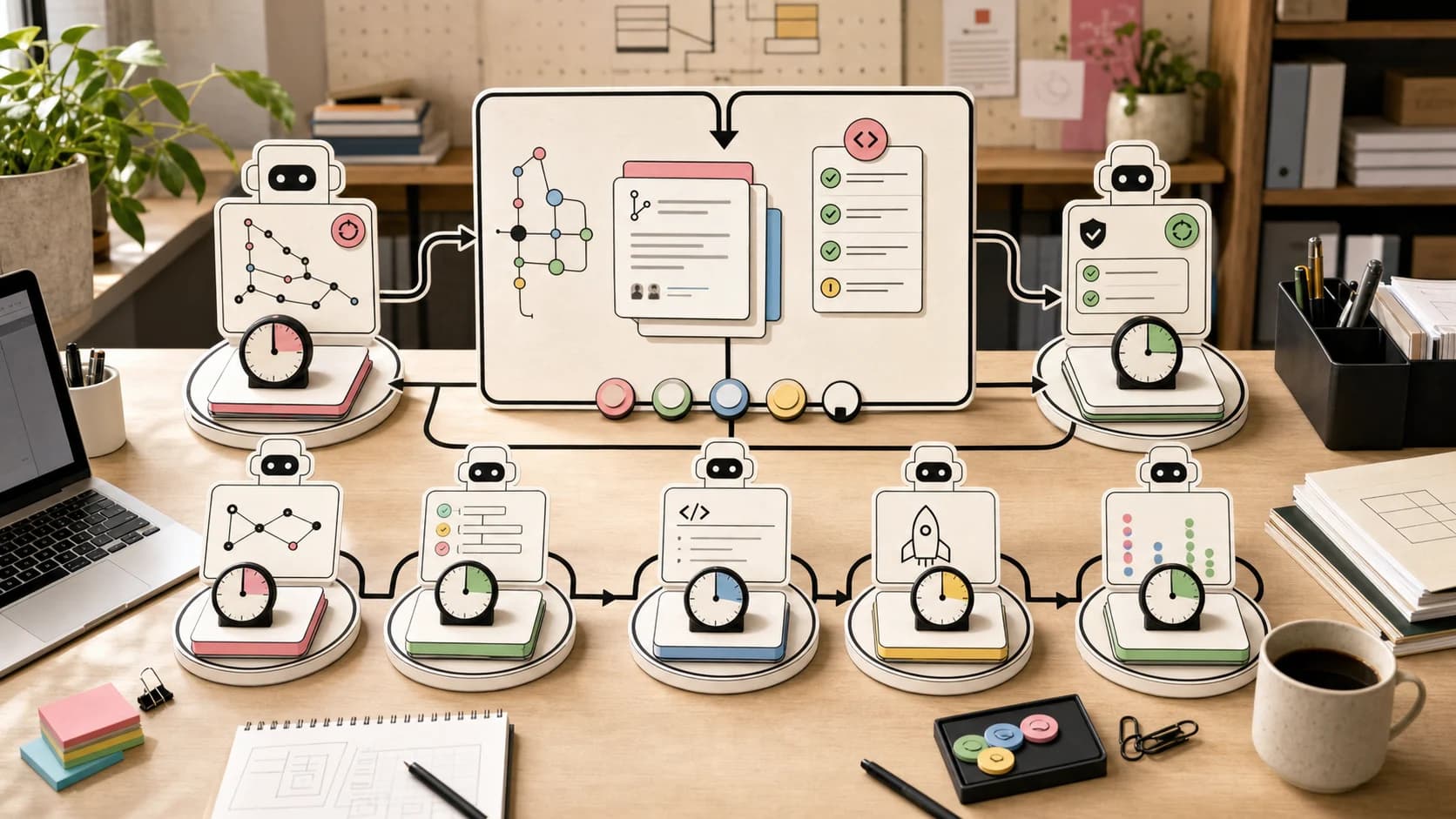
Self-Improving Applications Are Now Cheaper Than Hiring: The Claude Code and Codex Closed Loop
TL;DR
Self-improving applications shift the economics of maintenance. Instead of per-token pricing, you pay per closed issue - and the closed loop (user feedback to GitHub issue to Codex scheduled task to reviewed PR) means the cost is predictable, the fixes are testable, and the human is in the merge decision, not the implementation.
The economics of maintenance just changed. Self-improving applications are now cheaper than hiring someone to fix bugs and handle feature requests - and the interesting shift is not automation versus humans, it is the unit of cost. You are not paying per token. You are paying per closed issue, and the closed loop (user feedback to GitHub issue to Codex scheduled task to validated PR) means the cost is predictable, the fixes are testable, and you keep the merge decision while the agent handles the implementation.
Last updated: August 4, 2026.
Official Sources#
| Source | What it covers |
|---|---|
| Watch: Self Improving Applications with Claude Code & Codex | Full walkthrough of the feedback-to-fix pipeline |
| Vercel Eve framework | Agentic framework for building AI apps with Next.js |
| Vercel AI Gateway | Unified interface for LLM providers with caching and fallbacks |
| Codex scheduled tasks docs | How Codex runs recurring agent work on OpenAI's infrastructure |
| Claude Code documentation | Anthropic's terminal coding agent |
| Supabase GitHub connector | Postgres integration with GitHub webhooks |
Watch the full tutorial on the Developers Digest channel (26 minutes):
The Unit of Cost Is a Closed Issue#
Traditional agent-assisted development bills by the token. You submit a task, the model writes code, and you pay for input and output. That pricing structure works for one-off builds, but it falls apart for maintenance: bugs and feature requests arrive unpredictably, so you cannot budget them, and manual triage means every issue costs you attention before it costs you tokens.
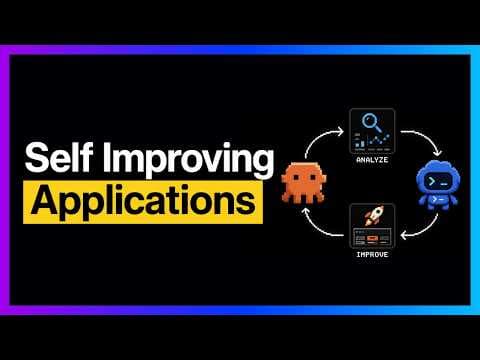
Self-improving applications flip that. The unit of cost becomes a closed issue. User submits feedback through the app, the feedback becomes a GitHub issue automatically, a scheduled agent task reads the issue against the live codebase and logs, writes a fix, opens a PR, and waits for human review. The developer sees a reviewable diff and a test report, not a raw prompt. Merge it or close it, but the implementation cost is already paid - and predictable.
The architecture matters because it changes what you can delegate. The human stays in the merge decision (the highest-leverage gate), and the agent handles the loop from issue filed to PR opened (the highest-volume work). That is not full autonomy. It is scoped autonomy with a review gate, which is exactly the shape maintenance work needs.
The Closed Loop: Feedback to Fix#
The video builds the full pipeline from scratch. Here is the shape:
-
User feedback flows into GitHub issues. A feedback form in the app (built with Eve and ShadCN chat UI) lets users describe bugs or request features. A scoped GitHub Personal Access Token (PAT) creates an issue from that feedback without exposing write access to the rest of the repo.
-
Supabase stores chat and context. The chat interface persists conversation history in Supabase Postgres tables, and file uploads go to Supabase Storage. The agent can read prior user context when it triages the issue.
-
Vercel deploys the app. Push to GitHub triggers a Vercel build and deploy. The live app is the canonical surface users report against.
-
Codex scheduled tasks run the fix loop. A scheduled task (1-hour minimum interval on Codex) reads open GitHub issues, pulls the current codebase and recent logs from Supabase and Vercel, validates the issue against real evidence, writes a fix, runs tests locally, and opens a PR if the fix passes.
-
Human reviews and merges. The developer sees a PR with a clear description, test results, and a diff. Merge it if it looks right, request changes if it needs refinement, or close it if the issue was invalid. The agent never merges on its own.
That is the closed loop. User feedback becomes a GitHub artifact, the agent treats that artifact as a work queue, and the output is a reviewable PR rather than uncommitted code or a vague suggestion.
Why This Works Now#
Three pieces converged to make this practical in 2026:
1. Scheduled agent tasks are production-ready#
Codex scheduled tasks and Claude Code routines both run recurring agent work on cloud infrastructure without you keeping a terminal open. Codex runs on OpenAI's servers with GitHub, Supabase, and Vercel connectors built in. Claude Code schedules run on Anthropic infrastructure with MCP server support. Both let you define the task once, set a schedule (1-hour minimum for Codex, varies for Claude), and let the agent loop while you ship other work.
The important detail: these are not cron jobs calling an LLM API. They are full agent runtimes with tool use, file editing, shell commands, and persistent memory. The agent can read the repo, inspect logs, run tests, and commit changes - the same capabilities you get in an interactive session, but triggered by a schedule instead of a human prompt.
2. Scoped credentials contain the blast radius#
A scoped GitHub PAT with repo access for issue creation and PR opening is enough to run the loop, and it never touches sensitive operations like force pushes, branch deletion, or secret writes. The video emphasizes this: the token is scoped to what the feedback flow needs, not to what a compromised agent could do.
Supabase credentials follow the same principle. The agent reads chat history and logs with read-only database credentials, and Vercel deploy logs are fetched through a read API. The agent has exactly the access required to validate an issue and propose a fix, and nothing more.
3. The cost is legible before you commit#
Because the agent opens a PR rather than merging directly, you see the full cost before you pay it: how many lines changed, which files, what tests ran, and whether the fix makes sense. That visibility matters for two reasons. First, you can reject bad fixes without deploying them. Second, you learn what the agent is good at and what it still needs human refinement for, so you can tune the task prompt or the review rubric accordingly.
Real Cost Math: Issues Per Month#
The Loop Engineering Definitive Guide covers the broader cost model for scheduled agents, but here is the specific math for a self-improving app running the architecture from the video.
Assume a small SaaS with 1,000 users generating 20 bug reports and 10 feature requests per month. The scheduled task runs every hour (the Codex minimum), but most runs find no new issues to process, so the agent only does substantive work when an issue is filed or updated.
- GitHub issue reads: free (GitHub API is free for public and private repos under normal rate limits).
- Supabase reads: negligible (small log and chat queries, well within the free tier for a low-traffic app).
- Agent task runs that produce PRs: 30 per month (one per issue, assuming most are actionable).
- Estimated tokens per PR: 50,000 tokens (reading the issue, codebase context, logs, writing a fix, running tests, opening a PR with a description).
- Total tokens per month: 1.5 million tokens.
At Codex cloud task pricing (roughly $0.03 per 1,000 tokens for GPT-5.5 as of mid-2026), that is $45 per month for 30 closed issues - or $1.50 per issue. For comparison, a junior developer at $60,000 annual salary costs roughly $30 per hour, and triaging and fixing a single issue averages 30 minutes to 2 hours depending on complexity. Even at the low end, that is $15 to $60 per issue in human time.
The agent is an order of magnitude cheaper per issue, and the cost is predictable: you pay per issue the agent actually closes, not per hour of availability.
When to Run This Architecture#
Use the self-improving app pattern when:
- Your app has predictable maintenance load. Bug reports, small feature requests, and minor refinements are the sweet spot. The agent handles the volume work, and you handle the architecture decisions.
- The review gate is cheap. If you can judge a PR in 2 minutes (read the description, skim the diff, check the test output), the human cost of review is negligible compared to the cost of implementing the fix yourself.
- You already use GitHub, Vercel, and Supabase (or equivalents). The video's stack is not the only option, but the pattern needs a work queue (GitHub issues), a deploy pipeline (Vercel or similar), and structured logs (Supabase or equivalent). The connectors are already built for these tools, so setup is fast.
Skip it when:
- Every issue needs custom judgment. If the right fix depends on design decisions, user interviews, or architectural tradeoffs, the agent cannot make those calls. Use it for the implementation after you decide, not for the decision itself.
- The codebase is unstable or under heavy development. If the repo changes frequently in ways that break prior fixes, the agent will produce stale PRs. Stabilize the architecture first, then automate maintenance.
- You do not want to review PRs. The architecture assumes you keep the merge gate. If you are not willing to review agent-generated diffs, do not run this loop - the risk of deploying bad fixes is too high.
FAQ#
What is a self-improving application?#
A self-improving application automates its own maintenance loop: user feedback becomes a GitHub issue, a scheduled agent task reads the issue against the live codebase and logs, writes a fix, runs tests, and opens a reviewable PR. The developer reviews and merges the PR, but the agent handles the triage and implementation.
How much does it cost to run a self-improving app?#
Cost depends on issue volume and agent task complexity. A small app processing 30 issues per month at 50,000 tokens per issue costs roughly $45 per month on Codex cloud tasks (or $1.50 per closed issue), assuming mid-2026 GPT-5.5 pricing. That is an order of magnitude cheaper than paying a developer $15 to $60 per issue in human time.
Can the agent merge PRs on its own?#
No, and the architecture from the video explicitly keeps the human in the merge decision. The agent opens a PR with a clear description and test results, and the developer reviews and merges it. That review gate is the highest-leverage control: you see the full cost of the fix before you deploy it.
What if the agent opens a bad PR?#
Close it and optionally refine the task prompt or the rubric the agent uses to validate fixes. The cost of a bad PR is the time to review and close it (2 minutes), not the cost of deploying and rolling back a bad fix. That is why the merge gate matters.
Do I need to use Vercel, Supabase, and GitHub?#
No. The video uses that stack because the connectors are already built for Codex scheduled tasks, but the pattern works with any work queue (Linear, Jira, Notion), any deploy pipeline (Netlify, Render, Railway), and any structured log store (Postgres, MongoDB, Datadog). The architecture is tool-agnostic - the important parts are the closed loop (feedback to issue to agent task to PR) and the review gate (human approves merges).
How often does the scheduled task run?#
The video uses a 1-hour interval, which is the minimum for Codex scheduled tasks as of mid-2026. Claude Code routines support different intervals depending on the plan. Most runs find no new issues to process, so the agent only does substantive work when an issue is filed or updated.
Can I use this for feature requests, or just bugs?#
Both. The agent treats feature requests the same way it treats bug reports: read the issue, validate it against the codebase, write the implementation, run tests, open a PR. The difference is scope - bug fixes are typically smaller and safer to automate than large features, so start with bugs and expand to small feature requests once you trust the agent's output.
Sources#
- Developers Digest video: Self Improving Applications with Claude Code & Codex - published August 4, 2026.
- Vercel Eve framework documentation - fetched August 4, 2026.
- Vercel AI Gateway - fetched August 4, 2026.
- Codex scheduled tasks documentation - fetched August 4, 2026.
- Claude Code documentation - fetched August 4, 2026.
- Supabase GitHub integration guide - fetched August 4, 2026.
- ShadCN chat UI component - fetched August 4, 2026.
Disclosure: The video mentions Supabase as a sponsor. The link in the video description (https://supabase.plug.dev/1wWOTGS) is a sponsored referral link. This post covers the technical architecture as demonstrated, and the Supabase integration is one of several database options that work with this pattern.
Continue Reading#
- The Definitive Guide to Loop Engineering in Claude Code and Codex - the broader cost model and patterns for scheduled agents, including goal loops, routines, and failure modes.
- Self-Improving AI Agents - the conceptual foundation for agents that improve their own prompts, tools, and workflows.
- Self-Improving Agents in 5 Minutes - a quick primer on the self-improvement pattern.
- Codex /goal and Claude Managed Outcomes: The New Control Loops - how Codex goals and Claude outcomes keep long-running agents on track.
- Overnight Agents Workflow - running agents for hours or days with scheduled tasks and loops.
Get the next deep dive like this in your inbox
One email a week on Claude Code and the rest of the AI dev stack. Free.
Read next on Claude Code
The Definitive Guide to Loop Engineering in Claude Code and Codex
Goal, loop, routine. Three verbs, two tools, one hard part. A complete field guide to running agentic loops in Claude Code and Codex, the real commands, the patterns people actually run, and the two failure modes that burn money.
16 min readSelf-Improving Agents in 5 Minutes: Reflect, Refine, Repeat
Agents that critique their own output, learn from mistakes, and get better over time - the three patterns that actually ship, from simple reflection loops to tree search and meta agents.
8 min readSelf-Improving AI Agents: Building Systems That Learn From Their Mistakes
AI agents that reflect on failures, accumulate skills, and get better with every session. Reflection patterns, memory architectures, skill extraction, and working code examples for building agents that actually learn.
13 min readTechnical content at the intersection of AI and development. Building with AI agents, Claude Code, and modern dev tools - then showing you exactly how it works.