Flint on Ollama: Best Local Coding LLM for Claude Code?

TL;DR
Recursive's Flint is a 40B open-weight coding model with 2.5B active parameters. How to run it on Ollama and point Claude Code at it, plus the benchmark caveats.
Flint is the first open-weight model in a while that makes "best local coding LLM" a real question for agent work: 40 billion parameters, only 2.5 billion active per token, Apache 2.0, and a one-line Ollama install. Recursive released it on October 21, and Ollama added it in v0.40.8. If you search for the best local coding LLM to run behind Claude Code or opencode, this is the new name to test.
Last updated: October 25, 2026
The pitch is speed on a laptop, not frontier intelligence. Recursive's own announcement says to expect to give it more guidance than the large closed coding models, and that is the right way to read the rest of this post.
What Recursive and Ollama actually shipped#
From the Hugging Face model card:
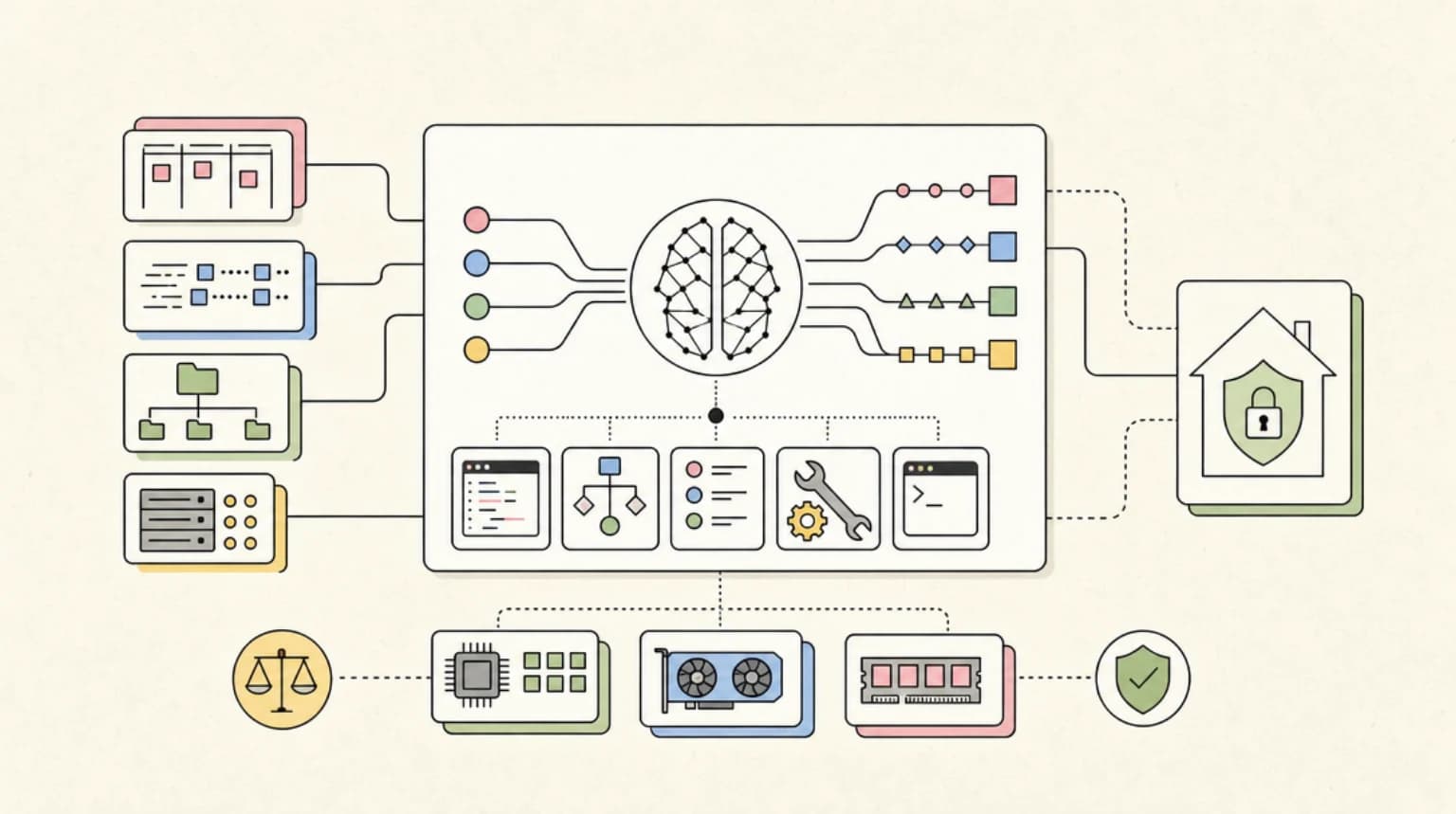
- A decoder-only mixture-of-experts model with 39.8B total parameters and roughly 2.5B active per token. It has 49 layers (2 dense, 47 MoE), 256 routed experts per MoE layer with 6 selected per token, plus a shared expert.
- Documented context of 262,144 tokens. The card recommends at least 32,768 output tokens for hard problems because reasoning shares the window.
- Text in, text out, reasoning and OpenAI-compatible tool calls. Apache 2.0 weights.
- The BF16 checkpoint is about 80 GB and the model card's reference serving kit targets one B300 or H200 GPU. Laptop use goes through the quantized builds.
The Ollama library page lists a single flint:latest tag at 23 GB with a 256K context window. The v0.40.8 release notes shipped it macOS-only; v0.40.9 extended it to Linux and Windows.
Run it, and point a coding agent at it#
The commands below come from the Ollama library page and release notes. I did not run them here, since this environment has no GPU and no Ollama install.
ollama run flint
ollama launch claude --model flint
ollama launch opencode --model flint
The library page lists Claude Code, OpenCode, Hermes Agent and OpenClaw as supported ollama launch targets. Two recent Ollama fixes matter if you do this: v0.40.7 clamps CLAUDE_CODE_AUTO_COMPACT_WINDOW so Claude Code stops warning about an oversized window, and v0.40.9 passes context length and capabilities through to the coding tool so compaction settings are right. Run Ollama 0.40.9 or newer.
For the memory math, 23 GB of weights plus KV cache fits a 36 GB or 48 GB Mac, but is tight on a 16 GB machine. Our VRAM guide covers the headroom you need for long contexts.
The numbers, and who reported them#
All of these are vendor-reported unless stated otherwise:
| Claim | Number | Source |
|---|---|---|
| SWE-bench Verified | 74.2% | Recursive model card |
| Terminal-Bench 2.1 | 54.9% | Recursive model card |
| SWE-bench Pro v2 | 89.7% | Recursive model card |
| Decode speed, M4 Pro MacBook Pro | more than 125 tokens/s | Recursive announcement |
| Decode speed, 64 GB NVIDIA RTX Spark | more than 150 tokens/s | Recursive announcement |
Three caveats from the sources themselves. First, the model card says agentic scores use temperature 1.0 and mini-swe-agent or Terminus 2, and that other models' comparison scores are developer-reported, so the setups are not identical. Second, the speed figures come from Recursive's own inference engine, rec, optimized for M4 Pro and M5 Pro/Max; Ollama's llama.cpp or MLX path may differ. Third, benchmark versions differ across vendors (the card cites SWE-bench Pro v2 and Verified), so check which version a competitor quotes before comparing.
TechCrunch's coverage adds that on Recursive's own six-test average only Alibaba's Qwen3.8 27B scored higher, and that a Wired reviewer using Flint on a 48 GB Mac found it handled several small programs where other small models errored or ran slowly. That is one reviewer on small tasks, not a repository-scale evaluation.
The angle: MoE speed changes which local model you pick#
The old local-coding trade was dense 27B to 35B models that were good but slow, or small models that were fast but unreliable. Flint's bet, per Recursive, is that only 2.5B active parameters per token gives a speed profile closer to a small model while the 40B of total weights keep quality closer to a mid-size one. The company claims it runs more than five times faster than dense 25B to 40B models with similar benchmark scores.
For agent loops this matters more than for chat. A coding agent makes many sequential calls, and decode speed multiplies across all of them. If your local setup is slow enough that you stop using it, a faster model that is slightly worse can still win on total completed work.
What a builder does Monday:
- Upgrade Ollama to 0.40.9 or newer, then pull
flintand run one task you already know the answer to. - Run it through
ollama launch claude --model flinton a small, well-scoped task with explicit instructions. Recursive's guidance is to break complex work into subtasks. - Keep your hosted model as the fallback for multi-file refactors. Compare wall-clock time and the number of retries, not just the pass rate. Our best local coding LLMs guide has the hardware tiers and cost comparison.
- Check the runtime, not just the model. The model card itself says results vary with checkpoint precision and inference runtime, so measure on the build you will actually run.
For how Ollama's storage and MLX changes affect pulling large models, see Ollama 0.40 and the disk doubling. For picking a runtime generally, see local LLM runtimes for coding agents.
What people are actually saying#
I could not open Reddit threads directly from this environment, so this section is based on thread titles and search excerpts only, and I have not verified any of the figures in them.
The r/LocalLLaMA launch thread became one of the most-discussed local model posts of the week, with the listing showing 502 upvotes and 230 comments. Other posters are already folding Flint into their own benchmark write-ups, such as a five-engine comparison on an M3 Max with 36 GB that adds Flint as a test case. A r/LocalLLM post reports about 128 tokens/s for a Q4 build on an M4 Pro with 48 GB, using a third-party engine called Kapitsa rather than Recursive's rec.
The counter-case is in the sources too. Recursive says Flint needs more hand-holding than large closed models, TechCrunch notes the reviewer tests were small programs, and Flint's speed headline depends on a custom engine. Treat early "it replaced my cloud model" claims as small-task results until someone publishes a repository-scale comparison.
FAQ#
Is Flint the best local coding LLM?#
It is the strongest new candidate for speed on laptops based on vendor-reported numbers, but "best" depends on your hardware and task size. Per TechCrunch, Qwen3.8 27B scored higher on Recursive's own six-test average, so test both on your repository.
How do I use Flint with Claude Code?#
Run ollama launch claude --model flint on Ollama 0.40.9 or newer. The Ollama library page lists this command alongside OpenCode, Hermes Agent and OpenClaw.
How much memory does Flint need?#
The Ollama build is 23 GB with a 256K context window, so plan for a 32 GB or larger machine once you add KV cache. The full BF16 checkpoint is about 80 GB.
Is Flint open source?#
The weights are released under Apache 2.0. The model card notes that Recursive's hosted API terms and data practices are separate from the weight license.
Continue Reading#
- The Best Local Coding LLMs in 2026 - hardware tiers and cloud versus owned-hardware cost
- How Much VRAM Do You Need for a Local LLM - the memory math for weights plus long contexts
- Ollama 0.40 and the Disk Doubling - the storage change to know before pulling more models
- Local LLM Runtimes for Coding Agents - which runtime to put under your agent
- Muse Glimmer 30B - Meta's open-weight local agent model for comparison
- Best Local Models - what else runs on your own hardware, by memory tier
- Claude Code - plans, install routes, and alternatives on one page
Sources#
| Source | URL |
|---|---|
| Recursive: Introducing Flint | https://recursive.com/updates/introducing-recursive-flint |
| Flint model card (Hugging Face) | https://huggingface.co/RecursiveSI/flint |
| Flint on Ollama | https://ollama.com/library/flint |
| Ollama v0.40.8 release notes | https://github.com/ollama/ollama/releases/tag/v0.40.8 |
| Ollama v0.40.9 release notes | https://github.com/ollama/ollama/releases/tag/v0.40.9 |
| Ollama v0.40.7 release notes | https://github.com/ollama/ollama/releases/tag/v0.40.7 |
| TechCrunch: Recursive launches Flint | https://techcrunch.com/2026/10/21/recursive-launches-flint-a-laptop-coding-model-it-says-was-largely-built-by-ai/ |
| r/LocalLLaMA: Flint launch thread | https://www.reddit.com/r/LocalLLaMA/comments/1xbqik0/recursivesiflint_40b_a25b_hugging_face/ |
| r/LocalLLaMA: five engines on an M3 Max | https://www.reddit.com/r/LocalLLaMA/comments/1xe3fug/five_engines_on_an_m3_max_36_gb_kapitsa_41_toks/ |
| r/LocalLLM: Flint Q4 on M4 Pro | https://www.reddit.com/r/LocalLLM/comments/1xchs03/flint_40b_a25b_q4_achieves_128_toks_on_macbook/ |
Get the next comparison like this in your inbox
One email a week on News and the rest of the AI dev stack. Free.
Read next on local and open-weight models
The Best Local Coding LLMs in 2026: Run Enterprise-Grade AI Without the Cloud
Best local coding LLMs in 2026: which models to run on what hardware, how they benchmark, owned hardware versus cloud API costs, and setups by team size.
8 min readHow much VRAM do you need to run a local LLM in 2026?
How much VRAM a local LLM needs: Q4 weights are about 30% of BF16, plus a KV cache that grows per token. Real numbers from 8 GB to 256 GB.
13 min readOllama 0.40 on Mac: MLX by Default, Disk Space Doubled
Ollama 0.40 runs supported models on MLX on Apple Silicon and keeps a backup copy of each model you load. What it costs in disk, what is fixed, and the cleanup.
7 min readNew here? Start with
Technical content at the intersection of AI and development. Building with AI agents, Claude Code, and modern dev tools - then showing you exactly how it works.