Change2Task: The Assembly Line for Coding Agent Training Data

TL;DR
Microsoft's Change2Task turns merged pull requests into verified, executable coding agent tasks: 79.6% construction success across 1,130 repo changes, 29.2% more verified tasks than PR baselines, and tasks that stay current with the codebase.
Coding agents are eating benchmarks, but the benchmarks themselves are running out of food. Every agent release is now sold with numbers on SWE-bench-style tasks, and every one of those tasks has to couple a realistic software state with a specification, development tools, and reliable verification. Building that data is slow, manual, and it goes stale the moment the repository moves on. A new paper from Microsoft, Change2Task (arXiv 2607.28591, submitted July 30), treats that problem as a manufacturing problem: a pipeline that converts merged pull requests into verified, executable agent tasks that stay current with the codebase.
What it is#
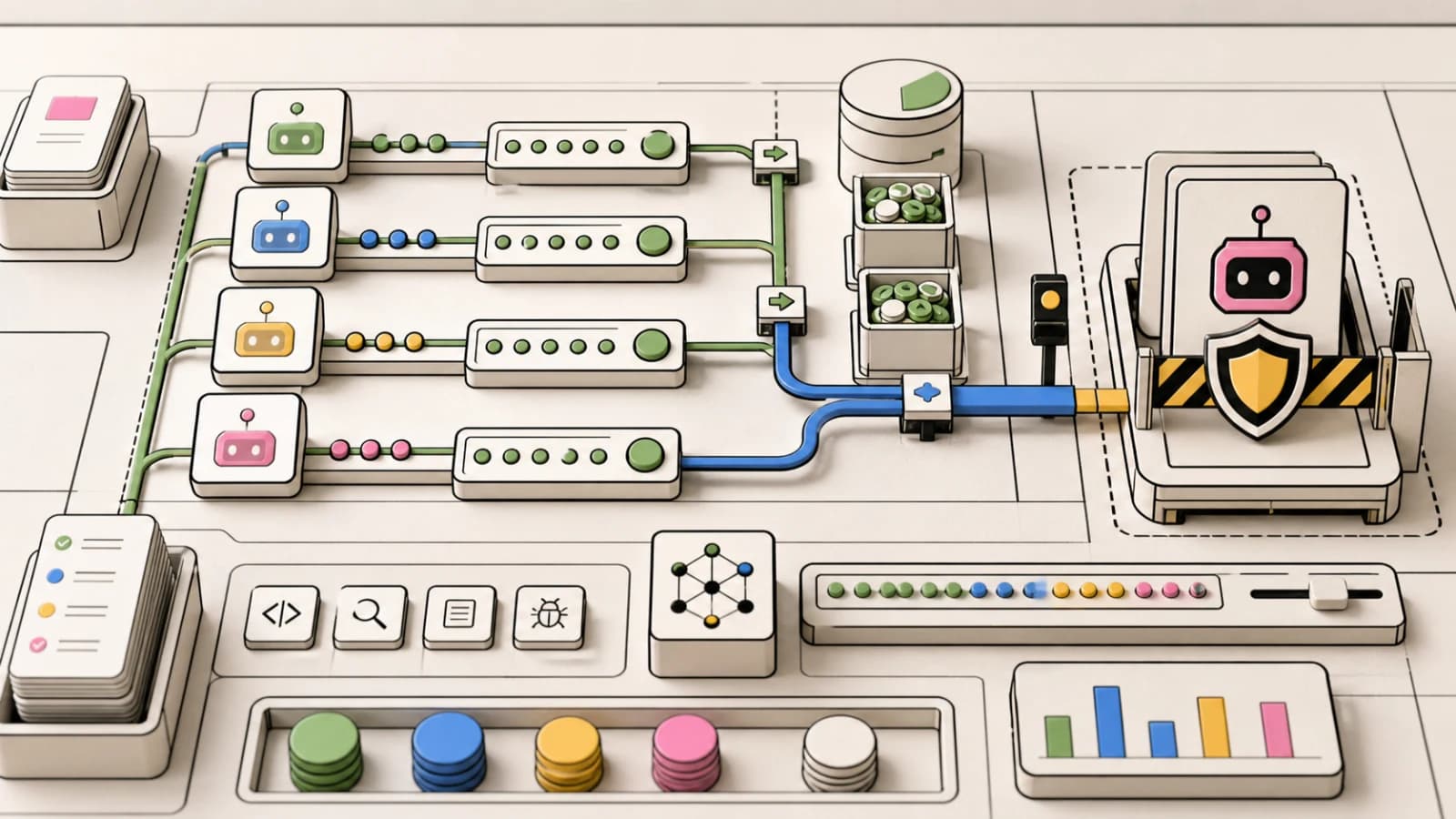
Change2Task is a system grounded in repository history. It takes a merged pull request and turns it into a task an agent can actually run: a starting state, a specification, tooling, and automated verification. The hard part is that repositories change after a PR lands, so the paper's core contribution is aligning historical evidence with the evolved code. Three reconstruction strategies cover different cases:
- Patch Reversal: when the code around the change is stable, reverse the patch to rebuild the pre-change state.
- Code Mapping: map the historical change onto the modern revision where files moved or were renamed.
- Agent Reconstruction: when the change is too entangled with history, have an agent rebuild the task state and validate it.
The pipeline validates a full lifecycle for every task: a healthy base state, a task state, and a restored state after the fix. No verified lifecycle, no task.
The scope covers five task families that map to real agent work: bug fix, feature addition, test generation, API migration, and security repair. Results from the paper, starting from 1,130 eligible source changes:
- 79.6 percent verified task construction success across all five families
- 29.2 percent more verified tasks than a construction baseline based on pull requests, on a matched candidate set
- Up to 98.0 percent matched outcome agreement between historical and reconstructed tasks under agent evaluation
- 10.8 percent lower measured expenditure across the full pipeline by reusing modern base states
The last number matters more than it looks. Task construction has real cost, mostly environment setup and storage, and Change2Task's design makes the base environment a shared, reused asset instead of a per-task snapshot.
From the archive
Claude Mythos Preview Explained: Anthropic's Gated Frontier Model and Project Glasswing
Jul 31, 2026 • 7 min read
Coding Agents Almost Never Read Open Source Contribution Rules: RepoComplianceBench Study
Jul 31, 2026 • 6 min read
DeepSeek V4 Flash 0731: The Official Release, Benchmarks, and How to Run It in OpenCode
Jul 31, 2026 • 7 min read
Gemini Robotics ER 2: Video-Feeding Embodied Reasoning Model Opens to All Developers
Jul 31, 2026 • 6 min read
Why it matters#
The trend line across recent agent research is that the data is the product. SWE-NFI built 188 tasks from real merged PRs to test whether agents can refactor without breaking behavior. DeepSeek's V4 Flash 0731 update is a model re-post-trained on agent work, which only happens when the training data pipeline exists. Change2Task is the plumbing underneath both: it makes the supply of executable tasks expandable rather than hand-curated.
Three concrete implications for developers:
Benchmark freshness becomes a feature. Most benchmark tasks are frozen at the commit where they were written, so an agent can "solve" a repository that no longer looks like the real one. Change2Task deliberately builds tasks on healthy modern revisions, so evaluation tracks the codebase agents will actually touch. That is the right bias: agents should be graded on today's tree, not last year's snapshot.
PR history is the untapped data source. Every merged pull request is a labeled example of a human doing the thing we want agents to do. The paper's 98 percent outcome agreement between reconstructed and historical tasks is the evidence that this source is trustworthy, not just plentiful. Teams with active repos could, in principle, generate their own in-house agent eval sets from their own PR history, which is closer to their real workload than any public benchmark.
Cost is being engineered out of evaluation. A 10.8 percent expenditure reduction on construction, plus shared base environments, changes the economics of continuous evaluation. Instead of a quarterly benchmark run, teams can afford evaluation on a rolling basis, which matters because review queues are already the bottleneck in agent-heavy workflows.
What it does not solve#
The paper is honest about limits. Agent Reconstruction tasks carry the risk of the agent contaminating the task with its own guesses, which is why the lifecycle validation and matched-outcome checks exist. And construction success is not task quality: 79.6 percent of changes become verified tasks, but verified means runnable, not necessarily useful for training. The harder filtering problem, which tasks teach agents anything, is still open.
There is also a public-good gap. The paper does not ship a released dataset or leaderboard with the preprint, so the 1,130-change corpus is not yet something you can pull and run against your own stack. If the authors publish the artifact, this becomes immediately more valuable; until then it is a method paper with strong internal numbers.
The pattern behind it#
Change2Task is one more entry in the running argument that the harness and the data beat the model. The context-files ablation showed agent performance is gated by what context the harness feeds the model, and baseline-receipt evals showed most agent evaluations are not measuring what they claim. Change2Task attacks the same theme from the data side: if the task supply is the bottleneck, industrialize the supply. That is the right instinct, and it is a safe bet that every frontier lab is building something like it right now.
Continue Reading#
- SWE-NFI: The Benchmark That Catches What Coding Agents Miss
- GitHub Stacked PRs Hit Public Preview: Small Reviews for the Agent Era
- DeepSeek V4 Flash 0731: The Budget Tier Just Overtook Pro Preview
- What Is an AI Coding Agent?
- Agent Evals Need Baseline Receipts
- ORCA-bench: Frontier Agents Score 10% on Hard Oncall RCA
Sources#
- Change2Task: From Repository Changes to Executable Coding Agent Tasks and Environments, arXiv 2607.28591 (fetched July 31, 2026; abstract and submission metadata only)
Read next
SWE-NFI: The Benchmark That Catches What Coding Agents Miss
A new 188-task benchmark for non-functional improvements finds coding agents hit 70% on functional correctness but lag humans on refactors and structural changes - the quality gap that becomes tech debt.
6 min readAGENTS.md Files Don't Move Coding Agent Correctness: A 288-Run Ablation
A controlled ablation across Claude Code and Codex, 17 real tasks, and 288 evaluated runs finds context-injection strategy does not measurably change correctness (bounded to under 10-15pp). The failures are implementation skill, not missing repository knowledge.
7 min readGitHub Stacked PRs Hit Public Preview: Small Reviews for the Agent Era
GitHub's stacked pull requests went into public preview on July 30. Stacks turn one large change into an ordered chain of small, reviewable PRs with one-click merge, plus a gh-stack skill for coding agents.
7 min readShare
Developers Digest
Technical content at the intersection of AI and development. Building with AI agents, Claude Code, and modern dev tools - then showing you exactly how it works.
300+ videos30K+ GitHub stars850+ articles
Related Tools
AI CodingAgent

OpenAI Codex
OpenAI's coding agent for terminal, cloud, IDE, GitHub, Slack, and Linear workflows. Reads repos, edits files, runs comm...
View ToolAI Coding

Replit Agent
Full-stack AI dev environment in the browser. Describe an app, get a deployed project with database, auth, and hosting....
View ToolAI Frameworks
C
Composio
Gives AI agents access to 250+ external tools (GitHub, Slack, Gmail, databases) with managed OAuth. Handles the auth and...
View ToolAI Coding

Cline
Open-source autonomous coding agent inside VS Code. Creates files, runs commands, and can use a browser for UI testing a...
View ToolApps from Developers Digest
Developer ToolsPlus $20/mo
Agent Eval Bench Plus
Score every coding agent on your own tasks. Catch regressions in CI.
View AppDeveloper ToolsIn Progress
Agent Benchmark Lab
Compare AI coding agents on reproducible tasks with scored, shareable runs.
View AppSaaS Products
Overnight Agents
Spec out AI agents, run them overnight, wake up to a verified GitHub repo.
View AppRelated Guides
Guide
Built-in Subagents - Claude Code
Researcher, auditor, reviewer, and other ready-made subagent types.
Claude CodeGuide
Subagent Context Isolation - Claude Code
Prevent bloating the main conversation with research or exploration.
Claude CodeGuide
Terminal CLI - Claude Code
The primary command-line entry point for Claude Code sessions.
Claude CodeRelated Videos

Buzz: Open-Source Collaboration for Humans + AI Agents
Buzz by Block: Open-Source Slack-Style Collaboration for Humans + AI Agents (Demo & Setup) Check out Arcade: https://arcade.dev.plug.dev/xiDRwlA Repo: https://github.com/block/buzz The video introd...
Video·
Agents 101: How to Build and Deploy Anything with AI Agents
Build Anything with Vercel, the Agentic Infrastructure Stack Check out Vercel: https://vercel.plug.dev/cwBLgfW The video shows a behind-the-scenes walkthrough of how the creator rapidly builds and d...
Video·
OpenAI's GPT 5.4 in 10 Minutes: 1M Context, Computer Use, Coding Gains, Benchmarks & Pricing
The video reviews OpenAI’s newly released GPT 5.4, highlighting access tiers (GPT 5.4 Thinking in ChatGPT Plus/Teams/Pro/Enterprise and GPT 5.4 in the $200/month tier) and API availability. It covers
Video·
Related Posts
6 min read
News
SWE-NFI: The Benchmark That Catches What Coding Agents Miss
A new 188-task benchmark for non-functional improvements finds coding agents hit 70% on functional correctness but lag h...

7 min read
News
AGENTS.md Files Don't Move Coding Agent Correctness: A 288-Run Ablation
A controlled ablation across Claude Code and Codex, 17 real tasks, and 288 evaluated runs finds context-injection strate...
7 min read
News
GitHub Stacked PRs Hit Public Preview: Small Reviews for the Agent Era
GitHub's stacked pull requests went into public preview on July 30. Stacks turn one large change into an ordered chain o...
9 min read
DeepSeek
DeepSeek V4 Flash 0731: The Budget Tier Just Overtook Pro Preview on Agent Benchmarks
DeepSeek re-post-trained V4 Flash into an agent workhorse: Terminal Bench 82.7, DeepSWE 54.4, native Responses API, and...
8 min read
AI Agents
Agent Evals Need Baseline Receipts
Hex's data-agent lab shows the practical eval pattern AI teams should copy: compare candidates against stable baselines,...

6 min read
News
ORCA-bench: Frontier Agents Score 10% on Hard Oncall RCA
A new benchmark drops five frontier coding agents into a live OpenTelemetry microservice system with real Prometheus, Ja...
Build with the member tools

Get Smarter About AI Dev
New tutorials, open-source projects, and deep dives on coding agents - delivered weekly.
One email per weekReal code, not theoryFree forever