GitHub Stacked PRs Hit Public Preview: Small Reviews for the Agent Era
TL;DR
GitHub's stacked pull requests went into public preview on July 30. Stacks turn one large change into an ordered chain of small, reviewable PRs with one-click merge, plus a gh-stack skill for coding agents.
What shipped#
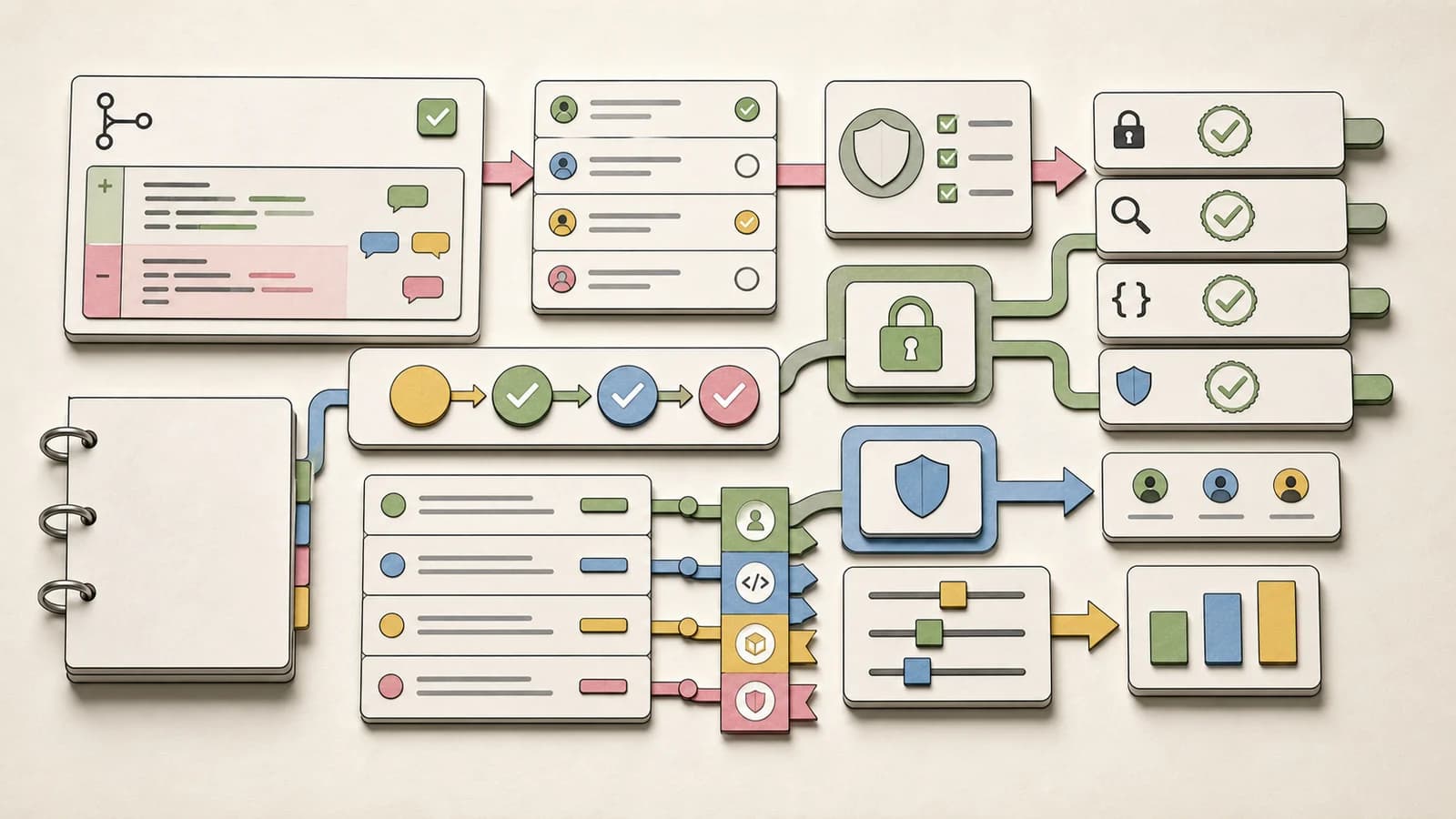
On July 30, GitHub put stacked pull requests into public preview for all repositories. A stack is an ordered series of pull requests where each PR targets the branch of the PR below it, forming a chain that ultimately lands on your default branch. It ships as a GitHub-native workflow plus a CLI extension:
gh extension install github/gh-stackcreates and manages stacks from the terminal- Stacks also work on github.com, the GitHub mobile app, and with coding agents that use the gh-stack skill
- Each PR shows a stack map at the top, so reviewers see how their layer fits into the larger change
- Any layer can be reviewed in isolation, showing only that layer's diff
- Merge one, some, or all: landing the bottom-most ready PR brings every merged layer below it, and open layers above stay open and auto-rebase and retarget
- Existing branch protections and required checks still govern what reaches
main
The preview is rolling out to all repositories "over the coming days," and merge queue support is rolling out progressively over the coming weeks, per the changelog.
The companion feature is stacked sessions in the GitHub Copilot app. An agent starts a new session on top of an existing one: it takes the previous context, branches off the existing session's work, plans, and opens its own pull request targeting the first PR's branch. The GitHub blog walkthrough shows the pattern end to end: a decade-old React 15 codebase gets a styling modernization PR, then a react-bootstrap removal PR stacked on top, each independently reviewable, landing as one unit.
Why it matters#
This is a direct answer to the bottleneck that agent-era development created. Coding agents generate large diffs faster than teams can review them - the exact problem we covered in AI Code Review Is the New Bottleneck and its follow-up, AI Coding Agents Move the Bottleneck to Review Queues. Stacks are the mechanical fix: narrow, dependency-ordered pieces that reviewers can check in parallel without blocking later work.
The changelog's quotes from named maintainers underline that this is a real production pattern, not a demo. TED CTO Andy Merryman: AI made his developers more productive, "but that created a new bottleneck: PRs were growing large enough that reviewers were struggling." Next.js lead Tim Neutkens says stacks helped his team at Vercel "introduce smaller individual changes while shipping larger features, making it easier to review PRs." jQuery creator John Resig reports landing "5 stacked PRs directly to a merge queue all at once."
From the archive
Inkling-Small: Thinking Machines Ships a 12B-Active Open Model That Beats Its Big Sibling on Agent Work
Jul 31, 2026 • 8 min read
LLMs Resolve Java Merge Conflicts Better Than Structured Tools - Because They Never Give Up
Jul 31, 2026 • 6 min read
Microsoft's CLI Coding Agent Study: Adoption Is a Workflow Problem
Jul 31, 2026 • 8 min read
MiniMax H3: An Omni-Modal Video Model With Native Audio, 2K Output, and Open Weights Coming
Jul 31, 2026 • 8 min read
My take#
Three things make this more than a nicety.
Native beats bolted-on. Until now, stacking meant third-party tooling or hand-rolled rebase choreography. Because stacks are built into GitHub, every existing review, check, and merge requirement works out of the box, which lowers the cost of switching to near zero. The default path to a small, reviewable PR just got shorter.
Agent-native by design. The gh-stack skill is the notable piece: a coding agent can open a stack without generating dozens of rebase commands. This is GitHub shipping the workflow that agents already need, and it fits the pattern we documented in Agent PR Governance: The New Rules for Copilot Reviews: the guardrails that kept agent PRs sane are now applied to the granular version of them.
Merging is where it pays off. One-click landing for the whole chain, with merge queue support coming, removes the choreography tax that made manual stacking unattractive. A stack of five small PRs that lands like one merge is a genuinely new primitive, closer to how git forges are being rebuilt for agents than to an incremental UI tweak.
The caveats are real. Public preview means behavior can change. Per-layer required checks multiply CI runs. Stacks assume linear, ordered work, so a hotfix that lands in the middle still needs the normal dance. And the auto-rebase path only helps if layers stay small - a stack of five 2,000-line diffs is just a large PR with extra steps.
Still, the direction is clear. The same logic that makes small commits cheap for a parallel fleet - we run one here - applies to review. Stacks give teams a first-class way to keep changes small without losing the atomic land, and the merged-stack workflow that 12 Tools in One Night showed agents already want is now the vendor default.
Continue Reading#
- Agent PR Governance: The New Rules for Copilot Reviews
- AI Code Review Is the New Bottleneck
- AI Coding Agents Move the Bottleneck to Review Queues
- Cursor Origin: A Git Forge Built for AI Agents, Not Humans
- 12 Tools in One Night: An Honest Overnight Agent Report
- PAIChecker: 13.6% of SWE-bench Verified Instances Have Misaligned PR-Issue Pairs
Sources#
Read next
Agent PR Governance: The New Rules for Copilot Reviews
GitHub's June Copilot review updates point to a practical policy stack for agent-authored pull requests: validation, review depth, repo instructions, attribution, and release-note accountability.
8 min readAI Code Review Is the New Bottleneck
Coding agents make code faster than teams can review it. The next advantage is not bigger prompts. It is review systems that force reproduction, small diffs, tests, and receipts.
8 min readAI Coding Agents Move the Bottleneck to Review Queues
As coding agents get easier to delegate to, the scarce resource shifts from code generation to review capacity, CI minutes, environment reliability, and merge discipline.
8 min readShare
Developers Digest
Technical content at the intersection of AI and development. Building with AI agents, Claude Code, and modern dev tools - then showing you exactly how it works.
300+ videos30K+ GitHub stars850+ articles
Related Tools
AI Frameworks
C
Composio
Gives AI agents access to 250+ external tools (GitHub, Slack, Gmail, databases) with managed OAuth. Handles the auth and...
View ToolAI CodingAgent

OpenAI Codex
OpenAI's coding agent for terminal, cloud, IDE, GitHub, Slack, and Linear workflows. Reads repos, edits files, runs comm...
View ToolAI FrameworksEssential

Vercel AI SDK
The TypeScript toolkit for building AI apps. Unified API across OpenAI, Anthropic, Google. Streaming, tool calling, stru...
View ToolAI Frameworks

LangChain / LangGraph
Most popular LLM framework. 100K+ GitHub stars. Chains, RAG, vector stores, tool use. LangGraph adds stateful multi-agen...
View ToolApps from Developers Digest
SaaS Products
Overnight Agents
Spec out AI agents, run them overnight, wake up to a verified GitHub repo.
View AppSaaS ProductsPopular
Fit
Log workouts, meals, and habits in plain English. Your progress shows up as a GitHub-style heatmap.
View AppDirectories
CLI Directory
Find the right CLI without trawling GitHub. Search, filter, install.
View AppRelated Guides
Guide
gh CLI Integration - Claude Code
Full GitHub CLI support for automated PR and issue workflows.
Claude CodeGuide
Routines (Web) - Claude Code
Managed scheduling on Anthropic infrastructure with API and GitHub triggers.
Claude CodeGuide
Claude Code Setup Guide
Configure Claude Code for maximum productivity -- CLAUDE.md, sub-agents, MCP servers, and autonomous workflows.
AI AgentsRelated Videos

Buzz: Open-Source Collaboration for Humans + AI Agents
Buzz by Block: Open-Source Slack-Style Collaboration for Humans + AI Agents (Demo & Setup) Check out Arcade: https://arcade.dev.plug.dev/xiDRwlA Repo: https://github.com/block/buzz The video introd...
Video·

Agents 101: How to Build and Deploy Anything with AI Agents
Build Anything with Vercel, the Agentic Infrastructure Stack Check out Vercel: https://vercel.plug.dev/cwBLgfW The video shows a behind-the-scenes walkthrough of how the creator rapidly builds and d...
Video·
TRAE: Custom AI Agents That Actually Understand Your Codebase
Check out Trae here! https://tinyurl.com/2f8rw4vm In this video, we dive into @Trae_ai a newly launched AI IDE packed with innovative features. I provide a comprehensive demonstration...
Video·
Related Posts
8 min read
GitHub Copilot
Agent PR Governance: The New Rules for Copilot Reviews
GitHub's June Copilot review updates point to a practical policy stack for agent-authored pull requests: validation, rev...
8 min read
AI Coding
AI Code Review Is the New Bottleneck
Coding agents make code faster than teams can review it. The next advantage is not bigger prompts. It is review systems...

8 min read
AI Coding
AI Coding Agents Move the Bottleneck to Review Queues
As coding agents get easier to delegate to, the scarce resource shifts from code generation to review capacity, CI minut...
8 min read
cursor
Cursor Origin: A Git Forge Built for AI Agents, Not Humans
At its Compile conference, Cursor announced Origin: a Git-compatible code hosting platform designed around AI agents as...
11 min read
AI Agents
12 Tools in One Night: An Honest Overnight Agent Report
I told an agent to improve the site every 10 minutes and went to sleep. Here is what 12 new repos, 60 PRs, and three goo...
7 min read
News
GitHub's AutoGPT Playbook: The Repo Instruction File Is Now an API for Other People's Agents
AutoGPT's founding AI engineer published the gates that keep an open source repo sane when agents submit the majority of...
Build with the member tools

Get Smarter About AI Dev
New tutorials, open-source projects, and deep dives on coding agents - delivered weekly.
One email per weekReal code, not theoryFree forever