Agent PR Governance: The New Rules for Copilot Reviews
TL;DR
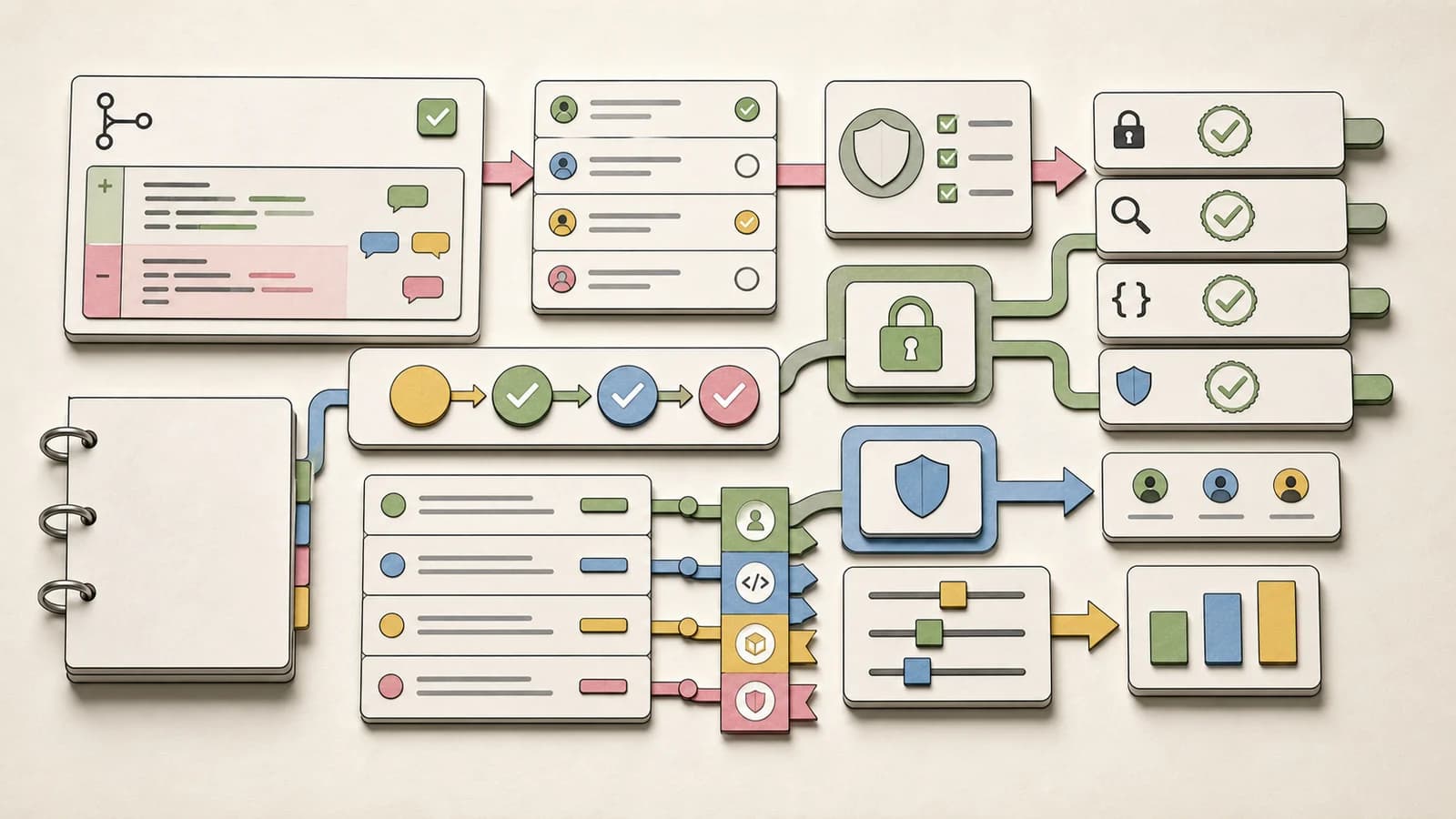
GitHub's June Copilot review updates point to a practical policy stack for agent-authored pull requests: validation, review depth, repo instructions, attribution, and release-note accountability.
Official Sources#
| Source | Description |
|---|---|
| Security validation for third-party coding agents | GitHub Changelog, June 9 2026 |
| Shape Copilot code review around your team | Skills, MCP, and medium review tier |
| Copilot code review AGENTS.md support | Repository-level agent instructions |
| Generated release notes credit developers | Attribution for Copilot PRs |
| GitHub Copilot Documentation | Official feature reference |
Last verified: June 25, 2026
Agent-authored pull requests are becoming normal enough that "does the agent write code?" is no longer the useful question.
The useful question is: what policy stack catches bad agent work before it reaches main?
GitHub's June Copilot updates are a good signal. The company shipped security validation for third-party coding agents, Copilot code review customization with skills and MCP, a medium review-effort tier, AGENTS.md support inside Copilot code review, author search for Copilot-authored pull requests, and release-note attribution that credits the human who asked Copilot to open the PR.
That is not one feature. It is a governance surface.
The teams that win with coding agents will not be the teams that generate the most pull requests. They will be the teams that make agent pull requests easy to validate, review, attribute, and reject.
Last updated: June 25, 2026
The June Signal#
Here is the GitHub update cluster that matters:
- Security validation for third-party coding agents is generally available.
- Copilot code review can be shaped around your team with skills, MCP, and a new medium review-effort tier.
- Copilot code review now supports repository-level AGENTS.md files, so review feedback can use repo instructions.
- Generated release notes credit the developer for Copilot pull requests, not only
@copilot. - GitHub's June changelog also says Copilot-authored pull requests now show up in author searches, making agent work easier to find and audit.
Read those together with GitHub Copilot Agent Finder and the direction is clear: GitHub is making agent work visible in the same places teams already manage software delivery.
That is the right place for the fight. Agent quality is not only a model problem. It is a pull request governance problem.
The Policy Stack Teams Actually Need#
A useful agent PR policy has five layers:
| Layer | Question it answers | GitHub signal |
|---|---|---|
| Validation | Is this agent allowed to act here? | third-party coding-agent security validation |
| Context | Did review use the repo's rules? | AGENTS.md and review skills |
| Depth | Was review effort matched to risk? | low, medium, and deeper review tiers |
| Attribution | Who initiated and owns the work? | Copilot PR attribution and author search |
| Release accountability | Does shipped work credit the right operator? | generated release-note credit |
This is more concrete than saying "humans should review AI code." Of course they should. The policy question is what evidence reviewers receive before they spend attention.
For the broader bottleneck, read AI Code Review Is the New Bottleneck. This piece is about the narrower GitHub-native policy stack.
Layer 1: Validate Which Agents Can Touch the Repo#
Third-party coding agents change the risk profile. A built-in Copilot feature and an external agent provider are not the same trust boundary.
Security validation is the first gate. Before an agent can create branches, open pull requests, or request review, the platform needs a way to prove the integration is configured correctly and operating under the expected permissions.
That does not remove the need for repository rules, branch protection, required checks, code owners, or human review. It gives teams a better starting point: agent access should be explicit, validated, and visible.
The policy I would write:
Text
Agent PRs are allowed only from validated agent providers.
Agent-created branches must target protected pull requests.
No agent-authored PR can merge without required checks and a human reviewer.
That is boring. Boring is good here.
For the wider tool-access checklist, pair this with the agent security checklist.
From the archive
Agent Sandbox Architecture: How to Choose the Right Runtime Boundary
Jun 23, 2026 • 8 min read
Agent Workflows as Code: Why State Machines Beat Prompt Checklists
Jun 23, 2026 • 8 min read
AI's Affordability Crisis Is Really an Agent Cost Accounting Problem
Jun 23, 2026 • 8 min read
Armin Ronacher on The Coming Loop and Why Agent-Driven Code Still Needs Human Comprehension
Jun 23, 2026 • 9 min read
Layer 2: Make Repo Instructions Part of Review#
AGENTS.md support in Copilot code review is more important than it looks.
Most agent mistakes are not syntax mistakes. They are local-context mistakes:
- using the wrong test command;
- ignoring a design-system rule;
- duplicating an existing helper;
- changing a public API without a migration note;
- writing a broad refactor when the repo prefers small diffs;
- missing a security boundary that exists only in project docs.
If review does not see the repo's rules, it can only judge generic correctness. That is not enough.
Put the review contract in plain language:
Text
For every agent-authored PR, review must check:
- the diff is smaller than the task requires;
- the PR includes the command output that proves the change;
- generated tests fail on the broken code when applicable;
- public behavior, docs, and changelog are updated together;
- security-sensitive changes name the permission boundary touched.
Then put that contract somewhere the review agent and humans both read: AGENTS.md, .github/skills/code-review/SKILL.md, PR templates, or repo docs.
This is where AI code attribution becomes practical. Attribution is only useful when it routes the right scrutiny.
Layer 3: Match Review Depth to Change Risk#
GitHub's new medium review-effort tier is a useful product detail because it acknowledges a real workflow problem: not every pull request deserves the same review budget.
A typo fix and a permissions refactor should not receive the same automated review pass. A dependency update that touches lockfiles, CI, and runtime code should not be treated like a CSS tweak.
Teams should define review tiers before the queue gets noisy:
| Change type | Minimum review tier | Extra requirement |
|---|---|---|
| docs-only or copy-only | low | link preview or rendered artifact |
| small bug fix | medium | failing test or reproduction note |
| dependency or lockfile change | medium | supply-chain review and install proof |
| auth, billing, security, or data access | high | code owner and threat note |
| generated migration or broad refactor | high | rollback plan and staged rollout |
The exact labels can change. The principle should not: review depth follows blast radius.
This also keeps AI review from becoming theater. A code review agent that comments equally on every PR is just another notification source. A review system that escalates based on risk can save human attention for the work that matters.
Layer 4: Attribute the Operator, Not Just the Agent#
Generated release notes now credit the developer who asked Copilot to open the pull request, alongside @copilot. That is the right direction.
Agent work still has a human operator.
The operator chooses the task, prompt, repo, branch, timing, acceptance criteria, and merge decision. If a Copilot cloud agent opens the PR, the agent is part of the provenance. But the human who initiated the work is still responsible for whether it should ship.
That is why attribution should answer three separate questions:
- Which tool generated or edited the code?
- Which human initiated the work?
- Which human approved the merge?
Those questions matter later when a regression appears. A Co-authored-by line or release-note credit is not a root-cause analysis. It is an audit pointer.
For that distinction, see AI Code Attribution Needs Defect Forensics. Attribution helps you find the trail. It does not prove cause.
Layer 5: Make Agent Work Searchable#
Copilot-authored pull requests appearing in author searches sounds minor. It is not.
Once agent PR volume rises, teams need ways to ask operational questions:
- Which repos receive the most agent PRs?
- Which agents open PRs that get merged?
- Which agent PRs fail checks repeatedly?
- Which teams are generating review load faster than they can absorb it?
- Which incidents involved agent-authored changes?
If agent work is not searchable, it becomes anecdotal. People argue from vibes. If agent work is visible in search, metrics, release notes, and review history, teams can inspect patterns.
This connects directly to FrontierCode and mergeability. Passing a narrow test is not the same as producing code maintainers would merge. Searchable agent PR history gives teams a way to measure their own mergeability, not only vendor benchmark scores.
The Opposing Take: Governance Can Become Theater#
The skeptical view is fair.
Security validation, review tiers, attribution, release-note credit, and AGENTS.md context can all become box-checking. A team can add every label and still merge a bad agent change because nobody reproduced the issue, read the diff carefully, or understood the product intent.
That is the failure mode to avoid.
Good governance should reduce reviewer uncertainty. Bad governance creates more dashboards and labels without changing decisions.
The test is simple: would this policy help a reviewer reject a bad PR faster?
If the answer is no, the policy is probably theater.
A Practical Agent PR Policy#
Here is the compact version I would put into a team handbook:
Text
Agent-authored PR policy

1. Only approved and validated agents may create branches or pull requests.
2. Every agent PR must include the task, acceptance criteria, and verification output.
3. Review depth must match blast radius: docs, bug fix, dependency, security, migration.
4. AGENTS.md and code-review skills are part of the review contract.
5. Human review is required before merge, even when automated review passes.
6. Release notes should preserve both agent provenance and human operator credit.
7. Any production incident involving an agent PR gets defect forensics, not blame-by-label.
That policy is short enough to enforce and specific enough to matter.
The main point: agent PR governance is not anti-agent. It is how you make agents useful without letting the review queue become a junk drawer.
FAQ#
What is agent PR governance?#
Agent PR governance is the set of policies and review controls for pull requests opened or edited by AI coding agents. It covers which agents may act, what evidence every PR needs, how review depth is chosen, how attribution works, and when humans must approve changes.
Does Copilot code review replace human review?#
No. Copilot code review can provide useful first-pass feedback, especially when it has repo instructions and team skills. It should not replace human review for product intent, architecture, security, migrations, or merge accountability.
Why does AGENTS.md matter for code review?#
AGENTS.md gives review systems and coding agents repo-specific instructions. That helps automated review check local rules instead of only generic correctness. It is useful when the file points to actual commands, constraints, ownership rules, and verification expectations.
Should all agent-authored PRs use the same review level?#
No. Review depth should follow blast radius. A copy edit, a small bug fix, a dependency update, and an auth change need different review effort. Teams should define tiers before agent PR volume grows.
Is AI attribution enough to prove an agent caused a bug?#
No. Attribution is an audit signal, not causal proof. If a regression appears in AI-assisted code, teams still need defect forensics: reproduction, commit range, failing test, review history, and an explanation of which decision actually introduced the issue.
Continue Reading#
Sources#
- GitHub Changelog: Security validation for third-party coding agents
- GitHub Changelog: Shape Copilot code review around your team
- GitHub Changelog: Copilot code review AGENTS.md support and UI improvements
- GitHub Changelog: Generated release notes credit you for Copilot pull requests
- GitHub June 2026 changelog archive
- GitHub Docs: About GitHub Copilot code review
- GitHub Docs: About third-party coding agents
Read next
VS Code Copilot Co-Author Attribution: The Real Problem Is Workflow Consent
VS Code 1.118 makes Copilot a Git co-author by default for chat and agent commits. The argument is not really about one trailer line. It is about consent, audit signals, and who controls developer workflow metadata.
8 min readAI Code Review Is the New Bottleneck
Coding agents make code faster than teams can review it. The next advantage is not bigger prompts. It is review systems that force reproduction, small diffs, tests, and receipts.
8 min readAI Code Attribution Needs Defect Forensics, Not Vibes
The rsync Claude debate shows why teams need reproducible defect forensics before AI attribution becomes a public blame machine.
8 min readShare
Developers Digest
Technical content at the intersection of AI and development. Building with AI agents, Claude Code, and modern dev tools - then showing you exactly how it works.
300+ videos30K+ GitHub stars850+ articles
Try These Tools
Related Tools
AI Coding328K views

GitHub Copilot
The original AI coding assistant. 77M+ developers. Inline completions in VS Code and JetBrains. Copilot Workspace genera...
View ToolAI FrameworksAgent UI

CopilotKit
Frontend stack for agent-native apps. React hooks, prebuilt copilot UI, AG-UI runtime, frontend tools, shared state, and...
View ToolAI Frameworks
C
Composio
Gives AI agents access to 250+ external tools (GitHub, Slack, Gmail, databases) with managed OAuth. Handles the auth and...
View ToolAI Frameworks

OpenAI Agents SDK
Lightweight Python framework for multi-agent systems. Agent handoffs, tool use, guardrails, tracing. Successor to the ex...
View ToolApps from Developers Digest
Related Guides
Guide
AI Agent Frameworks Compared: LangGraph vs CrewAI vs Mastra vs CopilotKit
Deep comparison of the top AI agent frameworks - LangGraph, CrewAI, Mastra, CopilotKit, AutoGen, and Claude Code.
AI AgentsGuide
Claude Code Setup Guide
Configure Claude Code for maximum productivity -- CLAUDE.md, sub-agents, MCP servers, and autonomous workflows.
AI AgentsGuide
MCP Servers Explained
What MCP servers are, how they work, and how to build your own in 5 minutes.
AI AgentsRelated Videos

Buzz: Open-Source Collaboration for Humans + AI Agents
Buzz by Block: Open-Source Slack-Style Collaboration for Humans + AI Agents (Demo & Setup) Check out Arcade: https://arcade.dev.plug.dev/xiDRwlA Repo: https://github.com/block/buzz The video introd...
Video·

Agents 101: How to Build and Deploy Anything with AI Agents
Build Anything with Vercel, the Agentic Infrastructure Stack Check out Vercel: https://vercel.plug.dev/cwBLgfW The video shows a behind-the-scenes walkthrough of how the creator rapidly builds and d...
Video·
TRAE: Custom AI Agents That Actually Understand Your Codebase
Check out Trae here! https://tinyurl.com/2f8rw4vm In this video, we dive into @Trae_ai a newly launched AI IDE packed with innovative features. I provide a comprehensive demonstration...
Video·
Related Posts
8 min read
GitHub Copilot
VS Code Copilot Co-Author Attribution: The Real Problem Is Workflow Consent
VS Code 1.118 makes Copilot a Git co-author by default for chat and agent commits. The argument is not really about one...

8 min read
AI Coding
AI Code Review Is the New Bottleneck
Coding agents make code faster than teams can review it. The next advantage is not bigger prompts. It is review systems...

8 min read
AI Coding
AI Code Attribution Needs Defect Forensics, Not Vibes
The rsync Claude debate shows why teams need reproducible defect forensics before AI attribution becomes a public blame...

8 min read
GitHub Copilot
GitHub Copilot Agent Finder: What ARD Means for Third-Party AI Tools in 2026
GitHub's Agent Finder discovers and invokes Claude, Codex, MCP servers, and skills automatically. Here is how the new AR...
8 min read
AI Security
The Agent Security Checklist I Use Before Connecting Tools
Before an AI agent gets tools, files, APIs, MCP servers, or deployment access, decide what it can read, write, call, log...
7 min read
News
GitHub Copilot Code Review Effort Levels Are GA: Lite vs Balanced
Copilot code review's Lite and Balanced effort levels are generally available. Here is what each level does, what it cos...
Build with the member tools

Get Smarter About AI Dev
New tutorials, open-source projects, and deep dives on coding agents - delivered weekly.
One email per weekReal code, not theoryFree forever