Put an AI Reviewer on Every Pull Request: A Webhook Build with OpenCode and Railway
TL;DR
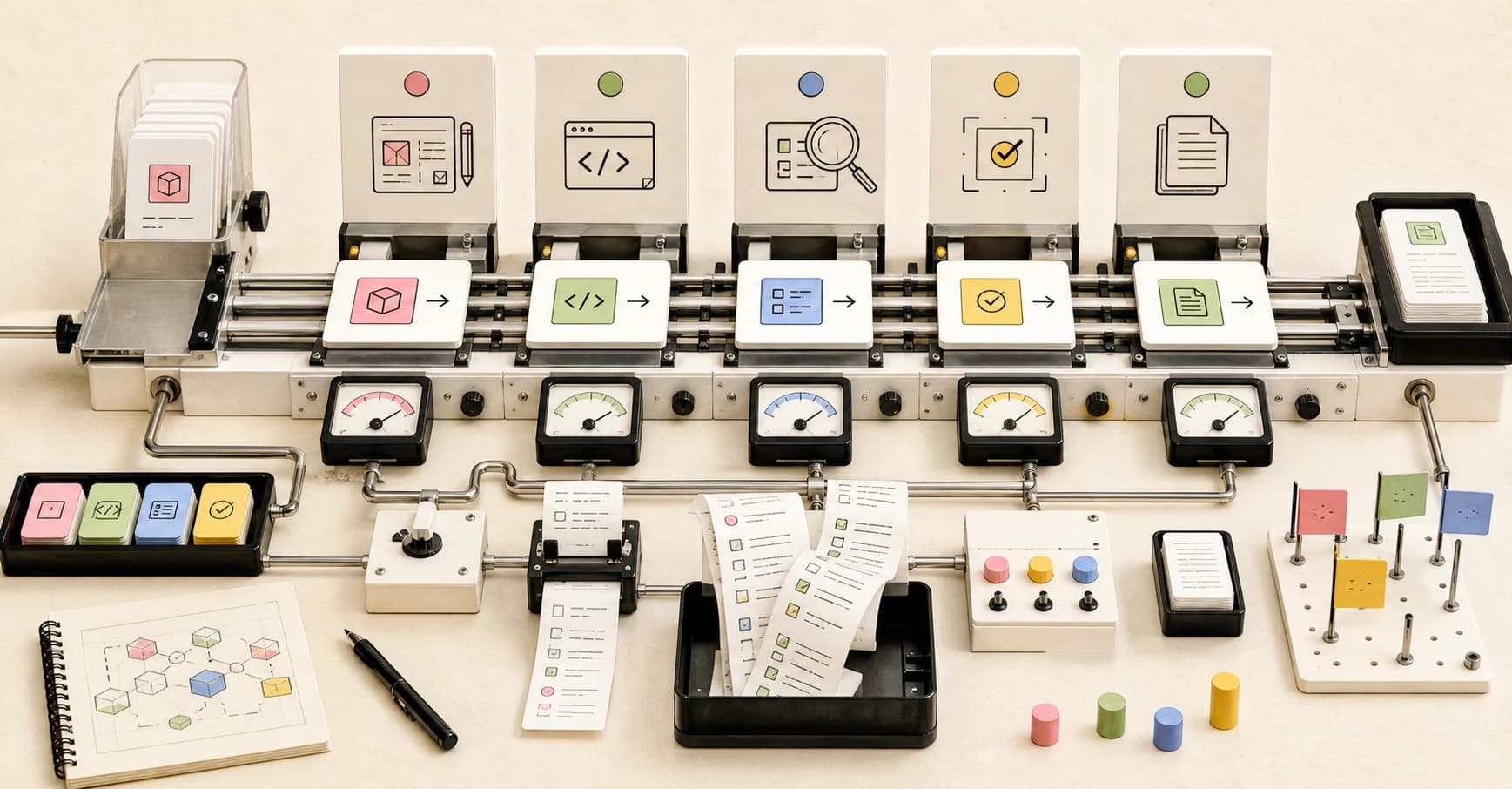
Review capacity is the real bottleneck now that agents ship pull requests faster than people can read them. A webhook service on Railway that runs OpenCode headless against every PR diff, posts findings as a review, and never touches the code: the complete one-hour build.
The bottleneck has moved. Coding agents generate pull requests faster than any human team can read them, and the review queue is where AI-assisted development backs up. One agent can open a PR every few minutes; a reviewer still takes twenty minutes to do the diff justice. The result is merged-with-a-glance or hours of unpaid night work, and both ship the interesting bugs.
The fix is a second pair of machine eyes that never sleeps and never skims: a webhook service that runs a headless coding agent against every PR in your repo, asks it for the three to five findings that actually matter, and posts them as a real GitHub review - without ever writing code itself. This guide builds that service end to end.
The receiving end is a small webhook service on Railway, and the reviewer is OpenCode in headless mode - the same opencode run pattern from our cron automation guide, pointed at the opposite job of the issue-to-PR webhook: that build turns labeled issues into pull requests, this one reviews them. We run a version of this shape for parts of this site; the mechanics below are the portable core. Seven steps, under an hour, every step ending in something you can run.
Official Sources#
| Resource | Description |
|---|---|
| OpenCode CLI docs | opencode run, headless mode, model and file flags |
| GitHub webhook events and payloads | The pull_request event, its actions, and the payload fields |
| GitHub REST: pull request reviews | Create and list reviews, the COMMENT review event |
| Railway Plans | Hobby and Pro subscription and included usage |
| DeepSeek Models and Pricing | Current Flash prices and the renamed model entries |
Step 1: Install OpenCode and pick the review model#
Prerequisites: a GitHub repo you own (a small one with real code is ideal), a free Railway account (new accounts get a one-time $5 trial grant per Railway's free trial docs, as of 2026-09-25), and an API key for an LLM provider.
Install OpenCode with the official one-liner from the OpenCode docs, authenticate a provider (opencode auth login), then prove the capability the whole pattern depends on - one task, no TUI, clean exit:
Terminal
curl -fsSL https://opencode.ai/install | bash
opencode auth login
opencode run --model opencode/deepseek-v4-flash "print the current directory tree, two levels deep"
If that prints a tree and returns, you have a reviewer. On model choice, the rule from our agent fleet economics post applies: escalate the judge, not the worker. A review is bounded and cheap to gate, so budget is the right default and a stronger model is one environment variable away.
The budget sweet spot for this job: DeepSeek's Flash line at $0.30 per million input tokens and $1.20 per million output tokens at peak hours, half that off-peak, per the DeepSeek pricing page as of 2026-09-25. Note the naming churn: DeepSeek retired the original V4 Flash on 2026-09-10, and deepseek-flash (plus the legacy deepseek-v4-flash alias OpenCode still accepts) now routes to the newer V4.1 Flash at the reduced price, per the change log as of 2026-09-10. The opencode/deepseek-v4-flash id from our earlier post keeps working - it is an alias, and it is the cheap default in the runner below. OpenCode reads provider API keys from the environment, so the same setup runs on a server with no interactive login.
What you have now: a proven headless agent command. One review costs about one to two cents at peak prices, so the gate below can afford to run on every PR.
Step 2: The webhook receiver for pull_request events#
The receiver is deliberately boring: standard library only, two routes - verify the request is really from GitHub, check the event type from the X-GitHub-Event header, acknowledge instantly, hand the payload to the runner. The GitHub docs are explicit about two rules this file honors: subscribe to the minimum number of events, and answer within 10 seconds with a 2XX or GitHub terminates the delivery. Both are built in - one subscribed event (pull_request), and a 202 sent before any heavy work starts.
JavaScript
// server.js
const http = require("node:http");
const crypto = require("node:crypto");
const { spawn } = require("node:child_process");

const SECRET = process.env.GITHUB_WEBHOOK_SECRET;
const ACTIONS = ["opened", "synchronize", "ready_for_review"];

function signatureMatches(rawBody, header) {
  if (!header || !SECRET) return false;
  const expected =
    "sha256=" +
    crypto.createHmac("sha256", SECRET).update(rawBody).digest("hex");
  const a = Buffer.from(expected);
  const b = Buffer.from(header);
  return a.length === b.length && crypto.timingSafeEqual(a, b);
}

http
  .createServer((req, res) => {
    if (req.method === "GET" && req.url === "/healthz") {
      res.writeHead(200);
      return res.end("ok");
    }
    if (req.method !== "POST" || req.url !== "/webhook") {
      res.writeHead(404);
      return res.end();
    }

    const chunks = [];
    req.on("data", (c) => chunks.push(c));
    req.on("end", () => {
      const raw = Buffer.concat(chunks).toString();
      if (!signatureMatches(raw, req.headers["x-hub-signature-256"])) {
        res.writeHead(401);
        return res.end("bad signature");
      }

      const event = JSON.parse(raw);
      const pr = event.pull_request;
      const relevant =
        req.headers["x-github-event"] === "pull_request" &&
        ACTIONS.includes(event.action) &&
        pr &&
        pr.draft !== true;

      // GitHub expects a 2xx within 10 seconds. Acknowledge now,
      // run the review in the background.
      res.writeHead(202);
      res.end("accepted");

      if (!relevant) return;

      const child = spawn("bash", ["review.sh"], {
        detached: true,
        stdio: "ignore",
        env: {
          ...process.env,
          REPO: event.repository.full_name,
          PR_NUMBER: String(pr.number),
          HEAD_SHA: pr.head.sha,
          BASE_REF: pr.base.ref,
        },
      });
      child.unref();
    });
  })
  .listen(process.env.PORT || 3000);
Three details are the security story:
- Signature first. GitHub signs every delivery with your secret as HMAC-SHA256 in
X-Hub-Signature-256; the timing-safe comparison over the raw body is the documented validation pattern and stops random internet traffic spending your tokens. - Filter on header and payload. Checking
X-GitHub-Eventbefore touching the body, and filtering actions toopened,synchronize(new commits pushed), andready_for_review(a draft marked ready), keeps the bot quiet outside the moments that matter - the action list comes straight from the webhook events docs. - Drafts never get reviewed. The payload's
pull_request.draftflag (part of the pull request object in the Pulls REST API) makes the filter one line, and no review lands until someone says the PR is ready.
What you have now: a receiver that can only ever do nothing or spawn a review. Test it locally: PORT=3000 GITHUB_WEBHOOK_SECRET=test node server.js.
From the archive
Weekly Highlights: The Price War Reached the Frontier
Sep 25, 2026 • 11 min read
Claude Opus 5.5 Release Guide: Fable 5.1-Level Coding at $4/$20, and How to Run It in OpenCode
Sep 23, 2026 • 8 min read
How GPT-6 Astra Builds a Real E-Commerce Site: Product Shots, Pages, and an AI Video Hero
Sep 23, 2026 • 8 min read
Agent-Native Apps Need Shared Actions, Not UI Puppeteering
Sep 22, 2026 • 7 min read
Step 3: The review runner#
One script, six moves: fresh clone, checkout the PR branch, write the diff to a file, one bounded agent run, validate the output, post the review. Note what is missing on purpose: no git push anywhere. This bot comments; it does not write code.
Terminal
#!/bin/bash
# review.sh - runs from the webhook receiver
set -eu
: "${REPO:?}"; : "${PR_NUMBER:?}"; : "${GITHUB_TOKEN:?}"; : "${HEAD_SHA:?}"

export GH_TOKEN="$GITHUB_TOKEN"
gh auth setup-git

WORK="$(mktemp -d)"
trap 'rm -rf "$WORK"' EXIT
cd "$WORK"

# A blobless clone gets full history for the merge-base diff
# without downloading every file's contents up front.
git clone --filter=blob:none "https://github.com/${REPO}.git" .
gh pr checkout "$PR_NUMBER"

# Already reviewed this exact commit? Quiet exit. The stamp lives on
# GitHub itself, so it survives service restarts with no extra storage.
if gh api "repos/${REPO}/pulls/${PR_NUMBER}/reviews" \
     --jq '.[] | select(.body | contains("reviewed-sha: '"$HEAD_SHA"'"))' \
     | grep -q .; then
  exit 0
fi

git fetch origin "${BASE_REF:-main}"
git diff "origin/${BASE_REF:-main}...HEAD" > diff.txt
test "$(wc -l < diff.txt)" -gt 1500 && echo "diff too large" && exit 0

PROMPT="You are a senior engineer doing a pull request review. \
The file diff.txt in this directory is the complete diff between the \
base branch and the head of PR #${PR_NUMBER} in ${REPO}. \
Read the diff, then inspect the actual files in this repo where a \
finding needs verification. Report exactly 3 to 5 findings, most \
severe first, skipping anything that is style preference. For each \
finding, one line of severity (blocker | should-fix | nit), the file \
path and line from the diff, one sentence describing the problem, and \
one concrete suggested fix. If nothing is wrong, write 'No findings.' \
Write the report to review.md in this directory. End the file with a \
line: reviewed-sha: ${HEAD_SHA}"

timeout 900 opencode run --model "${AGENT_MODEL:-opencode/deepseek-v4-flash}" \
  --file diff.txt "$PROMPT"

# Quiet no-op exits: most reviews should find little, and silence
# is the signal that nothing changed.
if [ ! -s review.md ] || [ "$(wc -l < review.md)" -gt 200 ]; then
  exit 0
fi
grep -q "reviewed-sha: ${HEAD_SHA}" review.md || \
  printf "\nreviewed-sha: %s\n" "$HEAD_SHA" >> review.md

gh pr review "$PR_NUMBER" --comment --body-file review.md
The pipeline details:
gh pr checkoutfetches the PR head and checks out its branch in the fresh clone, per the gh CLI manual.- The diff is data, not prompt glue. It lands in
diff.txtand is attached with OpenCode's--fileflag (CLI docs), andhead.shaandbase.refarrive via environment variables - a PR title full of shell metacharacters is data, never a command. - The review is posted with
gh pr review --comment --body-file review.md, the documented form of the create-review endpoint, whoseeventfield acceptsAPPROVE,REQUEST_CHANGES, orCOMMENT(REST docs). COMMENT is the honest default: the bot has opinions, not vetoes.
Runnable check: run the script once by hand against a test PR: REPO=you/test PR_NUMBER=1 GITHUB_TOKEN=... HEAD_SHA=<head-sha> BASE_REF=main ./review.sh. Watch it clone, review, and post. A reviewer you have never watched succeed is not ready to run unattended.
Step 4: Dedupe and the safety rails#
The failure mode of an always-on reviewer is not one bad comment, it is a bot repeating itself on every push. The rails that matter:
- The stamp is the dedupe. Every review body carries
reviewed-sha: <HEAD_SHA>, and the runner checks for it before each run - GitHub itself is the state store, so a restart cannot double-post. Amkdir-based lock on the PR number guards the rare double-delivery race. timeouton the agent. A review loop at 3am dies at the bound you set; 900 seconds covers real reviews, and the run happens in the background after the 202, so it never contends with Railway's edge timeout (5 minutes with no data transferred, 15 minutes if data keeps flowing, per Railway's specs as of 2026-09-25).- Quiet no-op exits and a size gate. Most changes should produce nothing worth saying - if the bot comments on every PR, its prompt is padded - and a diff over 1500 lines is almost certainly noise: skip it instead of burning tokens on a megadiff.
- A comment-only token. A fine-grained personal access token scoped to Contents Read, Pull requests Read and write, and Metadata Read on this one repo: it can post reviews and read code, nothing else. Compromised, the blast radius is one repo and one revocable token.
- Spend caps. The bounded run and budget model keep a review near a cent, but the $400 overnight bill is the canonical failure mode - set provider spending alerts before you enable the webhook.
What you have now: a reviewer that is safe to point at real traffic, by construction.
Step 5: Containerize and deploy to Railway#
Three files become a service. The Dockerfile is short because everything is a package: OpenCode installs from npm as opencode-ai, and gh and git come from apt.
Dockerfile
FROM node:22-slim

RUN apt-get update && apt-get install -y git gh && rm -rf /var/lib/apt/lists/*
RUN npm install -g opencode-ai

WORKDIR /app
COPY server.js review.sh ./
RUN chmod +x review.sh

CMD ["node", "server.js"]
Push server.js, review.sh, and the Dockerfile to a new GitHub repo. In Railway, create a new project and deploy from that repo - Railway detects the Dockerfile automatically, per the Services docs. Then add these variables in the service's Variables tab:
| Variable | Value |
|---|---|
GITHUB_WEBHOOK_SECRET | a long random string (you will reuse it in Step 6) |
GITHUB_TOKEN | the fine-grained token from Step 4 |
AGENT_MODEL | optional; defaults to opencode/deepseek-v4-flash |
The RAW editor accepts a whole .env, and values can be sealed so they are never visible again (Railway docs). The agent inside the container reads the same env vars OpenCode reads locally, so no interactive login ever happens on the server.
Last, expose it: Settings → Networking → Public Networking → Generate Domain. Railway provisions a *.railway.app domain with automatic SSL (Public Networking docs), satisfying GitHub's requirement to deliver webhooks over HTTPS - and a health check pointed at /healthz gives you uptime monitoring for free.
Runnable check: curl https://<your-service>.up.railway.app/healthz returns ok.
Step 6: Wire GitHub to the endpoint#
In your target repository: Settings → Webhooks → Add webhook:
- Payload URL:
https://<your-service>.up.railway.app/webhook - Content type:
application/json - Secret: the same random string from Step 5
- Which events: "Let me select individual events", and subscribe only to Pull requests
Save it. GitHub immediately sends a ping event - the Recent Deliveries tab shows both sides, and your service logs show the 202.
Runnable check: the delivery shows a 200 or 202 and no review is spawned (a ping is not a pull_request event, and the receiver's event-type check drops it).
Step 7: The first PR that reviews itself#
Open a real PR on the repo - a small change with one planted issue in it, like an unawaited promise that swallows an error. Then push a second commit to the branch. Watch: the synchronize event fires, the signature checks, the receiver answers 202 in milliseconds, a clone happens, OpenCode reads the diff and the code behind it, and a review lands on the PR naming the problem and a fix.
From here, compounding is a prompt change away: add "check against CONTRIBUTING.md", or use the bot as first-pass triage for agent-authored PRs (the policy half lives in our governance post, the mechanism here). If a repo gets noisy, gate the receiver on a review label the way the issue-to-PR build gates on agent.
What you have now: a repo where every pull request gets a fresh pair of machine eyes in under two minutes, for about a cent per review. The shape that makes it safe is repeated at every step here: verify, acknowledge fast, run one bounded job in a clean checkout, ship the result as a reviewable artifact - the harnesses post says it plainly, the script around the agent is the product.
FAQ#
Does the bot review draft PRs?#
No. The receiver checks the payload's pull_request.draft flag and drops the event - the only triggers are opened, synchronize (new commits on the branch), and ready_for_review, per the pull_request webhook events.
How does it avoid re-reviewing the same commit?#
Every posted review carries a reviewed-sha: <head-sha> stamp. Before each run the runner lists existing reviews via the Pulls reviews REST endpoint and skips when the stamp matches the current head. New commits change the SHA, so only new revisions get reviewed.
Can the bot request changes or approve?#
Yes, with one variable: the create-review endpoint accepts APPROVE, REQUEST_CHANGES, or COMMENT, and gh pr review exposes the same three via --approve, --request-changes, and --comment. Start with --comment: a machine veto on every PR trains your team to filter it out; a machine opinion does not.
How much does this cost to run?#
On Railway's Hobby plan ($5 per month with $5 of included resource usage, per Railway's plans page as of 2026-09-25), a service this small usually stays inside the included usage. Reviews run about one to two cents each on the DeepSeek Flash tier ($0.30 in / $1.20 out per million tokens at peak, half off-peak, per the pricing page as of 2026-09-25), so even a busy repo stays under a few dollars a month - as long as the timeout and spend alerts contain the loops.
Will this review agent ever commit code?#
It cannot. The runner contains no git push, and the token is scoped to read code and write reviews only. Reviewer agents hold opinions; humans hold the merge button.
Some links to tools above are referral links - see our affiliate disclosure.
Sources#
Last updated: September 25, 2026
Continue Reading#
- Put an AI Agent Behind a Webhook: Turn GitHub Issues into Pull Requests - the sibling build that opens agent PRs; this bot reviews exactly those PRs
- Put an AI Agent on a Cron Job - the same headless
opencode runpattern on a schedule - Why AI Code Review Is Becoming the Bottleneck - the analysis half: what gates fix the review queue
- AI Coding Agents Are Piling Up Review Queues - the queue mechanics and the receipt reviewers should ask for
- Long-Running Agents Need Harnesses - why the script around the agent matters
- The $400 Overnight Bill - agent FinOps, learned the hard way
Read next
Put an AI Agent Behind a Webhook: Turn GitHub Issues into Pull Requests
The most common trigger for an AI coding agent is not a clock, it is an event. A GitHub webhook, a Railway service, and OpenCode headless add up to a repo where a labeled issue gets a real pull request without anyone at the keyboard. The full build, start to finish.
10 min readPut an AI Agent on a Cron Job: Automating Dev Chores with OpenCode
An agent CLI plus a cron schedule turns recurring dev chores into background work: dependency bumps, doc freshness checks, morning briefs. The pattern, the guardrails, and where to run it - your own hardware or a cloud host.
11 min readAI Code Review Is the New Bottleneck
Coding agents make code faster than teams can review it. The next advantage is not bigger prompts. It is review systems that force reproduction, small diffs, tests, and receipts.
8 min readShare
Developers Digest
Technical content at the intersection of AI and development. Building with AI agents, Claude Code, and modern dev tools - then showing you exactly how it works.
300+ videos30K+ GitHub stars850+ articles
Related Tools
ProductivitySelf-hosted

n8n
Workflow automation platform with native AI agent building. Visual editor plus JavaScript/Python code nodes, 500+ integr...
View ToolAI CodingOpen source

OpenCode
Open-source AI coding agent for terminal, desktop, and IDE. Works with 75+ LLM providers including Claude, GPT, Gemini,...
View ToolAI Coding68K views

Lovable
AI app builder - describe what you want, get a deployed full-stack app with React, Supabase, and auth. No coding requi...
View ToolAI Coding

Replit Agent
Full-stack AI dev environment in the browser. Describe an app, get a deployed project with database, auth, and hosting....
View ToolApps from Developers Digest
Developer ToolsIn Progress
Workflow Autopilot Builder
Define AI-assisted business automations without locking the workflow to one vendor.
View AppSaaS Products
Agent Generator
Do a task once with AI, get a reusable agent forever.
View AppDeveloper Tools
DD CLI
One CLI to install, configure, and update every DD tool.
View AppRelated Guides
Guide
Run AI Models Locally with Ollama and LM Studio
Install Ollama and LM Studio, pull your first model, and run AI locally for coding, chat, and automation - with zero cloud dependency.
Getting StartedGuide
MCP Servers Explained
What MCP servers are, how they work, and how to build your own in 5 minutes.
AI AgentsGuide
Building Your First MCP Server
Step-by-step guide to building an MCP server in TypeScript - from project setup to tool definitions, resource handling, testing, and deployment.
AI AgentsRelated Videos
Build No-Code AI Agents, Automations and Apps with VectorShift
No-Code AI Automation with VectorShift: Integrations, Pipelines, and Chatbots In this video, I introduce VectorShift, a no-code AI automation platform that enables you to create AI solutions...
Video·

Build Interactive 3D Worlds With GPT-6 & Blender
Try the free Higgsfield Blender Plugin: https://higgsfield.ai/s/higgsfield-x-blender-yt-developersdigest-Iprxvy What happens when GPT-6 Astra goes beyond code? In this video, I use Codex to control B...
Video·

Agents 101: How to Build and Deploy Anything with AI Agents
Build Anything with Vercel, the Agentic Infrastructure Stack Check out Vercel: https://vercel.plug.dev/cwBLgfW The video shows a behind-the-scenes walkthrough of how the creator rapidly builds and d...
Video·
Related Posts

10 min read
railway
Put an AI Agent Behind a Webhook: Turn GitHub Issues into Pull Requests
The most common trigger for an AI coding agent is not a clock, it is an event. A GitHub webhook, a Railway service, and...

11 min read
opencode
Put an AI Agent on a Cron Job: Automating Dev Chores with OpenCode
An agent CLI plus a cron schedule turns recurring dev chores into background work: dependency bumps, doc freshness check...

8 min read
AI Coding
AI Code Review Is the New Bottleneck
Coding agents make code faster than teams can review it. The next advantage is not bigger prompts. It is review systems...

9 min read
AI Agents
Long-Running Agents Need Harnesses, Not Hope
A long-running coding agent is only useful if the environment around it can queue tasks, capture logs, checkpoint state,...

13 min read
AI Agents
The $400 Overnight Bill: Why Managed Agents Need FinOps Now
Five managed-agent providers, five pricing models, zero unified cost attribution. If you're running agents overnight, yo...

7 min read
deepseek
DeepSeek V4 Flash 0731: The Official Release, Benchmarks, and How to Run It in OpenCode
DeepSeek shipped the official V4 Flash release on July 31, 2026. The re-post-trained 0731 build beats V4-Pro-Preview on...
Build with the member tools

Get Smarter About AI Dev
New tutorials, open-source projects, and deep dives on coding agents - delivered weekly.
One email per weekReal code, not theoryFree forever