GitHub Copilot Agent Metrics Are the Real Product Update

TL;DR
GitHub's Copilot cloud agent updates are not just about autonomous coding. The bigger shift is usage metrics, session visibility, validation, and review quality.
GitHub Copilot's most important recent agent update is not a better demo.
It is measurement.
That sounds boring, but it is the thing most teams need before they can trust cloud coding agents with real work. A coding agent that opens a pull request is interesting. A coding agent that shows up in adoption metrics, session logs, validation checks, and review workflows is much more useful.
For the broader Copilot platform story, read GitHub Copilot Coding Agent and CLI: Why GitHub Is Back in the Agent Race. This piece is about the operational layer underneath it.
The take#
Agent adoption will be managed through metrics, not vibes.
GitHub has been adding Copilot cloud agent fields to its usage reporting. The April 23 changelog added a used_copilot_cloud_agent field to user-level reports. The April 10 changelog added aggregate cloud-agent active user counts. Earlier, GitHub said Copilot metrics was generally available, including reporting across completions, chat, and agent features.
That is the real maturity signal.
Autocomplete can be adopted informally. Cloud agents cannot. Once an agent is opening branches, spending compute, running checks, and asking humans to review its work, leadership will ask different questions:
- Who is using it?
- Which repos are using it?
- How many agent-authored changes become accepted changes?
- How much review time does it create?
- Which workflows save time, and which just move work into PR review?
If those questions are not answerable, the agent becomes a novelty tool instead of an engineering system.
Why this matters now#
GitHub is also moving Copilot toward usage-based economics. The company said Copilot is moving to usage-based billing because the product has changed from simple assistance into longer, multi-step agent workflows.
That is a fair technical point. A quick code completion and a long cloud-agent run do not cost the same to serve.
It is also where developer skepticism is strongest. In Copilot communities, the recurring complaint is not only "this costs more." It is "I do not understand what I am spending, why the metric changed, or whether the agent output was worth it."
That is the pricing problem every AI coding tool is walking into. The unit of value is not the prompt. It is the accepted change.
This is why AI coding tools pricing, agent receipts, and parallel agent merge discipline belong in the same conversation. Billing only feels reasonable when the work is measurable.
What teams should measure#
The obvious metric is active users. That is useful, but incomplete.
For coding agents, teams need a stronger scorecard:
Agent sessions started. How often developers delegate work instead of editing manually?
PRs opened. How many sessions make it to a reviewable branch or pull request?
PRs merged. How many agent-created changes become production code?
Review cycles. How many rounds does the agent need before the PR is acceptable?
Checks passed. Did tests, type checks, code scanning, and required checks pass before human review?
Human correction cost. Did the reviewer accept, request small changes, or rewrite the agent output?
Task type. Does the agent work better for docs, tests, dependency upgrades, bug fixes, or feature work?
GitHub's metrics API gives teams a better starting point, but teams still need to connect usage to outcomes. Agent usage without merge quality is just activity tracking.
The opposing view#
The strongest opposing view is that metrics can create the wrong incentives.
That is true.
If a company celebrates "agent PRs opened," developers may delegate too much vague work. If managers track "AI-generated lines," agents may produce bigger diffs instead of better ones. If cost dashboards punish experimentation too early, developers may stop trying the workflows that would eventually pay off.
The answer is not fewer metrics. The answer is better metrics.
The useful score is not agent output volume. It is reviewable, merged, low-regret change.
That is why an agent dashboard should pair usage with quality. A team should be able to see that Copilot cloud agent was active in a repo, but also whether the resulting work passed required checks, respected branch protection, and survived code review.
Session visibility is part of trust#
GitHub's Copilot cloud agent docs emphasize branch protections, required checks, and security limits, and the agent management docs cover tracking sessions and reviewing what the agent did. The details matter because agent work has to be reviewable.
If a developer cannot inspect what the agent tried, which files it touched, which checks it ran, and why it made a choice, the PR becomes harder to trust.
This is the same pattern behind Claude Code subagents, Codex managed agents, and long-running agent harnesses. Autonomy is only useful when the system produces enough evidence for humans to evaluate it.
For Copilot, GitHub has a natural advantage: the evidence already has a home.
Issues define the task. Branches isolate the work. Pull requests expose the diff. Actions run checks. Reviews capture the decision. Metrics report adoption. That is the workflow graph most engineering teams already understand.
The practical bottom line#
GitHub Copilot's cloud agent will not win only by writing more code.
It will win if teams can answer a simple question: did this agent produce accepted work at a cost and review burden we can defend?
That means metrics matter. Session logs matter. Validation matters. Small PRs matter. Review quality matters.
The next phase of AI coding is not just better agents. It is better accounting for what agents actually do.
Official Sources#
| Source | Description |
|---|---|
| Copilot Cloud Agent Fields in Usage Metrics | GitHub changelog adding used_copilot_cloud_agent field to user-level reports |
| Cloud Agent Active User Counts | GitHub changelog aggregating cloud agent active user counts |
| Copilot Metrics GA | GitHub announcement of Copilot metrics general availability |
| Copilot Usage Metrics Docs | Official documentation for Copilot usage metrics API |
| About Copilot Cloud Agent | Official docs for the Copilot cloud agent, formerly the coding agent |
| Manage and Track Agents | Official docs for tracking Copilot agent sessions |
| Copilot Usage-Based Billing | GitHub announcement of usage-based billing for Copilot |
FAQ#
What metrics does GitHub Copilot now track for cloud agents?#
GitHub added a used_copilot_cloud_agent field to user-level reports and aggregate cloud agent active user counts. Combined with the Copilot metrics API (now generally available), teams can track usage across completions, chat, and agent features. The key metrics for coding agents include sessions started, PRs opened, PRs merged, review cycles, and checks passed.
Why do Copilot agent metrics matter more than autocomplete metrics?#
Autocomplete adoption can be informal - a developer either uses it or not. Cloud agents require operational accountability because they open branches, spend compute, run checks, and create review work. Leadership needs to answer who is using agents, which repos benefit, how many agent changes get merged, and whether the review burden is sustainable.
How does GitHub's usage-based billing connect to agent metrics?#
GitHub moved Copilot to usage-based billing because quick completions and long cloud agent runs have different costs to serve. This makes metrics essential: billing only feels reasonable when the work is measurable. Teams need to connect agent usage to accepted changes, not just raw activity or token consumption.
What should teams measure beyond active agent users?#
Active users is incomplete. Teams should track: agent sessions started (delegation rate), PRs opened (completion rate), PRs merged (acceptance rate), review cycles (revision cost), checks passed (automation quality), human correction cost (rewrite burden), and task type effectiveness (which work agents handle well).
How does session visibility build trust in coding agents?#
Agent work must be reviewable. Developers need to inspect what the agent tried, which files it touched, which checks it ran, and why it made choices. GitHub has an advantage here: issues define tasks, branches isolate work, pull requests expose diffs, Actions run checks, and reviews capture decisions - a workflow graph teams already understand.
What is the risk of tracking the wrong agent metrics?#
Celebrating "agent PRs opened" may encourage delegating vague work. Tracking "AI-generated lines" may produce bigger diffs instead of better ones. Punishing experimentation costs too early may stop developers from finding workflows that pay off. The answer is not fewer metrics but better metrics focused on reviewable, merged, low-regret changes.
What makes a coding agent adoption dashboard useful?#
A useful dashboard pairs usage with quality. It should show that Copilot cloud agent was active in a repo and whether the resulting work passed required checks, respected branch protection, and survived code review. Agent activity without merge quality data is just tracking motion, not outcomes.
How does GitHub Copilot agent visibility compare to other coding agents?#
GitHub has a structural advantage: the evidence for agent work already has a home. Claude Code subagents, Codex managed agents, and long-running agent harnesses all need separate logging and validation infrastructure. GitHub's workflow graph - issues, branches, PRs, Actions, reviews, metrics - is the same one most engineering teams already use.
From the archive
Continue Reading#
Read next
GitHub Copilot Coding Agent and CLI: Why GitHub Is Back in the Agent Race
GitHub Copilot is moving from autocomplete into asynchronous coding agents, terminal workflows, MCP, skills, and model choice. Here is what changed in 2026.
8 min readMicrosoft's CLI Coding Agent Study: The Rollout Pattern Teams Should Copy
A Microsoft field study found that CLI coding-agent adoption spreads through peers and managers, while adopters merged roughly 24% more pull requests. The lesson is not to buy more seats. It is to instrument rollout, retention, cost, and review quality from day one.
9 min readSkills Are the New Agent Operating System
GitHub trending is full of agent skill frameworks. The real shift is not bigger prompts or more agents. It is turning team process into inspectable, reusable operating instructions.
9 min readShare
Developers Digest
Technical content at the intersection of AI and development. Building with AI agents, Claude Code, and modern dev tools - then showing you exactly how it works.
300+ videos30K+ GitHub stars850+ articles
Related Tools
AI Coding328K views

GitHub Copilot
The original AI coding assistant. 77M+ developers. Inline completions in VS Code and JetBrains. Copilot Workspace genera...
View ToolAI Coding

Jules
Google's asynchronous coding agent. Point it at a GitHub repo, it clones to a cloud VM, plans with Gemini, and opens a p...
View ToolAI CodingAgent

OpenAI Codex
OpenAI's coding agent for terminal, cloud, IDE, GitHub, Slack, and Linear workflows. Reads repos, edits files, runs comm...
View ToolAI FrameworksEssential

Vercel AI SDK
The TypeScript toolkit for building AI apps. Unified API across OpenAI, Anthropic, Google. Streaming, tool calling, stru...
View ToolApps from Developers Digest
SaaS Products
Overnight Agents
Spec out AI agents, run them overnight, wake up to a verified GitHub repo.
View AppSaaS ProductsPopular
Fit
Log workouts, meals, and habits in plain English. Your progress shows up as a GitHub-style heatmap.
View AppDeveloper ToolsIn Progress
Agent Benchmark Lab
Compare AI coding agents on reproducible tasks with scored, shareable runs.
View AppRelated Guides
Guide
Claude Code Setup Guide
Configure Claude Code for maximum productivity -- CLAUDE.md, sub-agents, MCP servers, and autonomous workflows.
AI AgentsGuide
AI Agent Frameworks Compared: LangGraph vs CrewAI vs Mastra vs CopilotKit
Deep comparison of the top AI agent frameworks - LangGraph, CrewAI, Mastra, CopilotKit, AutoGen, and Claude Code.
AI AgentsGuide
gh CLI Integration - Claude Code
Full GitHub CLI support for automated PR and issue workflows.
Claude CodeRelated Videos
GitHub Copilot Spark Launch: New Rival to Cursor + v0? Full Update in 6 Minutes
Learn The Fundamentals Of Becoming An AI Engineer On Scrimba; https://v2.scrimba.com/the-ai-engineer-path-c02v?via=developersdigest Introducing GitHub Spark and Exciting GitHub Copilot Updates!...
Video·
Continue: Incredible Open Source Github Copilot Alternative. Use Groq + Llama-3, Ollama and more
Introducing Continue: The Open Source Alternative to GitHub Copilot for Coding The video introduces 'Continue,' an open source alternative to GitHub Copilot, designed to enhance coding with...
Video·
GitHub Copilot Chat
#Github #GithubCopilot #GitHubCopilotChat #VSCode #ProgrammingWorkflow #CodeProductivity In this video, we dive into GitHub Copilot Chat in VS Code, exploring its powerful capabilities and...
Video·
Related Posts

9 min read
AI Coding
Microsoft's CLI Coding Agent Study: The Rollout Pattern Teams Should Copy
A Microsoft field study found that CLI coding-agent adoption spreads through peers and managers, while adopters merged r...
8 min read
GitHub Copilot
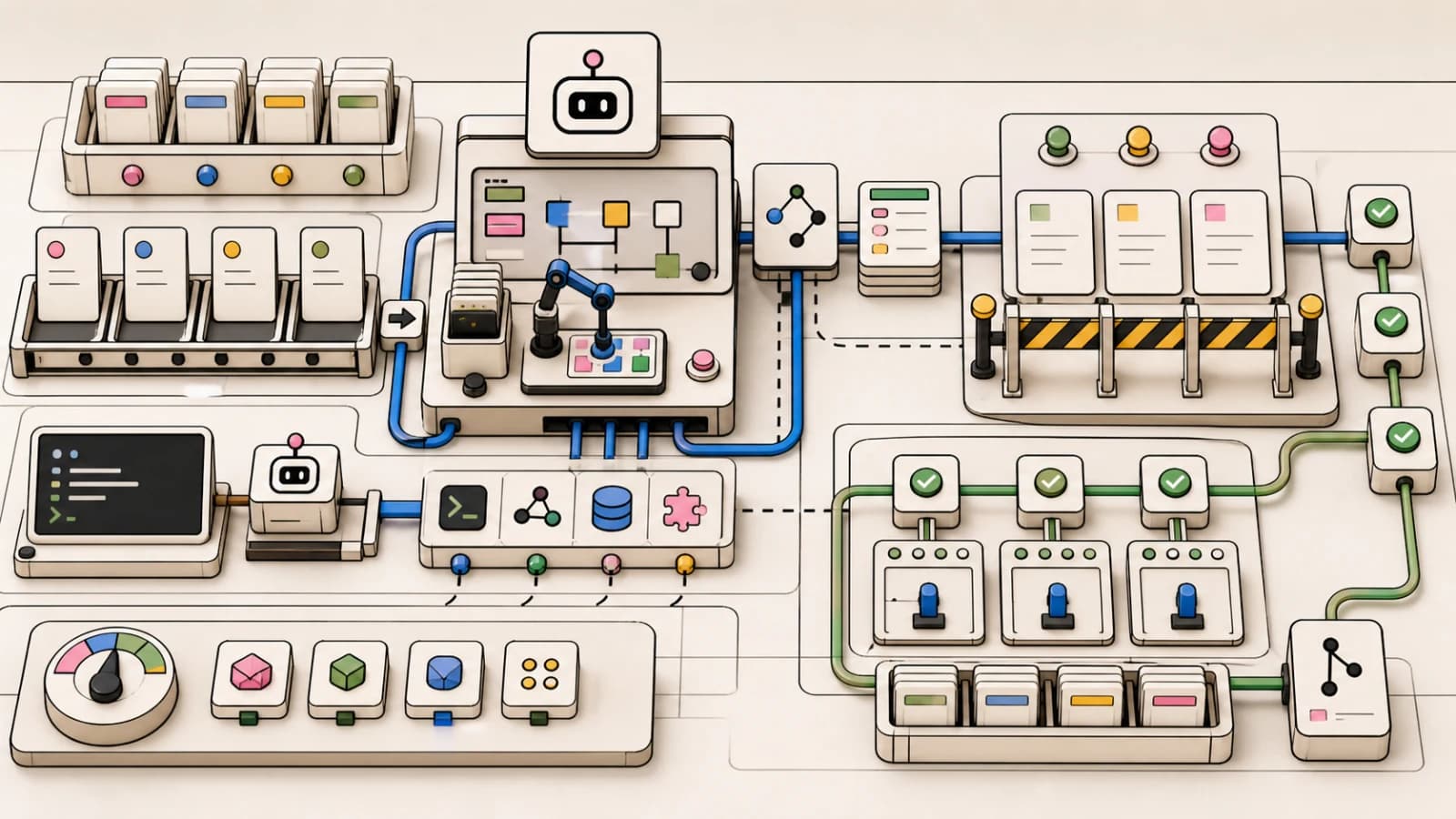
GitHub Copilot Coding Agent and CLI: Why GitHub Is Back in the Agent Race
GitHub Copilot is moving from autocomplete into asynchronous coding agents, terminal workflows, MCP, skills, and model c...

8 min read
AI Coding
Spec-Driven Agent Workflows: GitHub Spec Kit, gstack, and the New Handoff Layer
GitHub Spec Kit and gstack are trending for the same reason: coding agents need durable specs, plans, and task ledgers m...

7 min read
GitHub Copilot
MAI-Code-1-Flash Is a Model Routing Signal
Microsoft's new in-house coding model matters less as a benchmark headline and more as a signal that Copilot is becoming...

6 min read
Claude Code
Claude Code 2.1.128 Is an Ops Release, Not a Feature Drop
Claude Code 2.1.128 is full of small fixes around MCP, worktrees, OTEL, plugins, and permissions. That is exactly why it...
8 min read
AI Coding
Agent Swarms Need Receipts
GitHub is filling with multi-agent frameworks, skills, and coding harnesses. The useful lesson is not that every team ne...
Build with the member tools

Get Smarter About AI Dev
New tutorials, open-source projects, and deep dives on coding agents - delivered weekly.
One email per weekReal code, not theoryFree forever