Parallel Coding Agents Need Merge Discipline
TL;DR
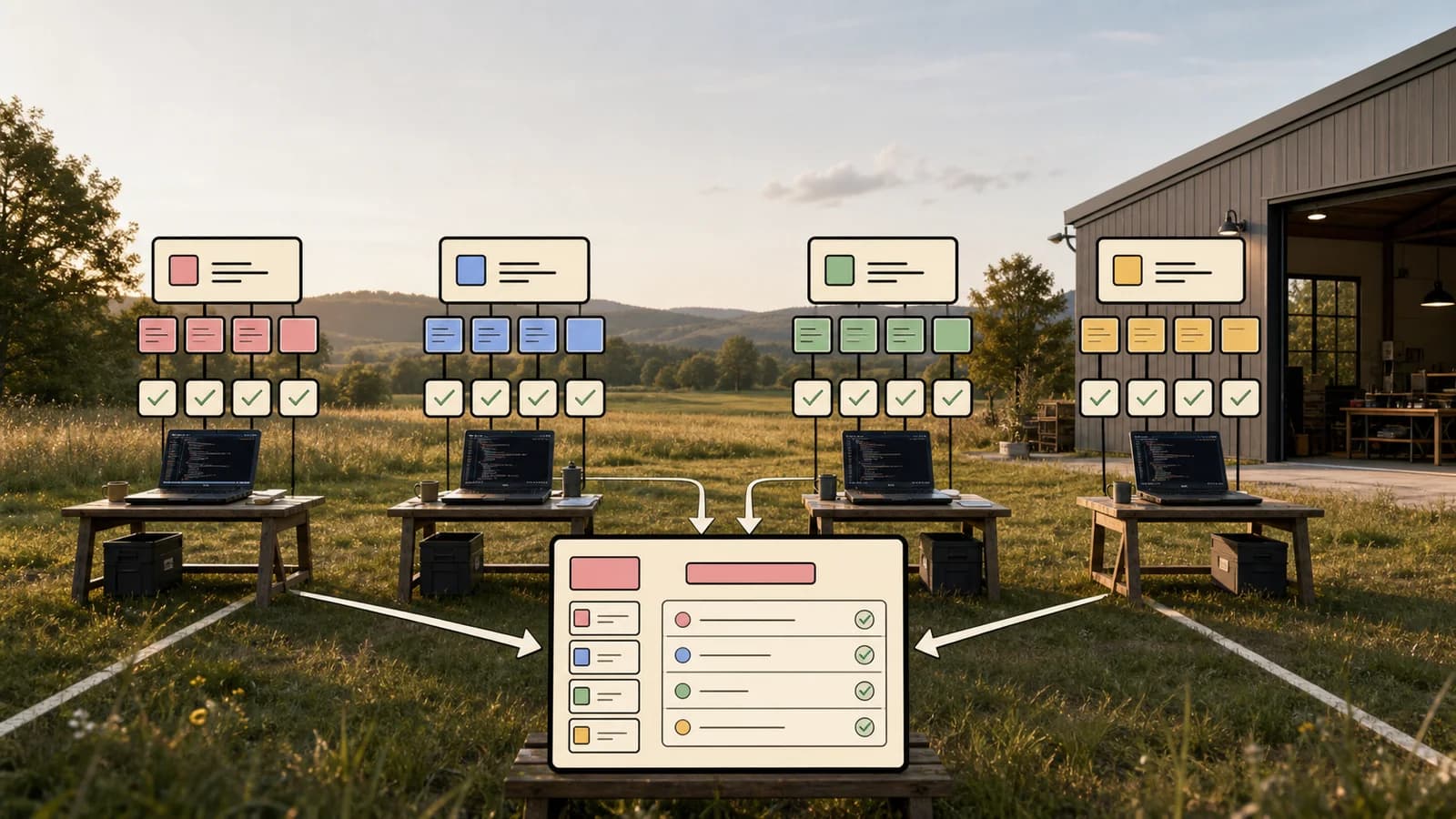
Parallel agents can move faster than one agent, but only when tasks have clean ownership, review receipts, and a merge path that does not turn speed into cleanup work.
Parallel coding agents are having their moment because the promise is obvious: split the work, run several agents at once, and get a bigger change done faster.
That promise is real. It is also incomplete.
The hard part is not spawning agents. The hard part is merging their work without creating a review mess.
The take#
Parallel agents need merge discipline before they need more autonomy.
A single coding agent can already create a noisy diff. Three agents can create three noisy diffs that overlap in surprising ways. If each agent touches shared files, changes conventions, or invents a slightly different abstraction, the human reviewer becomes the integration layer.
That is not leverage. That is deferred coordination cost.
This is why Claude Code subagents, parallel development workflows, and multi-agent orchestration need a boring operational rule: every agent should have a clear write boundary and an expected receipt.
What good parallel work looks like#
Good parallel agent work has three properties.
First, the tasks are independent. One agent updates docs, another writes tests, another implements a clearly bounded module. Their file ownership does not overlap unless the overlap is explicit.
Second, each agent returns evidence. Not "done." Evidence. Files changed, commands run, checks passed, checks skipped, and risks left open.
Third, the final merge has a single owner. Someone or something has to reconcile style, naming, shared assumptions, and test coverage.
Without those three pieces, parallelism just makes uncertainty arrive faster.
The opposing view#
The strongest opposing view is that agents should simply learn to coordinate with each other.
That might happen over time. We already see tools moving toward richer agent teams, background workers, and autonomous task loops. OpenAI has been pushing managed agent workflows through Codex, while Anthropic has made subagents and skills part of the Claude Code operating model.
But for real repos today, coordination by vibes is not enough.
Agents still miss implicit boundaries. They can both decide to "clean up" the same helper. They can both update the same README. They can both create similar utilities in different folders. The result might compile, but the architecture gets fuzzier.
That is why agent swarms need receipts. Parallelism is only useful when the review surface stays legible.
From the archive
A practical task split#
Here is a task split that usually works:
Agent A: implementation. Owns the feature files only. It should not update broad docs or shared infrastructure unless assigned.
Agent B: tests and fixtures. Owns tests, mocks, and focused regression coverage. It should not rewrite the implementation unless blocked.
Agent C: docs and examples. Owns docs, examples, changelog notes, or content updates. It should not change runtime code.
Main agent: integration. Pulls the pieces together, resolves conflicts, runs checks, and writes the final report.
That structure is slower than pure chaos, but faster than cleanup.
It also maps well to the agent skill trend. A test agent should have a testing skill. A docs agent should have a documentation skill. An integration agent should have a review receipt skill. That is how agent skills become production checklists, not just reusable prompts.
What to avoid#
Avoid assigning several agents to "improve the codebase."
That sounds productive, but it creates overlapping intent. Every agent can justify touching any file. The resulting merge has no obvious owner.
Also avoid asking multiple agents to independently solve the same implementation problem unless you are explicitly doing option generation. Option generation is useful, but it is a different workflow. You compare approaches, pick one, and discard the others. You do not merge all of them.
The best parallel tasks are narrow and named:
- Add route tests for this endpoint
- Update this component to use the existing design token
- Write migration docs for this exact API
- Find dead links in this content folder
- Implement this one adapter behind this interface
Specificity is the cheapest coordination mechanism.
The practical bottom line#
Parallel coding agents are useful when they reduce elapsed time without expanding review cost.
That requires task ownership, receipts, and a final integration pass. It also requires the humility to keep some work single-threaded when the next step depends on one hard decision.
The future is not one agent doing everything. It is small teams of agents working under clear contracts.
The team that wins will not be the one that spawns the most agents. It will be the one that makes each agent's work easiest to trust, review, and merge.
FAQ#
How many agents can safely work on the same repo at once?#
There is no fixed number. What matters is file ownership: as long as each agent's write scope is disjoint (or overlaps are explicit and assigned), you can run several agents in parallel. The moment two agents can both justify touching the same file, coordination cost grows faster than the speed gain.
What should each agent return besides "done"?#
A receipt: files changed, commands run, checks passed or skipped, and any risks left open. This is what lets a single integration pass reconcile several agents' work without re-deriving what happened from the diff alone.
Is it ever useful to have multiple agents solve the same problem?#
Yes, but only as explicit option generation, not as parallel execution of the same task. In that mode you compare the resulting approaches and pick one; you do not merge all of them together.
Who should own the final merge?#
A single person or a single integration agent, not the group of implementing agents. Someone has to reconcile style, naming, and shared assumptions across the parallel work, and that role should be assigned up front rather than improvised at merge time.
Sources: Claude Code subagents docs, Claude Code skills docs, OpenAI Codex docs, addyosmani/agent-skills.
Read next
AI Code Review Is the New Bottleneck
Coding agents make code faster than teams can review it. The next advantage is not bigger prompts. It is review systems that force reproduction, small diffs, tests, and receipts.
8 min readLocal Code Graphs Are the Agent Context Layer
CodeGraph shows why coding agents need a local, queryable repo map. The win is not magic token savings. It is faster orientation, fewer wrong files, and better review receipts.
9 min readWhy Skills Beat Prompts for Coding Agents in 2026
The coding-agent workflow is maturing past giant hand-written prompts. The winning pattern in 2026 is a control stack: project rules, reusable skills, bounded sub-agents, and deterministic tools around the model.
9 min readShare
Developers Digest
Technical content at the intersection of AI and development. Building with AI agents, Claude Code, and modern dev tools - then showing you exactly how it works.
300+ videos30K+ GitHub stars850+ articles
Related Tools
AI Coding
C
Conductor
Mac app for running parallel Claude Code, Codex, and Cursor agents in isolated workspaces. Watch every agent work at onc...
View ToolAI CodingDaily Driver

Claude Code
Anthropic's agentic coding CLI. Runs in your terminal, edits files autonomously, spawns sub-agents, and maintains memory...
View ToolAI CodingAgent

OpenAI Codex
OpenAI's coding agent for terminal, cloud, IDE, GitHub, Slack, and Linear workflows. Reads repos, edits files, runs comm...
View ToolAI Coding

Augment Code
AI coding platform built for large, complex codebases. Context Engine indexes 500K+ files across repos with 100ms retrie...
View ToolApps from Developers Digest
Developer Tools
Agent Hub
Every coding agent in one window. Stop alt-tabbing between Claude, Codex, and Cursor.
View AppDeveloper ToolsIn Progress
Agent Benchmark Lab
Compare AI coding agents on reproducible tasks with scored, shareable runs.
View AppDeveloper ToolsPlus $20/mo
Agent Eval Bench Plus
Score every coding agent on your own tasks. Catch regressions in CI.
View AppRelated Guides
Guide
Claude Code Setup Guide
Configure Claude Code for maximum productivity -- CLAUDE.md, sub-agents, MCP servers, and autonomous workflows.
AI AgentsGuide
AI Agent Frameworks Compared: LangGraph vs CrewAI vs Mastra vs CopilotKit
Deep comparison of the top AI agent frameworks - LangGraph, CrewAI, Mastra, CopilotKit, AutoGen, and Claude Code.
AI AgentsGuide
Worktrees - Claude Code
Isolated git worktrees for parallel Claude Code sessions.
Claude CodeRelated Videos

Generate Videos in Codex + Claude Code with This...
Check out HeyGen! https://heygen.1stcollab.com/developersdigest The video introduces HeyGen, an AI video generation platform with a rich API and a CLI that lets developers create, fetch, and manipula...
Video·

10x Design in Claude Code and Codex
Try Higgsfield: https://higgsfield.ai/s/higgsfield-general-campaign-developersdigest-juDMTi AI coding agents can build entire websites in minutes, but the default results often still look generic and...
Video·
Self Improving Applications with Claude Code & Codex
Build a Self‑Improving Next.js App: Supabase + Vercel Eve + GitHub Issues + Agent Loops Check out Supabase: https://supabase.plug.dev/1wWOTGS The video demonstrates how to build and deploy a self-im...
Video·
Related Posts
8 min read
Codex
Codex and Claude Code in July 2026: Agent Controls Are the Feature
The late-July Codex and Claude Code updates point in the same direction: coding agents are competing on approval modes,...
9 min read
AI Coding
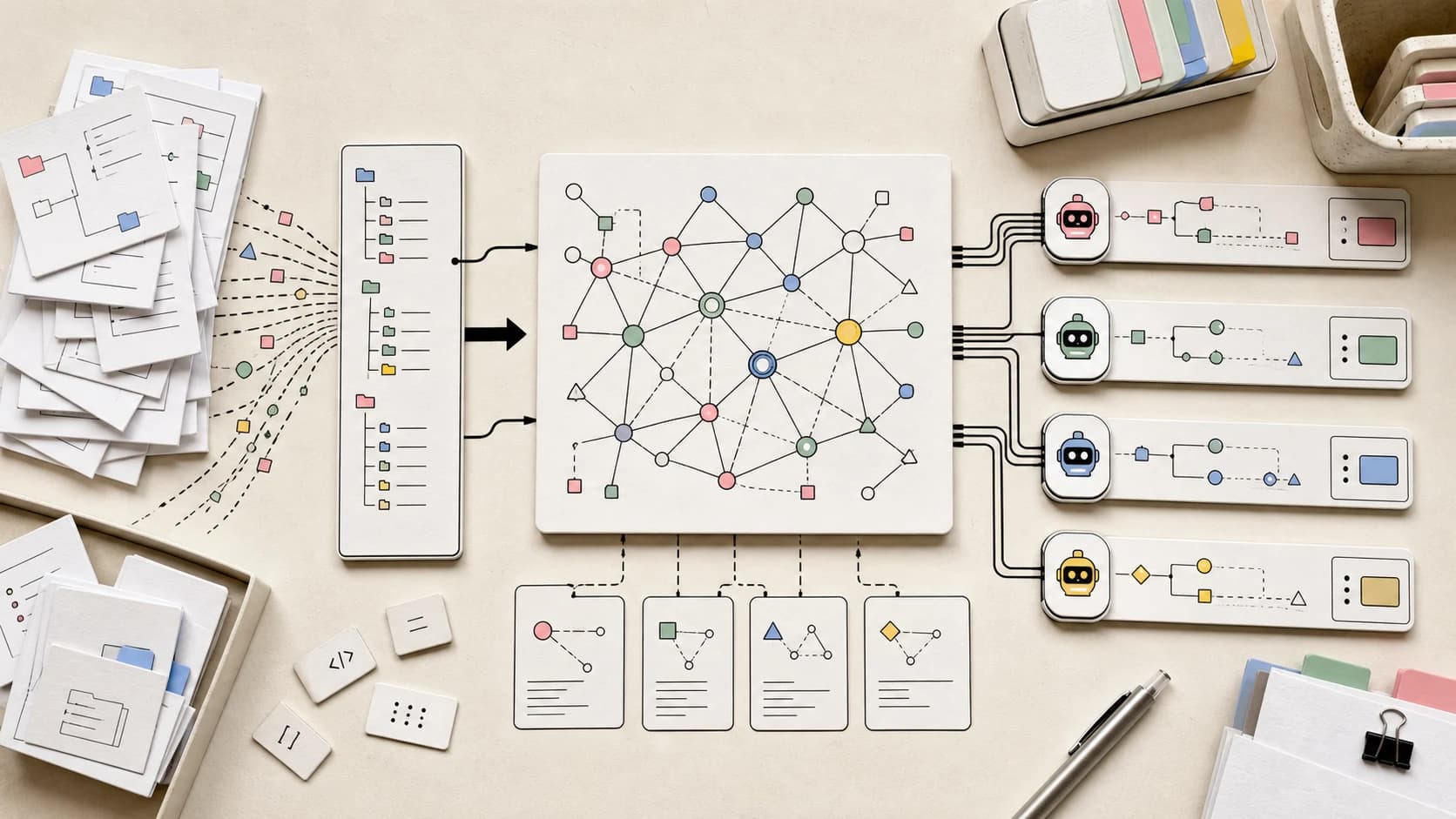
Local Code Graphs Are the Agent Context Layer
CodeGraph shows why coding agents need a local, queryable repo map. The win is not magic token savings. It is faster ori...
8 min read
AI Coding
AI Code Review Is the New Bottleneck
Coding agents make code faster than teams can review it. The next advantage is not bigger prompts. It is review systems...
7 min read
AI Coding
Skills for Real Engineers Need Governance, Not Fandom
Matt Pocock's skills repo is a useful signal for AI coding teams. The next step is treating skills like governed product...

9 min read
AI Coding
Why Skills Beat Prompts for Coding Agents in 2026
The coding-agent workflow is maturing past giant hand-written prompts. The winning pattern in 2026 is a control stack: p...
8 min read
AI Coding
The Coding-Agent Colony: What Gas Town Changes
Steve Yegge's Gas Town thesis is less about one tool than a shift from one coding agent to a durable, supervised colony...
Build with the member tools

Get Smarter About AI Dev
New tutorials, open-source projects, and deep dives on coding agents - delivered weekly.
One email per weekReal code, not theoryFree forever