GPT-5.6 Sol Ultra Coming to Codex with Cooperative Subagents
TL;DR
OpenAI teases its most capable coding model yet - Sol Ultra uses trained subagents that communicate during tasks, reportedly hitting 91.9% on Terminal-Bench 2.1.
OpenAI's Codex engineering lead Thibault Sottiaux dropped a teaser this weekend that set off a 340-comment Hacker News thread: GPT-5.6 Sol Ultra is coming to Codex. The "Ultra" tier had not been formally announced alongside the Sol, Terra, and Luna preview, so this confirmation caught the developer community off guard.
What Ultra Actually Does#
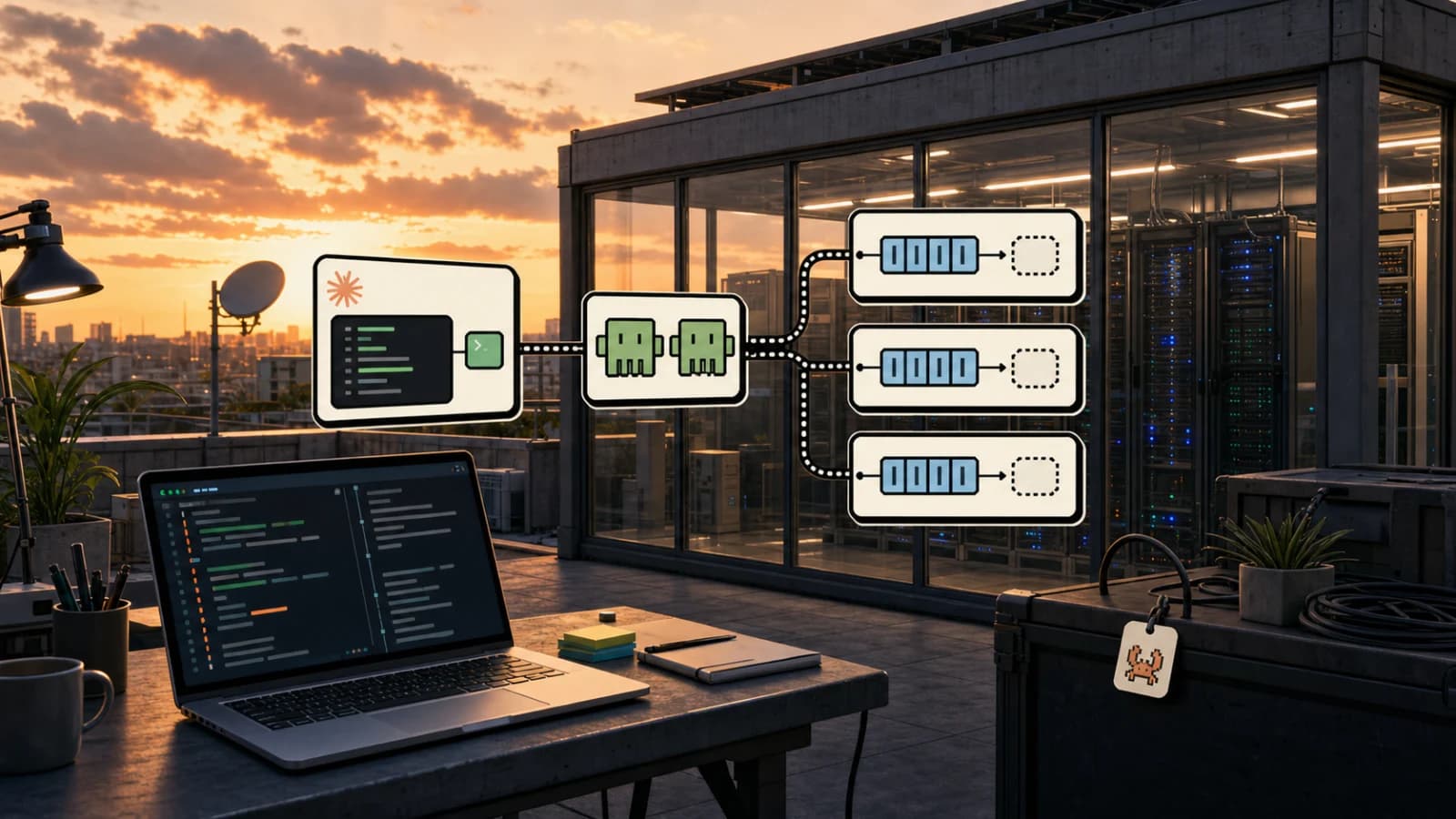
The key differentiator is architecture. While Sol already represents OpenAI's flagship model, Ultra "goes beyond the capabilities of a single agent by leveraging subagents to accelerate complex work." Critically, these subagents are "trained to cooperate and allowed to communicate with each other during a task."
This is not the same as spawning independent parallel agents. The subagents share context and coordinate in real time. If the reported Terminal-Bench 2.1 scores hold up - 91.9% for Sol Ultra versus 88.8% for base Sol - that 3-point jump represents meaningful progress on multi-step coding tasks.
For comparison, Claude Mythos 5 and GPT-5.5 both sit at 88.0% on the same benchmark, though these figures remain "reported, not settled" since they do not appear on OpenAI's official Sol preview page.
What HN Is Saying#
The Hacker News discussion split into a few distinct camps.
Skeptics on naming: Multiple commenters expressed fatigue with OpenAI's model naming conventions. One wrote: "Bruh when did understanding chatbots become like following pokemon? Wtf does any of this mean. Tf is sol? Tf is ultra? Tf is codex?" The Sol/Terra/Luna trio, plus Ultra/Pro/Extended variants, does create a confusing product matrix.
Pricing concerns: A commenter working at a large US corporation noted that internal guidance has shifted toward token conservation. Two months ago, management was praising employees who used the most tokens. Now they are getting weekly emails urging cheaper model usage and monitoring spend dashboards. This aligns with reports that OpenAI has found ways to cut inference costs by more than half through optimizations, though those savings have not translated to lower API prices yet.
Competition awareness: Several comments pointed to Anthropic and the GLM models as competitive pressure. One wrote: "they better get that out fast, it will become totally meaningless when the next GLM gets there first." Another hoped the release would "force Anthropic to be less stingy with Fable."
Architecture curiosity: The most interesting technical thread debated what "trained to cooperate" actually means. One commenter speculated about caching "the progression, the graph" rather than static answers - essentially edit scripts that can be replayed or adjusted. Another pointed out that this does not obviously fit standard LLM architecture, suggesting there may be novel inference-time coordination happening.
The Inference Cost Angle#
Alongside the Sol Ultra news, OpenAI engineers reportedly told colleagues they have figured out how to more than halve inference costs through newly discovered optimizations. According to The Information, when these techniques were applied to ChatGPT for logged-out visitors, it reduced GPU requirements to "just a couple hundred" at one point.
Possible techniques include quantization, key-value caching, batching, and routing simple tasks to smaller models. But the specifics remain unclear, and OpenAI has not announced cheaper rates for ChatGPT or the API.
For developers, this matters because running frontier models in agentic loops burns tokens fast. If Ultra's subagent coordination is genuinely more efficient than naive parallel calls, the architecture could partially offset the higher per-token cost of using a flagship model.
Current Sol Pricing and Availability#
Base Sol pricing sits at $5 input and $30 output per million tokens. No Ultra-specific pricing has been disclosed. The GPT-5.6 models remain in limited preview, with broader access "expected in the coming weeks."
OpenAI is also launching GPT-5.6 Sol on Cerebras infrastructure at up to 750 tokens per second - a significant latency improvement for interactive coding sessions.
For now, access is limited to trusted partners and organizations. Individual subscribers are asking when they will get access, but there is no confirmed timeline.
What This Means for Your Workflow#
If you are currently using Codex with GPT-5.5, Sol represents a clear upgrade path. The Terra and Luna variants offer balanced and budget options respectively, while Ultra sits at the top for complex multi-step work.
The cooperative subagent architecture is the interesting part. Most current agentic coding workflows spawn independent agents and hope they do not conflict. Trained cooperation could reduce the coordination overhead that currently requires careful orchestration at the application layer.
Whether the 91.9% benchmark holds under real-world coding conditions remains to be seen. But if OpenAI can deliver frontier performance with genuinely efficient multi-agent coordination, that changes the cost calculus for agentic development.
Keep an eye on the official rollout. The combination of Sol Ultra's capabilities with the reported inference cost improvements could shift the value proposition for teams evaluating their AI coding stack.
Continue Reading#
- ChatGPT Work and Codex Now Share One Desktop App: What Actually Changed
- Codex Hits 8 Million Users: What the GPT-5.6 Surge Means for Developers
- Codex CLI Vim Mode Is an Ergonomics Signal
Sources#
Get the next deep dive like this in your inbox
One email a week on News and the rest of the AI dev stack. Free.
Read next on AI coding tools
GPT-5.6 Sol Ultra Produces Proof of the Cycle Double Cover Conjecture
OpenAI claims GPT-5.6 Sol Ultra has generated a proof for a 50-year-old graph theory conjecture in under an hour. The math community is now verifying whether it holds up.
5 min readCodex Usage Limits and Pricing in 2026: Pro 100, Pro 200, Pro 500, Resets, and 'Model at Capacity' Errors
Codex is included in ChatGPT plans from Free to Enterprise. On September 29, 2026, OpenAI reopened Pro $200 with roughly half the old usage value, added Pro $500 with Astra Ultrafast, and left Plus at $20/month. Existing Pro $200 subscribers keep their old allowance through October 29, 2026. Here is how resets work, what each plan buys, and what to do about 'Selected model is at capacity'.
14 min readOpenAI Open-Sourced Codex Security: What HN Thinks
OpenAI released the Codex Security CLI and TypeScript SDK as open source on GitHub. The Promptfoo team behind it, the 2.1k-star reception, and what the HN community says about cost, guardrails, and local model support.
7 min readNew here? Start with
Technical content at the intersection of AI and development. Building with AI agents, Claude Code, and modern dev tools - then showing you exactly how it works.