Apertus: Europe's Answer to AI Sovereignty - and Why HN Is Skeptical
TL;DR
Switzerland's fully open foundation model promises transparent training data and EU compliance. The HN crowd has questions about actual performance.
Last updated: June 24, 2026
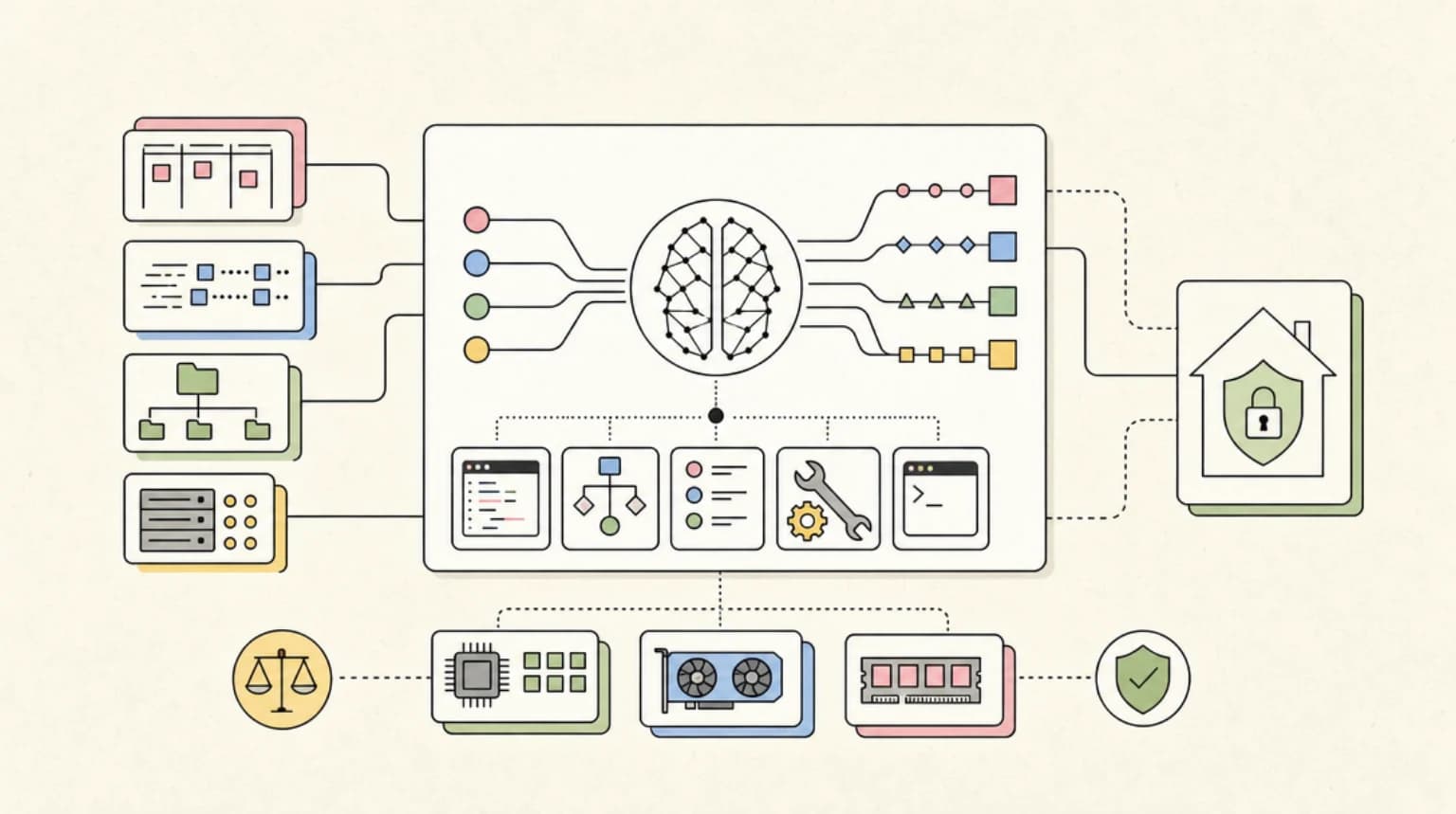
The Swiss AI Initiative just shipped Apertus, a fully open foundation model developed by EPFL, ETH Zurich, and the Swiss National Supercomputing Centre (CSCS). The pitch: complete transparency, EU AI Act compliance, and training data you can actually inspect.
The Hacker News response has been complicated. Developers like the ambition, but they are asking the same practical question that follows every open model launch: how much capability are you giving up for transparency?
What Apertus Actually Is#
Apertus ships in two sizes - 8B and 70B parameters - trained on 15 trillion tokens across 1,000+ languages. The headline differentiator is openness: training data, code, weights, methods, and alignment principles are all documented and reproducible.
From the official site:
Fully open model: open weights + open data + full training details including all data and training recipes.
The model was trained on CSCS's Alps supercomputer using up to 4,096 GPUs. Swisscom serves as the strategic partner, and you can access it through Hugging Face or the Public AI network.
Key claims:
- Built to meet EU AI Act requirements
- Respects opt-outs and removes PII
- Prevents memorization
- Competitive with top open models at equivalent scales
What HN Is Saying#
The HN discussion splits into a few camps:
The "Actually Open" Appreciation#
The core appeal is scientific reproducibility. Several commenters treated Apertus less as a leaderboard play and more as infrastructure for research: a model where training data, recipes, methods, and weights are visible enough to audit.
Several users pointed out that Apertus joins a small club of genuinely open models - alongside Allen AI's OLMo 3.1, MBZUAI's K2 Think V2, and Nvidia's Nemotron (though Nemotron has some proprietary data).
The Performance Question#
The most upvoted criticism is simple: is the model actually good?
Artificial Analysis now has dedicated pages for Apertus 8B Instruct and Apertus 70B Instruct, and the takeaway is not flattering on raw intelligence rankings. That does not invalidate the openness story, but it does make the tradeoff explicit: transparency is the product, not frontier capability.
The multilingual claims also drew skepticism from hands-on users. The safer read is that broad language coverage is a research and sovereignty win, while practical quality still needs task-by-task evaluation.
The Training Data Debate#
This is where things get philosophically interesting. Simon Willison noted that Apertus "uses fineweb, which is derived from Common Crawl, which is an unlicensed scrape of web pages."
This prompted a subthread about whether "sovereign AI" can really claim ethical high ground while using web-scale scraped corpora. One side argues public web analysis is legitimate and necessary. The other argues that transparency about scraping does not answer compensation or consent concerns. Apertus is useful here because it makes the debate inspectable instead of hiding it behind a closed training stack.
The Geopolitical Angle#
Several comments touched on why European AI independence matters. The argument is straightforward: even if Apertus is not state-of-the-art today, European-controlled AI infrastructure matters for data sovereignty, public-sector procurement, language coverage, and regulatory compliance.
From the archive
Claude Code's Extended Thinking Is a Summary - What That Means for You
Jun 22, 2026 • 5 min read
Codex CLI Needs Resource Budgets, Not Just Token Budgets
Jun 22, 2026 • 8 min read
Codex Logging Bug Can Write Terabytes to Your SSD
Jun 22, 2026 • 5 min read
Deno Desktop Lets You Build Native Apps with TypeScript
Jun 22, 2026 • 8 min read
The Practical Takeaway#
If you're evaluating Apertus for production use, here's what the evidence suggests:
Strengths:
- Full training transparency - you can audit everything
- EU AI Act compliance baked in
- No licensing restrictions for commercial use
- Multilingual training with underrepresented languages (Swiss German, Romansh)
Weaknesses:
- Performance lags behind Nemotron, DeepSeek, and frontier models
- Not ready for agentic use cases according to hands-on reports
- Multilingual quality is inconsistent in practice
Best use cases:
- RAG applications where transparency matters more than peak performance
- European organizations with strict data sovereignty requirements
- Research where reproducibility is the priority
That makes Apertus adjacent to the local/open-model lane rather than the frontier-agent lane. If you are choosing models for coding agents, start with the best local coding LLMs, Cohere North Mini Code, GLM-5.2 local deployment, or DeepSeek V4 budget coding agents. If you are choosing models for transparency, auditability, or public-sector sovereignty, Apertus enters the shortlist.
The Bigger Picture#
The debate in this thread mirrors a broader tension in AI development: should we prioritize transparency and ethical sourcing even at the cost of capability? Or does "open" only matter if the model is actually competitive?
For now, Apertus represents a credible attempt at the transparency-first approach. Whether the capability gap closes depends on continued funding and research. The Swiss AI Initiative has the institutional backing - EPFL and ETH Zurich are serious players - but catching up to labs spending billions requires more than good intentions.
If you want a model where you can trace every training decision, Apertus delivers. If you need frontier performance, you're still looking at Nemotron, DeepSeek, or the closed models.
The market has room for both. In practice, most teams should treat this as a routing decision: use transparency-first models where auditability matters, and route high-difficulty work to stronger models when quality is the binding constraint. That is the same operational pattern behind local Qwen as a different tool, VibeThinker small-model routing, and AI affordability as cost accounting.
FAQ#
Is Apertus fully open?#
It is one of the stronger openness claims in the model market: the project emphasizes open weights, open data documentation, training details, methods, and recipes. That is different from many "open-weight" models where the weights ship but the data and training process remain opaque.
Is Apertus good enough for production?#
It depends on the job. The practical evidence points toward transparency-first RAG, public-sector experimentation, multilingual research, and audit-heavy workflows. For frontier coding agents or general high-stakes reasoning, benchmark and hands-on reports suggest stronger models are still ahead.
Why does Apertus matter if it is not the strongest model?#
Because sovereignty and reproducibility are product requirements for some teams. A weaker but inspectable model can be more useful than a stronger closed model when procurement, compliance, language coverage, or research reproducibility matters.
Where can developers try Apertus?#
Start with the official Apertus site and documentation, then check the Swiss AI organization on Hugging Face. Availability and hosted routes may change, so verify the current model card and license before building around it.
Continue Reading#
- Inkling: Thinking Machines Lab Drops a 975B Open-Weights Model
- How to Stop Claude from Saying 'Load-Bearing'
- Vulnerability Reports Are Not Special Anymore
Sources#
Read next
Inkling: Thinking Machines Lab Drops a 975B Open-Weights Model
A new American open-weights frontier model with multimodal capabilities, 1M token context, and competitive benchmarks. Here's what the HN community thinks.
7 min readColibri: Running GLM 5.2 on a 32GB Laptop with Disk Streaming and Expert Offloading
A solo developer built a 1,300-line C inference engine that runs the 744B GLM 5.2 model on consumer hardware by streaming routed experts from disk. Here's how it works.
6 min readMozilla's State of Open Source AI Report: The Gap Is 3%, But Deployment Remains the Real Problem
Mozilla's inaugural report reveals open models now match closed AI on capability, but only 51% reach production. The harness layer and permission model gaps explain why.
8 min readShare
Developers Digest
Technical content at the intersection of AI and development. Building with AI agents, Claude Code, and modern dev tools - then showing you exactly how it works.
300+ videos30K+ GitHub stars850+ articles
Apps from Developers Digest
Related Guides
Related Posts
7 min read
News
Inkling: Thinking Machines Lab Drops a 975B Open-Weights Model
A new American open-weights frontier model with multimodal capabilities, 1M token context, and competitive benchmarks. H...
8 min read
News
Inkling-Small: Thinking Machines Ships a 12B-Active Open Model That Beats Its Big Sibling on Agent Work
Inkling-Small is a 276B-parameter MoE with 12B active per token, Apache 2.0, and open weights. It beats the 975B Inkling...

7 min read
News
Echo Claims Fable-Level Results at One-Third the Cost Using Open-Weight Models
A new multi-model orchestration system routes requests across open-weight models to match frontier performance at reduce...
8 min read
News
Mozilla's State of Open Source AI Report: The Gap Is 3%, But Deployment Remains the Real Problem
Mozilla's inaugural report reveals open models now match closed AI on capability, but only 51% reach production. The har...
6 min read
News
Colibri: Running GLM 5.2 on a 32GB Laptop with Disk Streaming and Expert Offloading
A solo developer built a 1,300-line C inference engine that runs the 744B GLM 5.2 model on consumer hardware by streamin...
6 min read
News
Tencent Hy3: A 295B Open MoE That Punches Above Its Weight
Tencent's Hy3 ships 295B parameters but activates only 21B per token, matching flagship performance at flash-tier pricin...
Build with the member tools

Get Smarter About AI Dev
New tutorials, open-source projects, and deep dives on coding agents - delivered weekly.
One email per weekReal code, not theoryFree forever