Cohere's North Mini Code: A 30B Open-Weight Coding Model That Runs on One H100
TL;DR
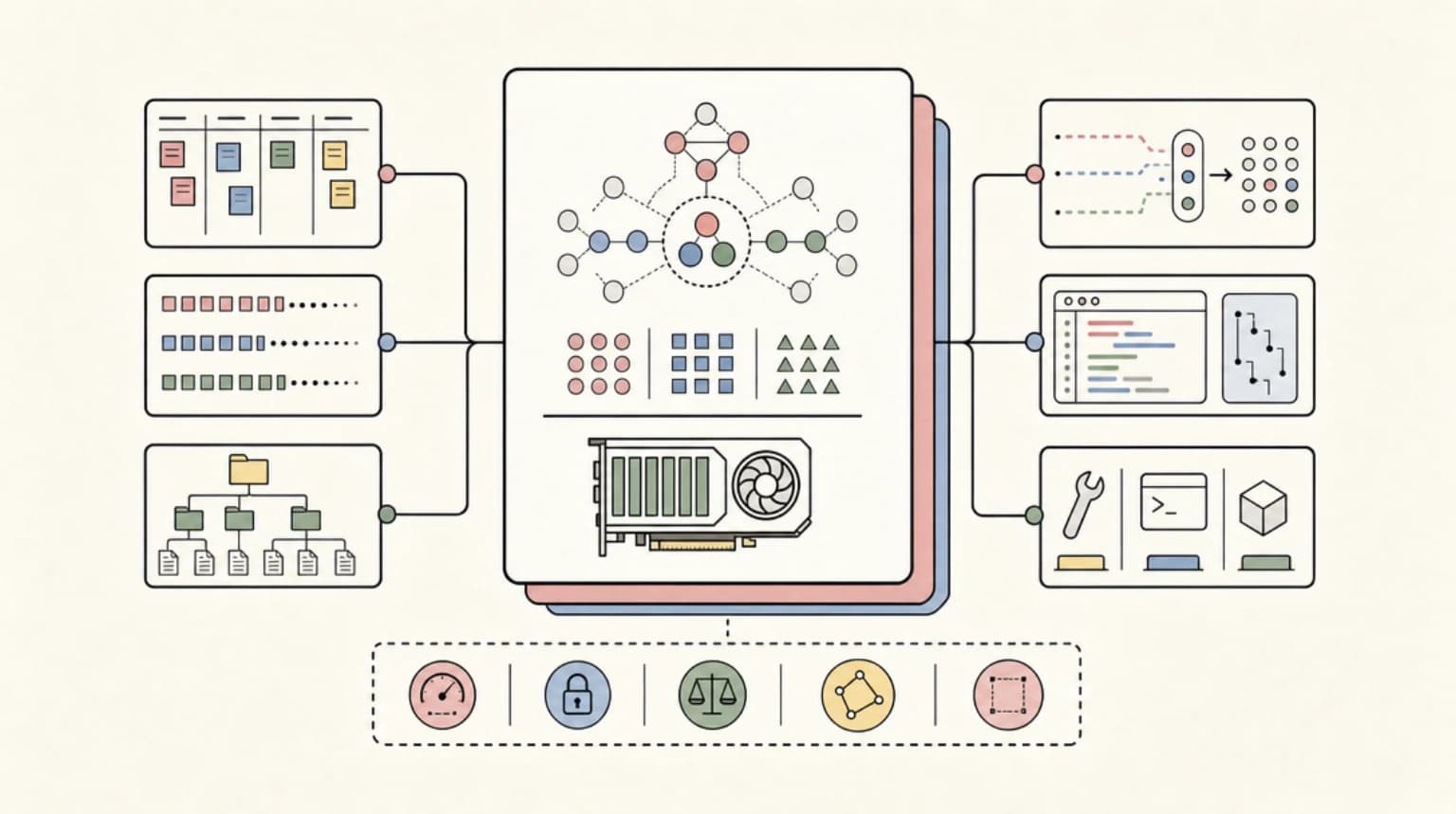
Cohere shipped its first developer-facing model on June 9, 2026. North Mini Code is a 30B mixture-of-experts coding model with 3B active parameters, Apache 2.0 weights, and a deployment footprint of a single H100. Here is what it actually offers and where the open questions are.
Last updated: June 24, 2026
Cohere has mostly been known for retrieval, embeddings, and enterprise RAG. On June 9, 2026, it stepped onto coding-model turf for the first time. North Mini Code is the company's first agentic coding model, released with open weights under Apache 2.0 and sized so it fits on a single H100. For teams that want a capable coding model they can actually self-host, that combination is the headline.
This post sticks to what Cohere has published and what independent coverage has confirmed. Where a number is a vendor claim rather than an independently reproduced benchmark, it is flagged as such.
What North Mini Code Is#
North Mini Code is a mixture-of-experts (MoE) model with 30B total parameters and 3B active per token. The MoE design is the whole point: you get the knowledge capacity of a 30B model while only paying the inference cost of routing through roughly 3B parameters on each forward pass. That is what keeps the deployment footprint small.
The specs Cohere lists:
- 30B total / 3B active parameters (MoE)
- 256K token context window
- 64K token maximum generation length
- Apache 2.0 license (open weights, commercial use permitted)
- Minimum hardware: 1x H100 at FP8 or 1x H100 at FP4
It is positioned as the first model in what Cohere calls its next generation, and it is aimed squarely at agentic software engineering - code generation, sub-agent orchestration, architecture mapping, code review, and terminal work. That places it in the same practical category as local Qwen workflows, GLM-5.2 local deployment, and the broader best local coding LLMs conversation.
Where You Can Run It#
Cohere made availability broad on day one, which matters more than benchmarks for a model people are meant to actually deploy:
- Hugging Face - weights in bf16, fp8, and w4a16 (4-bit) formats
- Cohere API - hosted inference
- Model Vault - Cohere's managed dedicated inference
- OpenCode - usable for free inside the open-source coding harness
- OpenRouter - routed access alongside other models
The OpenCode integration is a smart distribution move. OpenCode is currently the most-starred open-source coding agent, so dropping North Mini Code into that harness puts it in front of a large existing developer audience without asking anyone to change tools.
The Benchmark Picture (Read This Carefully)#
This is where favorable framing needs to give way to precision.
The single concrete launch number Cohere reports is 33.4 on the Artificial Analysis Coding Index, which the company characterizes as a competitive position among similarly sized models. That is an honest framing - it is not claiming frontier parity, it is claiming it competes in its weight class.
The current public Artificial Analysis model page is a useful second check, but it is not the same metric. At refresh time, it listed North Mini Code at 21 on the Artificial Analysis Intelligence Index and around 123 output tokens per second for the measured provider route. That supports the same practical read: this is a fast, efficient open-weight coding model, not a frontier hosted-model replacement.
Cohere's Hugging Face materials now expose more of the benchmark picture than the first version of this post had. The model card lists 67.6 on SWE-Bench Verified and 40.2 on SWE-Bench Pro, with evaluation through the SWE-agent harness. It also documents the broader evaluation suite: Terminal-Bench v2, Terminal-Bench Hard, SciCode, and LiveCodeBench v6, with three seeds averaged at temperature 1.0 and top_p 0.95.
That is useful, but still read it as a benchmark suite, not a universal quality guarantee. Harness choice matters for coding agents, and North Mini Code is clearly optimized for code and terminal work rather than general agentic tasks.
The efficiency claims are clearer, though still vendor-reported. Against Devstral Small 2, Cohere reports:
- Up to 2.8x higher output throughput
- A ~30% advantage in inter-token latency
- Devstral Small 2 keeps a slight lead on time-to-first-token
These are throughput-and-latency claims, not quality claims, and they have not been independently reproduced. They are plausible given the 3B active-parameter design, but worth confirming on your own hardware before you build a latency budget around them.
From the archive
Cursor Origin: A Git Forge Built for AI Agents, Not Humans
Jun 17, 2026 • 8 min read
DeepSeek V4 Economics: The Cost-Quality Frontier for Agentic Coding in 2026
Jun 17, 2026 • 9 min read
Epic Games Releases Lore: A Version Control System Built for Game Development
Jun 17, 2026 • 7 min read
Everything Vercel Shipped at Ship 26 (June 2026)
Jun 17, 2026 • 8 min read
Why This Matters#
The interesting story here is not "Cohere beat anyone." It is the shape of the offering.
Self-hosting just got more practical for coding. A 30B MoE that runs on one H100 with open weights and a permissive license lands in the same conversation as Devstral, Qwen-class coders, and other locally runnable models. For teams under data-residency or compliance pressure - the exact crowd that cannot send source code to a third-party API - a single-GPU footprint and Apache 2.0 terms remove two of the biggest blockers at once.
256K context is generous for the size class. Agentic coding chews through context fast once you add file trees, diffs, and tool output. A quarter-million-token window on a model this small is a real working advantage for repo-scale tasks.
Cohere is signaling a direction. Calling this the "inaugural member" of a next generation suggests more developer-facing models are coming from a company that previously stayed out of the coding race. That is worth watching even if this first model is a mid-tier entry rather than a leader.
Model routing gets more interesting. North Mini Code is exactly the kind of model that belongs in a router: cheap local repo exploration, high-volume edit generation, and privacy-sensitive codebase work can go to the open-weight model, while harder design calls can still route to a frontier model. That is the same cost-control pattern behind model routing recipes, DeepSeek V4 budget coding agents, and the broader AI affordability crisis.
The Honest Caveats#
- Coding-specialized, not generalist. The strongest story is code and terminal work. Do not extrapolate that into non-coding agentic workflows without testing.
- Efficiency numbers are vendor-reported. The 2.8x throughput and 30% latency figures come from Cohere, not independent labs.
- "Competitive among similarly sized models" is not "best." This is a small, efficient, openly licensed model - not a Fable 5 or GPT-5.5 competitor on raw capability. Set expectations accordingly.
Should You Try It?#
If you are already self-hosting coding models, North Mini Code is worth a slot in your evaluation harness this week - the Apache 2.0 license, single-H100 footprint, and OpenCode integration make it cheap to test. If you are happy with a hosted frontier model and have no compliance reason to bring inference in-house, there is no urgency here. And if you see a specific SWE-Bench percentage quoted for it, ask where the number came from before you trust it.
The most useful thing about this release is not the model itself but what it represents: capable, openly licensed coding models that fit on hardware a single team can afford are becoming normal. That trend is good for developers regardless of which vendor's logo is on this particular checkpoint.
FAQ#
Is North Mini Code open source?#
The weights are released under Apache 2.0, so the practical licensing story is permissive. Cohere and Hugging Face describe it as an open-weight research release rather than a fully open training-data-and-recipe release.
Can North Mini Code replace Claude, GPT, or other frontier coding models?#
Not for every task. It is more compelling as a local or routed model for high-volume coding work, repo exploration, and privacy-sensitive workflows. Keep frontier models in the loop for hard architecture decisions, ambiguous product work, and final review.
What hardware do you need to run North Mini Code?#
Cohere's launch materials say it can run on a single H100 in FP8 or FP4-style deployments, with Hugging Face variants available in bf16, fp8, and w4a16 formats. Your real footprint depends on serving stack, batch size, quantization, and context length.
What benchmark number should I trust?#
Use Cohere's launch numbers and Hugging Face model-card scores as vendor-published context, then use the Artificial Analysis model page as a current third-party snapshot. Do not mix the Coding Index, Intelligence Index, SWE-Bench, and speed numbers as if they measure the same thing.
Sources#
- North Mini Code: Agentic Coding Model for Developers - Cohere
- Cohere changelog: North Mini Code 1.0
- Introducing North Mini Code - Cohere Labs on Hugging Face
- North Mini Code model card - Hugging Face
- North Mini Code model page - Artificial Analysis
- North Mini Code on OpenRouter
- Meet North Mini Code - MarkTechPost
Read next
The Best Local Coding LLMs in 2026: Run Enterprise-Grade AI Without the Cloud
Choosing a local coding LLM in 2026 means balancing benchmark performance, hardware cost, and the compliance pressure to keep code off third-party servers. Here is what to run and on what hardware.
8 min readMAI-Code-1-Flash Is a Model Routing Signal
Microsoft's new in-house coding model matters less as a benchmark headline and more as a signal that Copilot is becoming a routing layer for cost, latency, ownership, and review quality.
7 min readOpenCode Developer Guide: The Open Source AI Coding Agent with 160K Stars
OpenCode is the fastest-growing open-source AI coding agent - 160K GitHub stars, 7.5M monthly users, 75+ model providers. Here is how to set it up, configure models, and use it effectively in your workflow.
11 min readShare
Developers Digest
Technical content at the intersection of AI and development. Building with AI agents, Claude Code, and modern dev tools - then showing you exactly how it works.
300+ videos30K+ GitHub stars850+ articles
Related Tools
AI Coding

Codex CLI
OpenAI's open-source terminal coding agent built in Rust. Runs locally, reads your repo, edits files, and executes comma...
View ToolAI CodingOpen source

OpenCode
Open-source AI coding agent for terminal, desktop, and IDE. Works with 75+ LLM providers including Claude, GPT, Gemini,...
View ToolAI Coding

Aider
Open-source AI pair programming in your terminal. Works with any LLM - Claude, GPT, Gemini, local models. Git-aware ed...
View ToolAI Models

Mistral
European open-weight models. Mistral Large for complex tasks, Mistral Small for speed, Codestral for code. Strong multil...
View ToolApps from Developers Digest
Related Guides
Guide
Run AI Models Locally with Ollama and LM Studio
Install Ollama and LM Studio, pull your first model, and run AI locally for coding, chat, and automation - with zero cloud dependency.
Getting StartedGuide
PR Status in Footer - Claude Code
Clickable PR link in the footer with review state color coding.
Claude CodeGuide
Migrating from Cursor to Claude Code
A concrete step-by-step guide to moving your development workflow from Cursor to Claude Code - settings, rules, keybindings, and the habits that transfer.
Getting StartedRelated Videos
Gemini 2.5 Pro 05-06 in 6 Minutes: The Best Coding Model?
Google has released an updated version of Gemini 2.5 Pro, enhancing its capabilities in coding and more. This video covers the announcement details, benchmarks, and how to leverage the model....
Video·
Minimax M2.7: Self-Evolving Agent Model
MiniMax Token Plan 12% OFF:https://platform.minimax.io/subscribe/coding-plan?code=5MBsFNv1Jf&source=link MiniMax Platform:https://platform.minimax.io API Documentation:https://platform.minimax.io/docs
Video·
Zed: The Open Source Agentic IDE - Use Claude Code, Codex & Gemini CLI in one place
Check out Zed here! https://zed.dev In this video, we dive into Zed, a robust open source code editor that has recently introduced the Agent Client Protocol. This new open standard allows...
Video·
Related Posts
8 min read
local llm
The Best Local Coding LLMs in 2026: Run Enterprise-Grade AI Without the Cloud
Choosing a local coding LLM in 2026 means balancing benchmark performance, hardware cost, and the compliance pressure to...
7 min read
GitHub Copilot
MAI-Code-1-Flash Is a Model Routing Signal
Microsoft's new in-house coding model matters less as a benchmark headline and more as a signal that Copilot is becoming...
11 min read
opencode
OpenCode Developer Guide: The Open Source AI Coding Agent with 160K Stars
OpenCode is the fastest-growing open-source AI coding agent - 160K GitHub stars, 7.5M monthly users, 75+ model providers...
10 min read
Claude Code
Claude Code vs Codex vs Cursor vs OpenCode: Which Agent Ships More Code?
Four agents, same tasks. Honest trade-offs from a developer shipping production apps with all of them.

7 min read
News
Local Qwen Is a Different Tool, Not a Worse Opus
Alex Ellis shares real production experience running local LLMs: $12k hardware investment, 2-3 month ROI, and why treati...
7 min read
News
LFM2.5-VL-3B: Liquid AI's 3B Vision Model Reads Screens, Grounds Objects, and Calls Tools on a Laptop
Liquid AI released LFM2.5-VL-3B on August 12, 2026: a 3.1B open-weights vision-language model that averages 80.7 on Scre...
Build with the member tools

Get Smarter About AI Dev
New tutorials, open-source projects, and deep dives on coding agents - delivered weekly.
One email per weekReal code, not theoryFree forever