The $500M Claude Bill: A Spend-Guardrails Playbook for AI-Native Teams
TL;DR
A company accidentally spent $500M on Claude in one month. Uber torched its whole 2026 AI budget by April. The fix is not less AI - it is guardrails. Here is the playbook: caps, alerts, gateway spend limits, model routing, prompt caching, and approval workflows.
Last updated: June 17, 2026
In late May 2026 an AI consultant disclosed that one of their enterprise clients had run up a roughly $500 million Claude bill in a single month after deploying the tool across their workforce with no spending caps, no rate limits, and no usage alerts (reported May 2026, Tom's Hardware). The company has never been named. The number is almost certainly an outlier. But it landed because it rhymed with a pattern everyone in the industry was already watching.
This is not a story about Claude being expensive. By every available signal Claude Code is the most useful coding tool most teams have ever shipped - it is the fastest-growing product in Anthropic's history, and the company crossed a roughly $30 billion annualized revenue run-rate in April 2026, up from $9 billion at the end of 2025 (reported May 2026, VentureBeat). People are not spending this money by accident in the aggregate. They are spending it because it works.
The story is about governance. Token billing scales with usage, agentic workflows can consume orders of magnitude more tokens than a chat message, and a flat per-seat license hides all of that until the invoice arrives. The teams getting burned are not the ones using too much AI. They are the ones using a lot of AI with the financial controls of a 2015 SaaS rollout. This post is the playbook for closing that gap without throttling the thing that is actually making your engineers faster.
The Pattern, Not Just the Headline#
The $500M figure is the viral one, but the more instructive cases are the named ones, because they show disciplined companies hitting the same wall.
Uber rolled Claude Code out to its engineering org in December 2025. By March 2026, 84% of engineers were classified as agentic coding users, up from 32% in February. By April, the CTO said the company had already exhausted its entire 2026 AI budget, with per-engineer monthly API costs running between roughly $500 and $2,000. Uber's response was not to pull the tool - it was to cap it, giving each employee a $1,500 monthly token allowance per AI coding tool (reported May 2026, Fortune, Inc.).
Microsoft hit the same dynamic from the other direction. After rolling Claude Code out to roughly 5,000 engineers in its Experiences and Devices division in December 2025, adoption climbed to 84-95% of the cohort by April. When billing moved from flat seats to usage-based, per-engineer costs of $500-$2,000/month became visible, and the division moved to cancel most internal Claude Code licenses effective June 30, 2026, redirecting engineers toward GitHub Copilot CLI (reported June 2026, The Next Web).
The common thread is not the model. It is that flat seat licensing made token consumption invisible during the pilot, and nobody had instrumented the spend before it compounded. Three different organizations, three different sizes, same root cause. That is what makes it a playbook problem rather than a one-off.
For the underlying mechanics of why parallel agents multiply this so fast - every session drawing from one quota - see our companion piece, What a Fleet of Claude Agents Actually Costs.
The Playbook#
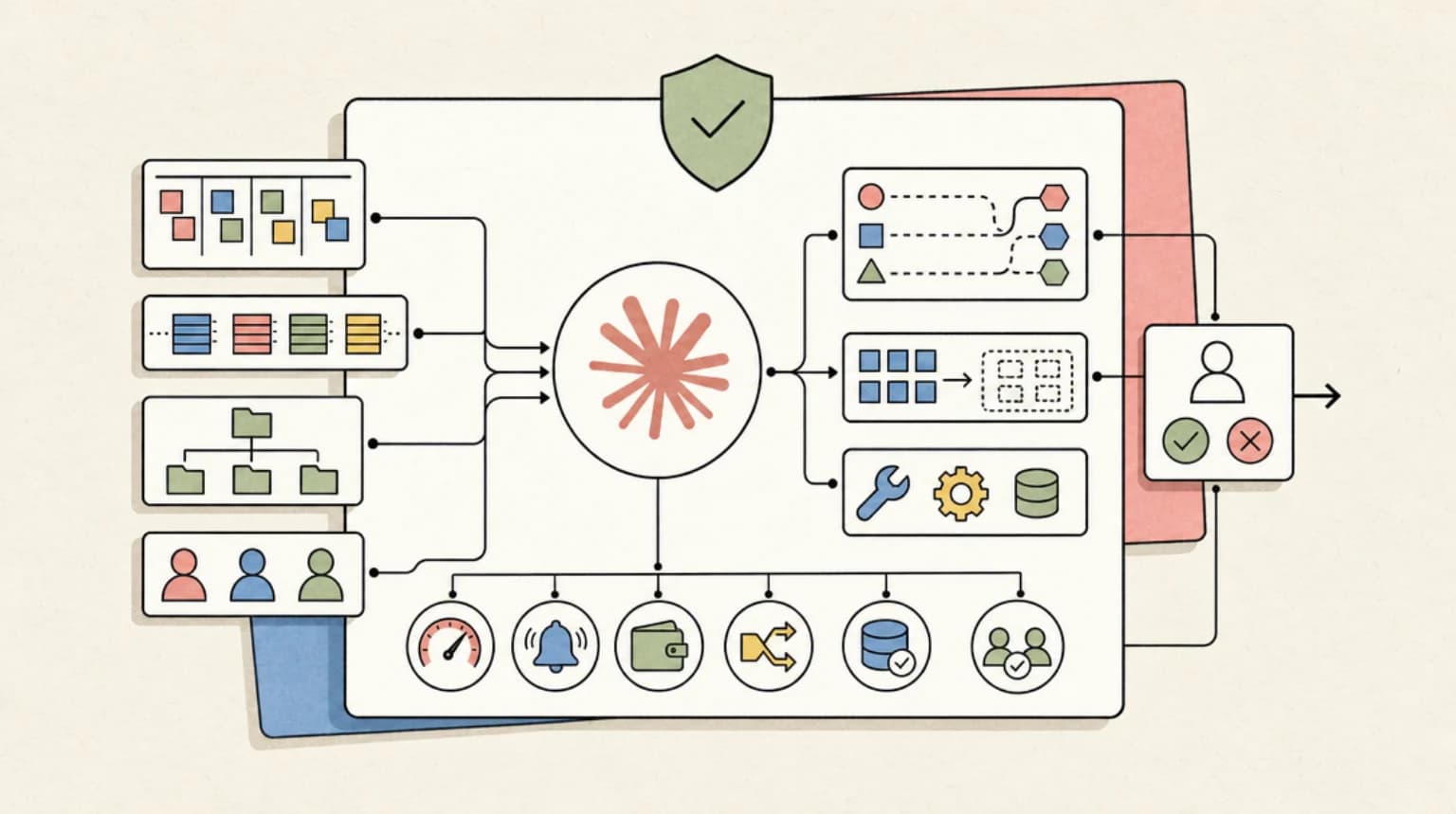
The goal is a system where a runaway month is structurally impossible, not merely discouraged. Work the layers from the outside in: hard caps first (they cannot be ignored), then alerts, then the optimizations that reduce the spend the caps are guarding.
1. Per-Seat and Usage Caps Come First#
A budget alert tells you the money is already gone. A cap stops it. Start with the hard limit and layer the soft signals on top, never the reverse - the $500M case is precisely what happens when there is no hard limit underneath.
- Set an explicit per-user monthly token or dollar ceiling. Uber's $1,500-per-tool allowance is a reasonable reference point for heavy agentic coders; calibrate to your own median active-day cost rather than copying the number. If you do not yet know your median, that is itself the first finding.
- Cap at the org boundary too. Per-seat limits do not protect you from a misconfigured agent loop on one account; a workspace-level monthly ceiling does.
- Prefer usage-based visibility over flat seats during any pilot. The Microsoft retreat happened because flat licensing hid the real number until the model changed. If you start usage-based, the cost is legible from week one.
2. Budget Alerts at Tiered Thresholds#
Caps are the floor; alerts are how you react before you hit them. Wire alerts at 50%, 80%, and 95% of each budget window, routed to a channel a human actually watches - not an inbox folder.
- Alert on rate of spend, not just cumulative total. A 3x day-over-day jump on a Tuesday is the early signal of a runaway agent; waiting for the 80% cumulative alert wastes the warning.
- Give every team its own budget envelope so one team's spike is visible against its own baseline instead of being averaged out across the org.
- Make at least one alert tier page someone. The difference between a $50K surprise and a $500M one is how fast a human sees the curve bend.
3. AI Gateway Spend Caps and Key Scoping#
If your team calls models through an AI gateway or proxy (LiteLLM, Cloudflare AI Gateway, OpenRouter, Portkey, or an internal one), that layer is where you enforce limits centrally instead of trusting every app to behave.
- Set hard spend caps per virtual key. Scope keys per team, per service, and per environment so a leaked or looping key has a bounded blast radius. A staging key that can spend production money is a $500M bill waiting for a bad deploy.
- Rate-limit at the gateway, not just the budget. Requests-per-minute and tokens-per-minute ceilings catch infinite loops the budget cap would only catch after the damage.
- Route all model traffic through the gateway so there is one chokepoint to instrument. Shadow direct-to-provider calls are exactly the spend you cannot see.
4. Route Cheap and Open Models for Routine Work#
Most of what an agentic workflow does does not need a frontier model. Classification, formatting, simple extraction, lint-style fixes, and first-draft boilerplate run fine on cheaper tiers or open-weights models at a fraction of the per-token cost - and the savings compound across millions of routine calls.
- Reserve the most capable model for the work that actually needs reasoning depth, and route the long tail of routine calls to a cheaper tier.
- Open-weights models have closed enough of the quality gap to be a serious cost lever for routine work. We ran the full math on this in GLM-5.2 Cost Math: When Open-Weights Coding Models Actually Save You Money - the headline is roughly one-sixth the per-token cost for tasks that clear the quality bar.
- The decision of when to use which model is becoming its own discipline. Our deep dive on the AI model routing and orchestration layer covers how to build that routing logic rather than hard-coding one model everywhere.
The point is not to use the cheapest model for everything - that just trades a money problem for a quality problem. It is to stop paying frontier prices for work a cheaper model does identically.
5. Prompt Caching for Repeated Context#
Agentic workflows resend the same large context - system prompts, tool definitions, codebase chunks, retrieved documents - on call after call. Prompt caching lets the provider reuse that prefix at a steep discount instead of charging full input rates every time, which is one of the highest-leverage optimizations available for agent-heavy workloads where the same context is read on every step.
- Structure prompts so the stable, reusable prefix comes first and the variable part comes last; only a stable prefix can be cached.
- This matters most exactly where bills explode: long-context agent loops that re-read the same files and instructions every turn.
- Treat caching as a default for any repeated-context workload, not a micro-optimization you get to later. (For provider-specific cache mechanics and pricing, check current docs - the discount structure changes.)
6. Observability: You Cannot Cap What You Cannot See#
Every control above depends on knowing where the money goes. Spend that is not attributable is spend you cannot govern.
- Tag every model call with team, user, service, and environment so the gateway dashboard answers "who spent this" without an investigation.
- Track cost per task or per workflow run, not just cost per token. A workflow that quietly grew from 3 model calls to 30 is invisible in the token total but obvious in cost-per-run.
- Review the spend curve on a fixed cadence. The $500M and Uber cases share a tell: nobody looked at the curve until it had already bent. A standing weekly five-minute review of the top spenders catches the bend while it is still cheap.
7. Approval Workflows for the Expensive Tail#
Most calls should flow freely - friction on routine work just trains people to route around your controls. Reserve gates for the genuinely expensive operations.
- Require approval for new high-volume integrations and batch jobs before they ship. The runaway-loop scenarios are almost always automated, not interactive.
- Default new keys and new services to conservative caps that a human raises on request, rather than generous caps a human has to remember to lower.
- Put a budget-impact line in the review checklist for any change that adds an automated model call in a loop. One sentence - "what is the worst-case spend if this runs unbounded" - would have caught all three cases above.
From the archive
Cohere's North Mini Code: A 30B Open-Weight Coding Model That Runs on One H100
Jun 17, 2026 • 7 min read
Cursor Origin: A Git Forge Built for AI Agents, Not Humans
Jun 17, 2026 • 8 min read
DeepSeek V4 Economics: The Cost-Quality Frontier for Agentic Coding in 2026
Jun 17, 2026 • 9 min read
Epic Games Releases Lore: A Version Control System Built for Game Development
Jun 17, 2026 • 7 min read
The Order of Operations Is the Whole Point#
Read the playbook back and the sequence is the lesson. Hard caps and key scoping make a $500M month structurally impossible. Tiered alerts and observability make a $50K surprise visible while it is still small. Routing, caching, and approval gates shrink the bill the caps are protecting, so you can set those caps generously enough that engineers never feel them.
That last part matters. The failure mode is not just overspending - it is overcorrecting into a regime so locked-down that people stop using the tool that was making them faster. Microsoft's retreat is the cautionary version of that. The goal is the Uber version instead: keep the tool, cap the blast radius, and let people work.
None of this is exotic. It is the same financial discipline every other major cost center in your company already has, applied to a line item that grew from a rounding error to a top-five expense in about two quarters. The companies that get burned are not reckless. They just instrumented the spend a quarter too late. The fix is to do it now, while your bill is still small enough that the playbook is cheap to install.
FAQ#
What is the first guardrail a team should put in place if they have none today?#
A hard spend cap at the account or key level, set before rollout rather than after a surprise invoice. Alerts and routing optimizations matter, but a cap is the only control that makes a runaway month structurally impossible rather than merely unlikely. See Anthropic's own rate limits and usage documentation for the mechanisms available on the API side.
Does usage-based billing mean flat per-seat licensing is always the wrong choice?#
Not always, but it hides the signal you need. Flat seats make budgeting predictable up front, at the cost of making token consumption invisible until a workflow's usage compounds well past what a seat price assumed. The Uber and Microsoft cases both show usage-based billing surfacing real per-engineer costs that flat pricing had been masking during the pilot phase.
How much can agentic workflows actually cost per engineer per month?#
The reported ranges in the Uber and Microsoft cases were roughly $500 to $2,000 per engineer per month once usage-based billing made the real consumption visible, though this depends heavily on how many parallel agent sessions and automated loops a given workflow runs. Treat any specific number as organization-dependent rather than a universal benchmark.
Should approval workflows slow down every model call?#
No. Reserve approval gates for the expensive tail, new high-volume integrations, batch jobs, and automated loops, rather than routine interactive use. Putting friction on every call just trains people to route around the controls, which defeats the purpose of having them.
Sources#
- Mystery company accidentally blew $500 million on Claude AI in a single month - Tom's Hardware
- Company accidentally spent $500 million on Claude AI in one month - Tech Startups
- Uber burned through its entire 2026 AI budget in four months - Fortune
- Uber Blew Through Its 2026 AI Budget in 4 Months - Now It's Capping Employee Use - Inc.
- Microsoft's quiet Claude Code retreat and the real cost of enterprise AI - The Next Web
- Anthropic says it hit a $30 billion revenue run rate after 'crazy' 80x growth - VentureBeat
Read next
What a Fleet of Claude Agents Actually Costs (July 2026 Math)
Claude Code parallel agents cost real money because every session draws from one quota - here is the July 2026 budgeting math, verified against live pricing.
10 min readEnterprise AI Coding Budget Blowouts: What Uber and Microsoft Teach Us
Uber burned through its entire 2026 AI tools budget by April. Microsoft is canceling Claude Code licenses company-wide. What enterprise teams can learn from the first major AI coding tool budget crises.
8 min readClaude Code Routines vs Managed Agents Schedules: Where Recurring Agent Work Should Live
Claude Code Routines and Managed Agents scheduled deployments both run Claude on a schedule - here is how the triggers, pricing, and limits differ, and which one fits your recurring agent work.
9 min readShare
Developers Digest
Technical content at the intersection of AI and development. Building with AI agents, Claude Code, and modern dev tools - then showing you exactly how it works.
300+ videos30K+ GitHub stars850+ articles
Related Tools
ProductivityNew
A
AgentCanvas
A hosted infinite canvas your headless AI agents drive over MCP. Any MCP-speaking agent - Claude Code, Codex, Cursor, or...
View ToolProductivity
C
Codeburn
Interactive TUI dashboard that shows exactly where your Claude Code and Cursor tokens are going, in real time.
View ToolAI Coding
C
Conductor
Mac app for running parallel Claude Code, Codex, and Cursor agents in isolated workspaces. Watch every agent work at onc...
View ToolRelated Guides
Guide
Agent Teams - Claude Code
Coordinate multiple Claude Code instances with a shared task list.
Claude CodeGuide
Subagent Definitions as Teammates - Claude Code
Reuse custom subagent types as Agent Teams members.
Claude CodeGuide
Terminal CLI - Claude Code
The primary command-line entry point for Claude Code sessions.
Claude CodeRelated Posts
10 min read
claude-code
What a Fleet of Claude Agents Actually Costs (July 2026 Math)
Claude Code parallel agents cost real money because every session draws from one quota - here is the July 2026 budgeting...
10 min read
pi
pi vs Claude Code vs OpenCode: Picking Your Agentic CLI
A decision-intent comparison of pi, Claude Code, OpenCode and Codex CLI as your main agentic coding harness in late 2026...

7 min read
composio
Composio CLI: Connect OpenClaw and Claude Code to 1,000+ Apps
A companion guide to the Composio CLI video: one command-line layer that lets Claude Code, OpenClaw, Codex, and other ag...
11 min read
claude-code
Claude Code Permissions: A Practical settings.json Guide for Allow, Deny, and Ask Rules
Stop the approval-fatigue prompts without going full YOLO mode. A hands-on guide to Claude Code's permission system - se...
8 min read
ai-agents
Omnigent: Databricks' Meta-Harness for Orchestrating Claude Code, Codex, and Custom Agents
Databricks open-sourced Omnigent, a meta-harness that sits above individual agent CLIs so your sessions, policies, and s...
8 min read
enterprise
Enterprise AI Coding Budget Blowouts: What Uber and Microsoft Teach Us
Uber burned through its entire 2026 AI tools budget by April. Microsoft is canceling Claude Code licenses company-wide....
Build with the member tools

Get Smarter About AI Dev
New tutorials, open-source projects, and deep dives on coding agents - delivered weekly.
One email per weekReal code, not theoryFree forever