Convex vs Supabase for AI Apps
TL;DR
Convex and Supabase both work for AI-powered apps.
I have shipped apps with both Convex and Supabase. The Developers Digest site runs on Convex. Several DD ecosystem apps use Supabase. Here is an honest comparison for AI-powered applications.
Last updated: July 31, 2026
What Changed on July 31, 2026#
- Supabase pricing was verified against the live pricing page today. The headline numbers are unchanged (Free, Pro at $25/mo, Team at $599/mo), but two details matter more than before: Pro and Team now include $10/month in compute credits (one Micro instance), and each additional project adds its own compute cost. Pro includes 8GB disk, 250GB egress, and 100K MAUs; Team adds SOC2 and ISO 27001.
- Convex pricing could not be re-verified today - the pricing page was unreachable from our refresh environment on July 31, 2026. The Convex rows below carry their previous verification date (May 6, 2026); check the live page before budgeting.
- Both platforms remain active: Supabase continues shipping Postgres-first AI features (pgvector, pipelines), and Convex keeps the reactive TypeScript runtime this post recommends for real-time UI.
- Model naming in the code examples below was updated to current APIs (
claude-sonnet-5).
Official Sources#
Always verify current features, pricing, and API changes against the official documentation:
| Platform | Documentation | GitHub | Changelog | Last verified |
|---|---|---|---|---|
| Convex | docs.convex.dev | get-convex/convex | Convex releases | May 6, 2026 |
| Supabase | supabase.com/docs | supabase/supabase | Supabase changelog | July 31, 2026 |
For pricing details, see Convex pricing and Supabase pricing.
Architecture Difference#
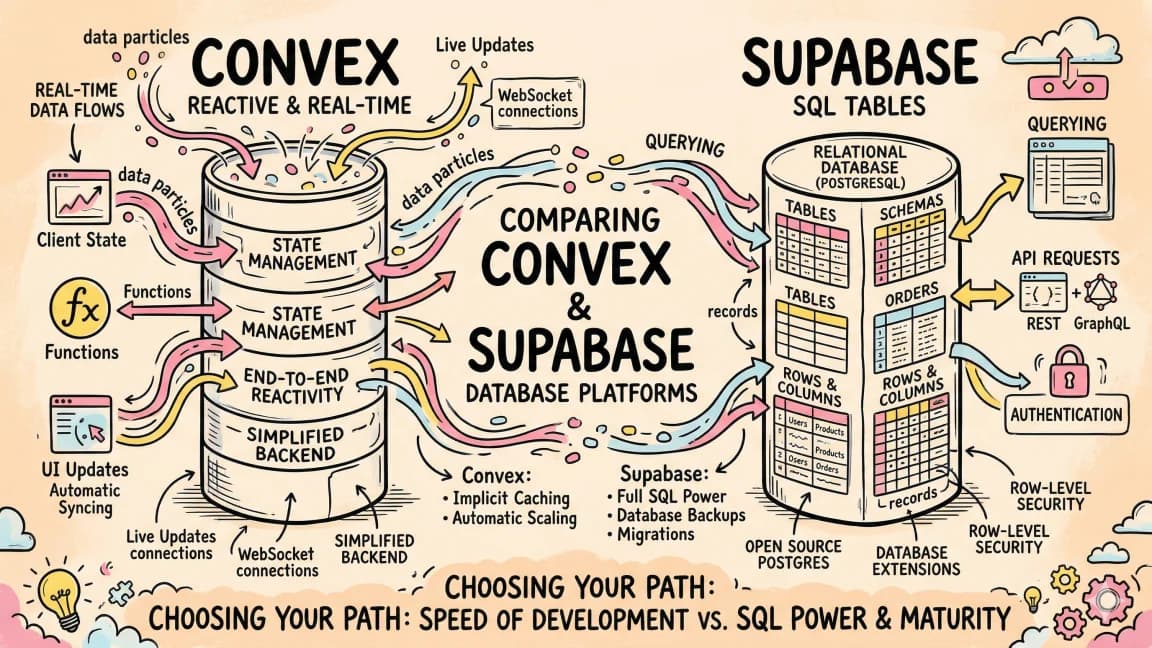
Supabase is a Postgres database with auth, storage, and edge functions bolted on. You write SQL, use the PostgREST API, or use the JavaScript client. Your data is relational.
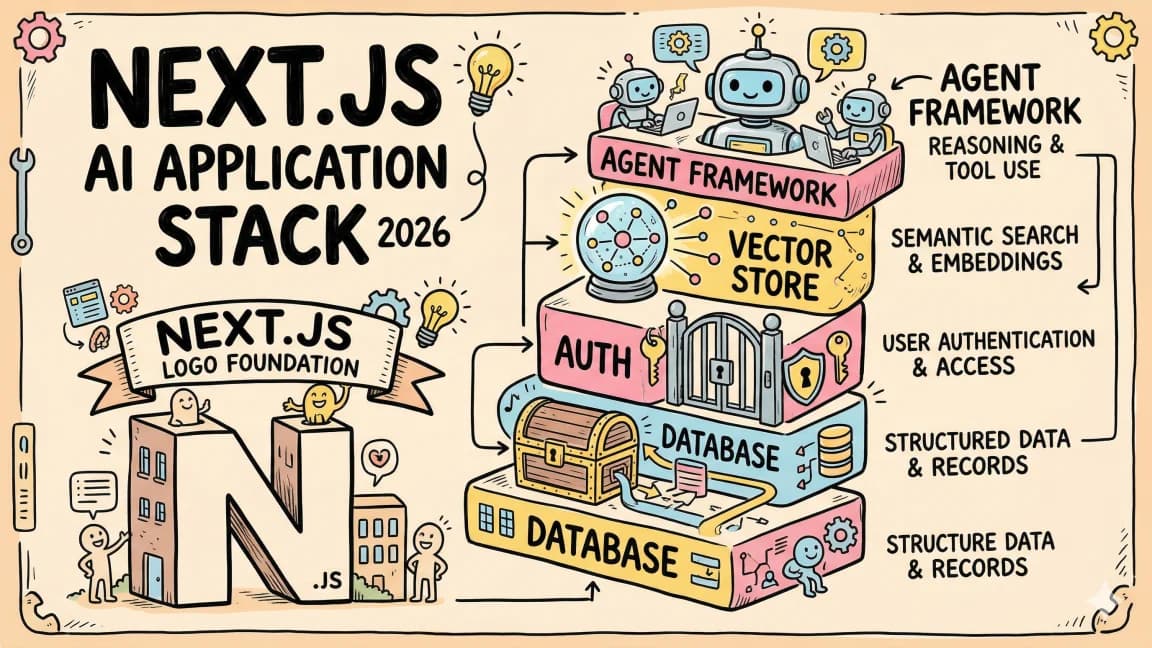
For broader context, pair this with How to Build Full-Stack TypeScript Apps With AI in 2026 and The Next.js AI App Stack for 2026; those companion pieces show where this fits in the wider AI developer workflow.
Convex is a reactive backend-as-a-service. You write TypeScript functions that run on Convex's infrastructure. Your data is document-based. Queries are reactive by default - when data changes, your UI updates automatically.
This is the core difference. Supabase gives you a database and lets you build everything else. Convex gives you a full backend runtime with the database included.
Real-Time for AI Features#
AI apps need real-time updates. Streaming responses, live collaboration, status indicators.
Convex wins here. Every query is reactive. When data changes, connected clients update automatically. No WebSocket setup, no subscription management, no polling.
// Convex: reactive by default
const messages = useQuery(api.messages.list, { chatId });
// UI re-renders automatically when any message changes
Supabase has real-time via Postgres changes, but you manage subscriptions manually.
// Supabase: manual subscription
const channel = supabase
  .channel("messages")
  .on("postgres_changes", { event: "*", schema: "public", table: "messages" }, (payload) => {
    setMessages((prev) => [...prev, payload.new]);
  })
  .subscribe();
For a chat interface with streaming AI responses, Convex's automatic reactivity saves significant code.
Server Functions for AI#
AI apps need server-side logic: calling APIs with secrets, processing results, chaining calls.
Convex actions are serverless functions that can call external APIs and are co-located with your schema.
// Convex action - calls AI API server-side
export const generateResponse = action({
  args: { prompt: v.string() },
  handler: async (ctx, { prompt }) => {
    const response = await anthropic.messages.create({
      model: "claude-sonnet-5",
      messages: [{ role: "user", content: prompt }],
    });
    await ctx.runMutation(api.messages.save, {
      content: response.content[0].text,
    });
  },
});
Supabase edge functions are Deno-based serverless functions deployed separately.
// Supabase edge function
Deno.serve(async (req) => {
  const { prompt } = await req.json();
  const response = await anthropic.messages.create({
    model: "claude-sonnet-5",
    messages: [{ role: "user", content: prompt }],
  });
  // Insert into database separately
  await supabase.from("messages").insert({ content: response.content[0].text });
  return new Response(JSON.stringify({ ok: true }));
});
Convex functions run in the same runtime as your database operations. Supabase edge functions are separate services that talk to your database over HTTP.
Cron Jobs for AI Workflows#
Both support scheduled functions. AI apps commonly need them for: processing queues, periodic summaries, content generation.
Convex cron jobs are defined in TypeScript alongside your functions.
// convex/crons.ts
const crons = cronJobs();
crons.interval("process-queue", { minutes: 5 }, api.ai.processQueue);
Supabase uses pg_cron or external schedulers. More setup, but you get full SQL access.
Type Safety#
Convex is fully typed. Schema defines types. Functions are typed. Client queries return typed data. End-to-end TypeScript with zero codegen friction.
Supabase generates types from your Postgres schema via CLI, but the chain can break. Schema changes require running supabase gen types again.
For AI apps that iterate fast, Convex's automatic type inference is a real productivity advantage.
Vector Search for RAG#
If your AI app needs retrieval-augmented generation (RAG), you need vector search.
Supabase has pgvector built in. Full-featured vector search with indexing, filtering, and similarity functions. Mature and battle-tested.
Convex has vector search support but it is newer and less feature-rich than pgvector.
For RAG-heavy applications, Supabase's pgvector is the stronger choice today.
When to Use Each#
Choose Convex when:
- Real-time UI is core (chat, collaboration, live dashboards)
- You want reactive queries without WebSocket management
- Your team is TypeScript-first
- You want server functions co-located with your schema
- You are building with Next.js and want the fastest integration
Choose Supabase when:
- You need relational data with complex queries
- Vector search (RAG) is a primary feature
- You want to use SQL directly
- You need row-level security for multi-tenant apps
- You want to self-host your backend
Choose both when:
- Convex for real-time features + Supabase for vector search/RAG
- This is a valid architecture that plays to each platform's strengths
Pricing#
Both have generous free tiers for getting started. See Convex pricing and Supabase pricing for current details. Supabase numbers below were verified July 31, 2026; Convex numbers were verified May 6, 2026 (pricing page unreachable at last refresh).
| Convex | Supabase | |
|---|---|---|
| Free tier | 1M function calls, 0.5GB database, 1GB file storage | 500MB database, 1GB file storage, 50K MAUs |
| Pro plan | $25/mo per developer | $25/mo (includes 100K MAUs, 8GB disk, 250GB egress, $10/mo compute credits) |
| Scale/Team | $2,500/mo minimum (Business) | $599/mo (Team, SOC2 + ISO 27001) |
| Compute | Included in plan | Billed per project; Micro $10/mo, Small $15/mo, up to 16XL $3,730/mo |
| Self-host | Yes (open source) | Yes |
Convex pricing is per-developer with pay-as-you-go usage. Supabase pricing is per-project: the plan covers platform features and quotas, while each project runs on its own compute instance billed separately. Both include compute credits that cover most small-to-medium workloads - on Supabase, Pro and Team include one Micro instance's worth.
Frequently Asked Questions#
Can I use Convex and Supabase together?#
Yes. Use Convex for real-time features and server functions, Supabase (with pgvector) for vector search and RAG. They complement each other well.
Which is better for a chat app with AI?#
Convex. The reactive queries mean your chat UI updates automatically when new messages arrive. Streaming AI responses integrate naturally with Convex mutations.
Which has better TypeScript support?#
Convex. Its type system is end-to-end - schema, functions, and client are all typed automatically. Supabase requires codegen and manual type maintenance.
Can I migrate from Supabase to Convex?#
Yes, but the data model changes (relational to document). Your application logic needs rewriting since Convex functions replace edge functions and API routes.
Which scales better for AI workloads?#
Both scale well. Supabase gives you more control over database optimization. Convex handles scaling automatically but you have less visibility into the infrastructure.
Continue Reading#
- Vector Database Comparison for RAG and Agents 2026 - pgvector and the alternatives, compared for retrieval workloads
- The Next.js AI App Stack for 2026 - how a backend choice fits the full AI app stack
- How to Build Full-Stack TypeScript Apps With AI in 2026 - end-to-end pattern with real-time backends
- MCP vs Function Calling - when your app should talk to tools instead of storing state
- What Is RAG? - retrieval-augmented generation basics before you pick a vector store
- Lovable: Building Full-Stack Web Apps with AI and Supabase
Get the next comparison like this in your inbox
One email a week on Convex and the rest of the AI dev stack. Free.
Read next
Vercel AI SDK: Build Streaming AI Apps in TypeScript
The AI SDK is the fastest way to add streaming AI responses to your Next.js app. Here is how to use it with Claude, GPT, and open source models.
5 min readHow to Build Full-Stack TypeScript Apps With AI in 2026
A practical guide to building Next.js apps using Claude Code, Cursor, and the modern TypeScript AI stack.
7 min readThe Next.js AI App Stack for 2026
The definitive full-stack setup for building AI-powered apps in 2026. Next.js 16, Vercel AI SDK, Convex, Clerk, and Tailwind - why each piece matters and how they fit together.
12 min readNew here? Start with
Technical content at the intersection of AI and development. Building with AI agents, Claude Code, and modern dev tools - then showing you exactly how it works.