NVIDIA Nemotron 3 Super: A Developer's Guide to the 120B Hybrid MoE
Prefer video? Watch the full tutorial with code walkthroughs.
Watch VideoTL;DR
A practical walkthrough of Nemotron 3 Super: latent mixture of experts, hybrid Mamba transformer architecture, 1M context, reasoning modes, and the code you actually need to run it on NVIDIA hardware.
What Nemotron 3 Super Actually Is#
NVIDIA shipped Nemotron 3 Super on March 11. The headline number is 120 billion total parameters with 12 billion active per token, but the parameter count is the least interesting thing about this release. What matters for anyone building on top of it is the architecture, the reasoning controls, and the fact that NVIDIA published the full training pipeline alongside the weights.
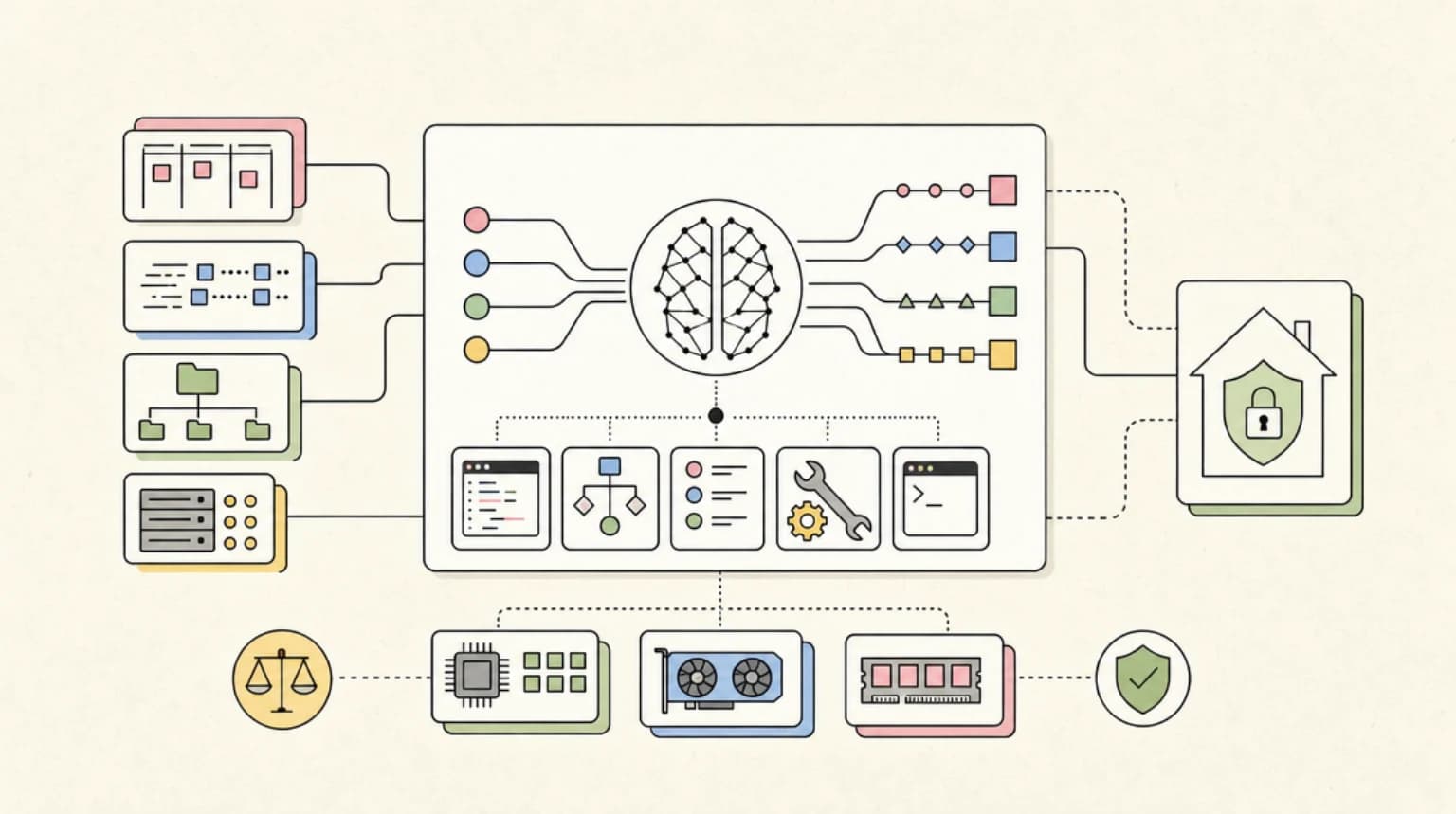
The model is a Latent Mixture of Experts Hybrid Mamba Transformer. Four words doing a lot of work. Each one corresponds to a real architectural decision that affects how you serve the model, how much it costs to run, and which workloads it handles well. This post walks through the pieces, then shows the code you need to actually use it.
For the visual breakdown of the announcement and a live demo, watch the companion video on the channel. Everything below is the practitioner's version.
The Architecture, Decoded#
Standard mixture of experts routes raw token embeddings to a small subset of expert feedforward networks. You save compute because only a fraction of the experts fire per token. The cost is memory bandwidth: every active expert still needs its weights resident on the device.
Latent MoE compresses tokens into a lower dimensional latent representation before routing. Experts then operate on the compressed view. The compression frees enough budget that NVIDIA can fit roughly 4x more experts at the same compute cost. More experts means more specialization, which translates to better performance on niche tasks (code in unusual languages, math at the edges of training data, multi-step planning) without the inference bill that a dense 120B model would carry.
The hybrid part is Mamba. Transformer attention layers handle reasoning steps that benefit from arbitrary token-to-token routing. Mamba state space layers handle the long stretches of sequence where attention's quadratic cost would dominate. The result is a model that uses the full 1 million token context window without falling over. NVIDIA reports 4x higher KV cache plus SSM cache utilization compared to a pure transformer at the same sequence length.
Multi-token prediction is the third lever. The model predicts multiple future tokens per forward pass instead of one. In practice this gives roughly 3x tokens per step at inference time when the speculative predictions hit. Combined with NVFP4 pretraining (4 bit floating point during training, which roughly doubles training throughput vs FP8), you get a model that is both cheaper to train and cheaper to serve than its parameter count would suggest.
Hardware Requirements#
The model is sized to fit comfortably on a single H100 node or a workstation with two or three high memory consumer cards once quantized. Concrete starting points:
- Full precision serving: 8x H100 80GB. Recommended for production multi-tenant inference where throughput matters and you want headroom for the 1M context.
- Single node serving: 4x H100 80GB or 2x H200 141GB. Works for most teams. KV cache plus SSM cache fits with margin.
- Workstation, FP4 quantized: A pair of RTX 6000 Ada cards (48GB each), or a DGX Spark. This is the dev box configuration. Speeds are lower but the model loads end to end with reasoning enabled.
- Single GPU, heavy quantization: Possible on an 80GB H100 with INT4 plus expert offloading, but expect significant throughput penalties. Prototype only.
If you are evaluating before committing to infrastructure, NVIDIA NIM exposes the model via an OpenAI compatible API at no charge for moderate volumes. Use that for the first round of validation.
Calling the Model: NIM via OpenAI SDK#
The simplest path is the hosted endpoint. Nemotron 3 Super on NVIDIA NIM speaks the OpenAI chat completions protocol, so any existing client works.
Python
from openai import OpenAI

client = OpenAI(
    base_url="https://integrate.api.nvidia.com/v1",
    api_key="nvapi-your-key-here",
)

response = client.chat.completions.create(
    model="nvidia/nemotron-3-super-120b-a12b",
    messages=[
        {"role": "system", "content": "You are a careful code reviewer."},
        {"role": "user", "content": "Refactor this Python function for clarity: ..."},
    ],
    temperature=1.0,
    top_p=0.95,
    max_tokens=2048,
    extra_body={
        "enable_thinking": True,
    },
)

print(response.choices[0].message.content)
The recommended sampling settings (temperature 1.0, top_p 0.95) come straight from the model card. Both reasoning on and reasoning off use the same sampler. The extra_body dict carries Nemotron specific flags through the OpenAI client.
Reasoning Modes#
Nemotron 3 Super exposes three reasoning controls. Pick the one that matches the workload:
| Flag | Behavior | When to use |
|---|---|---|
enable_thinking: True | Full chain of thought before answering | Multi step reasoning, agentic tool use, hard math, tricky code refactors |
enable_thinking: False | Direct answer, no visible thinking trace | Chat, summarization, classification, anything latency sensitive |
low_effort: True | Reduced reasoning tokens, faster | Light reasoning where you still want some deliberation |
reasoning_budget: <int> | Hard cap on reasoning tokens | Cost control in production, prevent runaway thinking |
The reasoning budget is the most useful flag once you ship to production. Without it, a hard prompt can spend 8000+ tokens deliberating before producing the answer. With reasoning_budget: 1024 you cap the thinking phase and force the model to commit. Tune the cap per workload.
Self Hosting with Transformers#
For teams that want the weights local, Hugging Face hosts the model under nvidia/NVIDIA-Nemotron-3-Super-120B-A12B-BF16, with FP8 and NVFP4 variants alongside it. The custom Mamba and latent MoE layers ship in the model repo, so you need trust_remote_code=True on load.
Python
import torch
from transformers import AutoModelForCausalLM, AutoTokenizer

model_id = "nvidia/NVIDIA-Nemotron-3-Super-120B-A12B-BF16"

tokenizer = AutoTokenizer.from_pretrained(model_id)
model = AutoModelForCausalLM.from_pretrained(
    model_id,
    torch_dtype=torch.bfloat16,
    device_map="auto",
    trust_remote_code=True,
)

messages = [
    {"role": "system", "content": "You are a precise SQL assistant."},
    {"role": "user", "content": "Write a query that returns daily active users for the last 30 days from a table called events(user_id, ts)."},
]

inputs = tokenizer.apply_chat_template(
    messages,
    add_generation_prompt=True,
    return_tensors="pt",
    enable_thinking=True,
).to(model.device)

with torch.inference_mode():
    output = model.generate(
        inputs,
        max_new_tokens=1024,
        temperature=1.0,
        top_p=0.95,
        do_sample=True,
    )

print(tokenizer.decode(output[0][inputs.shape[-1]:], skip_special_tokens=True))
apply_chat_template is the right entry point. It wires the reasoning flag into the prompt template so the model sees the correct control tokens. Skipping the template and concatenating strings by hand is a common source of degraded outputs.
Production Serving with Triton and TensorRT LLM#
For real deployments, the Hugging Face path is a starting point, not a destination. NVIDIA's serving stack for Nemotron 3 Super is Triton Inference Server with the TensorRT LLM backend. The conversion path looks like this:
Terminal
# 1. Pull weights
huggingface-cli download nvidia/NVIDIA-Nemotron-3-Super-120B-A12B-BF16 \
    --local-dir ./nemotron-3-super

# 2. Build a TensorRT LLM engine
python -m tensorrt_llm.commands.build \
    --checkpoint_dir ./nemotron-3-super \
    --output_dir ./engines/nemotron-3-super-bf16 \
    --gemm_plugin bfloat16 \
    --max_input_len 131072 \
    --max_seq_len 1048576 \
    --max_batch_size 8 \
    --tp_size 8

# 3. Stage in the Triton model repository
mkdir -p model_repo/nemotron-3-super/1
cp -r engines/nemotron-3-super-bf16/* model_repo/nemotron-3-super/1/

# 4. Launch Triton
tritonserver --model-repository=model_repo \
    --http-port=8000 \
    --grpc-port=8001 \
    --metrics-port=8002
Two flags matter most. --max_seq_len 1048576 tells the engine to allocate KV plus SSM cache for the full 1M context. If you only ever need 128k, drop this and you reclaim significant memory. --tp_size 8 matches an 8 GPU H100 node. For 4x H200 use --tp_size 4 with FP8 quantization to fit.
Once Triton is up, the Python client looks like any other Triton call:
Python
import tritonclient.http as httpclient
import numpy as np

client = httpclient.InferenceServerClient(url="localhost:8000")

prompt = "Explain the difference between Mamba and standard attention in three sentences."
inputs = [
    httpclient.InferInput("text_input", [1, 1], "BYTES"),
    httpclient.InferInput("max_tokens", [1, 1], "INT32"),
    httpclient.InferInput("temperature", [1, 1], "FP32"),
]
inputs[0].set_data_from_numpy(np.array([[prompt]], dtype=object))
inputs[1].set_data_from_numpy(np.array([[512]], dtype=np.int32))
inputs[2].set_data_from_numpy(np.array([[1.0]], dtype=np.float32))

result = client.infer(model_name="nemotron-3-super", inputs=inputs)
print(result.as_numpy("text_output")[0][0].decode("utf-8"))
For continuous batching, dynamic reasoning budgets, and streaming, use the TensorRT LLM in flight batching backend rather than the simple ensemble shown above. The model card includes a reference Triton config that handles all of this.
From the archive
Open-Source MCP Servers Worth Installing in 2026
Apr 29, 2026 • 12 min read
OpenAI AgentKit in Production: An Honest Builder's Review
Apr 29, 2026 • 11 min read
OpenAI Privacy Filter: Production PII Redaction Guide
Apr 29, 2026 • 10 min read
Assistants to Responses API: A Migration Field Guide
Apr 29, 2026 • 13 min read
Benchmarks Worth Quoting#
NVIDIA published numbers across the standard reasoning and coding suites. The ones that matter for evaluation:
- MMLU Pro: Competitive with the leading sub 250B open weight models, with a meaningful jump in reasoning on mode.
- LiveCodeBench: Strong on the coding subset, helped by the 10 billion token reasoning and coding pre-training corpus.
- SWE Bench Verified: This is where the NeMo RL Gym training shows up. NVIDIA reports roughly 2x intelligence index over the previous Nemotron generation on agent style tasks.
- Long context retrieval: Maintains accuracy across the full 1M window, which is the entire point of the hybrid Mamba design.
Benchmarks are vibes. Run your own evals on your own workload before committing.
When to Pick This Over the Alternatives#
Nemotron 3 Super is the right call when:
- You are already on NVIDIA hardware and want a model that is tuned for that stack end to end (NVFP4, TensorRT LLM, NIM).
- You need a long context window that actually works rather than one that nominally exists but degrades after 200k tokens.
- You want commercial use rights without negotiating a license.
- Your workload mixes reasoning heavy and latency sensitive requests, and you want one model that can switch modes per request.
It is the wrong call when you need a tiny model for edge inference (look at Nemotron Nano 9B V2 instead), when you need vision (try Nemotron Nano 2 VL), or when you are vendor agnostic and your stack lives on AMD or Apple Silicon.
Where the Family Goes Next#
Nemotron 3 ships in three sizes. Nano (30B with 3B active) is shipping. Super (120B with 12B active) is the focus of this post. Ultra (550B with 55B active) shipped on June 4, 2026. The architecture story is consistent across the three: same latent MoE, same hybrid Mamba, same reasoning controls, scaled across the size envelope. If Super clears the bar for your use case, Ultra is the same playbook at frontier scale.
Try It#
The fastest path to a working call is NIM. Grab a key, paste the OpenAI client snippet from above, and you have a reasoning capable model behind a familiar API in five minutes. From there, the Hugging Face checkpoint and the Triton path are both well worn.
For the visual walk through, the architecture diagrams, and a side by side latency demo with reasoning on and off, watch the Nemotron 3 Super video. For more on the family, see the Nemotron Nano 9B V2 deep dive and the Nano 2 VL post.
FAQ#
What hardware do I need to run Nemotron 3 Super?#
Full precision serving requires 8x H100 80GB GPUs. Single node serving works on 4x H100 80GB or 2x H200 141GB. For workstation use with FP4 quantization, a pair of RTX 6000 Ada cards (48GB each) or a DGX Spark handles the model. Single GPU on an 80GB H100 with INT4 plus expert offloading is possible but with significant throughput penalties - prototype only. NVIDIA NIM also offers hosted inference at no charge for moderate volumes if you want to evaluate before committing to hardware.
What is Latent Mixture of Experts and why does it matter?#
Standard mixture of experts routes raw token embeddings to a subset of expert feedforward networks. Latent MoE compresses tokens into a lower dimensional latent representation before routing, then experts operate on the compressed view. This compression frees enough budget for roughly 4x more experts at the same compute cost. More experts means better specialization on niche tasks like code in unusual languages, edge-case math, and multi-step planning - without the inference bill a dense 120B model would carry.
How is Nemotron 3 Super different from a pure transformer?#
Nemotron 3 Super is a hybrid Mamba transformer. Transformer attention layers handle reasoning steps that benefit from arbitrary token-to-token routing, while Mamba state space layers handle long stretches of sequence where attention's quadratic cost would dominate. The result is a model that uses the full 1 million token context window without falling over. NVIDIA reports 4x higher KV cache plus SSM cache utilization compared to a pure transformer at the same sequence length.
What reasoning modes does Nemotron 3 Super support?#
The model exposes four reasoning controls: enable_thinking: True for full chain of thought before answering (best for multi-step reasoning, agentic tool use, hard math, tricky code refactors), enable_thinking: False for direct answers without visible thinking (best for chat, summarization, classification), low_effort: True for reduced reasoning tokens with faster latency, and reasoning_budget: <int> for hard caps on reasoning tokens in production to prevent runaway thinking and control costs.
Can I use Nemotron 3 Super commercially?#
Yes. NVIDIA released Nemotron 3 Super under the NVIDIA Nemotron Open Model License, which permits commercial use without negotiating a separate license. This is one of the key differentiators from some other open weights models that restrict commercial deployment.
How do I deploy Nemotron 3 Super in production?#
For production deployments, use Triton Inference Server with the TensorRT LLM backend. The process involves downloading weights from Hugging Face, building a TensorRT LLM engine with appropriate settings (max sequence length, tensor parallelism matching your GPU count), staging in the Triton model repository, and launching Triton. For continuous batching, dynamic reasoning budgets, and streaming, use the TensorRT LLM in-flight batching backend.
How does Nemotron 3 Super compare to other open models on benchmarks?#
NVIDIA reports competitive performance on MMLU Pro among sub-250B open weight models, with meaningful improvements when reasoning mode is enabled. On LiveCodeBench it shows strong coding performance, helped by the 10 billion token reasoning and coding pre-training corpus. SWE Bench Verified shows roughly 2x intelligence index over the previous Nemotron generation on agent-style tasks. Long context retrieval maintains accuracy across the full 1M window.
When should I choose Nemotron 3 Super over alternatives?#
Choose Nemotron 3 Super when you are already on NVIDIA hardware and want a model tuned end-to-end for that stack (NVFP4, TensorRT LLM, NIM), when you need a 1 million token context window that actually works rather than one that degrades after 200k tokens, when you need commercial use rights without negotiating a license, or when your workload mixes reasoning-heavy and latency-sensitive requests and you want one model that can switch modes per request. Look elsewhere if you need tiny edge inference (use Nemotron Nano), vision capabilities (use Nemotron Nano 2 VL), or if your stack runs on AMD or Apple Silicon.
Official Sources#
| Resource | Link |
|---|---|
| Nemotron 3 Super Model Card | huggingface.co/nvidia/NVIDIA-Nemotron-3-Super-120B-A12B-BF16 |
| NVIDIA NIM API | build.nvidia.com/nvidia/nemotron-3-super-120b-a12b |
| TensorRT LLM Documentation | github.com/NVIDIA/TensorRT-LLM |
| Triton Inference Server | github.com/triton-inference-server |
| NVIDIA AI Blog | developer.nvidia.com/blog |
| NVIDIA Nemotron Open Model License | nvidia.com/en-us/agreements/enterprise-software/nvidia-nemotron-open-model-license |
Continue Reading#
Read next
NVIDIA Nemotron Nano 9B V2: Local AI That Punches Up
NVIDIA's Nemotron Nano 9B V2 delivers something rare: a small language model that doesn't trade capability for speed. This 9B parameter model outperforms Qwen 3B across instruction following, math,...
7 min readNVIDIA Nemotron Nano 2 VL: Open Source Vision-Language Model
NVIDIA's Nemotron Nano 2 VL delivers vision-language capabilities at a fraction of the computational cost. This 12-billion-parameter open-source model processes videos, analyzes documents, and reas...
5 min readNVIDIA's Nemotron 3 Super in 6 Minutes
NVIDIA's Nemotron 3 Super combines latent mixture of experts with hybrid Mamba architecture - 120B total parameters, 12B active per token, 1M context, and up to 4x more experts at the same cost.
5 min readShare
Developers Digest
Technical content at the intersection of AI and development. Building with AI agents, Claude Code, and modern dev tools - then showing you exactly how it works.
300+ videos30K+ GitHub stars850+ articles
Related Tools
AI Models

Qwen3-Coder
Alibaba's flagship open-weight coding model. 480B total parameters, 35B active (MoE). Native 256K context, scales to 1M....
View ToolAI ModelsOpen weights

DeepSeek V4
DeepSeek's open-weights frontier family, previewed April 24, 2026. V4-Pro is 1.6T total / 49B active params; V4-Flash is...
View ToolRelated Guides
Guide
Claude Code Setup Guide
Configure Claude Code for maximum productivity -- CLAUDE.md, sub-agents, MCP servers, and autonomous workflows.
AI AgentsGuide
Run AI Models Locally with Ollama and LM Studio
Install Ollama and LM Studio, pull your first model, and run AI locally for coding, chat, and automation - with zero cloud dependency.
Getting StartedGuide
Building Your First MCP Server
Step-by-step guide to building an MCP server in TypeScript - from project setup to tool definitions, resource handling, testing, and deployment.
AI AgentsRelated Videos
NVIDIA's NEW Open Source Nemotron Nano 2 VL Model in 5 Minutes
NVIDIA just released Nemotron Nano 2 VL - an open-source vision language model that's 4x more efficient than previous models. In this video, I break down what makes this 12-billion parameter...
Video·
NVIDIA's NEW Nemotron 3 Super in 6 Minutes
NVIDIA Nemotron 3 Super: Latent MoE + Hybrid Mamba, 1M Context, Faster Inference NVIDIA released Nemotron 3 Super, a new mixture-of-experts model with a new architecture combining latent mixture of e
Video·
NVIDIA's Llama Nemotron Nano 8B Vision Language Model
Check out NVIDIA's Llama Nemotron Nano 8B Vision Language Model here; https://nvda.ws/3HApYJ6 Exploring NVIDIA's Llama Nemotron Nano Vision Language Model: Benchmarks and Use Cases In this...
Video·
Related Posts

7 min read
NVIDIA
NVIDIA Nemotron Nano 9B V2: Local AI That Punches Up
NVIDIA's Nemotron Nano 9B V2 delivers something rare: a small language model that doesn't trade capability for speed. Th...

5 min read
NVIDIA
NVIDIA Nemotron Nano 2 VL: Open Source Vision-Language Model
NVIDIA's Nemotron Nano 2 VL delivers vision-language capabilities at a fraction of the computational cost. This 12-billi...

5 min read
NVIDIA
NVIDIA's Nemotron 3 Super in 6 Minutes
NVIDIA's Nemotron 3 Super combines latent mixture of experts with hybrid Mamba architecture - 120B total parameters, 12B...
6 min read
News
Tencent Hy3: A 295B Open MoE That Punches Above Its Weight
Tencent's Hy3 ships 295B parameters but activates only 21B per token, matching flagship performance at flash-tier pricin...
9 min read
Tencent
Tencent Hy4 Preview: 770B Open MoE, Agentic Benchmarks, and Where It Fits in 2026
Tencent's Hy4 preview ships 770B total parameters with 49B active under Apache 2.0 - a 1M-context text MoE with DeepSeek...
7 min read
News
LFM2.5-VL-3B: Liquid AI's 3B Vision Model Reads Screens, Grounds Objects, and Calls Tools on a Laptop
Liquid AI released LFM2.5-VL-3B on August 12, 2026: a 3.1B open-weights vision-language model that averages 80.7 on Scre...
Build with the member tools

Get Smarter About AI Dev
New tutorials, open-source projects, and deep dives on coding agents - delivered weekly.
One email per weekReal code, not theoryFree forever