NVIDIA Nemotron Nano 2 VL: Open Source Vision-Language Model
TL;DR
NVIDIA Nemotron Nano 2 VL is a 12B open vision-language model with a hybrid transformer-mamba design. What it does for documents and video, and its limits.
Last updated: June 6, 2026
| Official Sources | |
|---|---|
| NVIDIA Nemotron Models | Official Nemotron model overview and access |
| HuggingFace Nemotron Collection | Model weights and deployment documentation |
| NVIDIA Build | API playground and managed inference |
| NVIDIA AI Enterprise | Enterprise deployment and support |
| Mamba Architecture Paper | State space model architecture reference |
| NVIDIA Technical Blog | Architecture deep dives and benchmarks |
Overview#
NVIDIA's Nemotron Nano 2 VL delivers vision-language capabilities at a fraction of the computational cost. This 12-billion-parameter open-source model processes videos, analyzes documents, and reasons through visual problems while consuming 4x fewer tokens than comparable architectures. The model ships with practical toggles for reasoning modes and handles everything from invoice parsing to multi-image question answering.
For model-selection context, compare this with Claude vs GPT for Coding: Which Model Writes Better TypeScript? and OpenAI vs Anthropic in 2026 - Models, Tools, and Developer Experience; the useful question is not only benchmark quality, but where the model fits in a real developer workflow.
Hybrid Architecture for Speed and Accuracy#
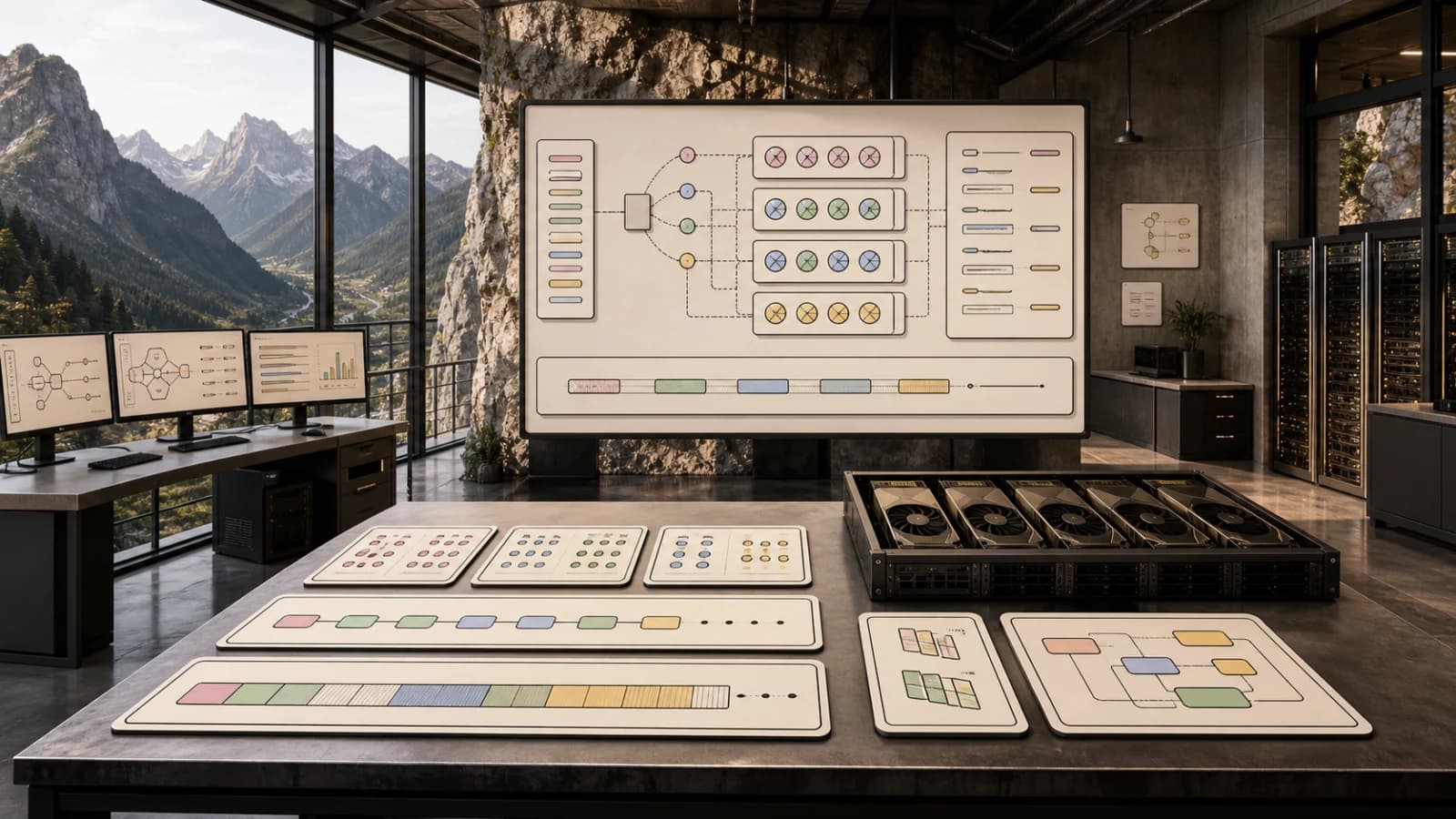
The efficiency gains stem from two core innovations. First, efficient video sampling reduces token usage by 4x, allowing longer video sequences to fit within standard context windows. Second, the hybrid transformer-mamba architecture addresses the fundamental trade-off between comprehension and speed.
Transformers excel at contextual understanding but slow down with long sequences. Mamba architectures process sequences rapidly but can miss subtle nuances. Nemotron Nano 2 VL combines both: transformers handle the heavy reasoning tasks while mamba layers manage the extended token sequences that video and multi-image inputs generate. The result is a model that maintains accuracy without the latency penalties typical of vision-language systems.
The Nemotron Ecosystem#
Nemotron Nano 2 VL joins NVIDIA's broader family of open-weight models spanning from edge-compatible nano variants to 235-billion-parameter ultra configurations. Unlike many labs that release weights alone, NVIDIA publishes training methodologies, compute budgets, token counts, and research papers under permissive licenses.
This approach mirrors Apple's vertical integration strategy. NVIDIA designs both the silicon and the models, allowing architectural decisions that exploit specific hardware capabilities. The hardware and research teams collaborate directly, producing optimizations that general-purpose labs cannot easily replicate.
Performance Benchmarks#
The model achieves best-in-class results on OCR and chart-reasoning tasks. Across standard vision-language benchmarks, Nemotron Nano 2 VL outperforms its predecessor, Nemotron Nano VL, on every metric NVIDIA reported. The critical distinction is that these gains come without the expected computational cost. Speed improves substantially while maintaining or exceeding the previous generation's accuracy.
Use Cases#
Document processing represents the most immediate application. The model extracts insights from invoices, contracts, and medical records, producing structured summaries from unstructured scans. Multi-image reasoning enables comparative analysis across visual datasets. Dense video captioning generates timestamped descriptions of long-form content.
The toggleable reasoning mode adds flexibility. Users can disable reasoning chains for latency-sensitive applications or enable them when accuracy matters more than speed.
Video Analysis in Practice#
A practical demonstration showcases the model's video capabilities. The workflow downloads YouTube content and feeds frames and audio into Nemotron Nano 2 VL as a unified payload. The model processes both visual elements and spoken dialogue simultaneously.
In one example, a five-minute technical video generates a five-bullet summary capturing key points from both the visuals and narration. Follow-up queries about specific segments, such as asking how to improve an introduction, receive contextual answers referencing both the visual presentation and spoken content.
The primary constraint is token limits. Users must trim videos to fit within the model's context window rather than processing full-length content in single passes.
Availability#
Nemotron Nano 2 VL is available now with open weights. NVIDIA provides accompanying documentation, training details, and sample applications for developers building document parsers, video analyzers, and multi-modal reasoning systems.
FAQ#
What is Nemotron Nano 2 VL?#
Nemotron Nano 2 VL is NVIDIA's 12-billion-parameter open-source vision-language model. It processes videos, analyzes documents, and reasons through visual problems while consuming 4x fewer tokens than comparable architectures. The model combines a hybrid transformer-mamba architecture for both speed and accuracy on multimodal inputs.
How does the hybrid transformer-mamba architecture work?#
The architecture addresses the fundamental trade-off between comprehension and speed. Transformers excel at contextual understanding but slow down with long sequences. Mamba architectures process sequences rapidly but can miss subtle nuances. Nemotron Nano 2 VL combines both: transformers handle heavy reasoning tasks while mamba layers manage the extended token sequences that video and multi-image inputs generate.
What makes the video sampling efficient?#
Nemotron Nano 2 VL uses efficient video sampling that reduces token usage by 4x compared to standard approaches. This allows longer video sequences to fit within standard context windows. The result is practical video analysis without hitting token limits as quickly, though users still need to trim very long videos to fit within the model's context constraints.
What are the main use cases for Nemotron Nano 2 VL?#
Document processing is the most immediate application - the model extracts insights from invoices, contracts, and medical records, producing structured summaries from unstructured scans. Multi-image reasoning enables comparative analysis across visual datasets. Dense video captioning generates timestamped descriptions of long-form content. The model can also analyze YouTube videos by processing both visual elements and spoken dialogue simultaneously.
Can I toggle reasoning mode on and off?#
Yes. Nemotron Nano 2 VL includes a toggleable reasoning mode. Users can disable reasoning chains for latency-sensitive applications where speed matters most, or enable them when accuracy takes priority over response time. This flexibility lets you match the model's behavior to your specific workload requirements.
Is Nemotron Nano 2 VL open source?#
Yes. NVIDIA provides open weights, accompanying documentation, training details, and sample applications. The permissive licensing allows developers to build document parsers, video analyzers, and multimodal reasoning systems. NVIDIA publishes training methodologies, compute budgets, token counts, and research papers alongside the model release.
How does it compare to other vision-language models?#
Nemotron Nano 2 VL achieves best-in-class results on OCR and chart-reasoning tasks within its parameter class. Across standard vision-language benchmarks, it outperforms its predecessor Nemotron Nano VL on every metric NVIDIA reported. The key advantage is that these gains come without the expected computational cost - speed improves while maintaining or exceeding previous accuracy levels.
What are the primary limitations?#
The main constraint is token limits. Users must trim videos to fit within the model's context window rather than processing full-length content in single passes. While the 4x token efficiency helps, very long videos still require segmentation. Hardware requirements for self-hosting a 12B parameter vision-language model are also non-trivial, though NVIDIA provides managed inference options.
Watch the Video#
Continue Reading#
- LFM2.5-VL-3B: Liquid AI''s 3B Vision Model Reads Screens, Grounds Objects, and Calls Tools on a Laptop
- NVIDIA's Nemotron 3 Super in 6 Minutes
- NVIDIA Nemotron 3 Super: A Developer's Guide to the 120B Hybrid MoE
- NVIDIA Nemotron Nano 9B V2: Local AI That Punches Up
Sources#
Get the next deep dive like this in your inbox
One email a week on NVIDIA and the rest of the AI dev stack. Free.
Read next
NVIDIA Nemotron Nano 9B V2: Local AI That Punches Up
NVIDIA Nemotron Nano 9B V2 is a hybrid Mamba-transformer small model that runs on consumer GPUs. See how its reasoning controls, open data and tool use work.
7 min readNVIDIA's Nemotron 3 Super in 6 Minutes
NVIDIA Nemotron 3 Super combines latent mixture of experts with hybrid Mamba layers - 120B total parameters, 12B active per token, 1M context and open weights.
5 min readTransformers.js: Run AI Models Directly in the Browser
Transformers.js lets you run machine learning models in the browser with zero backend. Here is how to use it for text generation, speech recognition, image classification, and semantic search.
7 min readNew here? Start with
Technical content at the intersection of AI and development. Building with AI agents, Claude Code, and modern dev tools - then showing you exactly how it works.