OpenAI vs Anthropic in 2026 - Models, Tools, and Developer Experience
TL;DR
A developer's comparison of OpenAI and Anthropic ecosystems - models, coding tools, APIs, pricing, and which to choose for different use cases.
Direct answer
OpenAI vs Anthropic in 2026 - Models, Tools, and Developer Experience
A developer's comparison of OpenAI and Anthropic ecosystems - models, coding tools, APIs, pricing, and which to choose for different use cases.
Best for
Developers comparing real tool tradeoffs before choosing a stack.
Covers
Verdict, tradeoffs, pricing signals, workflow fit, and related alternatives.
This is no longer a model comparison. OpenAI and Anthropic are building full developer ecosystems: models, APIs, coding agents, SDKs, and consumer products. Choosing between them in 2026 means choosing between two different philosophies for how AI should integrate into your development workflow.
Here is how they compare across every dimension that matters for working developers.
Official Sources#
Always verify current pricing and features against the official documentation:
| Company | Documentation | Pricing | Models |
|---|---|---|---|
| Anthropic | docs.anthropic.com | anthropic.com/pricing | Claude models |
| OpenAI | platform.openai.com | openai.com/api/pricing | GPT models |
Pricing and model capabilities change frequently. All prices in this post were verified against the live pages on July 31, 2026. The official pages are the source of truth.
Quick answer#
Both are essential. Claude for coding and deep analysis. ChatGPT for web browsing, image generation, and broad general tasks. The developer tools tell the real story, and that is where the comparison gets interesting.
If you are forced to pick one subscription, pick based on your primary use case. If you ship code daily, Anthropic's Max plan with Claude Code is the better investment. If you need a general-purpose AI assistant that browses the web, generates images, and handles a wide range of tasks, ChatGPT Pro is hard to beat.
Most serious developers use both. That is the honest answer.
For the buying path, pair this ecosystem overview with Anthropic vs OpenAI: Developer Experience Compared, Claude vs GPT for coding, Claude Code vs Codex, and the AI coding tools pricing comparison. The official source links to keep open are Anthropic pricing, OpenAI API pricing, Claude Code docs, and the Codex changelog.
What Changed on July 31, 2026#
- Anthropic's flagship is now Opus 5 - launched July 24, 2026 at $5/$25 per MTok, the same price as Opus 4.8, and it took the #1 spot on the Artificial Analysis Intelligence Index. It is the model behind the highest-end Claude Code workflows.
- Fable 5 is API-only. Since July 9, Fable 5 is no longer included in any subscription plan; it is available through the API at $10/$50 per MTok. It remains Anthropic's frontier reasoning model, now with Opus 5 sitting just below it at half the price.
- Sonnet 5 is here - $2/$10 per MTok introductory pricing through August 31, 2026, then $3/$15. It replaces Sonnet 4.6 as the default fast coding model.
- OpenAI's family is now GPT-5.6 - Sol ($5/$30), Terra ($2/$12), and Luna ($0.20/$1.20). The GPT-5.5 and GPT-5.4 tiers are legacy; OpenAI's own docs describe Sol as the flagship, Terra as the balanced workhorse, and Luna as the budget tier (see the GPT-5.6 developer guide).
- Codex runs the GPT-5.6 family - model selection in Codex now spans Sol, Terra, and Luna, with token-based billing and "fast mode" (renamed from priority on July 30, 2026) at 2x standard rates.
The models#
Both companies have shipped multiple model tiers through mid-2026. Here is where each one sits (see [Claude models documentation][claude-models] and [OpenAI models documentation][openai-models] for current specifications).
| Tier | OpenAI | Anthropic |
|---|---|---|
| Flagship | GPT-5.6 Sol | Opus 5 (Fable 5 API-only above) |
| Frontier reasoning | GPT-5.6 Sol / o3 family | Fable 5 / Opus 5 extended thinking |
| Fast | GPT-5.6 Terra | Sonnet 5 |
| Cheap | GPT-5.6 Luna | Haiku 4.5 |
| Coding specialist | Codex with Sol/Terra/Luna | Claude Code model selection |
The model tiers map to different trade-offs. OpenAI leans into speed, breadth, and a larger product surface. Anthropic leans into depth and correctness. Opus 5 is the new flagship for agentic coding at $5/$25, Fable 5 is the premium frontier option for the hardest reasoning tasks, and the GPT-5.6 family spreads OpenAI across three price points from $0.20 to $5 input.
For a deeper dive on model quality for coding specifically, see our Claude vs GPT for coding comparison.
Flagship models: Opus 5 vs GPT-5.6 Sol#
Claude Opus 5 is Anthropic's most capable generally available model. It plans before it writes, maintains coherence across large multi-file edits, and produces TypeScript that compiles on the first try more consistently than any other model in this comparison. At $5/$25 per MTok it costs the same as its predecessor did - half the price of Fable 5, which remains API-only at $10/$50 for teams that need frontier reasoning. Sonnet 5 at $2/$10 (introductory, through August 31) covers the everyday coding load.
GPT-5.6 Sol is OpenAI's flagship at $5/$30 per MTok. It generates quickly, works across more languages and domains, and pairs well with OpenAI's broader platform surface. Its weakness remains precision on complex multi-step coding tasks, where it can still drift on conventions or miss edge cases that Opus 5 catches. The GPT-5.6 family's real superpower is spread: Terra and Luna let a single OpenAI account route work across three price points.
Reasoning: o3 vs extended thinking#
OpenAI packages reasoning as a separate model family (o3). You route specific tasks to o3 when they need chain-of-thought reasoning: math proofs, algorithm design, complex debugging. GPT-5.6 Sol also reasons natively with configurable effort.
Anthropic bakes reasoning into the existing models via extended thinking mode. You toggle it on within Opus 5 or Fable 5, and the model reasons step by step within the same interface. No model switching required.
The Anthropic approach is more convenient. You stay in one context, one conversation, one model. The OpenAI approach gives you more explicit control over when you pay the reasoning cost. Both produce strong results on hard problems.
Fast and cheap tiers#
GPT-5.6 Terra and Sonnet 5 are the workhorse models. Both are fast, capable, and cheap enough for high-volume API use. Sonnet 5 at $2/$10 (introductory through August 31, then $3/$15) is slightly stronger on code quality. Terra at $2/$12 is a strong general-purpose OpenAI default. In practice, the difference is small enough that most developers pick based on ecosystem rather than model quality.
GPT-5.6 Luna and Haiku 4.5 are the budget options. Luna at $0.20/$1.20 (an 80% cut from its launch pricing) and Haiku at $1/$5 both handle classification, summarization, and simple generation tasks at low cost. Haiku is a better writer. Luna is faster and dramatically cheaper. Neither is suitable for complex coding work. For the full budget-tier picture, see our budget AI coding models comparison.
Developer tools#
This is where the two companies diverge the most. The models are close. The tools built around them are not.
OpenAI ecosystem#
- ChatGPT - the consumer product. Web browsing, image generation, file analysis, voice mode, plugins. The broadest general-purpose AI assistant available.
- Codex - coding agent available through app, IDE, CLI, web, Work, and automation surfaces. It runs the GPT-5.6 family (Sol, Terra, Luna) with token-based billing and can work in hosted environments or local workflows depending on how you use it. See the [official Codex documentation][codex-docs] and our Codex guide.
- Agents SDK - Python framework for building multi-agent systems. Handles tool use, handoffs between agents, and guardrails.
- Playground - web-based API testing environment.
- Skills and plugins - Codex added a skills system and a plugin marketplace in 2026, closing the skills gap with Claude Code (more on that below).
- Assistants API - managed conversation threads with file search, code interpreter, and tool use built in.
Anthropic ecosystem#
- Claude.ai - the consumer product. Strong on analysis and writing. Now includes web search, voice mode, and file uploads; the free tier carries the same search capability. No native image generation in chat - that lives in the separate Claude Design product.
- Claude Code - terminal coding agent. Runs locally, reads your filesystem, spawns sub-agents, and maintains persistent memory via CLAUDE.md files. Included in all paid Claude plans. See the [official Claude Code documentation][claude-code-docs] and our complete Claude Code guide.
- Claude Cowork, Design, Science - the 2026 product family. Cowork is Anthropic's agentic work surface, Design covers image and design work, Science targets research workflows.
- Agent SDK - TypeScript and Python framework for building agents with tool use.
- Skills - plain markdown files that teach Claude Code specific workflows, plus a growing public skills library.
- Messages API - clean, well-documented API with streaming, tool use, and structured output.
If you are choosing by daily coding workflow, jump straight to Claude Code vs Codex. If you are choosing by raw model behavior, use Claude vs GPT for coding.
What OpenAI has that Anthropic does not#
Image generation in chat. ChatGPT includes gpt-image for generating images directly in conversation. Anthropic offers image generation through Claude Design as a separate product, not inside chat.
Broader consumer surface. ChatGPT has the GPT store integrations, custom GPTs, plugins, and a larger surface area of pre-built tools. Claude has Projects and custom instructions, but the ecosystem is smaller.
Async cloud coding. Codex Work and the cloud environment let you assign long-running tasks that execute in OpenAI's hosted environment while you close your laptop. Claude Code's async story runs through its own cloud surface, which is newer and less complete.
What Anthropic has that OpenAI does not#
Local-first coding agent. Claude Code runs in your terminal, on your machine, against your actual filesystem. It reads your project configuration, respects your .gitignore, and operates with the same permissions as your user account. Codex has local and hosted surfaces, but Claude Code is still the more direct terminal-first workflow.
Sub-agent architecture. Claude Code can spawn specialized sub-agents that run in parallel, each with scoped tool access and expertise. A frontend agent handles React components while a backend agent writes API routes. They work concurrently without polluting each other's context. Codex has multi-agent support and its own subagent system, but the workflow is still more configuration than Claude Code's.
Persistent project memory. CLAUDE.md files store your project conventions, preferences, and context. They compound over time. Every project teaches Claude Code something that carries forward. AGENTS.md has become the cross-tool standard that Codex also reads, but Claude Code's memory model is deeper and has more history.
Skills system maturity. Claude's skills (markdown files plus a curated library) are the reference implementation that Codex and others are now cloning. Claude Code also has hooks, custom slash commands, and a plugin ecosystem that predates the OpenAI equivalents.
From the archive
Prompt Engineering for AI Coding Tools
Mar 19, 2026 • 9 min read
Open Source Has a Bot Problem: Prompt Injection in Contributing.md
Mar 19, 2026 • 8 min read
Vercel AI SDK: Build Streaming AI Apps in TypeScript
Mar 19, 2026 • 5 min read
Vibe Coding in 2026: Build Fast Without Losing the Plot
Mar 19, 2026 • 10 min read
Coding tools head-to-head#
The Codex vs Claude Code comparison is the most consequential tool comparison in AI development right now. Both are terminal agents that can write, test, and ship code autonomously. But they take fundamentally different approaches.
Codex (OpenAI)#
Codex is a multi-surface coding agent. You can use it from the app, IDE extension, CLI, web, Work, or automation surfaces. Depending on the surface, it can work against hosted environments or local project context, and it now runs the full GPT-5.6 family (Sol, Terra, Luna).
Terminal
codex exec "Add rate limiting to the /api/users endpoint.
Use a sliding window algorithm. Add integration tests."
Strengths:
- Hosted isolation can keep risky tasks away from your local environment
- Async workflow lets you close your laptop and check results later
- GitHub-native workflows can trigger from issues and deliver PRs
- CLI and IDE surfaces keep tighter feedback loops available when needed
- Model routing: switch Sol, Terra, and Luna per task from the same agent
Weaknesses:
- Hosted tasks need environment setup before they behave like your local machine
- The product surface is broader, which makes workflow choice more important
- Feedback loop depends heavily on whether you use app, CLI, IDE, web, or GitHub mode
Claude Code (Anthropic)#
Claude Code is a local-first agent. It runs in your terminal with direct access to your filesystem, your running processes, and your environment.
Terminal
claude "Add rate limiting to the /api/users endpoint.
Use a sliding window algorithm. Add integration tests."
Strengths:
- Zero latency startup. It reads files directly from disk
- Access to local services: databases, dev servers, environment variables
- Sub-agents run in parallel for complex multi-part tasks
- CLAUDE.md memory compounds across sessions and projects
- Real-time feedback. You watch it work and intervene if needed
Weaknesses:
- Runs on your machine with your permissions. Trust matters
- Heavy usage on Opus 5 requires the $100-200/mo Max plan
- No built-in sandbox isolation
Winner for coding: Claude Code. It is more mature, faster to iterate with, and the sub-agent plus memory systems give it a structural advantage that Codex has not matched. The local-first approach means tighter feedback loops and access to your full development environment. With Opus 5 at $5/$25 and Sonnet 5's introductory $2/$10 pricing, the model quality backs up the workflow advantage. For a broader look at all coding tools, see our best AI coding tools ranking.
API developer experience#
If you are building AI-powered products, the API is what matters. Both APIs are excellent, but the details differ.
SDK quality#
Both companies ship official TypeScript SDKs (see the Anthropic SDK documentation and OpenAI platform documentation). Anthropic's SDK is cleaner and more opinionated. It has strong TypeScript types, clear error handling, and a streaming interface that works well with the Vercel AI SDK. OpenAI's SDK is broader, with support for more endpoints (assistants, files, fine-tuning, image generation) but less type precision on some edges.
TypeScript
// Anthropic Messages API
import Anthropic from "@anthropic-ai/sdk";

const client = new Anthropic();
const message = await client.messages.create({
  model: "claude-opus-5",
  max_tokens: 4096,
  messages: [{ role: "user", content: "Explain the tradeoffs of RSC" }],
});

// OpenAI Chat Completions API
import OpenAI from "openai";

const openai = new OpenAI();
const completion = await openai.chat.completions.create({
  model: "gpt-5.6-sol",
  messages: [{ role: "user", content: "Explain the tradeoffs of RSC" }],
});
Both are clean. Both stream well. The Anthropic SDK has a slight edge in TypeScript ergonomics. The OpenAI SDK covers more surface area.
Tool use and structured output#
This is where Anthropic pulls ahead for agent builders. Claude's tool use implementation is more precise. The model follows tool schemas more reliably, handles complex nested tool calls better, and is less likely to hallucinate tool arguments.
OpenAI's function calling is also good, and their structured output mode (JSON mode with schema validation) is arguably more convenient for simple cases. But when you build multi-step agents that chain tool calls and need reliable execution across dozens of steps, Claude's consistency matters.
For a practical comparison of building agents with both APIs, see our guide on how to build AI agents in TypeScript.
Documentation#
Anthropic's docs are better organized and more developer-friendly. Clear examples, thoughtful guides, and a prompt engineering section that actually teaches you something. OpenAI's docs cover more ground but can be harder to navigate, with multiple overlapping APIs (chat completions, assistants, batch) that are not always clearly differentiated.
Rate limits#
OpenAI is more generous with rate limits at lower tiers. Anthropic gates higher rate limits behind larger spending commitments. For high-volume production workloads, both require enterprise discussions. For development and prototyping, OpenAI's limits are less restrictive.
Pricing#
API pricing (verified July 31, 2026)#
Prices per million tokens (check OpenAI pricing and Anthropic pricing for current rates):
| Model | Input (per 1M tokens) | Output (per 1M tokens) |
|---|---|---|
| Claude Fable 5 | $10 | $50 |
| Claude Opus 5 | $5 | $25 |
| GPT-5.6 Sol | $5 | $30 |
| Claude Sonnet 5 (intro through Aug 31) | $2 | $10 |
| GPT-5.6 Terra | $2 | $12 |
| Claude Haiku 4.5 | $1 | $5 |
| GPT-5.6 Luna | $0.20 | $1.20 |
The pricing picture is closer than it was earlier this year. Opus 5 and GPT-5.6 Sol are now comparable at the flagship tier. Fable 5 at $10/$50 carries a premium but delivers the strongest reasoning for complex multi-file tasks. For cost-sensitive workloads, Luna at $0.20/$1.20 and Haiku 4.5 at $1/$5 are the budget leaders - and Luna's 80% price cut in late July made OpenAI's floor dramatically cheaper than it was in June.
But price per token is not the full picture. If Opus 5 gets the answer right in one pass while GPT-5.6 Sol needs two rounds of revision, the effective cost is similar. Your mileage varies by task complexity.
Consumer pricing (verified July 31, 2026)#
Subscription tiers (see Anthropic pricing and OpenAI pricing for current plans):
| Plan | Price | What you get |
|---|---|---|
| Claude Free | $0 | Chat, web search, files, limited model access |
| Claude Pro | $17/mo (annual) or $20/mo | Claude Code, Cowork, Design, Science, more usage |
| ChatGPT Plus | $20/mo | GPT-5 family access, Codex, image generation, web browsing |
| Claude Max 5x | $100/mo | 5x Pro usage, full Opus 5, Claude Code |
| Claude Max 20x | $200/mo | 20x Pro usage, full Opus 5, Claude Code |
| ChatGPT Pro | $200/mo | Higher limits, advanced reasoning, Codex, voice mode |
At the $20 tier, ChatGPT Plus is better value if you need breadth - image generation, web browsing, and Codex all included. Claude Pro now includes Claude Code plus the Cowork, Design, and Science apps, which makes it the stronger pick if you ship code daily.
At the $100-200 tier, the choice depends on your workflow. Claude Max 5x at $100/mo is the middle ground for serious coding. If you code daily and want the best terminal agent, Claude Max 20x at $200/mo is the ceiling. If you need a Swiss Army knife with browsing, images, voice, and cloud coding, ChatGPT Pro at $200/mo covers more ground.
Which company to choose#
There is no single right answer. Here is a framework for deciding.
Choose Anthropic if:#
- Coding is your primary use case. Claude Code is the best AI coding tool available. The sub-agent architecture, persistent memory, and local-first approach give it a meaningful lead over Codex. If you spend most of your day writing and reviewing code, Anthropic's ecosystem is built for you.
- You build AI agents. Claude's tool use reliability, combined with better adherence to system prompts, makes it the safer choice for production agent systems that need to work consistently.
- Correctness matters more than speed. Opus 5 produces more precise output on complex tasks. If you are building systems where errors are expensive, the reasoning quality advantage is worth the price premium.
- You want your tools to learn. CLAUDE.md, skills, and project memory create a system that gets better over time. Each project compounds into the next.
Choose OpenAI if:#
- You need a broad general assistant. ChatGPT does more things. Web browsing, image generation, voice mode, file analysis, plugins. For non-coding AI work, the ecosystem is wider.
- Budget is a constraint. Luna at $0.20/$1.20 is the cheapest agent-capable tier on the market, and the 25x price spread inside the GPT-5.6 family means one account can route between workhorse and budget models. See our budget model comparison.
- You work across many languages and domains. GPT-5.6 Sol has broad coverage and handles many languages, frameworks, and problem domains.
- You want async and multi-surface coding workflows. Codex works well for fire-and-forget tasks, CI integration, local CLI work, and batch processing of GitHub issues. If your workflow is "open issues, review PRs," Codex fits naturally.
- Enterprise scale matters. OpenAI has a larger enterprise sales motion, broader compliance certifications, and more integration partners. If you need SOC 2, HIPAA, or FedRAMP, OpenAI is further along.
The real answer#
Use both. Use Claude Code as your primary coding tool. Use ChatGPT when you need to browse the web, generate images, or work through broad research tasks. Use whichever API fits your production workload on price and performance.
The developers getting the most done in 2026 are not loyal to one company. They are routing tasks to the best tool for each job. Claude for the hard coding problems. GPT for the fast, broad, general tasks. Specialized models for specific domains. The ecosystem is big enough for both, and treating it as a zero-sum choice leaves value on the table.
Related comparisons#
For deeper dives on specific tool matchups:
- Claude Code vs Codex - terminal agent comparison
- Claude vs ChatGPT - consumer product comparison
- Claude vs GPT for Coding - model quality for TypeScript
- Best AI Coding Tools 2026 - full ranking of every tool
- Cursor vs Claude Code - IDE agent vs terminal agent
Frequently Asked Questions#
Is Claude or ChatGPT better for coding in 2026?#
Claude is better for coding. Claude Code runs locally in your terminal with direct filesystem access, supports sub-agents for parallel work, and maintains persistent memory across sessions via CLAUDE.md files. Opus 5 produces more precise TypeScript output than GPT-5.6 Sol in complex multi-file tasks. OpenAI's Codex is capable and now spans app, IDE, CLI, web, and automation workflows, but Claude Code is still the tighter daily terminal agent.
How much do Claude and ChatGPT cost?#
Both offer $20/month and $200/month tiers. Claude Pro ($17-20) includes Claude Code, Cowork, Design, and Science. Claude Max ranges from $100/mo (5x usage) to $200/mo (20x usage) and includes full Opus 5 access. ChatGPT Plus ($20) includes GPT-5 family access, Codex, image generation, and web browsing. ChatGPT Pro ($200) adds higher limits, advanced reasoning, and voice mode. At $20, ChatGPT Plus offers broader features. At $100-200, Claude Max is better for daily coding workflows.
What can ChatGPT do that Claude cannot?#
ChatGPT has image generation directly in chat, a larger plugin ecosystem with custom GPTs, and a broader consumer surface with more pre-built tools. Claude.ai now has web search and voice mode built in, so the old browsing gap is gone. Anthropic's image generation lives in the separate Claude Design product rather than inside chat.
What can Claude do that ChatGPT cannot?#
Claude Code provides a local-first terminal agent with direct filesystem access, sub-agent architecture for parallel tasks, and persistent project memory via CLAUDE.md files. Claude also has a mature skills system using plain markdown files to teach custom workflows. The local-first approach means faster startup, access to local services, and tighter feedback loops. Codex has closed parts of this gap with its own skills and plugins, but Claude Code's implementation is still deeper.
Which AI has better API pricing?#
Pricing is close at the flagship tier. GPT-5.6 Sol costs $5/$30 per million tokens (input/output), Opus 5 is $5/$25. Fable 5 at $10/$50 carries a premium for frontier reasoning. At the workhorse tier, GPT-5.6 Terra ($2/$12) and Sonnet 5 ($2/$10 introductory through August 31, then $3/$15) are comparable. The budget leader is GPT-5.6 Luna at $0.20/$1.20. Effective costs depend on how many attempts each model needs.
Should I use both OpenAI and Anthropic?#
Yes. Most serious developers use both. Use Claude Code as your primary coding tool for the superior terminal agent experience. Use ChatGPT when you need image generation, broad research tasks, or cloud coding workflows. Use whichever API fits your production workload based on price, performance, and specific task requirements. Treating it as a zero-sum choice leaves value on the table.
Which company has better AI models?#
Both are competitive with different strengths. Claude Opus 5 is the strongest generally available coding model - it plans before writing, maintains coherence across large multi-file edits, and produces TypeScript that compiles correctly more consistently. Fable 5 remains the frontier option for the hardest reasoning tasks, API-only at $10/$50. GPT-5.6 Sol is faster and handles a broader range of languages and domains, with Terra and Luna below it for cost-sensitive work. For complex coding work, Opus 5 has the edge. For speed, breadth, and budget, the GPT-5.6 family wins.
Is OpenAI or Anthropic better for building AI agents?#
Anthropic is better for building production agents. Claude's tool use implementation is more precise - the model follows tool schemas more reliably, handles complex nested tool calls better, and is less likely to hallucinate tool arguments. Opus 5 and Sonnet 5 both adhere more consistently to system prompts, which matters for guardrails and agent reliability. OpenAI's function calling is good, but Claude's consistency across dozens of chained tool calls gives it an advantage for serious agent development.
Continue Reading#
- Claude vs GPT for Coding - the model-quality head-to-head for TypeScript work, refreshed July 31, 2026
- Anthropic vs OpenAI: Developer Experience Compared - SDKs, APIs, and day-to-day DX
- GPT-5.6 Sol/Terra/Luna Developer Guide - the OpenAI family breakdown with per-tier pricing
- Claude Sonnet 5 Developer Guide - the new workhorse model and the August 31 intro-price deadline
- Budget AI Coding Models Compared - Luna vs V4 Flash vs Gemini 3.5 Flash vs Haiku 4.5
- AI Coding Tools Pricing Comparison - the full pricing map across every major tool
Sources#
- OpenAI API Pricing - Official API pricing for GPT models (verified July 31, 2026)
- Anthropic Pricing - Official API and subscription pricing (verified July 31, 2026)
- Claude Code Documentation - Official Claude Code overview and features
- OpenAI Codex Documentation - Official Codex product documentation
- OpenAI Platform Documentation - API reference and guides
- Anthropic API Documentation - Messages API and tool use reference
- Claude Models Overview - Model specifications and capabilities
- OpenAI Models Documentation - GPT model specifications
Read next
Anthropic vs OpenAI: Developer Experience Compared
Two platforms, two philosophies. Here is how Anthropic and OpenAI compare on APIs, SDKs, documentation, pricing, and the actual experience of building with each.
8 min readClaude vs GPT for Coding: Which Model Writes Better TypeScript?
Claude vs GPT for real TypeScript work: benchmarks, pricing, model families, and the practical differences that matter when picking a coding model.
9 min readClaude Code vs Cursor vs Codex: Which Should You Use?
Terminal agent, IDE agent, local-plus-cloud agent. Three architectures compared - how to decide which fits your workflow, or why you should use all three.
8 min readShare
Developers Digest
Technical content at the intersection of AI and development. Building with AI agents, Claude Code, and modern dev tools - then showing you exactly how it works.
300+ videos30K+ GitHub stars850+ articles
Related Tools
AI Models

OpenRouter
Unified API for 200+ models. One API key, one billing dashboard. OpenAI, Anthropic, Google, Meta, Mistral, and more. Aut...
View ToolAI Coding

Droid
Factory AI's terminal coding agent. Runs Anthropic and OpenAI models in one subscription. Handles full tasks end-to-end...
View ToolAI FrameworksEssential

Vercel AI SDK
The TypeScript toolkit for building AI apps. Unified API across OpenAI, Anthropic, Google. Streaming, tool calling, stru...
View ToolAI ModelsNew

Claude Fable 5
Anthropic's first generally available Mythos-class model, released June 9, 2026. 1M context, 128K max output, $10/$50 pe...
View ToolApps from Developers Digest
Related Guides
Guide
Routines (Web) - Claude Code
Managed scheduling on Anthropic infrastructure with API and GitHub triggers.
Claude CodeGuide
Run AI Models Locally with Ollama and LM Studio
Install Ollama and LM Studio, pull your first model, and run AI locally for coding, chat, and automation - with zero cloud dependency.
Getting StartedGuide
AI Agent Frameworks Compared: LangGraph vs CrewAI vs Mastra vs CopilotKit
Deep comparison of the top AI agent frameworks - LangGraph, CrewAI, Mastra, CopilotKit, AutoGen, and Claude Code.
AI AgentsRelated Videos
OpenAI's GPT 4.5 ChatGPT Compared to Anthropic Claude 3.7 Sonnet
In this video, I dive into an in-depth comparison between the latest AI models GPT-4.5 and Claude 3.7 Sonnet. 📊 You'll learn about the strengths and weaknesses of each model, as well as...
Video·
OpenAI Codex in 7 Minutes
OpenAI Codex Desktop App: Plan/Goal Modes, Plugins, Multi-Agent Workflows & UI Annotation Demo The video showcases OpenAI’s Codex desktop app, which the creator calls OpenAI’s best product and a prem...
Video·
OpenAI's GPT 5.4 in 10 Minutes: 1M Context, Computer Use, Coding Gains, Benchmarks & Pricing
The video reviews OpenAI’s newly released GPT 5.4, highlighting access tiers (GPT 5.4 Thinking in ChatGPT Plus/Teams/Pro/Enterprise and GPT 5.4 in the $200/month tier) and API availability. It covers
Video·
Related Posts
8 min read
Anthropic
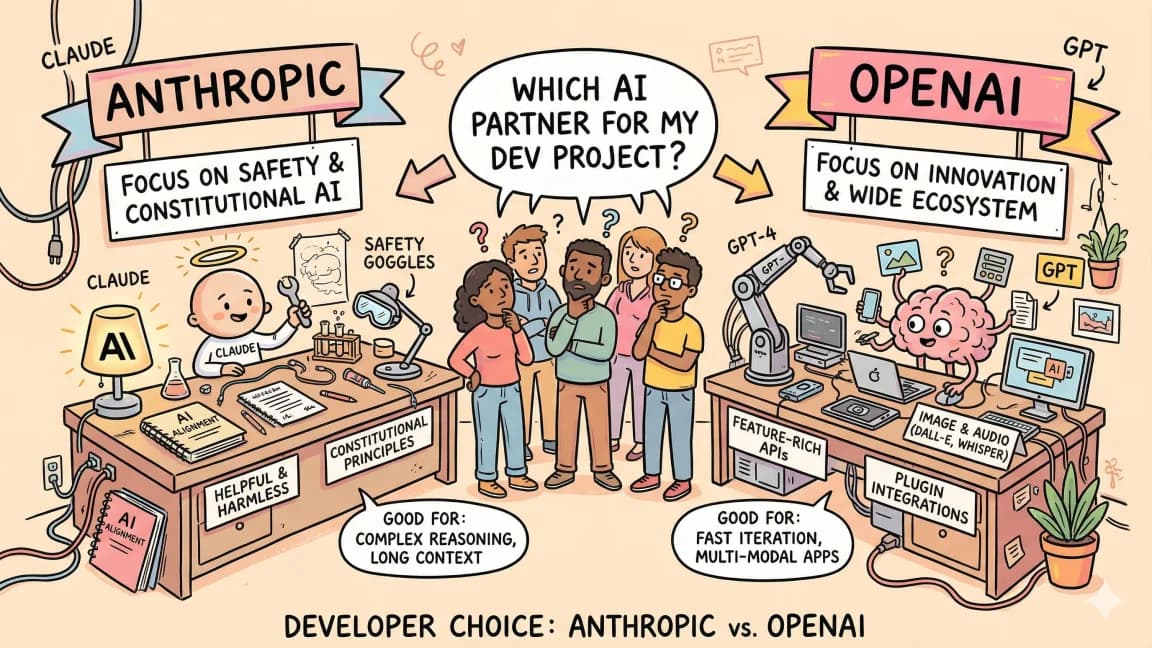
Anthropic vs OpenAI: Developer Experience Compared
Two platforms, two philosophies. Here is how Anthropic and OpenAI compare on APIs, SDKs, documentation, pricing, and the...
9 min read
Claude
Claude vs GPT for Coding: Which Model Writes Better TypeScript?
Claude vs GPT for real TypeScript work: benchmarks, pricing, model families, and the practical differences that matter w...
8 min read
Claude Code
Claude Code vs Cursor vs Codex: Which Should You Use?
Terminal agent, IDE agent, local-plus-cloud agent. Three architectures compared - how to decide which fits your workflow...
12 min read
AI Coding
AI Coding Tools Pricing Comparison 2026
Complete pricing breakdown for every major AI coding tool. Claude Code, Cursor, Copilot, Windsurf, Codex, Augment, and m...
15 min read
Claude Code
What Is Claude Code? The Complete Guide for 2026
Claude Code is Anthropic's AI coding agent for terminal, IDE, desktop, and browser workflows. Learn what it does, how it...
8 min read
OpenAI
GPT-5.6 Sol, Terra, and Luna: A Developer's Guide to OpenAI's New Model Family
A practical guide to choosing GPT-5.6 Sol, Terra, and Luna, using programmatic tool calling, caching, and the multi-agen...

8 min read
Claude
Claude Sonnet 5 Developer Guide: Migration, API, and Effort Levels
Everything developers need to migrate from Sonnet 4.6 to Sonnet 5 - three breaking API changes, the new effort parameter...
Build with the member tools

Get Smarter About AI Dev
New tutorials, open-source projects, and deep dives on coding agents - delivered weekly.
One email per weekReal code, not theoryFree forever