Anthropic vs OpenAI: Developer Experience Compared
TL;DR
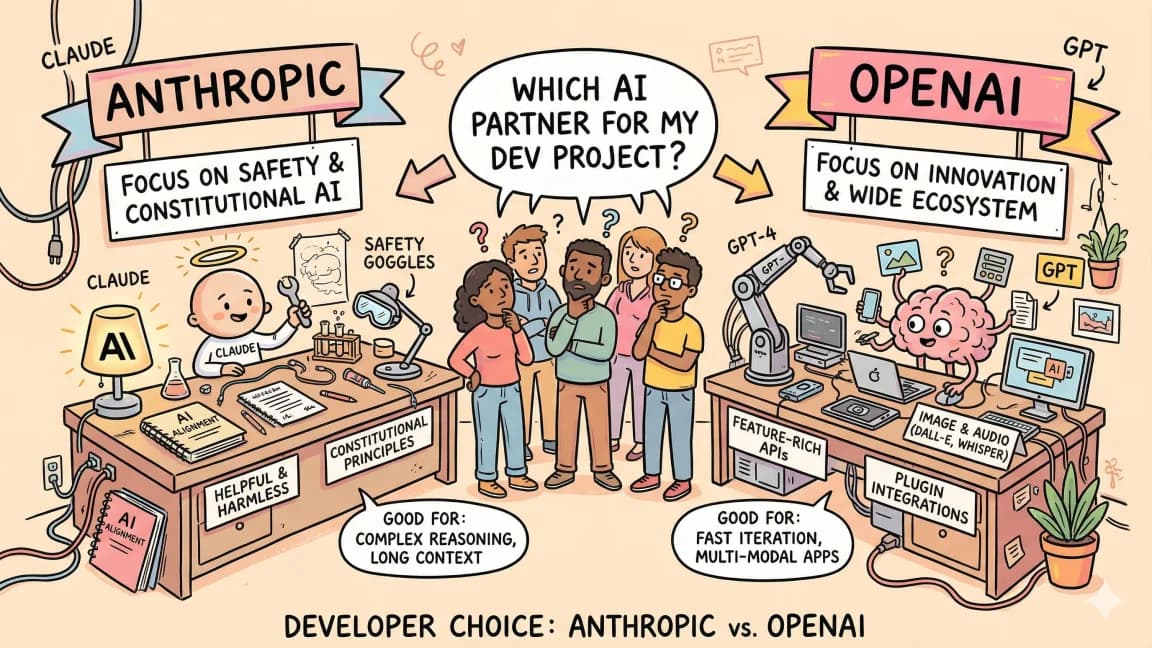
Two platforms, two philosophies.
I build with both platforms daily. Anthropic for Claude Code and the Messages API. OpenAI for GPT-5 family models and Codex. They have different strengths and the developer experience reflects different design philosophies. If you are at the agent-CLI choice rather than the raw-API choice, our AI coding agent picker will narrow the field in a minute.
Official Sources#
Before comparing, bookmark the official documentation for each platform:
| Platform | Documentation | Pricing |
|---|---|---|
| Anthropic | API Docs - Claude Code Docs | Pricing |
| OpenAI | API Docs - Codex Changelog | Pricing |
If your main question is budget rather than API shape, start with the AI coding tools pricing comparison and the pricing calculator.
Read This Alongside#
This article is the platform-level comparison. The tool-specific questions branch into nearby posts:
| Question | Best next read |
|---|---|
| Which coding agent should I use day to day? | Claude Code vs Codex vs Cursor vs OpenCode |
| What changed recently on the OpenAI side? | Codex changelog April 2026 |
| How should I budget the tools? | AI coding tools pricing comparison |
| How do MCP and tool connections affect platform choice? | Complete MCP server guide |
| When should I choose Claude-specific workflows? | Why skills beat prompts |
The short version: OpenAI versus Anthropic is no longer just a model benchmark. It is also a question of agent surface, tool protocol, pricing shape, and how much of your workflow you want inside one vendor's product.
API Design#
Anthropic Messages API is minimal. One endpoint, one format. Messages go in, a response comes out. Streaming, tool use, and vision all work through the same interface.
For broader context, pair this with the OpenAI Codex guide and OpenAI vs Anthropic in 2026 - Models, Tools, and Developer Experience; those companion pieces show where this fits in the wider AI developer workflow.
const response = await anthropic.messages.create({
  model: "claude-sonnet-4-6",
  max_tokens: 1024,
  messages: [{ role: "user", content: "Explain TypeScript generics" }],
});
OpenAI Chat Completions API has a similar structure but more options. Response formats, function calling syntax, and streaming modes have evolved through multiple iterations.
const response = await openai.chat.completions.create({
  model: "gpt-5",
  messages: [{ role: "user", content: "Explain TypeScript generics" }],
});
Both work well. Anthropic's API has fewer surprises because it has had fewer breaking changes. OpenAI's API has more features but the migration path from GPT-3 to GPT-4 to GPT-5 has required code changes.
SDKs#
| Anthropic | OpenAI | |
|---|---|---|
| TypeScript | @anthropic-ai/sdk | openai |
| Python | anthropic | openai |
| Streaming | Native async iterators | Native async iterators |
| Type safety | Full | Full |
| Bundle size | Smaller | Larger |
Both SDKs are well-maintained and fully typed. The Anthropic SDK is leaner. The OpenAI SDK covers more products (DALL-E, Whisper, Assistants, Realtime).
Coding Tools#
This is where the gap is widest.
Anthropic: Claude Code is a terminal-native agent that reads your codebase, makes multi-file changes, runs tests, and commits. It has sub-agents for parallel work, MCP for tool integration, hooks for automation, and CLAUDE.md for persistent memory. It is the most capable AI coding tool available.
OpenAI: Codex is a cloud-based coding agent. You connect a repo, describe a task, and it works asynchronously in a sandboxed environment. It is powerful but less hands-on than Claude Code, and the recent Codex April changelog shows OpenAI pushing it toward a broader agent workspace. You review results after the fact rather than collaborating in real time.
For daily development, Claude Code is more integrated into the workflow. For large async tasks, Codex has merit.
For the dedicated tool comparison, read Claude Code vs Codex, then check Codex changelog April 2026 for the latest OpenAI-side product changes covered here.
Documentation#
Anthropic docs are clear and focused. The Claude Code docs are particularly good - practical, well-organized, with real examples. The API docs are straightforward.
OpenAI docs are comprehensive but can be overwhelming. There are many products, many API versions, and the Assistants API / Realtime API add complexity. The cookbook has good examples.
Pricing#
| Anthropic | OpenAI | |
|---|---|---|
| Best model | Opus 4.7 ($5/$25 per M) | GPT-5.5 long context ($5/$22.50 per M) |
| Fast model | Sonnet 4.6 ($3/$15 per M) | GPT-5.4 long context ($2.50/$11.25 per M) |
| Cheap model | Haiku 4.5 ($1/$5 per M) | GPT-5.4-mini short context ($0.375/$2.25 per M) |
| Coding tool | Claude Code (Max starts at $100/mo) | Codex pricing varies by plan and model |
OpenAI is usually cheaper on fast and small-model tiers, while flagship pricing is now close enough that context length, cache usage, and output volume matter. Check the Anthropic pricing page and OpenAI API pricing for current rates.
Context Windows#
Anthropic leads on the breadth of long-context Claude models. Opus 4.7 and Sonnet 4.6 support 1M tokens, while GPT-5.5 also publishes a 1M-token context window on the OpenAI side. The practical difference is less about the headline limit and more about which model tier you can afford to run at that size.
For large codebase analysis and long-document work, both platforms handle it well at the premium tier.
The Bottom Line#
Choose Anthropic when: You want the best coding agent (Claude Code), need large context windows, prefer a simpler API, or value the CLAUDE.md memory system.
Choose OpenAI when: You need multimodal capabilities (DALL-E, Whisper, Realtime), want cheaper token pricing, or your team is already invested in the OpenAI ecosystem.
Use both when: You are building a production application that benefits from model diversity. Use the Vercel AI SDK to swap providers with a single import change.
Frequently Asked Questions#
Which has better TypeScript support?#
Both SDKs are fully typed. Anthropic's is leaner. OpenAI's covers more products. For pure chat/completion work, they are equivalent.
Can I use both in the same project?#
Yes. The Vercel AI SDK provides a unified interface. Switch between anthropic("claude-sonnet-4-6") and openai("gpt-5.5") by changing the model string.
Which is better for building AI agents?#
Anthropic, primarily because of Claude Code and the Claude Agent SDK. OpenAI's Assistants API is capable but more complex to set up for agent workflows.
Which has better rate limits?#
OpenAI has more generous free tier limits. Anthropic's paid tiers are more straightforward. For production usage, both require paid plans with adequate limits.
Related apps#
- Migrate - OpenAI Assistants API is sunsetting August 26 2026. Paste your code, get Responses API equivalent. Built for the migration deadline.
- Hookyard Pro - Premium hooks library and config builder for Claude Code. Pro hooks, private bundles, team sync.
Related#
- Subscribe to DevDigest on YouTube for hands-on walkthroughs
Continue Reading#
Sources#
- Anthropic API Documentation - Official API reference for Claude models
- OpenAI API Documentation - Official API reference for GPT models
- OpenAI Models Documentation - Official GPT model reference
- Claude Code Documentation - Official Claude Code features and usage
- Codex CLI Documentation - Official OpenAI Codex documentation
- Codex Changelog - Latest Codex product updates
- Anthropic Pricing - Claude API and subscription pricing
- OpenAI API Pricing - GPT model API rates
- Anthropic Python SDK - Official Python SDK repository
- OpenAI Python SDK - Official Python SDK repository
- Anthropic TypeScript SDK - Official TypeScript SDK repository
- OpenAI Node SDK - Official Node.js/TypeScript SDK repository
Get the next comparison like this in your inbox
One email a week on Anthropic and the rest of the AI dev stack. Free.
Read next on Claude Code
Claude vs GPT for Coding: Which Model Writes Better TypeScript?
Claude vs GPT for real TypeScript work: benchmarks, pricing, model families, and the practical differences that matter when picking a coding model.
9 min readWhat Is Claude Code? The Complete Guide for 2026
Claude Code is Anthropic's AI coding agent for terminal, IDE, desktop, and browser workflows. Learn what it does, how it works, pricing, setup, MCP, skills, hooks, and subagents.
15 min readOpenAI Codex: Terminal and Cloud AI Coding Agent
Codex works from the terminal, cloud tasks, IDEs, GitHub, Slack, and Linear. Here is how to use it and how it compares to Claude Code.
5 min readTechnical content at the intersection of AI and development. Building with AI agents, Claude Code, and modern dev tools - then showing you exactly how it works.